Home Blog Page 157

The Alarming Rise of Hate Crimes Against Black Americans: Confronting Trauma and Demanding Change

In a year marked by an overall decline in violent crime across the United States, a disturbing trend has emerged from the FBI’s annual crime report. While the nation celebrates the return to pre-pandemic levels of violent offenses, a stark increase in hate crimes, particularly those targeting Black Americans, demands our immediate attention and action.

The FBI’s data reveals that in 2022, hate crime incidents surged to 11,634, a significant increase from the 10,840 reported the previous year. Even more concerning is the fact that a staggering 51.9% of these hate crime victims were targeted due to “anti-Black or African American bias.” This statistic highlights the urgent need for heightened awareness and proactive measures to combat the persistent issue of racism and discrimination in our society.

The disturbing prevalence of these crimes today is a testament to the ongoing struggle for equality and justice that has plagued our country for centuries. It speaks to the failure of our leaders and society to fully confront and dismantle the white supremacist structures and boundaries that continue to oppress and marginalize Black communities. These systemic injustices permeate every aspect of American life, perpetuating disparities in wealth, education, health, and opportunity.

Addressing this issue will require honest reckoning with our past and present, as well as sustained commitment to uprooting racist mindsets and institutions. We must work towards a future where Black Americans can live free from the constant threat of hate and discrimination and where our nation truly lives up to its highest ideals of liberty, equality, and justice for all. Only then can we hope to heal the deep wounds of racism and build a more perfect union.”

Efforts have been made to counteract bias in law enforcement through specialized police training. However, unfortunately, the Black community still experiences a pervasive sense of bias within the very institutions that are supposed to protect them. This lack of trust and the persistent fear of discrimination undermines the fundamental principles of justice and equality that our society is based on. Hate crimes against Black Americans are, unfortunately, as American as apple pie.

Moreover, these alarming rates of hate crimes perpetuate the trauma of being Black in America, a reality that is often overlooked and denied by White America and its politicians. The collective trauma experienced by the Black community, rooted in a long history of oppression, discrimination, and violence, is compounded by the ongoing threat of hate crimes and the lack of adequate support and acknowledgment from those in power.

It is imperative that we recognize and address the psychological and emotional impact of this trauma on the Black community. The denial and dismissal of their experiences by those in positions of privilege and authority only serve to deepen the wounds and hinder the healing process.

We must stand united in our condemnation of these heinous acts and work tirelessly to foster a society that embraces diversity, inclusion, and respect for all individuals, regardless of their race or ethnicity. It is the responsibility of every American, especially those in positions of power and influence, to actively combat racism and acknowledge the trauma endured by the Black community.

To effectively address this issue, we must prioritize education and awareness campaigns that promote understanding, empathy, and acceptance. By engaging in open and honest conversations about the realities of racism, trauma, and its impact on the Black community, we can begin to dismantle the prejudices that fuel hate crimes and provide the necessary support and resources for healing.

Furthermore, it is imperative that law enforcement agencies and the justice system take a firm stance against hate crimes, ensuring that perpetrators are held accountable for their actions. Stricter penalties and comprehensive hate crime legislation can serve as a deterrent and send a clear message that such behavior will not be tolerated in our society.

Additionally, it is essential that we hold our institutions accountable for addressing and eliminating bias within their ranks. Transparency, rigorous training, and independent oversight must be implemented to restore trust between law enforcement and the communities they serve, particularly the Black community.

As we celebrate the overall decline in violent crime, let us not forget the alarming rise in hate crimes against Black Americans, the persistent bias they face within our institutions, and the trauma they endure as a result. It is our collective responsibility to confront this issue head-on, to stand in solidarity with the Black community, to acknowledge and address their trauma, and to work tirelessly towards creating a society where every individual can live free from fear, discrimination, and violence. We can only genuinely claim progress in pursuing justice, equality, and healing for all.

Black Minds Must Matter: The Fight Against Anxiety and Depression in the Black Community

Depression and mental health struggles are serious issues facing the Black community, yet they often go unrecognized and untreated. In my book, “Black Minds Must Matter”, I discuss how people, especially Black men, suffer in silence due to cultural conditioning that discourages vulnerability and seeking help. This lack of support has led to an alarming rise in suicides among Black men.

The Black community faces unique challenges that contribute to higher rates of depression compared to white communities. These include racism, economic and political oppression, police brutality, fear of violence, and a systematic cultural separation between Black men and women. America’s deeply rooted structural racism, perpetuated through its policies and historically racist institutions, adds to the everyday struggles of Black men, leading to increased stress, anxiety, and mental health issues that may ultimately result in suicide.

Despite the prevalence of these issues, Black mental health remains largely absent from national conversations and community support systems.

Recent studies have highlighted the growing mental health crisis in the Black community:

  1. In 2015, researchers found higher suicide rates among African American children ages 5 to 11 compared to Caucasian children.
  2. While Black men are more likely to die by suicide, Black women are more likely to attempt suicide. Caribbean Black men in the US have the highest attempt rate within the African American community.
  3. In 2014, 80.38% of the 2,421 African Americans who died by suicide were male.
  4. Firearms were the predominant method of suicide among African Americans (47.42%), followed by suffocation (29.9%).

Depression is a complex and personal experience that can manifest differently in each individual. Common symptoms include a pervasive sense of despair, loss of energy, focus, and joy. Physical symptoms may include changes in appetite and activity levels. If left untreated, depression can have severe consequences on an individual’s life.

To overcome depression, it is crucial to:

  1. Talk about it with a trusted friend or family member.
  2. Seek professional help, even if you have concerns about insurance coverage or affordability. Many mental health centers offer free or sliding-scale services.
  3. Become involved in helping others, such as volunteering at a local center for seniors or abused families.
  4. Exercise regularly to release endorphins and improve mood.
  5. Consider getting a pet for emotional support and responsibility.
  6. Explore holistic and spiritual solutions that resonate with your beliefs and values.
  7. Create and promote safe spaces for Black men and boys to express themselves, find support, and build community.

Most importantly, seeking professional help from a culturally competent clinician is essential for developing a personalized treatment plan. Black individuals should be aware of potential racial stereotypes in the healthcare system and advocate for their needs.

In conclusion, addressing the mental health crisis in the Black community requires breaking toxic cultural conditioning, working together holistically, and providing support for those who are struggling. By raising awareness, prioritizing Black mental health, and creating safe spaces for healing and growth, we can work towards a healthier, more resilient community that can better cope with the ongoing challenges posed by systemic racism in America.

Revisiting the Paleo Diet: New Study Reveals Plant-Based Eating in Stone Age Diets

A recent study has challenged the traditional understanding of the Paleo diet, suggesting that ancient Stone Age people might have leaned more towards a plant-based eating style rather than focusing primarily on meat.

The Paleo diet, also known as the caveman or Stone-Age diet, typically encourages the consumption of lean meats, fish, fruits, vegetables, nuts, and seeds. Proponents of this diet often highlight the importance of selecting low-glycemic fruits and vegetables for better health.

This diet is based on the idea of mimicking the nutritional habits of early humans up until around 2000 BC. Advocates argue that since our genetics and physiology have changed little since the Paleolithic era, eating like our ancestors could offer health benefits.

However, a new study published in the Nature Ecology & Evolution Journal has shed light on the dietary habits of ancient hunter-gatherer groups, specifically the Iberomaurusians, who lived during the Paleolithic period. Researchers analyzed chemical signatures in bones and teeth to gain insights into their diet.

Contrary to the common belief that meat was the primary protein source for these ancient people, the study found evidence suggesting that they consumed a significant amount of plant-based foods, including wild plants. This discovery challenges the notion that the Paleo diet was strictly meat-centric.

Stable isotope analysis focused on nitrogen and zinc isotopes in teeth enamel and collagen revealed that plant matter was an important part of the Iberomaurusians’ diet. Additionally, the presence of cavities in buried remains indicated the consumption of starchy plants like beets, corn, rye, and cassava.

Although this finding suggests a high proportion of plant-based foods in the diet of these pre-agricultural populations, it doesn’t discount the possibility of variation in individual protein intake during the Stone Age. Nonetheless, it marks a significant shift in our understanding of Paleolithic diets, highlighting the importance of plant foods in early human nutrition.

Free Speech and Peaceful Protest Under Threat on U.S. College Campuses, AAUP Warns

The American Association of University Professors (AAUP) and its chapters are sounding the alarm over what they see as a growing assault on the rights to free speech and peaceful protest at colleges and universities across the United States. In a statement released and endorsed by over 60 AAUP chapters and other organizations, the AAUP condemns many university administrations’ “heavy-handed, militaristic response” to largely peaceful student activism in recent months.

The statement argues that even as protests and counter-protests have escalated on campuses this fall, the response by many institutional leaders has been to “invite law enforcement in riot gear to campus and condone violent arrests.” The AAUP calls this a failure of university leaders’ “duty to their institutions, their faculty, their students, and their central obligation to our democratic society.”

“When university administrators limit when, where, and how free speech may be exercised, and require advanced applications for permission of such expression, they effectively gut the right itself,” the statement reads. “To insist that harsh discipline and violent repression are necessary to combat hate on a college campus is a pretext to suppress protest and silence speech.”

The AAUP points to what it calls “shameless exertion of pressure on university leaders by the nation’s politicians, by the universities’ most powerful donors, and by other interest groups,” and criticizes institutional leaders for “abandoning long-standing principles of academic freedom and shared governance.”

The organization is calling on university leaders to “reinstate student organizations shut down in recent months for political activity, to drop charges against peaceful protesters, to observe due process in disciplinary actions, to keep armed law enforcement off campuses, and to uphold fundamental freedoms for students and faculty.”

“The way forward is through education and dialogue, not through zip-ties and fear-mongering,” the statement concludes. The AAUP says it stands with its members nationwide “who are defending free speech, the right of assembly, and associational rights for students.”

The statement reflects growing concerns among many in academia that the heated political climate and increasingly polarized debates around issues of free speech, diversity and inclusion on campus are leading to a crackdown on legitimate protest and dissent. As the country heads into a presidential election year, the AAUP’s call to protect free speech and peaceful demonstration at colleges and universities is likely to resonate both on and off campus.

Hochul Says Black Kids In Bronx Don’t Know What The Word Computer Is

New York Gov. Kathy Hochul made the erroneous and what some believe is racially charged statement on Monday, May 6, at the 27th annual Milken Institute Global Conference to discuss expanding economic opportunities in artificial intelligence for low-income communities.

“Right now, we have young Black kids growing up in the Bronx who don’t even know what the word computer is. They don’t know, they don’t know these things,” Hochul said while on stage.

In a Day One Milken conference chat with newscaster Jonathan Capehart, Hochul “explained her desire to make technology more widely accessible, especially in low-income communities.”  It was while she breathlessly touted spending “the money to build a phenomenal supercomputer,” something that “no other state has done,” that she harped on New York’s opportunity to be “the best” and then stumbled into her remark. 

There was no pushback to Hochul’s comment in the moment, whether from Capehart himself (who is Black) or from conference attendees. The remark went unaddressed during the interview and the governor went on to explain that her goal is to provide avenues for communities of color to access emerging artificial intelligence technologies as a means to address social inequality. But the governor’s comments caused immediate backlash from officials and lawmakers in the Bronx.

Assemblywoman Amanda Septimo, a Bronx Democrat, slammed the New York politician, stating that her statements were “harmful, deeply misinformed, and genuinely appalling.”

“Repeating harmful stereotypes about one of our most underserved communities, while failing to acknowledge the state’s consistent institutional neglect, only perpetuates systems of abuse,” she said. “I would invite Gov. Hochul to visit us in the Bronx to experience first-hand the intelligence, resilience, and joy that radiate from Bronx children and residents each day.”

“Deeply disturbed by [Hochul’s] recent remarks and the underlying perception that she has of Black and brown children from [the Bronx],” said New York State Assembly Member Karines Reyes. “Our children are bright, brilliant, extremely capable, and more than deserving of any opportunities that are extended to other kids. Do better.”

“I’m deeply troubled by the recent statements made by [Hochul]. The underlying perception conveyed about Black and brown children from the Bronx is not only disheartening but also deeply concerning,” fellow Assembly Member John Zaccaro Jr. said.

Others on social media were offended by Gov. Hochul’s statements, even as she later backpedaled, explaining that she regrets her making the statement.

“What the f—k is this? This just shows how out of touch they are,” read one comment on the Hip Hop Wolf’s Instagram profile. “They be 2 years old and know how to work a iPad better than the people in the Apple Store.”

“Governor Kathy Hochul saying black people don’t know what a computer is. Hope every Black American remembers this on November 5th when they vote!” another tweeted.

A third comment said, “I guarantee she ain’t had a conversation with a young black kid from the Bronx to know that.” Another Instagram user added, “Correction… Half of the kids in the Bronx don’t know who you are miss thing. She tried it.”

In a statement later Monday, Hochul said “I misspoke and I regret it.”

“Of course Black children in the Bronx know what computers are,” Hochul said. “The problem is that they too often lack access to the technology needed to get on track to high-paying jobs in emerging industries like AI. That’s why I’ve been focused on increasing economic opportunity since Day One of my Administration.”

Rapper, actor, television producer, and businessman 50 Cent clearly was not moved and after catching wind of her statement, he took to Instagram on May 8 to say, “I don’t know, any black kids that don’t know what a computer is in the Bronx. WTF They know how to work a iPad better than me.”

“Black Americans like me are often guilted into defaulting to supporting the Democratic Party — but with friends like the Democrats, who needs enemies?” Adam B. Coleman, author of “Black Victim to Black Victor” and founder of Wrong Speak Publishing wrote in his column in the NY Post.

Univ of South Carolina Unveils Monument, Celebrating First 3 Black Students to Integrate University

Statue near McKissick Museum recognizes desegregation trailblazers Robert Anderson, Henrie Monteith Treadwell and James Solomon Jr.

The University of South Carolina (USC) unveiled a monument Friday, April 19th honoring the first Black students admitted since Reconstruction — Robert Anderson, Henrie Monteith Treadwell and James Solomon Jr. — whose enrollment six decades ago changed the course of university history.

Commissioned by the Board of Trustees, the 12-foot bronze monument now stands near McKissick Museum on the historic Horseshoe. Treadwell, Solomon and representatives from Anderson’s family were joined by Board Chairman Thad Westbrook, USC President Michael Amiridis and other university and civic leaders for the unveiling.

“Robert Anderson, Henrie Montieth Treadwell and James Solomon Jr. are an important part of the university’s past, present and future. Through their courage and sacrifice to challenge the status quo of their time, they helped pave the way for the University of South Carolina to grow into the diverse campus we experience today. This monument will serve as a reminder of how far we’ve come as an institution and as a place for future generations to reflect on the legacies of these three pioneers,” Julian Williams, vice president of access and opportunity shared.

In 2022, the university announced the selection of Jamaican-born sculptor Basil Watson, whose past work includes tributes to Martin Luther King Jr. and Rep. John Lewis. Watson’s vision for the statue was inspired by the now-iconic photograph of the three students stepping out of the Osborne Administration building after meeting with university officials on Sept. 11, 1963.

“This inspiring monument, standing tall at the heart of our historic Horseshoe, will bear witness every day to the university’s unwavering promise to provide educational opportunities for all,” said Amiridis. “This is our responsibility to the people of South Carolina.”

“It has been a long journey but a gratifying one that gives a sense of pride, knowing that my contribution will be a lasting monument to the building of a legacy that represents values of equality and justice,” said sculptor Basil Watson.

Treadwell, at just 16 years old, filed the lawsuit that led to USC’s integration. She went on to earn a bachelor’s in biochemistry in 1965, becoming the university’s first Black graduate since Reconstruction. Her education didn’t end at USC — she also earned a master’s from Boston University, a Ph.D. from Atlanta University and completed postdoctoral studies at the Harvard University School of Public Health. She has enjoyed a long career in public health and is founding executive director of Community Voices at Morehouse School of Medicine, where she has advanced health care for underserved populations.

Anderson, a political science major and Greenville native, transferred to USC from Clark College. After graduation, he served a combat tour in Vietnam, then became a social worker in New York City, where his public service efforts included helping Cuban refugees and running an alcohol counseling program. He died in 2009.

Solomon was a faculty member at Morris College who transferred into USC’s mathematics department as a graduate student. In addition to his career in higher education, he was elected to the Sumter District 17 School Board and held various administrative positions in South Carolina state government, eventually retiring as commissioner of the Department of Social Services. When ground was broken on the monument in September, Solomon was honored with a plaque in LeConte College, home of the university’s math department.

“It is appropriate that the Board of Trustees led the effort to recognize the bravery and determination of our students who desegregated the university,” said Westbrook. “The Board pays tribute to Dr. Henrie Monteith Treadwell and James L. Solomon Jr. and to the memory of Robert G. Anderson. The Board appreciates the leadership that Chair Emeritus Smith and Trustee English demonstrated in the effort to conceptualize and finalize the desegregation monument. The Board is grateful for the incredible talent of sculptor Basil Watson and for the patient oversight of university architect Derek Gruner.”

A statue unveiling Friday, April 19, 2024 honors the first three Black students to enroll in the University of South Carolina post-reconstruction. Greenville native Robert G. Anderson joins Henrie Monteith Treadwell and James L. Solomon Jr., on the desegregation monument near the McKissick Museum. [ALEX HICKS] JR./STAFF

The monument’s location outside McKissick Museum is significant not only because of its proximity to the Osborne Administration building, but because it is prominently displayed near the university’s Visitor Center. For Treadwell, it will serve as a symbol of the university’s progress to all who come to campus.

“I want them to see a place where all are welcome that has embraced the fact that we are different people,” Treadwell says. “I want them to see in my colleagues, but also in myself as a woman, someone who said, ‘I can do this. This should be done so that you can also come.’ That doesn’t mean you as simply African American, but you as a member of society. Everybody is welcome here. And that’s really what I want people to think about. This university took a huge step that day, and it is continuing to walk forward.”

Macklemore Calls Out Latimer, AIPAC & Others In Pro Palestine Music Video Hind’s Hall

The Grammy Award winning rapper calls out George Latimer, AIPAC and others, tosses in a Drake diss while calling out the silence of other recording artists.

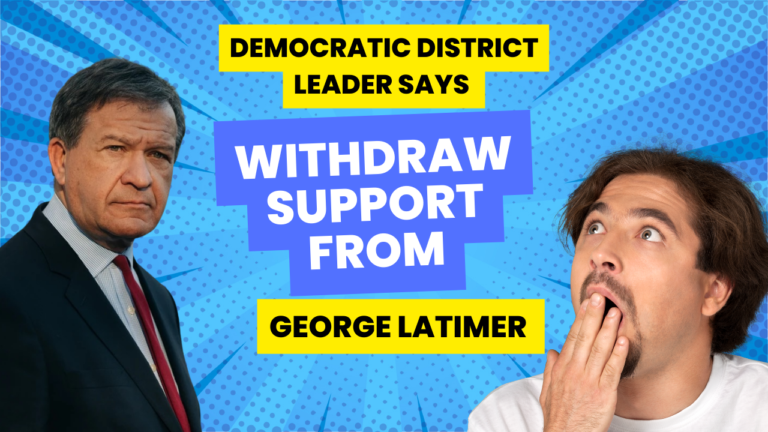
Macklemore released a powerful protest track, “Hind’s Hall” on social media May 6 supporting pro-Palestinian protesters at college campuses across the country, calling for an end to Israel’s war in Gaza. He calls out politicians backed by AIPAC including CD-16 Congressional candidate George Latimer and others including President Biden.

You can pay off Meta, you can’t pay off me
Politicians who serve by any means
AIPAC, CUFI, and all the companies
You see, we sell fear around the land of the free

County Executive George Latimer’s image appears on the screen as Macklemore raps, “Politicians who serve by an means, AIPAC, CUFI and all these companies,” alluding to Latimer being recruited to run against Rep. Jamaal Bowman, D-N.Y., by the American Israel Public Affairs Committee (AIPAC)’s PAC who has infused over a million dollars into Latimer’s campaign. AIPAC and others have invested millions to challenge Bowman, a member of the Squad who has called for a Gaza ceasefire.

The song’s accompanying video (see below) is made up of clips of people protesting and showing support for Palestinians, plus various clips of police officers and politicians. As I write this, it had received 24.7 million views on X, formerly Twitter, and more than 75 million views on Instagram. However, the video has been age-restricted on YouTube, where it has been viewed 714,476 times and counting, prompting social media users to accuse the company of limiting the song’s reach.

I’m sure when Latimer was talked into primarying Bowman, he had no idea he would be mentioned in such a powerful protest and pro-Palestine song. He will not be the first elected official or candidate to receive pushback for being on the wrong side of history. Over the years, there have been a number of Hip-Hop songs that have addressed political issues such as police brutality, oppression, war, racism, and poverty, among others. This song is bigger than Hip-Hop. Hine’s Hall by Macklemore is just the latest in a long list of anti-war protest songs in Hip-Hop, Rock, R&B, Soul Music, and several other musical genres.

The Seattle rapper released “Hind’s Hall” and says once it’s up on streaming services, he’ll donate all proceeds to the United Nations Relief and Works Agency for Palestine Refugees (UNRWA), an independent 501c3 nonprofit organization that provides support for humanitarian work of the United Nations Agency for Palestine Refugees. The song’s title is a reference to the new name protesters at Columbia University gave to Hamilton Hall when they occupied it last month, re-naming it after Hind Rajab, a six-year-old likely killed by the Israeli military in February. 

The people, they won’t leave
What is threatenin’ about divesting and wantin’ peace?
The problem isn’t the protests, it’s what they’re protesting
It goes against what our country is funding
(Hey) Block the barricade until Palestine is free
When I was seven, I learned a lesson from Cube and Eazy-E
What was it again? Oh yeah, fuck the police (Woo)

In one of the most notable quotables of the song, Macklemore who defeated Kendrick Lamar in the Best Rap Album category at the 56th Annual Grammy Awards in 2014 calls out his fellow recording artists for their silence and a image of the unapologetic Tupac Shakur graces the screen. Formerly known as Professor Macklemore, he also takes a shot at the infamous Kendrick/Drake beef that has literally stopped the world waiting for the next response instead of addressing broader social issues.

What happened to the artist? What d’you got to say?
If I was on a label, you could drop me today
I’d be fine with it ’cause the heart fed my page
I want a ceasefire, fuck a response from Drake (Woo)
What you willin’ to risk? What you willin’ to give?
What if you were in Gaza? What if those were your kids?
If the West was pretendin’ that you didn’t exist
You’d want the world to stand up and the students finally did, let’s get it (Woo)

I echo Macklemore’s sentiment, “what happened to the artist? What d’you got to say? Why did it take a white rapper to call it out, to call them out. I too have gone down the rabbit whole of this battle between Kung Fu Kenny and Drizzy Drake, I also echo, “I want a ceasefire, fuck a response from Drake.” Since its earliest days, Hip-Hop has been inherently political – a powerful vehicle to deliver messages society needs to hear. Through the spoken word, emcees have often conveyed the politics of hip-hop even more directly than those of their rock and folk predecessors. Reflecting and commenting on the world around them, the most gifted and charismatic emcees have taken the politics of Hip-Hop into the mainstream for years.

But I am also perplexed by the silence of the leaders in the Black Community, but that’s an essay for a later day! Lastly I had a recent conversation with someone close to Latimer and texted a link to the video who wrote this off to “celebrities getting paid to record stuff,” I told him this is not that, he donating the proceeds to UNRWA, it’s not even about the money for him. Macklemore has a long track record for speaking up on issues and has been standing on business for awhile. This isn’t even the first time he has spoken on this issue. This song is the very essence of what Hip-Hop and musical compositions of anti-war and protest from Bob Dylan and Marvin Gaye to Macklemore today have always represented. Like we remember those songs of the 60s this will be remembered as well, its already gone viral and is just scratching the surface. In response to all that the Latimer associate still not taking it seriously replied, “So Latimer is losing the Hip-Hop/Rapper vote.” I felt no need to continue the conversation and decided to write this instead!

Macklemore has spoken out against the war in Gaza before, releasing a statement last October and then speaking at a demonstration in Washington, D.C., the following month. “They told me to be quiet,” he said at the time. “They told me to do my research, to go back, that it’s too complex to say something, right? To be silent in this moment. In the last three weeks I’ve gone back and I’ve done some research … I’m teachable. I don’t know enough. But I know enough that this is a genocide.”

Macklemore voiced his support of LGBT rights and same-sex marriage in the song “Same Love” released in 2012, which also condemns homophobia in mainstream hip-hop, society, and mass media. Macklemore is an outspoken critic of Donald Trump. In July 2016, he was featured on the song “FDT (Fuck Donald Trump), Pt. 2” by YG and Nipsey Hussle, alongside G-Eazy. In January 2021, after the presidential inauguration of Joe Biden, he released “Trump’s Over Freestyle”. Macklemore attended the 2017 Women’s March on Washington. On May 16, 2019, Macklemore received the Stevie Ray Vaughan Award from MusiCares, in recognition of his support of MusiCares and the addiction recovery process. For those who think someone paid him, he is not new to this.

Latimer and his supporters have called out Jamaal Bowman for calling for a ceasefire and for an end to the innocent lives lost in Gaza at the hands of Israel. Now he shifts calling for a temporary ceasefire. To all who criticized those who have called for a ceasefire from almost the beginning, I say to you all, History Is Watching. What side of history do you want to be remembered for? Thanks to Macklemore’s track Latimer will be remembered by many more people and not for the good work he has done in his 30 plus political career. I ask Latimer is this the hill you want to die on?

I end leaving you the words of Macklemore,

The problem isn’t the protests, it’s what they’re protesting
It goes against what our country is funding

And to George Latimer you may have shifted your opinion, but Macklemore addresses your shift as well;

But it’s too late, we’ve seen the truth, we bear witness
Seen the rubble, the buildings, the mothers and the children
And all the men that you murdered, and then we see how you spin it
Who gets the right to defend and who gets the right of resistance
Has always been about dollars and the color of your pigment, but
White supremacy is finally on blast

Let’s hope for your sake these words are not how history remembers you! And that’s Real Talk!

Racism By Zip Code: Peekskill’s Toxic Waste Dump Exposes Environmental Racism

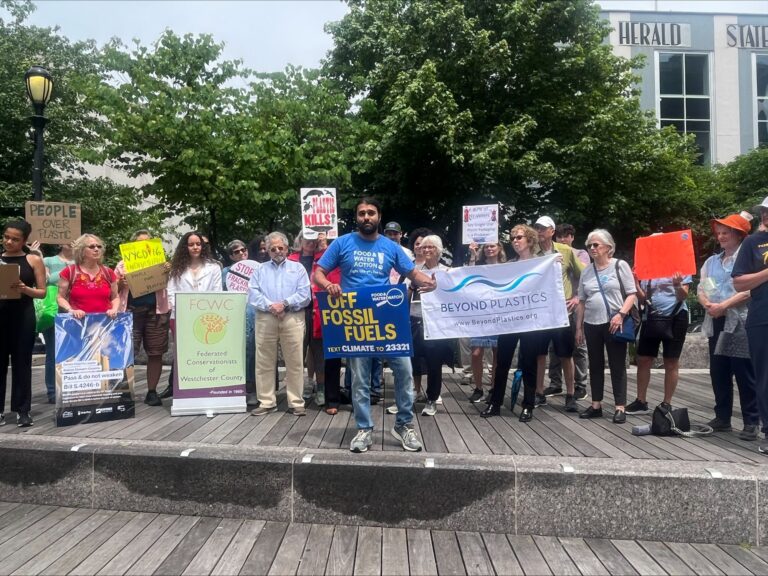
Championing Clean Air in Westchester County: Dr. Courtney Williams Leads the Charge Against Waste Incineration in Peekskill

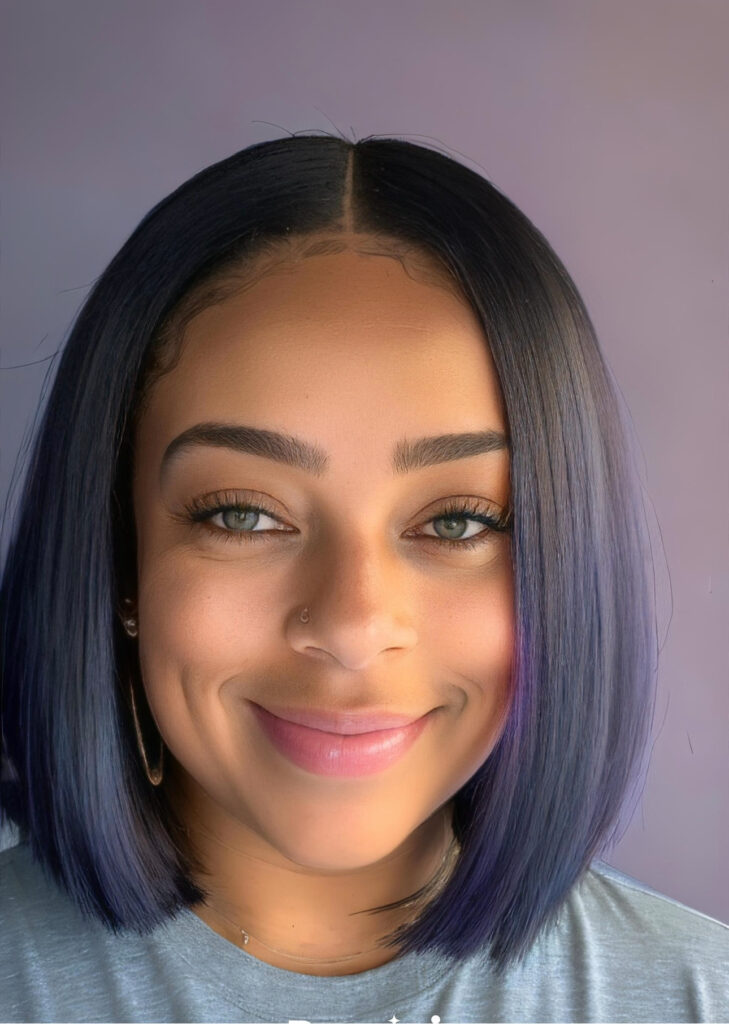
Dr. Courtney M. Williams, Co-Founder of Westchester Alliance for Sustainable Solutions (WASS)Peekskill, NY — Dr. Courtney Williams, is at the forefront of a critical environmental battle in Westchester County. As the Founder of the Westchester Alliance for Sustainable Solutions (WASS), she is rallying residents and local leaders to confront the alarming air quality issues posed by the Peekskill waste incinerator.

For years, the incinerator, operated by Wheelabrator Technologies, has been a contentious fixture in the community. Officially termed a “waste-to-energy plant,” it has recently come under scrutiny for its prolonged operation beyond its expected lifespan and for operating with an expired Title V Air Permit since December 2021. Dr. Williams highlighted that the facility, now marking its 40th year, is set to become the nation’s oldest incinerator by 2029.

On a recent appearance on Black Westchester’s People Before Politics Show last Sunday, Dr. Williams shared disturbing data about the pollutants being emitted by the incinerator. “We’re talking about over 600 million pounds annually of harmful pollutants like Lead, Cadmium, Carbon Monoxide, and Mercury—substances that are severely compromising the health of our residents,” she stated.

These emissions are not just numbers on a page; they translate into real health crises. Peekskill, a vibrant community along the Hudson River, is witnessing rising rates of asthma and other respiratory ailments, particularly troubling in a county already battling significant environmental justice issues.

The Westchester County Industrial Development Agency (IDA), which renewed a 10-year contract for the incinerator in 2019, has been criticized for its lack of action in fostering sustainable waste management solutions. Advocates like Dr. Williams argue that the county’s inaction not only perpetuates environmental degradation but also overlooks the voices of Peekskill residents who bear the brunt of these policies.

Dr. Williams, who also serves on the City of Peekskill’s Conservation Advisory Council, has been a vocal advocate for environmental justice, drawing attention from multiple media outlets including LoHud, ABC News, and the River Journal. Her activism is fueled by her scientific background and a deep commitment to her community.

The efforts of Dr. Williams and WASS highlight a growing movement towards sustainable solutions that prioritize public health and environmental integrity over outdated and harmful practices. As Peekskill and similar communities nationwide face the challenges of aging infrastructure and environmental inequity, the resolve and activism of individuals like Dr. Williams are vital in steering the conversation towards cleaner, healthier futures.

As this issue continues to unfold, all eyes will be on Peekskill and the actions of Westchester County’s leaders. Will they finally heed the calls for change, or will the smokestacks of Wheelabrator continue to cast a shadow over the community’s health and environmental well-being? Only time will tell, but with advocates like Dr. Williams, the fight for clean air is far from over, especially with Waste Incineration being an issue impacting Black & Brown communities such as Newark, New Jersey; Colfax, Louisiana; Baton Rouge, Louisiana; and El Dorado, Arkansas.

Jamaica Shakes Up Middle East Politics: Officially Recognizes Palestine

In a significant diplomatic move, Jamaica has officially recognized the State of Palestine, aligning itself with approximately 140 other UN member states and 11 Caribbean Community (CARICOM) countries. This decision reflects Jamaica’s commitment to the principles of the United Nations Charter, including mutual respect, peaceful coexistence, and the right to self-determination.

Foreign Affairs and Foreign Trade Minister Kamina Johnson Smith emphasized Jamaica’s support for a peaceful resolution to the Israeli-Palestinian conflict, advocating for the dignity and rights of Palestinians while ensuring Israel’s security. The recognition of Palestine demonstrates Jamaica’s nuanced approach to the complex geopolitical landscape of the Middle East, despite Prime Minister Andrew Holness’s previous expressions of solidarity with Israel.

For Palestine, Jamaica’s recognition represents a diplomatic victory, strengthening its position on the global stage and providing hope for its aspirations of statehood. However, the move may strain Jamaica’s relations with some Western allies who have traditionally supported Israel, potentially impacting business ties.

The recognition also raises questions about the broader implications for Palestinians, who continue to face challenges such as displacement, economic hardship, and restricted access to basic services. Without widespread recognition from Israel, the United States, and other Western powers, achieving a just resolution to the conflict may remain difficult.

Nonetheless, Jamaica’s decision underscores the importance of multilateralism and adherence to international law in addressing complex global challenges. As the international community grapples with the Israeli-Palestinian conflict, Jamaica’s recognition of Palestine serves as a reminder of the ongoing quest for justice, peace, and security in the region.

Jalen Brunson Becomes 4th Player To Score 40 Or More Points In 4 Consecutive Postseason Games, Leading Knicks To Victory In Game 1

New York Knicks All-Star guard Jalen Brunson has scored 47, 41, 40 and now 43 points over his past four games. Brunson has become the fourth player to score 40 or more points in four consecutive postseason games, the first since Michael Jordan in the 1993 NBA Finals.

“The little things can go a long way,” Brunson said. “So yeah, the 40 points are cool and all, but it’s the little things that help us win games like that. So I’m just happy I have the group of guys that I do. I just know that we’re going to fight every single day. That’s all I’m thinking about.”

Jalen Brunson has scored 47, 41, 40 and now 43 points over his past four games. Lakers Hall of Famer Jerry West holds the record with six consecutive games of 40 or more points, set during the 1965 postseason. Bernard King had four straight for the Knicks in 1984 and Jordan did it en route to his third straight championship.

Brunson erupted for 21 in the fourth quarter of Game 1 of the Eastern Conference Semifinals and finished with 43 overall as New York rallied from nine points down late to beat Indiana 121-117.

Brunson has scored or assisted on 321 points in his past five games, the second most over a five-game span in NBA postseason history. He trails only Denver Nuggets star Nikola Jokic from last postseason (329 over five playoff games).

The final assist in Game 1 was the biggest. Just as he did in the last two victories over the 76ers, Brunson took advantage of defenders rushing at him to fire a laser to Donte DiVincenzo. His former Villanova teammate nailed a 3-pointer to break a 115-115 tie with 40 seconds left and provide the separation the Knicks rode to victory.

DiVincenzo, his college roommate, made the biggest plays on both sides of the ball, including a clutch trey with 40 seconds left to give the Knicks the lead for good. He took a pass from Brunson and buried the shot in rhythm. 

“I felt it,” DiVincenzo said. “I believe every shot that I shoot is going in.” 

DiVincenzo scored 21 of his 25 points in the second half, making 8 of 10 shots.

The third member of the Villanova Trio, Josh Hart added a playoff career-high 24 points and added 13 rebounds and eight assists.

And of course, OG Anunoby put his stamp on the game, including a steal and power slam in the ending moments of the game, much to former Knick point guard Stephon Marbury who was at the garden cheering on the hometown team.

Obi Toppin return to his hometown and first franchise when the Pacers faced off against the Knicks.

The Indiana Pacers forward returned to Madison Square Garden on Monday night to start a second-round series against his former team, the New York Knicks. The former Slam Dunk champ made a thunderous statement with a highlight dunk.

Toppin went between his legs and dunked with one hand.to give Indiana an 84-77 lead. The Brooklyn native and Ossining High School grad who started his career with the Knicks, returned to New York for Game 1 in the Eastern Conf. semifinals, Monday night. Obi finished the night with 12 points, 6 rebounds and 3 assist in a losing effort to steal one against his former team.

Turner scored 23 points for the sixth-seeded Pacers, who got strong play from their bench and were in good shape to follow their first-round ouster of Milwaukee by jumping to the lead against the Knicks.

But Brunson guided New York through another tight finish, after it outscored Philadelphia by one total point over six games in the first round.

Brunson soundly outplayed fellow All-Star point guard Tyrese Haliburton, the NBA’s assists leader who finished with six points and eight assists after being listed as questionable with back spasms.

Pascal Siakam scored 19 for Indiana and McConnell added 18, leading a bench that finished with a whopping 46-3 advantage over its New York counterparts.

This is the renewal of a fierce Easter Conference rivalry.

The Knickz lost Eastern Conference finals to the Pacers in rivalry that began in the 1990s. The teams met three straight times from 1993-95 and again from 1998-2000 — when Thibodeau and Indiana’s Rick Carlisle were assistants with their current teams.

I think it’s safe to say the renewal is off to a pretty good start, and the Knicks are once against tough competitors to like they were in the 90s.