


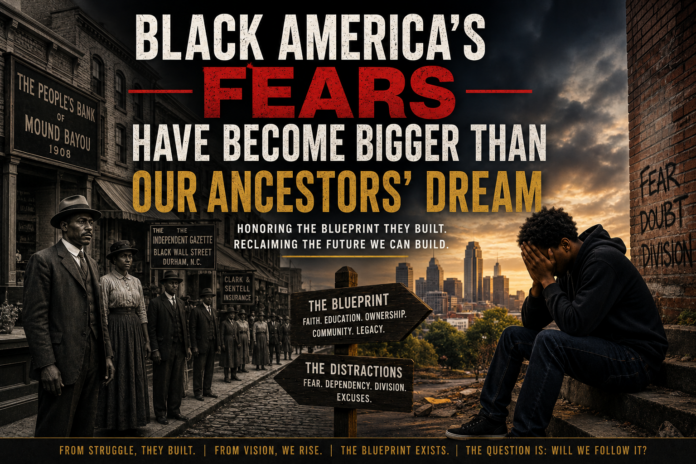




Every generation inherits more than its history—it inherits a responsibility. For Black Americans, that responsibility is to honor the dreams our ancestors left us. They endured slavery, segregation, discrimination, and broken promises not for immediate comfort, but because they believed the next generation could build a life they themselves would never see.
Our ancestors dreamed of freedom while living in bondage. They dreamed of reading when it was against the law to teach them. They dreamed of owning land when they themselves were legally considered property. They dreamed of voting when they had no political voice, educating their children when schools were denied to them, and building businesses despite having little access to capital. Their vision reached far beyond their own circumstances because they believed that faith, perseverance, and hard work could create opportunities for generations yet unborn.
Today, I wonder whether we have allowed our fears to outweigh that inheritance. Too much of our public conversation centers on what we might lose rather than what we can build. We fear election outcomes, political parties, economic uncertainty, racism, changing demographics, criticism on social media, and the next crisis dominating the news cycle. Fear has become the lens through which many people view the future, making it harder to imagine possibilities beyond our immediate challenges.
None of this is meant to dismiss the realities that Black America continues to face. Inequities still exist, barriers remain, and history continues to shape present-day outcomes. However, acknowledging obstacles is different from allowing obstacles to define our identity. Our ancestors faced conditions that were objectively harsher than those confronting most Americans today, yet they refused to allow oppression to become the final chapter of their story. They understood that while they could not always control their circumstances, they could control whether they continued building.
That is exactly what they did. They established churches that became the center of community life. They created schools because they understood that education was essential to freedom. They organized mutual aid societies to care for one another when no one else would. They founded businesses, purchased land, created newspapers, opened banks, built colleges, hospitals, insurance companies, farms, hotels, and civic organizations that strengthened entire communities. They did not wait for government to solve every problem before taking responsibility for their own future. They built institutions because they understood that institutions outlive individuals and provide opportunities for generations.
One of the greatest misconceptions about Black history is that our story is defined only by oppression. In my book, The Forgotten Blueprint, I write that from 1800 to 1965, Black America had its own economy. Yes, racism systematically destroyed much of it. Prosperous Black communities were burned to the ground, Black entrepreneurs were denied access to capital, discriminatory laws restricted opportunity, and generations of accumulated wealth were undermined through violence and unequal enforcement of the law. In Tulsa, Greenwood was destroyed. In Rosewood, a Black community was attacked. But they lived a dream. They proved that Black Americans could be self-reliant, build institutions, create jobs, circulate dollars within their own communities, and leave an economic foundation for future generations. They gave us more than inspiring stories—they gave us a blueprint.
That is why I believe the greatest obstacle facing Black America today is not only what others may do to us, but also what we may have done to ourselves. It is what fear prevents us from doing for ourselves. Too many of us have become convinced that our future depends almost entirely on who wins the next election, what government program is created, or what political party controls Washington. Meanwhile, the blueprint our ancestors left behind sits largely ignored. If they could build thriving communities under slavery, Reconstruction, Jim Crow, and legalized segregation, why do so many of us believe we cannot build under conditions that offer far greater legal rights and opportunities than they possessed?
Adding to that concern is the recent Supreme Court debate over the scope and enforcement of the Fourteenth Amendment. Regardless of where one stands on the Court’s recent decision, it should remind Black Americans that the Thirteenth, Fourteenth, and Fifteenth Amendments were born out of the bloodshed of the Civil War and the struggle to secure freedom, citizenship, and equal protection for formerly enslaved Black men and women. Historically, these Reconstruction Amendments were written to overturn slavery, reverse the injustice of Dred Scott, and secure the constitutional rights of the Freedmen. When those amendments are narrowed, reinterpreted, or weakened, every Black American should pay attention—not simply because of the legal issue before the Court, but because they represent rights our ancestors fought, bled, and died to secure.
In my opinion, one of the greatest tragedies is that fear has become so dominant in our political thinking that many of us no longer recognize the very rights our ancestors fought to secure. We have become so consumed with what might be taken away that we have neglected to fully exercise what has already been secured. Our ancestors fought not only for citizenship, equal protection, due process, property ownership, voting rights, and the opportunity to build independent institutions. They expected future generations to use those rights—not merely defend them. Those constitutional guarantees were never intended to produce a fearful people. They were intended to empower a free people capable of determining their own future.
Politics certainly matters. Laws matter. Equal treatment under the law matters. Public policy can either expand opportunity or restrict it. However, no election has ever replaced the importance of strong families, successful businesses, quality education, community institutions, or economic ownership. Governments can create conditions that encourage opportunity, but they cannot manufacture the character, discipline, entrepreneurship, responsibility, and faith that sustain communities over generations.
Perhaps this explains why so many of our ancestors placed equal emphasis on faith, family, education, and ownership. They understood that political rights without economic strength would always leave a community vulnerable. They recognized that voting was important, but so was owning property. They believed education opened doors, but they also believed that building businesses created independence. They valued civil rights while simultaneously creating institutions capable of serving their own communities. Their vision extended beyond protest toward production, beyond resistance toward ownership, and beyond survival toward legacy.
The greatest irony is that today’s Black America possesses purchasing power our ancestors could scarcely have imagined. Collectively, we spend close to $2 trillion each year as consumers. Yet despite that enormous economic influence, we have not rebuilt many of the institutions our ancestors created when racism and discrimination were far worse than they are today. They built businesses without equal access to capital. They founded banks despite being denied financial opportunities. They acquired land while facing violence and legal barriers. They established schools, hospitals, newspapers, insurance companies, and thriving commercial districts under conditions that demanded extraordinary courage. Today, we have greater legal protections, greater educational opportunities, greater access to capital, and significantly greater consumer spending. The question is not whether we have enough economic power. The question is whether we have the vision, discipline, and collective commitment to use that power to rebuild what our ancestors already proved was possible.
The challenge before Black America is not simply whether we will continue fighting injustice. We should. The greater question is whether we are spending as much time building as we are debating, as much energy creating as we are criticizing, and as much effort preparing future generations as we are reacting to current events. Communities become stronger when they produce more than they consume and invest more energy in creating solutions than merely identifying problems.
Our ancestors dreamed of opportunities that many of us now possess. The responsibility of our generation is to multiply them. The measure of our success should not be determined solely by who occupies political office or which party wins the next election. It should be measured by the strength of our families, the number of businesses we own, the amount of land we control, the quality of our schools, the wealth we pass to our children, the institutions we leave behind, and the faith that continues to guide our decisions.
History will ultimately judge every generation by what it leaves behind. Our ancestors left us courage, sacrifice, resilience, and an unshakable belief that tomorrow could be better than today. They dreamed beyond their circumstances, and because they did, we inherited freedoms, opportunities, constitutional protections, and possibilities they never lived to fully enjoy.
The question is no longer whether our ancestors succeeded. They did. The question is whether we have been faithful stewards of what they won. Have we expanded the economic foundation they built, or have we allowed it to disappear? Have we strengthened our families, institutions, and communities, or have we become consumed by fear, waiting for someone else to determine our future? Have we honored the blueprint they left behind, or have we forgotten it?
Perhaps the most important question of all is this: Have we failed our ancestors?
Not because we face challenges—they did too. Not because injustice still exists—it always has. But because we have allowed fear to become greater than vision, politics to become greater than purpose, and dependency to replace determination.
Our ancestors built businesses despite having no access to capital. They built schools when it was illegal to educate them. They built churches when they had little protection under the law. They built communities when society was determined to destroy them. They built an economy because they believed freedom required ownership, not merely survival.
They lived a dream.
We are living in fear.
The question is not whether we can rebuild. The blueprint already exists. The only question is whether we still have the courage to follow it.