Home Blog Page 151

Community Building Initiative For Race Equity Launched In Greenburgh

0

The Greenburgh Restorative Circle Project is a community-building initiative sponsored by local community organizations for advancing race equity. Greenburgh residents are invited to participate in Listening Circles that allow community members to share with each other how their racial and cultural identities affect their experience as residents and how the Town of Greenburgh is meeting its commitment to racial equity. 

Sponsoring organizations include Restorative Justice Westchester (RJW), the Greenburgh Human Rights Advisory Committee, Showing Up for Racial Justice (SURJ) Westchester, and the Westchester Racial Equity Collective (WREC).

The goals of the circles are: 

  • To build relationships that transcend racial and cultural barriers
  • To foster an environment of healing and reconciliation
  • To create a more inclusive Greenburgh

With roots in Indigenous cultures around the world, Listening Circles provides people an opportunity to speak and listen to one another in an atmosphere of decorum and equality and enables us to cultivate empathy, foster collective understanding, and share an emotional connection. Residents are invited to sign up for one Listening Circle session. Circles will be led by trained circle keepers using a restorative justice framework, grounded in shared values and agreements that all participants commit to upholding.

The project will also serve as a needs assessment for a wider approach to healing racial divisions in the town, contributing to a stronger, more cohesive community.

There are currently five opportunities to join a listening circle, hosted by community partners:

Greenburgh residents can register for one of the upcoming circles on Eventbrite or with the Greenburgh Public Library as indicated. Participants are encouraged to sign up for a location that you may not ordinarily attend.  Participation is FREE and light refreshments will be served. Please register for only one circle.

For more information or questions please reach out to greenburghrcp@gmail.com.  

America’s First Black Soap Opera Star Ellen Holly Dies At 92

0

Ellen Holly, the first Black person to have a lead role in daytime television, died in her sleep Wednesday, December 6th at Calvary Hospital in the Bronx. She was 92. In October 1968, Actress Ellen Holly – a longtime White Plains resident – became the first Black actress to be cast on daytime TV as a recurring cast member. Holly played Carla Gray on ABC’s One Life to Live, a role from 1968 to 1980 and again from 1983 to 1985.

The actress was also a star of the stage (Broadway) and of film as well as a published author. Her autobiography One Life: The Autobiography of an African American Actress detailed her career and her historic Black family.

ONE LIFE TO LIVE – Airdate August 20, 1979. (Photo by ABC Photo Archives/Disney General Entertainment Content via Getty Images) ELLEN HOLLY

Holly was born on January 16, 1931, in Manhattan to parents William Garnet Holly, a chemical engineer, and Grayce Holly, a housewife and writer. Ellen Holly’s was a prominent Black family that included her paternal great-grandmother, Susan Smith McKinney Steward, the first African American woman to earn a medical doctorate (MD) in New York State and the third in the United States; her great aunt Minsarah Smith Thompson Garnet, a suffragette and the first Black female principal of a New York City school; Minsarah’s husband, the Rev. Henry Highland Garnet, an abolitionist who was appointed Minister (ambassador) to Liberia by President James A. Garfield; her great-grandfather the Rev. James Theodore Holly, the first African American to be ordained a bishop in the Protestant Episcopal Church and a prominent missionary to Haiti; and her great-great grandfather Sylvanus Smith, one of the leaders of the movement urging Black people to purchase land in Kings County, New York, in an area later known as the Weeksville settlement and a landowner there. Her maternal aunt Anna Arnold Hedgeman was the first Black woman to be in the cabinet of a New York City mayor (Robert F. Wagner Jr.), one of the lead organizers of the March on Washington and a founding member of the National Organization of Women.

Holly herself grew up in Richmond Hill, Queens. A graduate of Hunter College, she became a member of the Delta Sigma Theta Sorority, Inc. during her college years.

Holly began her acting career on New York City and Boston stages, earning instant critical acclaim. She made her Broadway debut in Too Late the Phalarope in 1956 and she went on to star in the Broadway productions Face of a HeroTiger Tiger Burning Bright and A Hand is on the Gate. From 1958 to 1973, she led productions of numerous Joseph Papp New York Shakespeare Festival productions. Throughout her years in the theater, she worked opposite such luminaries as Roscoe Lee Browne, James Earl Jones, Jack Lemmon, Barry Sullivan and Cicely Tyson. Holly also studied with dance pioneer Katherine Dunham and was passionate about the role of dance in revealing the richness of African-American culture.

Her first roles on television included appearances on The Big Story (1957), The Defenders (1963), Sam Benedict (1963), Dr. Kildare (1964) and The Doctors and the Nurses (1963 and 1964).

Holly played the groundbreaking character Carla Gray on the hit ABC show One Life to Live from 1968 to 1980 and 1983 to 1985. She was personally chosen for the role by television producer Agnes Nixon after she saw a New York Times opinion piece that Holly wrote called “How Black Do You Have To Be?” about the difficulty of finding roles as a light-skinned Black woman. The first time a Black person starred in a soap opera, it was a watershed moment, coming as it did during the turbulent and racially divisive 1960s. Carla’s attempt to come to terms with her racial identity and her love triangle with two doctors — one white, the other Black — helped launch viewership of the nascent soap opera into the stratosphere. Holly exploded onto the pages and covers of publications like Newsweek, TV Guide, Ebony, Soap Opera Digest and the New York Times. Soon there were Black story lines on All My Children and General Hospital, helping ABC to dominate daytime for two decades. In later years, Holly spoke out about being underpaid and other mistreatment she claimed she and some of her fellow Black cast mates received from show executives despite their contributions to the show’s success.

She continued to appear on the small screen, with a recurring role as a judge on The Guiding Light from 1988 to 1993 and In The Heat of the Night from 1989 to 1990 as well as the television movie 10,000 Black Men Named George, alongside Andre Braugher and Mario Van Peebles.

She also appeared on the big screen in Take a Giant StepCops and Robbers and Spike Lee’s School Daze.

An accomplished writer, over the years, Holly wrote numerous pieces for the New York Times. In 1996, her autobiography, One Life: The Autobiography of an African American Actress, was published. Reflective of a life dedicated to the arts and civil rights causes, in her final years she began preparations on a documentary about her life and the storied activism of her family.

In the 1990s, she took the civil service examination and became a librarian, serving as such for many years at White Plains Public Library. In her autobiography, she referred to her years there as some of the happiest of her life.

Holly had many friends and was a well-loved member of her White Plains community. She was predeceased by her younger sister, Jean H. Gant, and her niece, Holly Gant Jones. She Is survived by her grand-nieces Alexa and Ashley Jones (White Plains), daughters of her beloved niece, Holly Gant Jones, who predeceased her, and their father, Xavier Jones; first cousins Wanda Parsons Harris (Dayton, Ohio), Julie Adams Strandberg (Providence, Rhode Island), Carolyn Adams-Kahn (New York), Clinton Arnold (Los Angeles) and a host of other loving family members. She is sorely missed and mightily celebrated. 

In keeping with Holly’s wishes, there will be no funeral. As an expression of sympathy, donations may be made to The Obama Presidential Center or St. Jude Children’s Research Hospital.

I celebrated Ellen Holly in my book earlier this year, Black Westchester Celebrates Black Women of Westchester. Ellen Holly is a true Black Westchester Legend and we celebrate her life and legacy!

Letter Writing Campaign Asking Gov Hochul To Sign Reparation Commission Bill, Have You Signed It?

Several organizations and stakeholders in Westchester County have started a letter-writing campaign asking Governor Kathy Hochul to sign the bill that would establish a commission for the study of reparations to descendants of enslaved people before it expires at midnight on December 31, 2023.

The bill in question is Reparations Commission – A7691/S1163A, which was sponsored by Assembly Member Michaelle Solages and state Sen. James Sanders Jr., this bill would establish a commission to study the historical and lasting impacts slavery has had on Black New Yorkers and potential reparations for the legacy of slavery.

Below you can find the letter and information how to sign it and where to send it;

I am writing to invite you to join me in a letter-writing campaign to Governor Hochul asking her to sign into law – Bills A7691 / S1163A in favor of forming a reparations commission in NYS before the legislative session runs out at year-end.

These pivotal bills aim to establish a commission for studying and developing reparation proposals for African-Americans. This commission would delve into the impacts of slavery and persistent racial discrimination in New York State. It’s tasked with recommending forms of compensation and restitution, acknowledging the state’s role in perpetuating these injustices.

I have attached a template to this email. Here is a link to a digital copy. 

Letter to Gov. Hochul – A7691/S1163A Reparations Bill

Please print, date, sign and send a letter by snail mail. 

You could also cut and paste the letter into this contact form – Governor Contact Form | Governor Kathy Hochul (ny.gov)

I am sure that people could send postcards as well – just be sure to ask Gov. Hochul specifically to sign into law – Bills A7691 / S1163A in favor of forming a reparations commission.
I am hopeful that you will consider sending a letter and urging friends, family, and community members to send letters as well. This is a landmark moment for New York State and we need to do all we can to take advantage of this moment in history.

Around 25 students gathered at Washington Square Park on Friday, December 1, 2023, in support of the bill that would establish a commission for the study of reparations to descendants of enslaved people. 

At the rally, which was organized by the Student Government Assembly’s Diversity Committee, students demanded that New York Gov. Kathy Hochul sign the bill before it expires at midnight Dec. 31. If the bill is signed, New York will become the second state in the country to take a step toward reparations, with California having passed a similar bill in October 2020. 

Black Westchester shares this information because we hear people complain about it, and are asking all of our readers, what are you going to do about it? If you believe this pass should pass, get up, get out, and do something. Maybe you didn’t know what to do. Well, this letter-writing campaign is something everyone can do. If the bill is not signed, it will have to go through the state senate and the assembly all over again in 2024, and there is no promise Democrats will be in control if others have their way, so you can continue to complain its not fair or sign, send and share this letter with others, the choice is yours!

Public Notice – General Ordinance – Noise

0

GENERAL ORDINANCE AMENDING CHAPTER 66 OF THE CODE OF THE CITY OF YONKERS KNOWN AS “NOISE” RELATING TO PROHIBITED NOISES

Notice is hereby given that the City Council of the City of Yonkers has adopted the abovementioned legislation that amends Chapter 66 of the Code of the City of Yonkers entitled “Noise” is hereby amended, in part, by amending Subsection A of 66-4 entitled “Enumeration of prohibited noises” to raise the decibel levels for certain noise violations.

The penalties for violation of this ordinance are as follows:
§ 66-24 Penalties for offenses.
Any violation of any provision of this chapter or violation of a lawful abatement order shall constitute a Class II offense.

The complete text of the ordinance is on file and may be examined at the Office of the City Clerk, City Hall, 40 S. Broadway, Yonkers, NY 10701.

Jews For Jamaal Send Letter To George Latimer

2

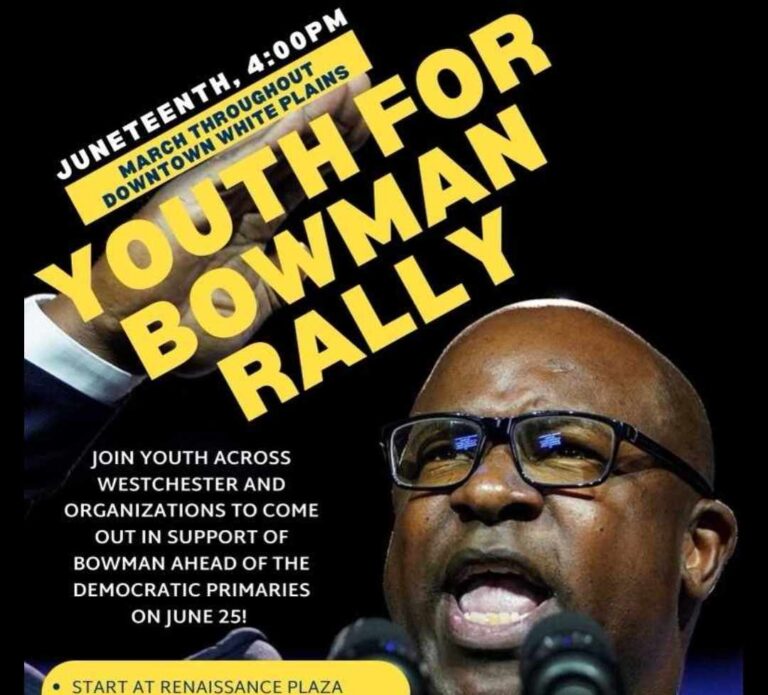
In the highly publicized CD-16 Congressional race, there has been much written about the dozens of rabbis who publicly urged County Executive George Latimer to challenge him in October, citing actions such as Bowman’s boycotts of a speech by Herzog last July.

But just as the assumption is that Latinos or Black are a monolithic group of voters would be incorrect, to assume all Jewish voters are monolithic would be equally as wrong. Just like we warn our readers that no one group of Black leaders speaks for all Black people or all Black voters, we share this letter now because it shows the same goes when it comes to Jewish leaders.

An October 19th letter from dozens of Jewish stakeholders in Westchester County proves that to be the case. Although this letter did not get the publicity of the dozens of rabbis who urged CE Latimer to challenge Rep. Bowman, there were several dozen Jewish stakeholders who questioned the judgment of the rabbis and strongly urged CE Latimer not to run for Congress (see letter below).

Dear Mr. Latimer:
We are Jewish residents of Westchester living in the towns and cities of New York’s 16th Congressional district. While many of us are active in a variety of political and civic organizations, including the Democratic Party, the Working Families Party, Indivisible, and a range of Jewish groups and synagogues, we are writing to you today in our personal capacities, to urge that you NOT run for Congress.

For over three decades, our district (though in slightly different form) was represented by a Democrat who grew out of touch with its changing demographics and who took increasingly rightwing positions on a range of topics–supporting the “war on crime,” voting to deregulate the banks, and backing George Bush’s mistaken invasion of Iraq. As Israel’s governments became more and more rightwing, he stood by them unquestioningly, failing again to notice the changing attitudes of many in his district, including among Jews.

Three years ago, Jamaal Bowman defeated Eliot Engel in the Democratic primary by 55.4% to 40.6%, demonstrating that his progressive approach was more in tune with the values of the district’s voters. In 2022, he again won the primary by a similar margin, showing that he is quite popular with our district.
We are aware that a group of rabbis in our district have called on you to run against Congressman Bowman in next year’s primary. While we have great respect for the role that all our rabbis play as spiritual guides and community stewards, we question their political judgment.

As Jews active in the civic life of our district, we have been and remain tremendously supportive of Congressman Bowman. He is, as you are, a champion of the core Democratic values of prioritizing the needs of the weakest and most downtrodden, a fighter for public education, health care, labor and the environment, and a strong advocate for the communities of Westchester. He is a constant presence in the district and open to dialogue with all.

We also support Congressman Bowman for his honesty and consistency in supporting global human rights and for his clear support for Israel as a Jewish and democratic homeland. He is not “anti-Israel.” and to refer to him that way is to deliberately distort his record, which includes many votes in favor of military and economic aid to Israel. He has also supported appropriate and fair efforts to oppose Israeli settlement expansion, annexation, and violations of Palestinian human rights, all in pursuit of peace and security for all Israelis and Palestinians. The rabbis urging you to challenge him represent only one segment of the Westchester Jewish community which is not at all monolithic. Congressman Bowman’s comments on the current conflict merely echo comments in Israel and the U.S. by many leading Jewish commentators and scholars as well as many American rabbis, none of whom are “anti-Israel.”

We are dismayed to see these rabbis, who are usually so careful with their words, not only distort his past record but also twist his clear condemnation of the October 7 Hamas terrorist attack into a false assertion that he blames Israel for it. Here’s what he actually said on October 7 in the wake of Hamas’s attack:

“I strongly condemn the horrific attacks by Hamas and am saddened by the loss of precious lives, especially on the holy day of Simchat Torah. We need a way to end this deadly violence that is killing and traumatizing generations of Israelis and Palestinians alike–including the blockade of Gaza. I have been to the Gaza border and know that Israelis and Palestinians are constantly living in fear. We must work harder to ensure peace in the region.”

The brutal attack of October 7 has shocked and traumatized all of us in the Jewish community, and we appreciate the statements of support that have come from across the political spectrum, including from you. You have been a Democratic champion throughout your career and as our county executive. But we urge you to resist any temptation to primary Congressman Bowman, who is also a popular Democrat who is clearly aligned with the voters on so many issues, a great representative for all of us and particularly the Black and Brown communities that make up a majority of our district.

A primary between the two of you would be needlessly wasteful and terribly divisive, especially at a time when all Democrats need to stand united against the rise of MAGA demagogues and authoritarianism.

We look forward to hearing from you soon.
Sincerely,

Micah L. Sifry, Hastings-on-Hudson
Peter Bernstein, Irvington
Iris Hiskey Arno, Hastings-on-Hudson
Peter Arno, Hastings-on-Hudson
Todd Brecher, New Rochelle
Mindy Chettih, Hastings-on-Hudson
Jay Gilbert, Hastings-on-Hudson
Paula Gilbert, Hasting-on-Hudson
Michael Goldstein, New Rochelle
Howard Horowitz, New Rochelle
Sarah Cox, Irvington
Lisa Genn, Irvington
Sara Gold, Hartsdale
Scott Rasmussen, Hartsdale
Maxine Golub, New Rochelle
Robert Herbst, Larchmont
Sharon Kivowitz, Hastings-on-Hudson
Amy Lieberman, Hastings-on-Hudson
Leslie Lieman, Hastings-on-Hudson
Jon Mermelstein, Scarsdale
Joey Parnes, Yonkers
Greta Parnes, Yonkers
Noah Parnes, Yonkers
Alexander Rabb, Hastings-on-Hudson
Steven Rabinowitz, White Plains
David Saphra, Irvington
Tula Schapiro, Hastings-on-Hudson
David Schwartz, Irvington
Martha Schwartz, Irvington
Renee Shanker, White Plains
Hattie Shapiro, Hastings-on-Hudson
Scott Silberberg, Scarsdale
Bruce Soloway, New Rochelle
Caroline Stern, Yonkers
Ellen Tattelman, Yonkers
Thom Thacker, Irvington
Alisse Waterston, New Rochelle
Julie Weiner, Yonkers
Lara Weitzman, Hastings-on-Hudson
Michael Yellin, New Rochelle
Steve Zeitlin, Hastings on Hudson

Black Westchester questions why this letter did not get the same media coverage as the group of rabbis urging Latimer to run. This letter at least shows there are as many Jewish voters—who are active in a variety of political and civic organizations, including the Democratic Party, the Working Families Party, Indivisible, and a range of Jewish groups and synagogues throughout Westchester—that do support Congressman Bowman, but why haven’t we read or heard much about that?

Stay tuned to Black Westchester for more updates and how race, religion, and redistricting will play a role in this highly publicized potential congressional showdown.

County Legislator James Nolan Opposes National Menthol Ban in Letter to Senator Schumer

In a letter addressed to Senator Schumer, Legislator James Nolan, who represents District 15, the Village of Bronxville, and parts of the City of Yonkers, on the Westchester County Board of Legislators, expressed his opposition to a proposed statewide ban on flavored tobacco products. He argued that such a ban would have far-reaching consequences, including potentially exacerbating the illicit tobacco market and unfairly targeting specific communities.

Last year, the Westchester County Board of Legislators passed a bill to ban flavored tobacco products, but Westchester County Executive George Latimer vetoed it. Nolan has retaken the task in this letter to Senator Schumer, highlighting the significant opposition they have encountered from Westchester County residents, businesses, and commuters, who voiced their concerns about the potential statewide ban.

One of the central arguments against the proposed ban is the potential boost it might provide to the illicit tobacco market. Nolan pointed out that in 2020, 53.5% of cigarettes smoked in New York were purchased from illicit sources. Such a ban, if implemented statewide, would place even more control in the hands of black market operators. This, in turn, could empower highly organized, international crime syndicates involved in tobacco smuggling – a concern recognized by the U.S. State Department as a “threat to national security.”

Tobacco smuggling has become a profitable venture for criminal groups, and the black market trade is lucrative. Additionally, there is a worry that terrorist groups could exploit these profits in the future. Notably, governments in the United States already lose billions of dollars in tax revenue each year due to tobacco-related issues, and implementing a flavored tobacco ban would likely exacerbate this issue.

Another significant concern raised by Nolan is the potential racial disparities that could arise from the ban. Banning flavored tobacco products could result in all menthol cigarettes in the state becoming untaxed and, therefore, illegal to possess. Nolan cited the tragic case of Eric Garner, who lost his life in 2014 during an encounter with the NYPD related to the sale of untaxed cigarettes. Garner’s family has expressed concerns that flavored tobacco bans could have unintended negative consequences in communities, particularly for African Americans and Middle Eastern Americans.

Moreover, it is suggested that prohibiting the sale of flavored tobacco may not effectively deter smokers from accessing these products. Criminals do not pay sales tax on their illicit profits, meaning the state will not recoup the lost sales tax revenue, ultimately placing the burden on taxpayers through new tax increases.

Legislator James Nolan and his colleagues urge Senator Schumer to reconsider supporting a national ban on flavored tobacco products. They argue that the potential benefits of the ban are far outweighed by the significant negative impacts it could have on illicit markets, tax revenue, and specific communities.

The Vital Role of Black Men as Exemplars of Manhood and Health for Black Children

During a recent visit to the Junior Student Council of Athur Truman School in Harlem, New York, where I spoke about my book, “The Empowering Benefits of Detox Cleansing and Eating Clean,” I was struck by the impressive understanding and execution of Robert’s Rules of Order by children of that age. Their commitment to structured meetings, with roll calls and opening and closing procedures, showed remarkable maturity.

This experience compelled me to reflect on the crucial role that Black men must play as role models for our children, not only in matters of character but also health and wellness. It’s imperative that we, as Black men, lead by example, emphasizing the significance of maintaining good physical health. Our choices and behaviors in this area send potent messages to Black children about the importance of caring for their bodies.

In light of the concerning fact that 24 percent of Black children are grappling with obesity, it becomes paramount to underscore the importance of maintaining a well-balanced diet and regular exercise to safeguard their health. It is worth noting that Black children are facing a disproportionately higher likelihood of experiencing food insecurity, being six times more susceptible compared to their peers from diverse backgrounds.

In addressing this critical issue, Black men can assume a pivotal role in influencing the dietary choices of Black children by actively championing healthier eating habits within our families and communities. This includes instilling the value of incorporating fresh fruits, vegetables, and whole grains into our daily diets while discouraging the consumption of sugary and processed foods. Undertaking these measures represents a significant and impactful stride toward enhancing Black children’s health and overall well-being.

Furthermore, Black men have a responsibility to educate Black children about the dangers of harmful habits such as smoking, excessive alcohol consumption, and substance abuse. Sharing personal stories and emphasizing the importance of healthy choices can guide young individuals away from detrimental behaviors.

It’s crucial to recognize that many of these children come from single-parent households, and we’ve witnessed a trend of Black children born out of wedlock for decades. This underscores the importance of Black men serving as examples of Black manhood and a commitment to healthy living.

In a world where societal perceptions and stereotypes often shape the identity and self-esteem of Black youth, having positive role models who embody both strong character and physical well-being is essential. We are facing a national crisis in recognizing the significance of Black men as role models and their critical role in fostering healthy lifestyles among Black children.

Historically, Black men have been subjected to various stereotypes perpetuated by media and societal biases. These stereotypes can have detrimental effects on the self-esteem and aspirations of Black children. However, Black men who excel in various fields prove that these stereotypes do not define them. They inspire younger generations to break free from limiting beliefs and strive for excellence in their endeavors.

Black men must also lead by example when prioritizing education and intellectual growth. It’s time to challenge the modern portrayal of Black men as scammers, drug dealers, and materialistic individuals. Instead, we should exemplify Black excellence to Black children, demonstrating that our intelligence transcends our surroundings.

Our role as Black men is encouraging young Black minds to pursue knowledge, higher education, or trades, opening doors to a brighter future. Successful Black men serve as beacons of hope for Black children, showcasing that hard work, dedication, and resilience can lead to professional success and motivating Black youth to aim high in their careers.

Moreover, in the contemporary era, it’s crucial to acknowledge the profound influence that actively engaged Black men have on developing values and social awareness among Black children, with a particular focus on Black girls. Statistics indicate that 61% of Black teenage girls express the need for assistance with their emotional and mental well-being, surpassing the nearly 45% rate among all adolescent girls. When Black girls can observe positive Black male role models, it empowers them and solidifies their belief in their own potential and inherent worth. This highlights the critical role of representation, allowing individuals to visualize themselves in positions of achievement, leadership, and impact, ultimately nurturing a heightened sense of self-esteem and aspiration.

In relationships, positive Black male role models can guide young Black girls in establishing high standards. They demonstrate the importance of mutual respect, effective communication, empathy, and kindness in healthy partnerships. By witnessing these positive dynamics, young Black girls can discern acceptable and unacceptable behavior in their relationships.

It is equally essential for Black men to serve as exemplars of good fatherhood and husbandry for young Black men. This influence is vital in instilling values of respect towards women and their bodies. By setting a positive example in these roles, we can work towards reversing the troubling trend of declining Black marriages within the Black community. Our marriage rates are the lowest among all ethnic groups, standing at just 30 percent.

In conclusion, Black men are profoundly responsible for serving as exemplars of manhood, fatherhood, health, and character for Black children. Through our actions, choices, and commitment to excellence, we can inspire the next generation to embrace their potential, prioritize health and wellness, and build strong, respectful, and fulfilling relationships. This collective effort is instrumental in fostering empowerment, challenging stereotypes, and nurturing a sense of belonging and possibility among Black youth, ensuring a brighter future for all.

How Will Redistricting Affect Latimer’s Potential Challenge Versus Bowman?

1

City & State Magazine asked the question, “Will Latimer challenge Bowman? It may come down to redistricting,” Black Westchester further delves into how race and redistricting will play a role in the potential congressional showdown.

“For months, Westchester County Executive George Latimer has been nudged towards running for Congress in New York’s 16th Congressional District against incumbent Rep. Jamaal Bowman. He would be a formidable candidate in the Democratic primary, thanks to strong name recognition in the district and a decent campaign war chest, and he is widely expected to eventually jump into the race. But so far, he has made a point of refusing to confirm his candidacy. The reason may be New York’s ongoing fight over redistricting.” City & State Magazine wrote.

Black Westchester is paying close attention to any potential changes to the district’s boundaries, which could have ramifications that would extend through the state, shaking up the race for the state’s 17th Congressional District and having a rippling effect throughout the state of New York. In CD-17, Democrats are hoping to take back the seat now held by incumbent Republican Rep. Mike Lawler as the Democrats look to recapture control of the lower chamber.

“The final boundaries of the state’s congressional districts are currently up in the air. Last year, the Court of Appeals struck down the district map passed by the state Legislature on the grounds that it was an unconstitutional gerrymander, which resulted in a court-appointed expert drawing a new, more Republican-friendly map for the 2022 election cycle. Democrats are now arguing that the court-appointed expert’s map was just a temporary fix, and the state’s Independent Redistricting Commission must be given the chance to draw new district maps before the 2024 election,” City & State wrote.

What Black Westchester found interesting was the next sentence in the article: “If the Court of Appeals accepts that argument, the Independent Redistricting Commission – which is led by Latimer’s deputy, Ken Jenkins – will have the opportunity to change the boundaries of the 16th Congressional District.”

One has to ask the question: is Deputy County Executive Ken Jenkins leading the Independent Redistricting Commission that will decide the district’s boundaries a conflict of interest?

“That’s an important factor. Anyone’s gonna want to know where their voters are and if you think about it, if they’re going to make changes to that district, where are they going to make the changes? Does it mean that it’s going to go further north into Westchester County, which conventional wisdom (says) would benefit Latimer or does it mean that it goes further south into the Bronx? Conventional wisdom is that that would benefit Bowman, but it depends on where in the Bronx, right?” Political consultant John Tomlin told City & State.

Jenkins who is the chair of the IRC, will be involved in deciding the district’s boundaries, which have the potential to benefit County Executive George Latimer should he decide to officially enter the race to challenge Congressman Bowman.

We reached out to DCE Jenkins to ask just that.

“No. I am appointed to serve on the IRC by Senator Stewart-Cousins. I am 1 of 10 votes. Should the Court of Appeals uphold the 3rd Department’s decision to have “the IRC get back to work,” the IRC will make a submission to the State Legislators for their consideration. The IRC is not the last word,” DCE Jenkins replied to Black Westchester.

The other nine commissioners of the IRC are former president of the NYS Tax Appeals Tribunal Charles H. Nesbitt (Vice Chair), former Administrator of Union Temple of Brooklyn Attorney Ross Brady, Esq., Director of Community Relations of the Carpenter Contractor Alliance of Metropolitan New York Yovan Samuel Collabo, former Asst. Dean at Albany Law School of Union University Attorney John Conway III, Esq., Dr. Ivelisse Cuevas-Molina, Dr. John Flateau (scholar-activist working at the intersection of Voter’s Rights and Election Reform), Elaine Frazier of Albany, Dir of Business Strategy & Risk at Meta Lisa Harris, Esq., and Willis H. Stephens Jr., Esq. of Mt. Kisco.

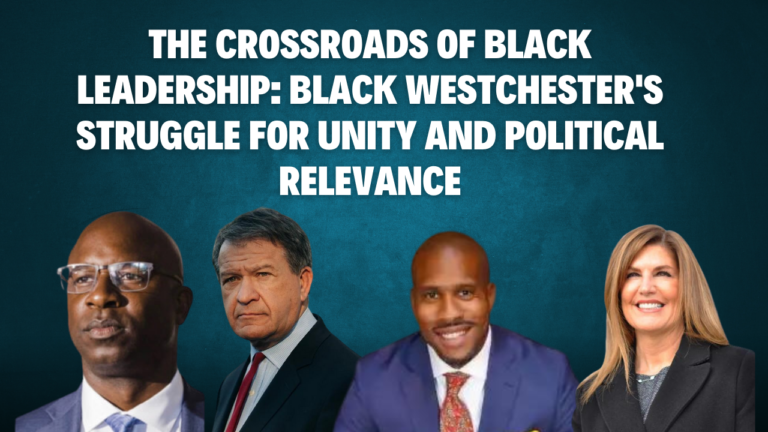
For many constituents, there is much riding on both this race and the redistricting. While many of Bowman’s Jewish constituents have urged CE Latimer to challenge CD-16’s first Black Congressman, several other organizations, including NYCD16 Indivisible, Concerned Families of Westchester, For the Many, New York Communities for Change, and Food & Water Action have all urged Latimer ‘to prioritize building Democratic power in Westchester over a possible primary against incumbent Democratic representative Jamaal Bowman in the 16th Congressional District.’ The Anti-Racist Alliance also wrote a letter urging Latimer ‘to seek another political path to avoid potential division among progressives.’

Black Westchester has also run a series or articles by Tasha Young titled, “Navigating The Shift,” parts one and two.

In part one she wrote;

“In 2020, the political landscape underwent a seismic shift as Jamal Bowman unseated the long-standing representative in CD 16. This change, however, was not isolated; Mondaire Jones, a black and openly gay man, emerged out of a field of 10 candidates to also become the first-ever Black person to represent Congressional District 17. These history makers both saw their constituents through Donald J. Trump, COVID-19, George Floyd, and Black Lives Matter, an insurrection in their first six days in office, unprecedented funding votes and subsequent fund allocation in the district, and the devastating impact of having congressional lines redrawn and having to defend their seats with a new constituent base. They have both legislated in a manner that brings more of their constituents into the decision-making process and they have delivered!”

In part two, she wrote:

“We need a party that pioneers new policy territories, and frankly, white male leadership isn’t cutting it. They don’t represent our needs; they can’t, not without us, and it’s time they step up to the plate. It’s part of the problem—the privilege of power without shouldering the responsibility to tackle these crucial issues. Where does this leave people of color? It’s time for a change—a change rooted in genuine action and representation. Now, let’s talk about understanding race equity and policy innovation. Imagine someone at the intersection of being white and male, trying to comprehend these concepts without facing the weight of systemic oppression. Their race and gender often grant them a free pass on showcasing innovation and serving credibility and resources on a silver platter, oftentimes without any accountability. That’s the epitome of white male privilege. For Black, indigenous folks, people of color, and women, it’s a different ball game. Credibility and resources are often denied. Respect? Not freely given. White women might get a bit more, but let’s discuss women of color—their respect often hinges on their proximity to whiteness.”

We agree with City & State Magazine when they wrote; “Should the district lines change, it will change the dynamics of the race… If the district were drawn to exclude some heavily Jewish areas of Westchester or to include Bronx neighborhoods like Co-Op City, Bowman would be much tougher to beat. But if the district were drawn to include even more neighborhoods in northern Westchester, it would likely benefit Latimer.”

As we have written before, this will be one of the most watched races in the 2024 election, with everyone waiting for Latimer’s decision to challenge Bowman with bated breath. Stay tuned to Black Westchester on this developing story of an election that could come down to not just race, but the ramifications of redistricting.

Environmental Justice in Mount Vernon: Recap of A Community Conversation – Save the Sound

0

[Republished with permission; originally posted, November 17, 2023, on SaveThe Sound.org]

At the heart of environmental justice is recognizing the right of people to have a real voice in what happens to the place they live. That’s why we’re partnering with other regional and national environmental groups to engage in conversation with residents of communities in the Long Island Sound region that have been impacted—historically and today—by excessive pollution, lack of access to green space and waters, and other forms of environmental racism.

On November 11, Save the Sound co-hosted a Hutchinson River-focused community conversation with Environmental Leaders of Color (ELOC), Adopt Clean Energy, Restore America’s Estuaries (RAE), and Long Island Sound Study (LISS) members at Mount Calvary CME Church in Mount Vernon, NY. This event follows a similar forum in the Fair Haven neighborhood of New Haven, CT

Dr. Diana Williams, executive director of Environmental Leaders of Color (ELOC) kicks off the Hutchinson River-focused community conversation at the Mount Calvary CME Church.

The conversation began with attendees completing an Environmental Justice (EJ) Needs Assessment survey. This survey, created by LISS and research firm Responsive Management, aims to ascertain what environmental justice needs residents encounter in their communities. This includes obstacles like proximity to polluting facilities, barriers to waterfronts, and inaccessibility to funds for sustainability projects or programs. Collection of the data will help LISS better identify inequities in the region and determine where to prioritize resources to support community-based sustainability initiatives.

Once the attendees completed the survey, Dr. Diana Williams, executive director of ELOC, kicked off the event. She spoke to how ELOC is assisting marginalized communities in preparing for climate change’s adverse impacts through education and advocacy and noted the need for more expertise and collaborations towards fixing Mount Vernon’s sewage infrastructure. She then welcomed introductions from Save the Sound, New York Sea Grant, and Restore America’s Estuaries.

Alex Rodriguez, environmental justice with Save the Sound in his introductory remarks.

Our environmental justice specialist Alex Rodriguez presented on the Hutchinson River and how its watershed connects to the Sound, as well as our shared goals: (1) protecting the health of the Sound and the people who live near it, (2) providing educational, recreational, and conservation opportunities for the public, and (3) elevating the needs of priorities of underserved communities.

“The earth is similar to our bodies, and the water within it; from the river to the Sound, is our blood. We have to take care of it and keep it clean,” said one Mount Vernon resident.

There was a significant dialogue about the need to clean the Hutchinson River and there was also prizes for participants who answered trivia questions correctly. Those questions included identifying what a watershed is, identifying what substances cannot be poured safely down a drain, and naming what municipalities are included within the Hutchinson River watershed.

“I didn’t know that pouring juice down the sink drain could impact my pipes because of its high acidic value. I learned you should dilute it with water if you needed to pour it down the drain,” said another resident.

Maddie Duda of Responsive Management, flanked by her colleague, Amanda Center, facilitating the envisioning portion of the conversation.

ELOC and Responsive Management then facilitated a group discussion regarding the visioning of the Hutchinson River. Mount Vernon and Bronx residents relayed their visions, including:

  • More youth programming
  • Less trash and illegal dumping
  • Better quality of surrounding waterways for things like fishing and swimming
  • More outdoor programs and opportunities to get outside
  • More natural places with water, trees, plants, and parks
  • More access to natural places
  • Lower food costs
  • More jobs that focus on the environment
  • More affordable housing
  • Clean up creeks and waterways
U.S. Representative Jamaal Bowman (NY-16) addresses community conversation participants.

The conversation attracted municipal officials from the sustainability department, city councilpersons, the local Parent Teacher Association (PTA), and U.S. Representative Jamaal Bowman (NY-16). Rep. Bowman noted that thanks to the Bipartisan Infrastructure Law and the Inflation Reduction Act, there are more federal dollars than ever before for environmental justice-focused projects and encouraged participants to take advantage of the opportunities.

Shahela Begum, program director of the Long Island Sound Community Impact Fund with Restore America’s Estuaries in her introductory remarks.

Save the Sound and Restore America’s Estuaries informed attendees about the Long Island Sound Community Impact Fund (LISCIF), formed through a partnership with RAE, the Environmental Protection Agency (EPA), and LISS and funded by EPA through the Bipartisan Infrastructure Law. It is awarded to projects that will increase access to Long Islan.d Sound while reducing environmental public health risks. LISCIF will also provide technical assistance in underserved communities. 

The event concluded on a positive note with residents eager to engage in additional activities related to the Hutchinson River. Fortunately, there are many opportunities coming up! Save the Sound is wrapping up development of a watershed management plan for the Westchester County portion of the Hutchinson River, and starting one for the Bronx portion. If you are a Mount Vernon or Bronx resident, please click here for our Hutchinson River Public Input Map and add your thoughts. The information gathered from watershed residents and users of the lands and waterways will help us:

  1. Identify nonpoint source pollution contributing to water quality impairment and risks associated with flooding, and propose management, restoration, and design recommendations to improve water quality and reduce flooding in the watershed;
  2. Identify implementable restoration and stormwater mitigation projects with a focus on those that provide flood mitigation and emphasize nature-based solutions; and
  3. Engage and educate municipal agencies, key stakeholders in the watershed, and the public through the formation of a Watershed Steering Committee, volunteer opportunities, public meetings, and webinars.

The information and visions you share can help us make environmental justice for the Hutchinson River watershed a reality—together.


About Save The Sound: Save the Sound leads environmental action in your region. We fight climate change, save endangered lands, protect the Sound and its rivers, and work with nature to restore ecosystems.

What makes us unique among regional nonprofits is the breadth of our toolkit and results. We work in many ways, from legislative advocacy and legal action to engineering, environmental monitoring, and hands-on volunteer efforts. Together, we restore and protect all that impacts New York’s and Connecticut’s environment, from rivers and shorelines to wetlands and forests, from the air we breathe to the waters of the Sound itself. For 50 years, we’ve been ensuring people and wildlife can enjoy the healthy, clean, and thriving environment they deserve—today and for generations to come.

Save the Sound is committed to justice in environmental action, and our team is constantly looking for ways to ensure both our internal operations and our programming support a diverse and equitable world.

Chief Judge Wilson Announces Appointment of Hon. Shirley Troutman as Franklin H. Williams Judicial Commission Co-Chair

0

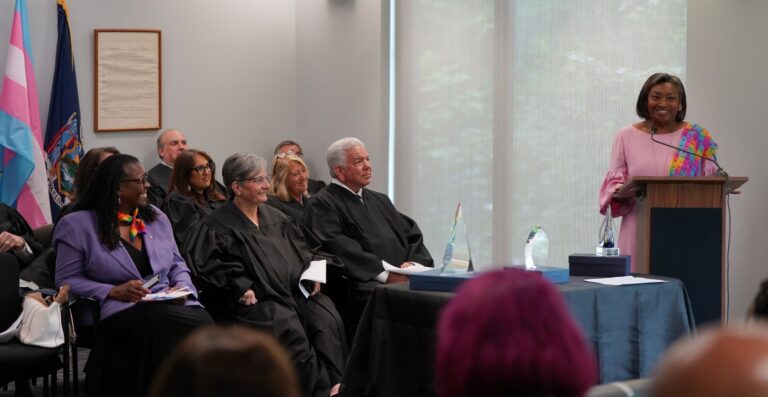
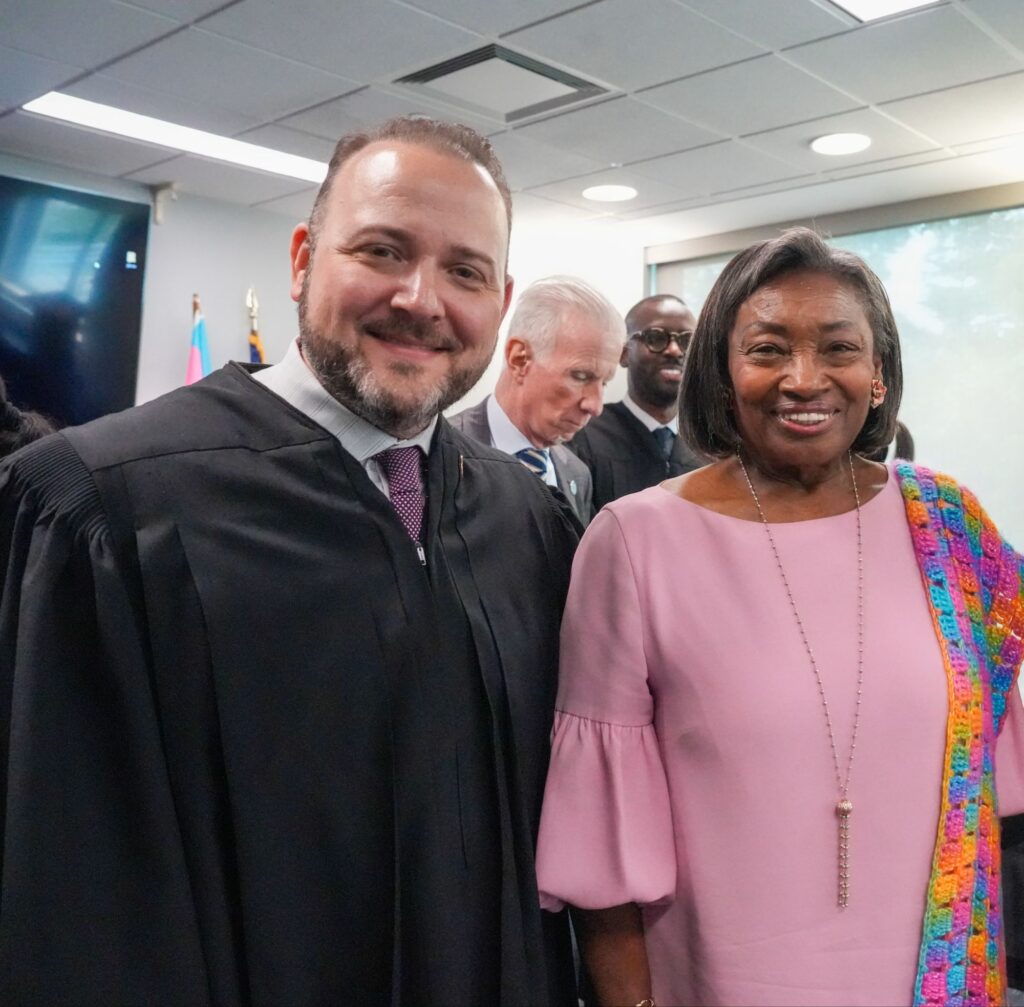
Judge Shirley Troutman of the Court of Appeals has been appointed co-chair of the Franklin H. Williams Commission, joining Justice Troy K. Webber in leading the first court-based entity in the nation committed to racial and ethical fairness in the courts.

NEW YORK — Chief Judge Rowan D. Wilson announced on Wednesday, November 29th, the reappointment of Hon. Shirley Troutman as co-chair of the Franklin H. Williams Judicial Commission, which works to promote equal participation and equal justice for employees and litigants of color, advising court leaders on enhancing racial and ethnic fairness, diversity, and meaningful inclusion in the courts and justice system. Judge Troutman, who co-chaired the Commission from 2018 to 2022, is filling a vacancy left by Hon. Richard Rivera, who served as the Commission’s co-chair since February 2022, and was recently named to the newly created position of Statewide Coordinating Judge for Family Court Matters.

“I am delighted that my Court of Appeals colleague, trailblazing Associate Judge Shirley Troutman, who so ably co-chaired the Commission for four years, has enthusiastically agreed to again take the helm, along with Commission co-chair and Appellate Division, First Department Associate Justice Troy K. Webber, moving the Commission forward on the path to equal justice,” said Chief Judge Wilson. “Judge Troutman and Justice Webber have a spectacular record working together as co-chairs of the Commission. I can think of no one more committed to, or more qualified for, this important work than Judge Troutman, and look forward to the Commission’s important work under her renewed co-leadership.”

“I appreciate Chief Judge Wilson’s reappointment of me as co-chair of the Franklin H. Williams Judicial Commission and look forward to re-establishing a productive partnership with Justice Webber. The Commission is an answer to the clarion call of Ambassador Williams to persevere in the struggle to rid this nation of racism. I relish the opportunity to help the Commission continue to fulfill its mission,” said Judge T. Routman.

“I would like to thank Chief Judge Wilson for the reappointment of Judge Troutman as co-chair of the Williams Commission. I look forward to working with her again to achieve the goals of the Commission. I would be remiss in not thanking Judge Richard Rivera for his co-leadership during these past years and wish him continued success,” said Justice Webber.

Judge Troutman was born in Fort Valley, Georgia, and raised in Buffalo, New York, where she attended public schools. She is a graduate of the State University of New York at Buffalo and Albany Law School.

She began her legal career as an Assistant District Attorney in Erie County, then served as an Assistant Attorney General and as an Assistant U.S. Attorney, representing the State of New York and the United States in civil litigation. She has also served as an adjunct professor at the University at Buffalo School of Law.

In 1994, she was appointed by Mayor Anthony Masiello to serve as a judge for the Buffalo City Court and was elected to a full ten-year term that same year. In 2002, she was elected to the County Court in Erie County, where she served until her election to New York State Supreme Court in 2009. In 2016, she was designated by Governor Andrew Cuomo to serve on the Rochester-based Appellate Division, Fourth Department.

In 2021, she was nominated by Governor Kathy Hochul to serve on the New York State Court of Appeals, becoming the second African-American woman to sit on New York’s highest court. In addition to her previous service as co-chair of the Franklin H. Williams Commission, she is a past president of the National Association of Women Judges – New York Chapter and has served as a member of both the New York State Court System’s Advisory Committee on Judicial Ethics and Ethics Commission.

In tribute to outgoing Commission co-chair Hon. Richard Rivera, Chief Judge Wilson said, “I am grateful for Judge Rivera’s dedicated stewardship of the Commission as co-chair over the past 20 months. His new role as our first Statewide Coordinating Judge for Family Court Matters will be all-consuming, and we are relying on his expertise, sensitivity, and tireless dedication in promoting access to equal justice for children and families who appear in our State’s family courts. Those courts disproportionately involve low-income New Yorkers and people of color, and our efforts to improve the lives of distressed families in New York will benefit immeasurably from Judge Rivera’s intimate familiarity with operational and other issues impacting the family courts discussed in a recent report issued by the Franklin H. Williams Judicial Commission.”