



When Zohran Mamdani publicly singled out Ken Griffin and used Griffin’s penthouse as a symbol for taxing the rich, many treated it as populist theater. But this is bigger than a viral political stunt. It raises a serious question about whether New York is beginning to confuse hostility toward capital with economic justice. Those are not the same thing, and history shows they often produce opposite results.
The issue is not whether wealthy people should contribute. The issue is whether it makes sense to politically target people and institutions already contributing at extraordinary levels to the city’s economy. By Citadel’s own accounting, Griffin, his firms, and employees have paid nearly $2.3 billion in city and state taxes over the past five years. That is not symbolic money. That helps finance the government itself. Add to that Griffin’s reported $650 million in charitable support to schools, hospitals, and civic institutions in New York, and the caricature of someone not carrying his share begins to collapse.
More importantly, this is not just about one taxpayer. It is about what New York risks if this political climate pushes away investment. Citadel has signaled that its planned $6 billion 350 Park Avenue development could be reconsidered. That is not a small threat. That project is expected to generate 6,000 construction jobs, support 15,000 permanent jobs, and represent billions in economic activity tied to payrolls, vendors, contractors, property taxes, and long-term commercial growth. If a project of that scale pulls back, the loss is not theoretical. It is measurable.
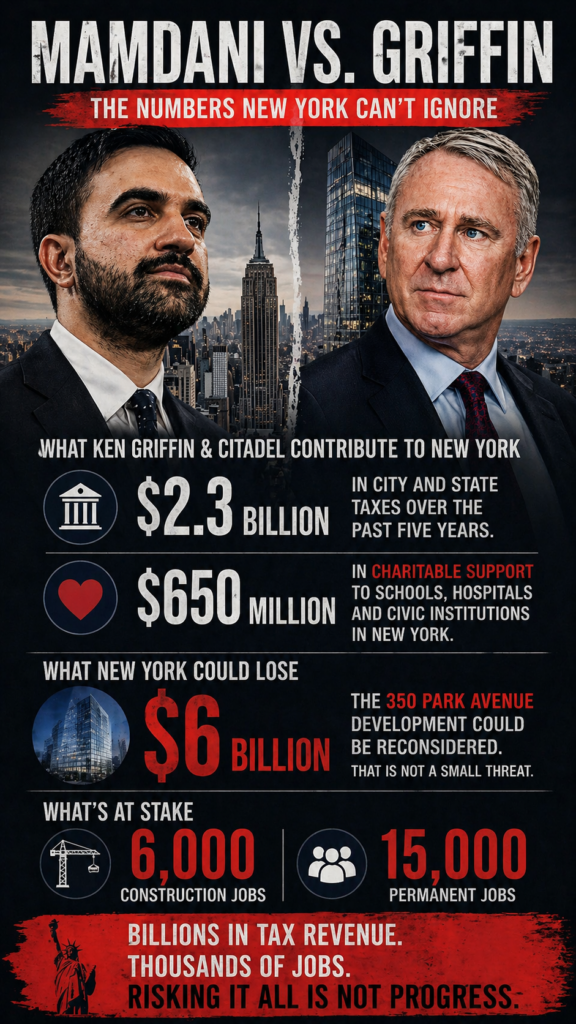
And this is where the politics begins to work backward. A movement claiming to fight for working people is risking policies and rhetoric that could cost working people jobs. That is a contradiction too few are willing to confront. If New York loses billions in investment, thousands of jobs, and future tax revenue to posture against wealth, that is not progressive economics. That is economic self-sabotage.
Cities do not become stronger by driving away those who expand the tax base. They grow by attracting investment, rewarding enterprise, and making it rational for capital to stay. This is what too much redistribution politics ignores. Wealth is not merely something governments divide. It is something economies must continue producing.
This is why the Griffin episode matters beyond one billionaire’s penthouse. It signals a broader governing philosophy that treats productive capital less as a partner in growth and more as a political target. That may produce applause in the short run. But cities are not governed by applause. They are governed on outcomes.
Thomas Sowell has long argued that the question is never whether a policy sounds fair, but whether it works. That is the question here. What exactly is gained by threatening or alienating taxpayers and investors who are already helping finance the city? Does that produce more housing, stronger budgets, more jobs, or more opportunity? Or does it simply make New York less competitive while pretending moral victory?
And let us be honest about the stakes. If firms like Citadel conclude New York has become openly hostile to capital, there will be others watching. Investors watch signals. Markets watch signals. Employers watch signals. If one major player pulls back, others may rethink expansion too. That is how erosion begins, not always with collapse, but with cumulative decisions that slowly weaken a city’s economic base.
The irony is painful. In the name of helping ordinary people, this kind of politics can end up hurting ordinary people first. Because when capital leaves, the wealthy often relocate. Working people do not. They stay and absorb the consequences.
If New York loses billions in taxes, thousands of jobs and major development because leaders chose to demonize investment instead of attract it, that is not taxing the rich. That is taxing the city’s future.
That is not moving forward.
That is governing in reverse.