






Let’s begin with what cannot be ignored.
According to the Centers for Disease Control and Prevention, African Americans are significantly more likely to be hospitalized for asthma and nearly three times more likely to die from it than white Americans.
The American Lung Association has consistently shown that communities of color are more likely to live in environments where air quality is poorer and asthma triggers are more concentrated.
And in New York, data from the New York State Department of Environmental Conservation (NYSDEC) confirms that pollution exposure is not evenly distributed, it clusters in high-traffic, densely populated areas.
So before anything else, this is not random. This is patterned. It is predictable.
Now step inside a home.
It’s late, past midnight, in Westchester County. The house is quiet, but not settled.
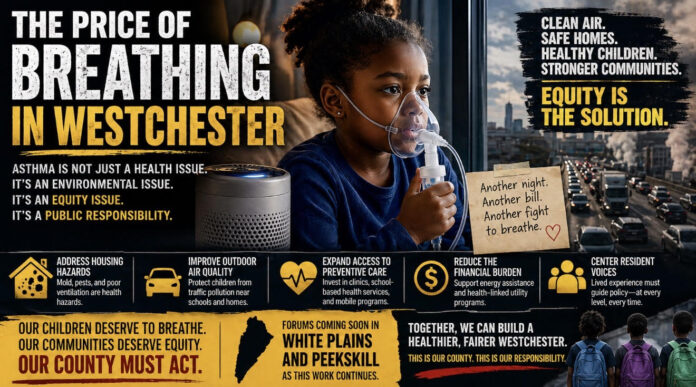
There’s a steady hum filling a small bedroom. Not loud, but constant. A nebulizer sits on a nightstand, its plastic tubing looping gently toward a child who is half-awake, half-exhausted. A faint mist rises and disappears into the air.
Across the room, an air purifier runs without pause. Its low vibration becomes part of the atmosphere, something you stop hearing but never escapes you. The window is shut tight, even though the air feels warm and slightly heavy. Opening it would mean letting in whatever rides along the nearby roads, diesel fumes, dust, something sharp enough to trigger a cough within minutes.
On the edge of the bed, a parent leans forward, elbows on knees.
Listening.
Not casually, carefully.
They’ve learned the difference between normal breathing and the kind that signals trouble. They count seconds between breaths without realizing they’re counting. They notice every small shift, the slight tightening, the pause that lasts just a little too long.
Sleep comes in fragments, if at all.
This is what “manageable” asthma looks like in real life.
And it’s not an exception, it’s a pattern repeating itself across Mount Vernon, Yonkers, and New Rochelle.
In these communities, asthma is not a background condition. It is an active presence.
It shows up in the morning when a child hesitates before walking to school, checking their backpack for an inhaler the way others check for homework.
It shows up in classrooms, where sitting still is easier than risking a coughing episode that draws attention.
It shows up in after-school hours, where play is negotiated, how much running is safe today?
It shows up in the car rides to the hospital, quiet, focused, urgent.
And it shows up in ways that never make headlines, in the monthly bills.
Because everything that made that bedroom stable overnight, the nebulizer, the air purifier, the humidifier, requires power.
Continuous power.
These machines don’t rest, because the risk doesn’t rest.
And so the cost builds.
Electric bills climb higher than expected. Then higher again. And suddenly, what was already a tight budget becomes something else entirely, a constant balancing act.
At kitchen tables, late in the evening, decisions are made quietly:
What can be delayed?
What can be reduced?
What cannot be turned off?
Because turning something off might mean more than discomfort, it might mean danger.
This is the hidden cost of asthma.
And it does not fall equally.
It follows patterns shaped by housing conditions, environmental exposure, and access to care, patterns that have been in place for years and continue to affect the same communities.
Even in a county known for its resources, disparity remains visible to those living within it.
Because in Westchester, where you live still shapes how you breathe.
In November 2025, residents, health professionals, and community leaders gathered in Mount Vernon through the Westchester County African American Advisory Board to confront these realities directly.
What emerged from that conversation was not new, but it was undeniable:
Asthma is not only a medical condition.
It is connected to environment.
It is shaped by structure.
Since then, the work has expanded through the Advisory Board’s Asthma Committee.
In Greenburgh, Dr. Suzanne D. Phillips, a prominent longtime educator, has worked to connect residents with accessible health resources, helping bridge gaps that often leave families without consistent care.
In Yonkers, Larry Sykes has helped create forums where residents can speak openly about their experiences, describing patterns that data alone cannot fully capture.
In New Rochelle, Gwen Clayton Fernandes hosted a community forum at Alvin & Friends, bringing the conversation into a familiar, grounded space where people could reflect and share without formality.
These efforts have been strengthened by Assemblywoman Mary Jane Shimsky, whose support helped bring in the American Lung Association. Their involvement added broader public health perspective, but the lived experience remained the clearest guide.
At these gatherings, the details repeated themselves with striking consistency.
Children carrying inhalers throughout the day.
Homes where mold returns despite repeated cleaning.
Apartments where ventilation is limited, and air feels heavy in the summer months.
Schools positioned near major roadways, where traffic emissions linger.
These are not isolated incidents.
They are recurring conditions with measurable consequences.
And beneath all of it is the same truth:
Living with asthma carries a cost beyond health.
It is financial.
It is emotional.
It is constant.
Westchester County has begun to respond. The creation of an Asthma Subcommittee within the Advisory Board represents an important step. Community forums have expanded awareness. Partnerships have strengthened coordination.
These efforts are guided under the leadership of Barbara Edwards, whose direction has helped maintain focus on the issue.
But awareness does not reduce exposure.
It does not repair housing conditions.
It does not prevent an attack in the middle of the night.
And those nights are still happening.
Children are still waking up struggling to breathe.
Parents are still listening in the dark.
Families are still making urgent decisions about when to seek emergency care.
If Westchester is serious about equity, then the response must extend beyond conversation.
Housing conditions must be addressed at their source. Mold, pests, and inadequate ventilation are not minor concerns, they are direct health risks.
Outdoor air quality must be treated as a public health priority, especially near schools and residential areas impacted by traffic.
Access to preventive care must expand, so families are not relying on emergency rooms as a primary form of treatment.
And the financial burden must be recognized. No family should face economic strain for maintaining the equipment necessary to breathe safely.
Finally, the voices of residents must remain central. Their experiences provide essential insight into what is working and what is not.
Additional forums are planned in White Plains and Peekskill as this work continues.
Across each community, the message remains steady:
Asthma in Westchester is not just a health issue.
It is an environmental issue.
It is an equity issue.
It is a shared responsibility.
Because no county can claim prosperity while families are sitting awake in the early hours of the morning, listening to a child struggle for air and no family should have to wonder if they can afford to make it to morning.