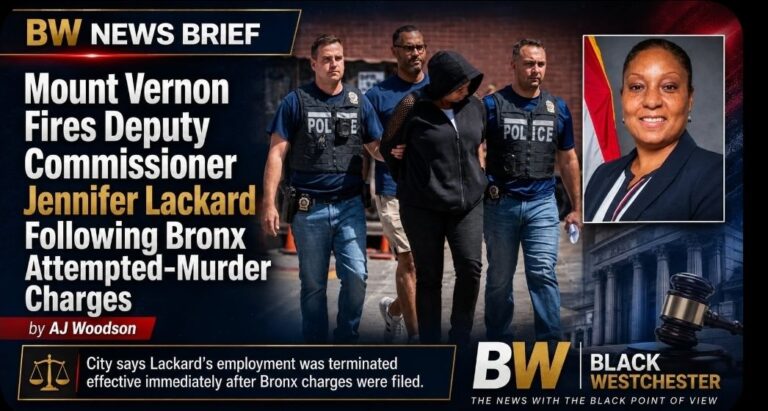
MOUNT VERNON, N.Y. — The City of Mount Vernon has terminated Deputy Commissioner of Wellness Jennifer Lackard following her arrest and indictment in connection with an alleged gang-related shooting outside the Bronx Criminal Courthouse.
Lackard, 49, and her 20-year-old son, Chase Lackard, were arrested Tuesday morning at their home on Boynton Avenue in the Soundview section of the Bronx. They face charges that include attempted murder, attempted assault, criminal possession of a weapon, conspiracy and reckless endangerment.
Prosecutors allege Chase Lackard opened fire from a Chrysler Pacifica near East 162nd Street and Grand Avenue, an intersection located directly behind the Bronx County Hall of Justice, shortly before midnight on June 29, targeting individuals believed to be affiliated with a rival gang. No one was struck or injured.
Court filings reportedly allege that Jennifer Lackard participated in planning her son’s escape from the scene. Prosecutors claim text messages show Chase directing his mother to position herself near the courthouse when he exited, and that she discussed timing the pickup to avoid waiting directly outside. Additional court allegations describe the family leaving the area and stopping near their home so Chase could change his clothing.
Lackard pleaded not guilty. Her attorney argued that the allegations presented by prosecutors are inconsistent with her life, career and record of community service. Bail was set at $75,000, and she is expected to return to court in September.
Hours after the arrest, the Mount Vernon Police Department announced that Lackard’s employment had been terminated effective immediately at approximately 1:09 pm.
“The Mount Vernon Police Department is aware of the criminal charges filed by the Bronx County District Attorney’s Office against former Deputy Commissioner of Wellness, Jennifer Lackard. Effective immediately, the City of Mount Vernon has terminated Jennifer Lackard’s employment. The allegations are unrelated to her duties with the Mount Vernon Police Department and do not stem from any conduct associated with the Department or the performance of her official responsibilities. The Mount Vernon Police Department remains fully committed to its nationally recognized Wellness Unit. The department will continue to operate without interruption, and the critical wellness services and support it provides to our officers, civilian employees, their families and the community at large will continue as part of the Department’s ongoing commitment to the health and well-being of its workforce. As this is an active criminal matter being prosecuted by the Bronx County District Attorney’s Office, the Mount Vernon Police Department will not comment on the underlying allegations,” the city stated.
Mount Vernon officials said the department’s nationally recognized Wellness Unit will continue to operate without interruption, providing services to police officers, civilian employees, their families, and the broader community.
Because the case is being prosecuted by the Bronx County District Attorney’s Office, the Mount Vernon Police Department said it would not comment further on the underlying allegations.
Lackard was appointed deputy commissioner of wellness in 2020. Before joining the department, she was known for her work involving reentry programs and previously served two terms on Bronx Community Board 9.
Mount Vernon City Council President Derrick Thompson said the council was alarmed by the arrest but would await additional verified information before drawing conclusions.
“As Council President of the City of Mount Vernon, I was alarmed to learn about the arrest involving Deputy Police Commissioner Jennifer Lackard. At the time, the Mount Vernon City Council is awaiting additional facts as the investigation into the incident in the Bronx involving Deputy Commissioner Lackard and her son continues. We firmly believe in the principle of due process and that every individual deserves a fair and impartial process,” Thompson stated. “For that reason, we will refrain from drawing conclusions until all of the facts have been gathered.”
Thompson added that the council’s primary responsibility remains serving Mount Vernon residents and ensuring that one incident does not overshadow the work of the city’s public servants, businesses and community leaders.
The charges are allegations, and Lackard and the other defendants are presumed innocent unless proven guilty in court.
Stay with Black Westchester for continuing coverage as additional information becomes available.
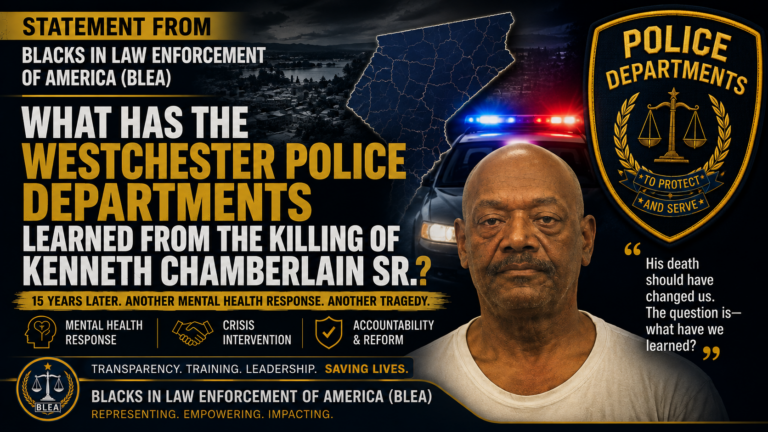
Fifteen years after the death of Kenneth Chamberlain Sr., one question continues to demand an honest answer:
What have Westchester County police departments actually learned?
Kenneth Chamberlain’s death was supposed to become a turning point in how law enforcement responds to people experiencing mental health crises. His death sparked national attention, lawsuits, policy discussions, and renewed calls for crisis intervention, de-escalation, and specialized mental health training.
Yet, more than a decade later, Westchester County continues to see police encounters with individuals in mental health crises end in gunfire.
If Mount Vernon is now explaining another shooting involving a court-ordered mental health response, then this is no longer just a Mount Vernon issue. It is a question for every police department in Westchester County.
If you read the investigative reports surrounding the Kenneth Chamberlain incident, there are broad similarities in the sequence of events that have been publicly discussed: a forced entry into a residence, the use of less-lethal options such as conducted-energy devices (Tasers) and impact munitions, and ultimately the use of deadly force. While every incident has its own facts and must be judged independently, those similarities raise legitimate questions about whether law enforcement’s overall approach to mental health crises has fundamentally changed.
That leads to an even larger question.
In 2026, with modern technology, advanced crisis intervention training, less-lethal tools, specialized units, and decades of lessons learned, are we really saying that law enforcement is incapable of safely extracting a mentally ill person armed with a knife without resorting to deadly force?
That is a question the public deserves to have answered.
We know these situations are among the most dangerous an officer can face. We also know they require split-second decision-making. But we should continually ask whether evolving training, equipment, and tactics are providing officers with realistic alternatives that better protect everyone involved.
As someone with 33 years of experience in corrections, I know that correction officers regularly manage inmates armed with homemade knives and other dangerous weapons inside secure facilities. Through coordinated team tactics, communication, shields, less-lethal options, and controlled extraction techniques, these incidents are often resolved without deadly force. The correctional environment is different from policing, and no comparison is exact, but it demonstrates that armed encounters do not always have to end with use of deadly force.
The public deserves more than assurances that officers have received training. The public deserves measurable evidence that the training is producing better outcomes.
Kenneth Chamberlain Sr.’s death should have transformed how police departments throughout Westchester County approach mental health emergencies. Every chief, commissioner, sheriff, and municipal leader should be able to explain what specific reforms were adopted because of that tragedy—and what measurable improvements have resulted.
If another person experiencing a mental health crisis is shot after years of promised reforms, the public has every right to ask whether those reforms have truly changed anything.
The question is no longer simply what happened in this latest incident.
The larger question is this:
What have Westchester County police departments learned from the killing of Kenneth Chamberlain Sr.—and how are they demonstrating that those lessons are saving lives?
Until that question is answered with measurable results instead of promises, public confidence will remain difficult to restore.
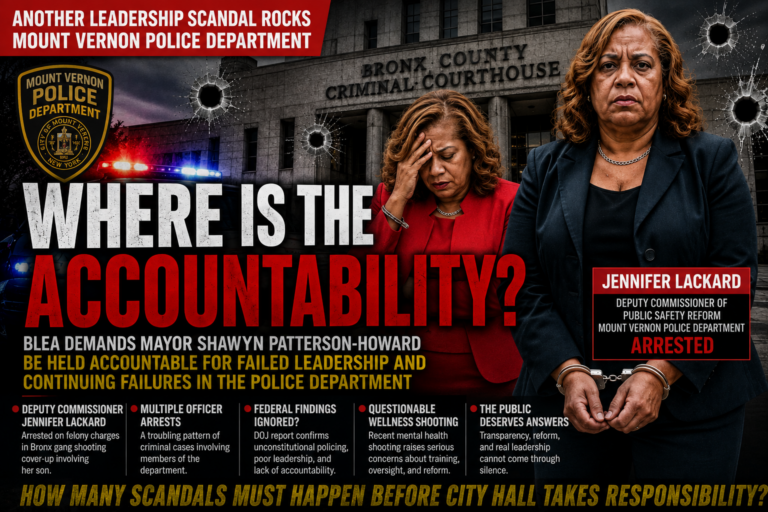
MOUNT VERNON, N.Y. — Blacks in Law Enforcement of America (BLEA) is calling on Mount Vernon Mayor Shawyn Patterson-Howard to accept responsibility for what the organization describes as a growing pattern of leadership failures within the Mount Vernon Police Department following the arrest of Deputy Commissioner Jennifer Lackard.
Lackard, the department’s Deputy Commissioner of Public Safety Reform, was arrested Tuesday alongside her son, Chase Lackard, after Bronx prosecutors alleged she drove the getaway vehicle following an attempted gang-related shooting outside the Bronx Criminal Courthouse on June 29. Both face multiple felony charges, including attempted murder, attempted assault, criminal possession of a weapon, conspiracy, and reckless endangerment. The charges are allegations, and both are presumed innocent unless proven guilty in court.
In a statement released Tuesday, BLEA said the arrest of one of the department’s highest-ranking executives should force City Hall to answer difficult questions about leadership, oversight, and accountability.
Federal Findings Already Warned the City
BLEA argues that the latest arrest cannot be viewed in isolation.
The organization pointed to the U.S. Department of Justice’s December 2024 findings, which concluded that the Mount Vernon Police Department engaged in a pattern or practice of unconstitutional policing. Federal investigators cited deficiencies in supervision, training, accountability, use-of-force practices, investigative procedures, and leadership oversight.
According to BLEA, those findings should have served as a blueprint for reform.
“Instead,” the statement reads, “the City now finds itself confronting yet another crisis involving one of the department’s highest-ranking officials.”
The organization questioned what reforms have actually been implemented since the DOJ report and whether those reforms have been effectively measured.
A Growing List of Officer Arrests
BLEA also highlighted what it described as a troubling series of criminal cases involving members of the department during the past year.
Among those cited were:
Deputy Commissioner Jennifer Lackard, arrested on multiple felony charges related to the Bronx investigation.
Detective Kyren Braunskill, indicted in a Suffolk County investigation involving conspiracy and financial crime allegations.
Officer Brandon Hunter-Carney, charged with grand larceny and criminal possession of stolen property.
Officer Steven Moreano, arrested on misdemeanor DWI charges while off duty.
Officer Frank Lucadamo, arrested in Florida on stalking allegations involving a retired Mount Vernon police officer.
While some of the alleged conduct occurred before certain officers joined the department, BLEA said the cumulative effect of these cases has damaged public confidence and raises questions about hiring standards, background investigations, supervision, and executive leadership.
Questions Remain About the Wellness Division
The organization also connected the latest arrest to broader concerns surrounding the department’s Wellness Division, which Deputy Commissioner Lackard oversaw as part of her role leading public safety reform.
Only days before her arrest, Mount Vernon officers responding to a court-ordered mental health commitment shot 58-year-old Ulysses McGhee after hours of negotiations failed. Officers reportedly used less-lethal force before a firearm was discharged. The New York State Police continue to investigate the shooting.
BLEA emphasized that it is not alleging any connection between Lackard’s criminal charges and the McGhee shooting. Still, it said her leadership responsibilities make it appropriate to examine whether the City’s reform initiatives were adequately implemented.
The organization is calling for answers to several questions, including:
Were nationally recognized Crisis Intervention Team (CIT) standards followed?
Were DOJ recommendations fully implemented?
Who evaluated the effectiveness of the department’s Wellness Division?
What accountability measures exist when reform efforts fail to prevent controversial outcomes?
“Leadership Must Be Accountable”
BLEA said the issues now facing the department extend beyond individual misconduct.
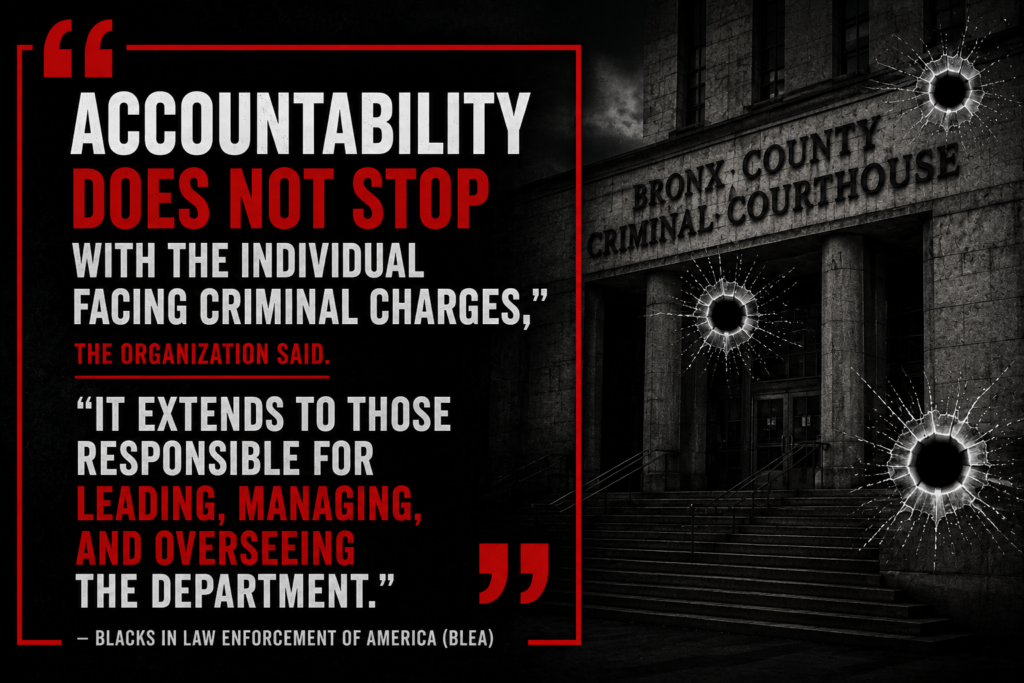
“When a police department has been the subject of a federal civil rights investigation, receives findings of unconstitutional policing from the U.S. Department of Justice, experiences multiple officer arrests, faces repeated controversies involving the use of force, and now sees one of its highest-ranking executives arrested on serious felony charges, the conversation must move beyond individual misconduct and toward executive accountability,” the organization stated.
BLEA is calling on Mayor Shawyn Patterson-Howard to publicly explain what reforms have been completed since the DOJ report, how those reforms have been measured, what changes have been made to leadership and supervision, and why serious controversies continue to emerge.
The organization concluded by saying that public trust cannot be restored through silence.
“The honorable men and women who wear the badge deserve ethical leadership, effective supervision, and a department they can be proud to serve,” the statement reads. “The residents of Mount Vernon deserve a police department that reflects professionalism, constitutional policing, transparency, and accountability.”
BLEA said meaningful reform requires “honest leadership, measurable accountability, and transparency at every level of government.”
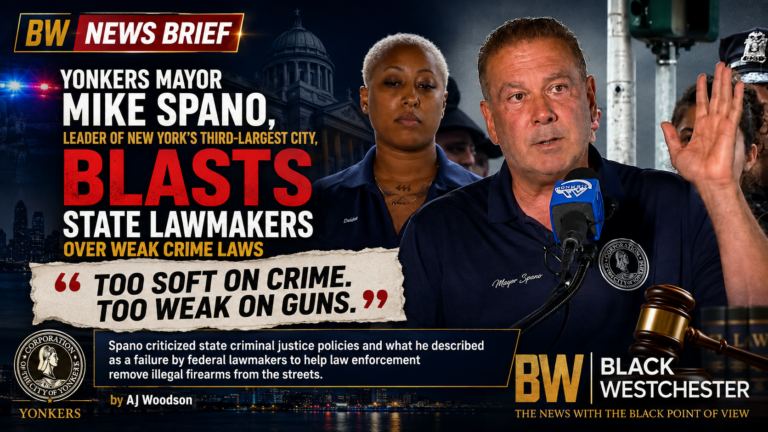
Yonkers Mayor Mike Spano urged residents against retaliatory violence, while Acting Police Commissioner Daniel Campanini said officers would maintain a heightened presence in the neighborhood as the investigation continues.
Spano said the shooting unfolded in only a matter of seconds but left five people wounded and one family grieving.
“The incident took all of maybe five seconds, and we have five people shot and one person dead,” Spano said. “Even one crime, even one shooting, is too much for any one of us to bear—especially the family of that 20-year-old who is dealing with the loss of their child today.”
The mayor also used the moment to criticize state criminal justice policies and what he described as a failure by federal lawmakers to help law enforcement remove illegal firearms from the streets.
“People want to know who to blame—go to the state Legislature,” Spano said. “They have succeeded in taking the handcuffs off the bad guys and putting them on law enforcement and the judges. And we can blame the democrats at home, we can blame the Republicans in Washington for their inability to do the things that will allow law enforcement to take illegal guns off the streets. How does a 15-year-old end up with a gun like that?”
Spano said the Yonkers Police Department had moved a mobile command unit from the Third Precinct to Elm Street and increased both uniformed and plainclothes patrols in the area.
“We’re taking our streets back,” he said. “We’re not going to let the bad guys think they somehow have control of Elm Street. They don’t. We have cameras, uniformed officers, plainclothes officers and all kinds of police activity here. So, for those who might be thinking about retaliation, they may want to think again.”
Spano again questioned how the 15-year-old suspect allegedly obtained the firearm and called for continued vigilance as police work to prevent further violence.
Spano appeared to be referring to a series of controversial New York criminal justice reforms—including bail reform, Raise the Age, discovery reform and the Less Is More Act—which critics argue have limited the authority of judges, prosecutors, police and parole officers. Supporters dispute claims that the reforms caused increased crime and maintain that they were designed to correct longstanding inequities without eliminating accountability for serious violent offenses. However, it would be inaccurate to report as an established fact that these laws “created” more crime. But what is certain is that the laws and their impact remain heavily debated, and they apply differently depending on the defendant’s age, criminal history, and charges.
For this particular shooting involving an alleged 15-year-old gunman, New York State’s Raise the Age law is the most directly relevant policy debate, although serious murder and gun charges may still be handled in criminal court. The exact application will depend on the charges ultimately filed. But Raise the Age does not prevent a 15-year-old accused of murder or another designated serious felony from being prosecuted as a juvenile offender in the Youth Part of Criminal Court.
The 2017 Raise the Age law increased New York’s age of adult criminal responsibility from 16 to 18 and moved most cases involving 16- and 17-year-olds into age-appropriate court proceedings and facilities. Critics contend that the law weakened consequences for teenage offenders and allowed gangs to recruit younger people who believe they will face less serious punishment.
Spano expanded on his criticism of state and federal lawmakers, arguing that reforms such as Raise the Age and bail reform may have been created with legitimate intentions but were never adequately revisited to determine whether they had gone too far.
“Look, I’ve been mayor now for 15 years, and I spent 20 years in the state Legislature, so I get it,” Spano said. “We do things like Raise the Age, and there were a lot of positives to raising the age. There were reasons for cash bail reform. But there was never a look back to say, ‘You know what? Where did we go too far? How can we change these laws so we’re not handcuffing law enforcement and we’re not handcuffing our judges?’ That’s what I’m concerned about.”
Spano said elected officials must address both sides of the crisis: what he described as weak consequences for people who commit crimes with guns and the federal government’s failure to stop illegal firearms from being trafficked into local communities.
“On one hand, we are being weak on people who commit crimes with guns. On the other hand, look at Congress and its inability to keep guns from being trafficked into our communities,” he said. “You also have to blame Congress because they will not address the issue. If they don’t address it, we will continue to see carnage like this in our communities.”
The mayor said the consequences of inaction are already clear.
“One murder is too many,” Spano said. “We have a family that is going to mourn the loss of a 20-year-old because some 15-year-old got his hands on a gun.”
Spano also called on state lawmakers to seek greater input from mayors, police officials and prosecutors before enacting major criminal justice changes.
“New York State has got to start listening to the mayors,” he said. “The mayors are the generals on the front lines of the wars over things like this that are happening in our communities. When they make changes—whether at the federal or state level—they usually do so without consulting us or talking to us about it.”
He pointed specifically to the passage of bail reform under the previous gubernatorial administration, arguing that local officials were excluded from the process.
“Go back to bail reform. It happened in a budget bill, and we had no input on it—none whatsoever,” Spano said. “Neither did law enforcement, and neither did the district attorneys. It was passed in a budget bill without their input, and a call like that usually doesn’t work.”
At the end of the day, this cannot become another tragedy reduced to political talking points and forgotten after the cameras leave Elm Street. A 20-year-old is dead, four teenagers were wounded, and a 15-year-old allegedly had access to a gun capable of destroying multiple lives in seconds. State lawmakers, Congress, law enforcement, community leaders and parents must all confront the uncomfortable truth that our young people are being failed from every direction. We can debate bail reform, Raise the Age and gun laws, but while elected officials argue over who deserves the blame, another family is preparing to bury a child. One murder is one too many—and doing nothing guarantees that Elm Street will not be the last community forced to endure this kind of pain in Westchester County and the surrounding areas.
YONKERS, NY — A 20-year-old man was killed, and four teenagers were critically wounded in a shooting near the intersection of Elm Street and Palisade Avenue at approximately 8:43 p.m. on Sunday, August 2.
According to Yonkers police, the victims were standing near the street corner when a gunman approached from across the roadway and opened fire. Authorities said the entire shooting unfolded in approximately five seconds. The 20-year-old victim, who was struck in the back, was pronounced dead at the scene.
Two 15-year-old boys, a 16-year-old boy and a 14-year-old girl were also struck by gunfire. All four were transported to area hospitals in critical but stable condition. Police believe the group was deliberately targeted, although investigators are still trying to determine which individual was the intended target. Authorities said the 20-year-old man may have been an innocent bystander.
An on-duty police captain reportedly heard the gunshots and joined responding officers in pursuing the alleged gunman. A 15-year-old boy was tackled and taken into custody near the scene. Investigators recovered a loaded firearm, ballistic evidence, and surveillance footage, and currently believe the teenager was the sole shooter.
The Yonkers Police Department has classified the incident as group-related violence, with its gang unit leading the investigation. Police said there is no immediate threat to the general public but warned that officers would maintain a heightened presence in the neighborhood because of concerns about possible retaliation.
Yonkers Mayor Mike Spano criticized state criminal justice policies and what he described as a failure by federal lawmakers to help law enforcement remove illegal firearms from the streets and said the Yonkers Police Department had moved a mobile command unit from the Third Precinct to Elm Street and increased both uniformed and plainclothes patrols in the area.
“Yonkers, which is just still statistically the safest city in all New York State. One of the safest cities in America. Now that tells you something, because even one crime, even one shooting, is too much for anyone of us to bear. Especially the family of that 20-year-old that is dealing with the loss of their child today. But think about this, we have to continue to be vigilant. We have to continue to do the things that we need to do to keep our community safe. And that’s why you’ll see the police mobile command unit, because we’ve taken our command unit out of the third precinct and we put it here in Elm Street. We’re taking our street back. We’re not going to let the bad guys think that they somehow have control of Elm Street. They don’t, and we’ll deal with this. And our law enforcement officers thay always do and continue to do the things that they do. I will make sure that this is surveyed. We have cameras. We have law enforcement officers that are in uniform who are not in uniform. There’s all kinds of police activity here, so for those who might think about a retaliatory strike, they might want to think again,” Spano said at the presser Monday.
The identity of the deceased victim has not yet been publicly released. The investigation remains active, and additional details—including the charges the 15-year-old may face—were not immediately available. Investigators said they believe the shooting was related to a gang turf dispute.
“The victim is merely two years younger than my own son. There are no words for a parent who has to bury their child. My prayers are with the family and the entire community,” Yonkers City Council President Lakisha Collins-Bellamy shared on Facebook.
Black Westchester will continue to follow this developing story and provide updates as more information becomes available.
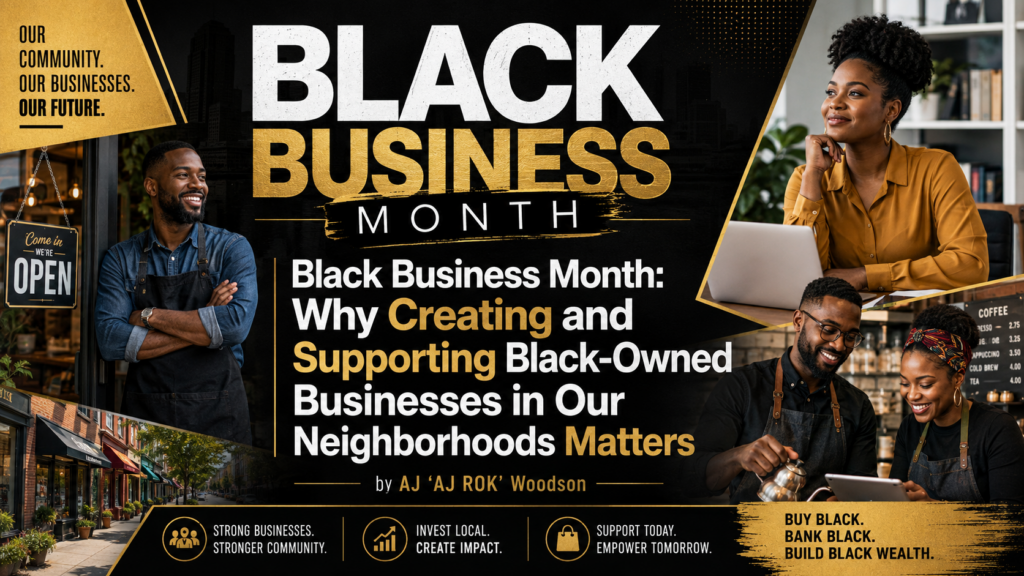
August is National Black Business Month, an annual observance established in 2004 by historian John William Templeton and engineer Frederick E. Jordan. It is a time to celebrate Black entrepreneurs and recognize their contributions to the American economy—but it must also be a time to confront the barriers that continue to prevent too many Black-owned businesses from surviving, expanding, and becoming lasting community institutions.
Let me say this plainly: Black Business Month has to be about more than posting a “Buy Black” graphic on social media.
It must challenge us to examine where we spend our money, who benefits from that spending and whether our dollars are helping build the communities we say we care about.
Creating, supporting and sustaining Black-owned businesses creates jobs, strengthens neighborhoods, expands opportunity and helps transform individual ideas into institutions that can serve generations. Supporting Black businesses is not charity. It is an investment in economic independence, community stability and Black wealth.
Black Businesses Are Growing—but the Barriers Remain
Black entrepreneurs have always created businesses despite discriminatory lending, redlining, exclusion from established marketplaces and limited access to investment capital. They opened stores, restaurants, barbershops, beauty salons, professional practices and community institutions when many traditional doors were deliberately closed to them.
Those barriers did not simply disappear.
In 2024, the Alliance for Entrepreneurial Equity—a partnership between the National Urban League and Third Way—released The State of Black Business, examining the economic landscape confronting Black entrepreneurs across the country.
The report found that Black businesses are growing, but they remain woefully underrepresented. Black-owned employer businesses grew by approximately 30 percent between 2018 and 2021, yet they still represented only about 2.5 percent of all employer businesses in the United States.
Most Black-owned companies remain small, many employing fewer than five people. That is not because Black entrepreneurs lack ambition, talent, innovation or work ethic. Too many are attempting to grow within an economic system where access to capital, contracts, customers, resources and influential professional networks remains unequal.
National Urban League President and CEO Marc H. Morial stated that business ownership directly leads to economic empowerment and wealth creation, but systemic barriers continue to make success more difficult for Black entrepreneurs.
Access to financing remains one of the clearest examples.
Only 32 percent of Black-owned businesses seeking financing reportedly received the full amount requested, compared with 56 percent of white-owned businesses. Meanwhile, 40 percent of Black-owned businesses were completely denied loans, credit lines or cash advances, compared with 18 percent of white-owned businesses. Black founders also received only 0.5 percent of venture-capital funding in 2023.
Those disparities have consequences. They lead to fewer businesses being launched, limited opportunities to expand, smaller workforces and higher rates of closure.
So yes, we must celebrate Black entrepreneurship. But we must also understand that celebration without investment, access and consistent support will not close the gap.
The Power of the Black Dollar
Black Americans command approximately $2.1 trillion in annual buying power. That makes Black consumers one of the most influential forces in the American marketplace.
But buying power should never be confused with wealth.
The real question is not simply how much money Black America spends. The real question is: Where does that money go, who benefits from it and how many times does it circulate within our communities before leaving?
Every dollar we spend is an economic vote. We are voting for the businesses, institutions and communities we want to see survive.
Imagine the impact if more of that $2.1 trillion were intentionally deposited in Black-owned banks, spent with Black-owned businesses, invested in Black entrepreneurs, used to hire Black professionals and circulated several times within our neighborhoods before leaving.
When we buy Black, bank Black, advertise with Black media, hire Black professionals and invest in Black entrepreneurs, we help create jobs, strengthen families, finance community institutions and build generational wealth.
Our dollars should not merely pass through our hands on their way to making everyone else wealthy. They should work for us before they work for everybody else.
Real Support Requires More Than Likes
The most direct way to support a Black-owned business is to become a paying customer.
Likes, compliments, and promises of future support do not pay the rent, purchase inventory, cover payroll, or keep the lights on. Revenue does.
Before making a purchase, take the time to look for a Black-owned option. That may include restaurants, caterers, bookstores, clothing designers, barbershops, beauty salons, contractors, accountants, attorneys, photographers, printers, consultants and other professional service providers.
And do not stop after one purchase. Become a repeat customer. Purchase gift cards. Use Black-owned vendors for family celebrations, organizational events and workplace functions. Encourage churches, nonprofits, political campaigns, government agencies and corporations to add qualified Black-owned companies to their procurement lists.
We have to move beyond asking, “Do I know a Black-owned business?”
The better question is: “Did I look for one before I spent my money?”
Social media also gives each of us the power to become a small marketing department. Do more than press “like.” Repost the product. Share the menu. Tag the business. Post a picture of what you purchased. Include the website, location, and ordering information.
One repost can lead to a new customer, a catering contract, a corporate partnership or an opportunity that the business owner may not otherwise have received.
Then there is the oldest and still one of the most effective forms of promotion: word of mouth.
Tell people about the restaurant that served an excellent meal. Recommend the contractor who performed quality work. Share the name of the attorney, accountant, designer or consultant who provided professional service. Bring someone with you the next time you visit.
Do not keep a good Black-owned business a secret. When you discover excellence, spread the word.
Positive online reviews also matter. A detailed Google, Yelp, or Facebook review can strengthen a company’s reputation, improve its visibility, and help it compete with larger businesses that have significantly greater advertising budgets.
When a problem does arise, give the owner a reasonable opportunity to address it before attempting to destroy the business online. Accountability is necessary, but so are fairness, communication, and the opportunity to correct an honest mistake.
Black businesses should be held to professional standards, but they should also receive the same grace many consumers routinely extend to major corporations.
Stop Asking for “The Hookup”
Let me say this plainly: if someone you call a friend owns a Black business and you have never purchased anything, shared a post, referred a customer or supported that business in any meaningful way, you may need to reconsider what friendship really means. Support is more than applause, likes, and encouraging words. Real friends show up—and when possible, they spend, promote, recommend and help one another grow.
Supporting Black businesses also means respecting their prices and paying them on time.
Black entrepreneurs have rent, payroll, insurance, taxes, utilities, inventory and operating expenses just like every other business owner. Constantly asking for discounts, free products or “the hookup” does not demonstrate support.
Do not expect Black friends, relatives or community members to work for exposure while paying everyone else without question.
Exposure does not pay bills.
We cannot claim to support Black businesses while attempting to negotiate them out of profitability.
Support Must Continue After August
Black Business Month may increase awareness, but Black-owned businesses need customers in September, December, March and every other month of the year.
Sustainable businesses are built through consistent patronage—not seasonal attention.
Create a personal directory of Black-owned businesses. Include them in your holiday shopping, celebrations, professional needs and everyday spending. Recommend them for grants, contracts, vendor fairs and certification opportunities. Introduce entrepreneurs to decision-makers who may be able to open doors.
A recommendation that leads to a long-term contract may have a much greater impact than a single purchase.
Supporting Black-owned businesses is not about excluding everyone else. It is about confronting a long-standing economic imbalance and ensuring Black entrepreneurs have a fair opportunity to participate in—and benefit from—the economy.
When we purchase, promote, recommend, review, invest and connect, we are doing more than supporting an individual business owner. We are helping create jobs, stabilize neighborhoods, strengthen Black institutions and build the foundation for generational wealth.
The message of Black Business Month is simple:
We cannot demand strong Black communities while refusing to build and sustain strong Black businesses.
Now it is your turn. In the comment section, share your favorite Black-owned business—the one you believe everyone needs to know about, support, and help grow. Your recommendation could introduce that business to its next customer, client, contract, or opportunity.
Black Westchester has always been an advocate for supporting Black-Owned Businesses and recycling our Black Dollars. We started a Black 2 Business Section here on the website, where we will feature Black-Owned Businesses from time to time. Feel free to suggest Westchester County-based Black-Owned Businesses you think we should spotlight in the comment section below!
Black Westchester and People Before Politics Radio is celebrating our 12th anniversary issue this month with a special commemorative issue. To advertise or make a donation to celebrate our anniversary, email us at AdvertiseWithBW@gmail.com and help us continue to deliver The News With The Black Point of View free to our community
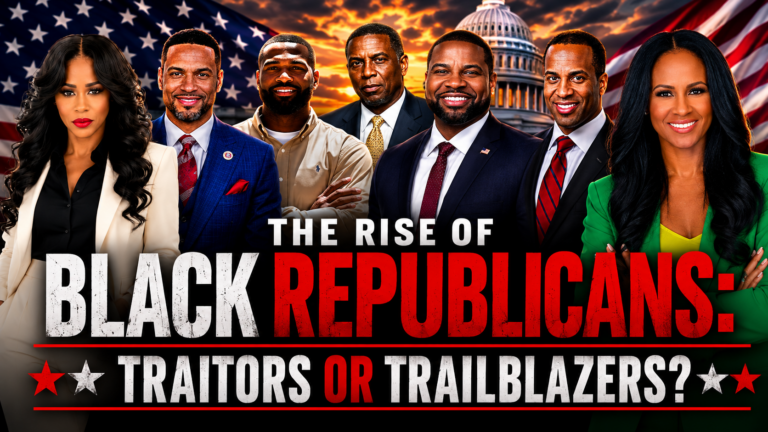
For more than half a century, Black Americans have been one of the Democratic Party’s most dependable voting blocs. Since the passage of the Civil Rights Act of 1964 and the Voting Rights Act of 1965, Democratic presidential candidates have routinely received between 80 and 90 percent of the Black vote, a level of political loyalty unmatched by almost any other demographic group in American politics. That loyalty helped elect presidents, shape Congress, influence state governments, and secure many of the civil rights gains that transformed this country. Yet while that history deserves recognition, it also raises a question that is becoming increasingly difficult to ignore: Has decades of overwhelming political loyalty produced the measurable outcomes Black America expected, or has it reduced the incentive for either major political party to compete aggressively for Black voters?
That question is one reason the growing visibility of Black Republicans deserves serious attention. Across the country, Black Republicans are running for governor, Congress, statewide office, and local government in numbers and with visibility that would have been difficult to imagine a generation ago. Whether they ultimately win or lose, their campaigns are forcing a broader conversation about race, representation, political independence, and the future of Black political power. More importantly, they are challenging a long-held assumption that Black political identity must be tied almost exclusively to one political party.
The rise of Black Republican candidates extends far beyond two campaigns.
Congressman John James is running for governor of Michigan after serving in Congress and previously seeking statewide office. A West Point graduate, Army veteran, and businessman, James has built his campaign around economic growth, educational opportunity, and government accountability.
Congressman Burgess Owens continues to represent Utah in Congress, while Ohio State Representative Josh Williamsis seeking a congressional seat after becoming one of the first Black Republicans elected to the Ohio House in decades. In Michigan, Navy veteran and former law enforcement officer Amir Hassan is also pursuing a seat in Congress.
Looking ahead to 2027, Danielle Carter-Walters is running for mayor of Chicago. Although her election falls outside the 2026 midterms, her campaign represents another example of Black Republicans competing in cities where Democratic dominance has long been considered politically unshakable.
Another candidate drawing attention is Christian Maxwell, the Republican nominee for Illinois’ 1st Congressional District. A business consultant, entrepreneur, and mother, Maxwell is challenging incumbent Congressman Jonathan Jackson in one of the country’s most historically significant Black congressional districts. Her campaign emphasizes economic growth, public safety, parental rights, and family-centered policies. Regardless of the outcome, Maxwell’s candidacy reinforces the broader trend explored in this article: Black Republicans are increasingly competing for office in districts and communities where Republicans have traditionally struggled, further expanding the conversation about political diversity within Black America.
Taken together, these campaigns demonstrate that Black Republicans are no longer isolated exceptions. Whether they ultimately win or lose, they are becoming more visible in American politics and forcing conversations that many political leaders would rather avoid.
The conversation surrounding Black Republicans is rarely limited to policy. For many, it quickly becomes personal. Black conservatives have often described being called “traitors,” “sellouts,” or “Uncle Toms” because of their political affiliation. Their critics argue that supporting the Republican Party undermines Black political interests and ignores the historical relationship between Black America and the Democratic Party during the modern civil rights era. Their supporters respond that no political party deserves permanent ownership of Black votes and that true political independence requires the freedom to disagree without having one’s racial identity questioned.
That is why this article asks a question instead of offering a conclusion. Are Black Republicans traitors to Black America, or are they trailblazers expanding the boundaries of Black political thought? The answer depends largely on one’s understanding of history, one’s evaluation of current political realities, and one’s expectations for the future. It is also a question that deserves thoughtful discussion rather than partisan slogans.
According to the Pew Research Center, approximately 14 percent of Black Americans identify with or lean toward the Republican Party. In comparison, 73 percent identify with or lean toward the Democratic Party, and 13 percent identify with or lean toward neither party. Those numbers make one fact clear. Republicans remain a minority within the Black electorate. They also demonstrate, however, that millions of Black Americans no longer fit the stereotype that Black political thought is unanimous. That reality alone suggests the political landscape is evolving, even if the Democratic Party continues to command overwhelming support among Black voters.
Perhaps no recent campaign illustrates that evolution more clearly than Winsome Earle-Sears’s. In 2025, Earle-Sears had the opportunity to become the first Black woman ever elected governor of any state in American history. She is a Black woman, married to a Black man, raising Black children, and a Marine Corps veteran who built a distinguished public career in Virginia. Yet despite the historic significance of her candidacy, many of the organizations and political leaders who frequently celebrate Black representation showed little enthusiasm for her campaign because she was running as a Republican. The NAACP endorsed her Democratic opponent, Abigail Spanberger, prompting supporters of Earle-Sears to ask a difficult question: If electing the first Black woman governor in American history was not viewed as a historic milestone worth supporting, does Black representation only matter when the candidate belongs to one political party?
The Vote Must Be Earned
Whether Black Republicans are ultimately remembered as traitors or trailblazers will not be decided by television commentators, social media influencers, or political activists. History will make that determination based on something far more important: results.
If these candidates succeed in improving educational outcomes, expanding Black homeownership, creating opportunities for Black-owned businesses, strengthening families, reducing violent crime, and helping Black communities build generational wealth, history may remember them as pioneers who expanded the boundaries of Black political thought. If they fail to deliver meaningful results, history will judge them accordingly. The same standard should apply to Democrats, Independents, and every elected official who asks for the support of Black America.
This article is not an endorsement of the Republican Party or any Republican candidate. Nor is it an argument that Black Americans should abandon the Democratic Party. I am an Independent Freedman, and I believe no political party deserves automatic loyalty. Every candidate should have to earn our vote through character, competence, vision, accountability, and measurable outcomes—not campaign slogans, historical affiliations, or assumptions that our votes belong to them.
Whether people welcome it or not, the political landscape is changing. More Black Republicans are running for office. More Black Americans are identifying as independents. More voters are asking difficult questions about what decades of political loyalty have produced and whether a more competitive political environment could better serve Black communities. That does not mean Black America is abandoning one party for another. It means more Black Americans are insisting that their vote has value and should never be taken for granted.
Perhaps that is the real story behind the rise of Black Republicans. It is not simply about Republicans. It is about political competition. It is about accountability. It is about reminding every elected official, regardless of party, that the Black vote is not owed—it must be earned.
As an Independent Freedman, I have no permanent friends in politics and no permanent enemies. I have permanent interests. My interest is not in electing Republicans or protecting Democrats. My interest is in advancing the constitutional, economic, educational, and civic interests of Black America. If the rise of Black Republicans causes both major parties to compete harder for our votes, present stronger ideas, and produce better results, then Black America—not either political party—stands to benefit the most.
The question, then, is not whether Black Republicans are traitors or trailblazers.
The real question is whether Black America is finally prepared to make every political party earn its vote.
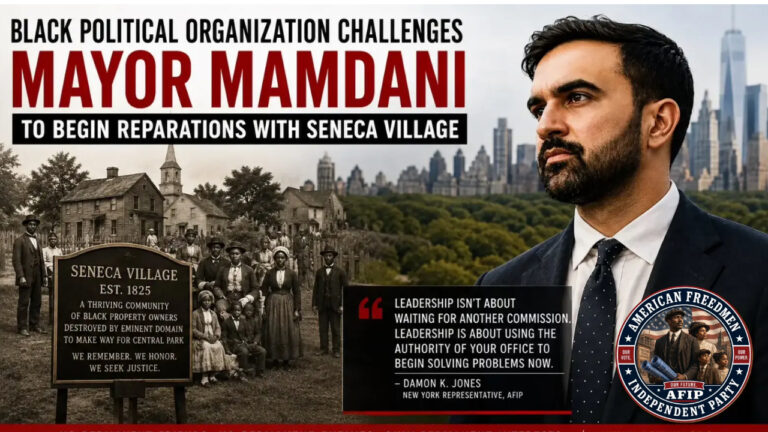
American Freedmen Independent Party Says New York City’s Reparations Effort Should Begin with One of the City’s Most Documented Historical Injustices
The American Freedmen Independent Party (AFIP) is challenging New York City Mayor Zohran Mamdani to move beyond supporting the idea of reparations and begin taking concrete action by addressing one of the city’s most documented historical injustices—the destruction of Seneca Village.
The challenge comes in response to Mayor Mamdani’s recent interview with journalist Charles M. Blow of The Root, during which the mayor said New York City has a responsibility to confront its history of slavery and discrimination. When asked whether he would support cash reparations if recommended by the New York City Reparations Commission, Mamdani declined to make that commitment, explaining that he would wait for the commission’s recommendations before deciding.
AFIP says the mayor does not need another commission to identify where reparative justice should begin.
“Mayor Mamdani is not simply another politician discussing history,” said Damon K. Jones, New York Representative for the American Freedmen Independent Party. “He is the Chief Executive Officer of the City of New York. That office gives him the authority to recommend legislation, direct city agencies, appoint advisory bodies, and use the influence of his office to begin correcting historical injustices committed by the very government he now leads.”
Founded as an independent political club, AFIP advocates for the constitutional, economic, educational, and civic interests of American Freedmen—the descendants of those who were enslaved in the United States. The organization says it is guided by principles and measurable outcomes rather than loyalty to any political party.
“At AFIP, we believe no political party owns the Black vote,” Jones said. “Our responsibility is to hold every elected official accountable based on results, not rhetoric. If a public official says government has a responsibility to repair historical injustices, we expect them to explain how they intend to do that.”
According to the organization, Seneca Village represents one of the clearest examples of government-sanctioned economic harm against Black New Yorkers.
Before Central Park existed, Seneca Village was a thriving community of predominantly Black property owners. Residents owned homes, churches, schools, and businesses, building wealth through land ownership during a time when opportunities for Black Americans were severely limited. In the 1850s, the City of New York used eminent domain to acquire the land, displacing residents and demolishing the community to make way for Central Park.
“The city gained one of the world’s most celebrated public parks,” Jones said. “Black families lost homes, churches, businesses, land, and generations of wealth that should have been passed on to their children. That history has already been documented. The question today is whether New York City’s leadership is prepared to act on it.”
AFIP is calling on Mayor Mamdani to establish a Seneca Village Reparative Justice Initiative that would identify descendants where possible, recommend legislation to the New York City Council, preserve the community’s history, and explore policies designed to repair the economic harm caused by the city’s actions.
Jones said reparative justice should extend beyond symbolic acknowledgment and include policies that promote long-term economic opportunity.
“Reparations should not simply be about acknowledging what happened,” he said. “They should be about restoring opportunities that government helped destroy. That includes strengthening Black homeownership, expanding Black-owned businesses, increasing access to capital, preserving historically Black communities, and rebuilding generational wealth.”
The organization also credited Charles M. Blow for raising the issue of reparations during The Root interview but argued that a key follow-up question was left unanswered.
“Charles M. Blow deserves credit for asking the mayor about reparations,” Jones said. “But the obvious follow-up is this: If you believe New York City has a responsibility to repair historical injustice, what specific actions are you prepared to take today? Leadership isn’t about waiting for another commission. Leadership is about using the authority of your office to begin solving problems now.”
AFIP said its challenge is intended to move the public conversation beyond general support for reparations and toward specific policies tied to documented historical injustices.
“We’re not asking the mayor to abandon the commission,” Jones said. “We’re asking him to lead. Seneca Village is one of the most well-documented examples of Black wealth being taken through government action. If New York City is serious about reparative justice, that’s where the conversation should begin.”
The American Freedmen Independent Party describes itself as an independent political organization dedicated to advancing the permanent interests of American Freedmen through civic education, policy development, leadership training, and voter engagement.
“Our guiding principle is simple,” Jones said. “‘No Permanent Friends. No Permanent Enemies. Only Permanent Interests.’ That’s how we evaluate every elected official and every public policy.”
For more information about the American Freedmen Independent Party or to read the organization’s full statement, visit www.AFIPNY.org.
However, the limited information provided by city officials left Black Westchester—and many concerned residents—with more questions than answers.
After our original report was published, the New York State Police released a more detailed statement regarding the officer-involved shooting. While the latest account answers several of the questions we raised, important questions remain.
You can read the New York State Police’s full statement below.
On July 30, 2026, at about 9:50 p.m., members of the Mount Vernon Police Department responded to an apartment on East Fourth Street to execute a mental health commitment order.
Officers encountered the subject, 58-year-old Ulysses McGhee, who was armed with two knives. McGhee retreated into his apartment, and members of the Mount Vernon Police Department attempted to negotiate with him into the early morning hours. After those efforts were unsuccessful, search and arrest warrants were obtained, and the department’s Emergency Service Unit (ESU) responded.
At about 2:06 a.m. this morning, ESU members breached the door to the apartment and encountered McGhee, who was still armed with the knives. Officers attempted to subdue McGhee using less-lethal measures, including Tasers and beanbag rounds, which were not effective, and one officer discharged their firearm, striking McGhee.
McGhee was transported to Jacobi Medical Center in the Bronx, where he remains in critical condition.
The officer who discharged the firearm was transported to New York-Presbyterian Westchester for evaluation. No injuries to that officer were reported. A second Emergency Service Unit officer was treated for an ear injury sustained during the incident.
At the request of the Mount Vernon Police Department, the New York State Police is conducting the investigation. The investigation remains ongoing, and additional information will be released as it becomes available.
After the statement released by the NYS Police, Kenneth Chamberlain Jr, son of Kenneth Chamberlain Sr who was murdered by the White Plains police shared how this incident is painfully familiar.
“While every case is different and must be judged on its own facts, there are troubling similarities that cannot be ignored.
Once again, we have a person reportedly experiencing a mental health crisis, negotiations taking place, and an encounter that ended in the use of deadly force.” Chamberlain Jr shared with Black Westchester.
Stay tuned to Black Westchester for the latest developments. Continue checking back and refreshing this page, as we will update this story whenever new information becomes available.
MOUNT VERNON — A Mount Vernon police officer shot 58-year-old Ulysses McGhee, who was armed with two knives and had barricaded himself inside an apartment during an apparent mental health crisis Thursday night, according to police.
Members of the Mount Vernon Police Department’s (MVPD) Emergency Services Unit (ESC) responded shortly before 10 p.m. to serve court-ordered mental health commitment papers at an apartment near Columbus Avenue and East Fourth Street.
Police said the man was armed, refused to comply with the order, and barricaded himself inside the apartment. Hostage negotiators and mental health professionals attempted to de-escalate the situation, while officers also used non-lethal methods without success.
According to a statement released by the City of Mount Vernon, upon arrival, ESU officers encountered an armed individual who refused to comply with the court order or be taken into custody. Officers immediately employed non-lethal tools in an effort to safely gain compliance. Those efforts were unsuccessful, and the individual subsequently barricaded himself inside the apartment.
Hostage negotiators and the Mount Vernon Police Department’s Wellness Division were then called to the scene. For several hours, hostage negotiations, de-escalation techniques, and wellness interventions were utilized in an effort to execute the commitment order. Despite these sustained efforts, the individual remained noncompliant.
After obtaining a warrant and exhausting negotiation efforts, at about 2:06 a.m., ESU officers entered the apartment. Police said the man continued threatening to harm himself and responding officers. After additional non-lethal efforts failed, an officer discharged a firearm.
McGhee was transported to Jacobi Medical Center in the Bronx for treatment. His condition was not immediately released.
While this may ultimately prove to have been a justified shooting, the statement released by the City of Mount Vernon was vague and left many residents with more questions than answers.
We understand the city’s need to acknowledge the incident and get ahead of the story. However, when officials are intentionally vague about a police shooting, they create an information vacuum. That vacuum is quickly filled with speculation, social-media commentary and people rushing to judgment before all the facts are known.
Kenneth Chamberlain Jr., co-founder of the Westchester Coalition for Police Reform, cautioned against doing exactly that when he spoke with Black Westchester. He stressed the importance of waiting for a thorough, independent investigation before reaching conclusions, while also recognizing that transparency from public officials is essential to maintaining the community’s trust.
“I don’t think anyone should be rushing to judgment, but if you read the department’s statement, it raises more questions than it answers,” Chamberlain Jr shared with Black Westchester. “We know there was a mental health response, we know negotiations took place, and we know an officer discharged their firearm. What we don’t know are the circumstances that led to that decision, which is why transparency is so important. Far too often, people pick a side before they know the facts. If the facts support the actions that were taken, then let the facts speak, but if they don’t, then accountability must follow.”
Statement by officials leaves residents with more questions than answers
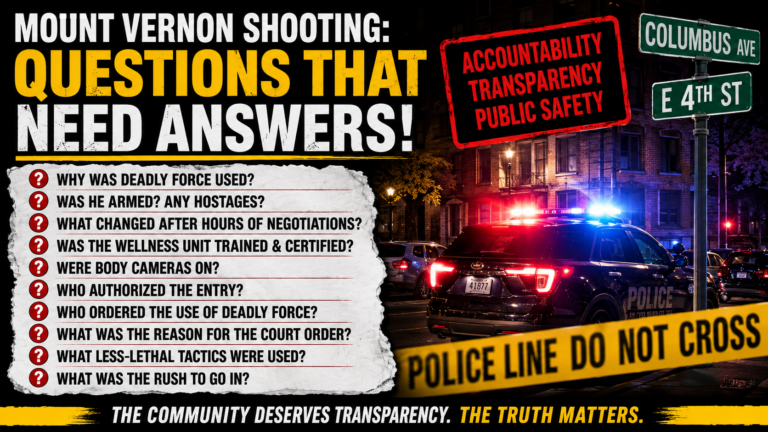
As the New York State Police investigates Thursday night’s officer-involved shooting during a court-ordered mental health response in Mount Vernon, several important questions deserve clear answers. These questions are not intended to assign blame or reach a premature conclusion. They are necessary to promote transparency, accountability, and public understanding.
Was the individual armed? If so, what type of weapon did he possess, and what immediate threat did it present to officers, other occupants, or the public? If he was unarmed, what specific actions led officers to believe deadly force was necessary? Sources have told us that after the first posting, the individual was armed with two knives, but we have not been giving confirmation from MVPD.
Was anyone else in immediate danger? Reports indicate that the individual had barricaded himself inside an apartment. Were there hostages or other occupants inside? If no one else was at risk, what circumstances made an immediate entry necessary? We were able to confirm he was alone; his family was there, but they were outside.
What role did the Mount Vernon Police Department’s Wellness Division play? If crisis negotiators, mental health professionals, and Wellness Division personnel had been working to resolve the situation peacefully, what changed? Why did the response move from negotiation and de-escalation to forced entry?
Why didn’t the Mount Vernon Police Department request assistance from Westchester County’s Project Alliance for crisis intervention? Project Alliance was created in the aftermath of the 2011 fatal shooting of Kenneth Chamberlain Sr. by White Plains police to provide specialized crisis response and de-escalation services. Based on the initial reports, this incident appears to be similar to the circumstances surrounding Mr. Chamberlain’s case. If that is true, why wasn’t Project Alliance activated or consulted before the situation escalated to the use of deadly force?
What crisis-intervention training had the responding officers received? Were members of the Wellness Division and Emergency Services Unit certified in Crisis Intervention Team training or another recognized de-escalation program? Who provided that training, and how frequently is it renewed?
Who made the decision to enter the apartment? Was the entry authorized by the incident commander, a supervising officer, or another official? What information and risk factors were considered before that decision was made?
What happened at the moment deadly force was used? Police officers generally do not wait for a separate command authorizing them to fire when they believe an immediate threat exists. Therefore, the public deserves to know which officer discharged the weapon, what threat that officer perceived, and whether the shooting was consistent with departmental policy and state law.
Were the officers’ body-worn cameras activated? If so, was all footage properly preserved, and will it be released in accordance with state law and departmental policy? Body-camera footage may provide crucial context that a written statement cannot.
What is the individual’s current condition? Is he still alive? How many times was he shot, and where on his body was he struck? As of the latest publicly available information, the City of Mount Vernon reported that the man was transported to a local hospital and was in stable condition, which indicates he was alive when that update was issued. However, officials have not publicly disclosed how many times he was shot, where he was struck, the extent of his injuries or whether his condition has changed since then. Those details are not insignificant. They could help the public better understand the level of force used, the nature of the perceived threat and what occurred when officers entered the apartment. Until the New York State Police or the City release more information, those questions remain unanswered.
What specific less-lethal methods were attempted? Police said non-lethal tactics were used before the officer fired. What tools or techniques were deployed, how many times were they attempted, and why did they fail? Mental health calls are among the most difficult and unpredictable situations officers face. They require officers to balance compassion, public safety and the safety of the person experiencing the crisis. That is precisely why transparency is essential.
Lastly and not least: Did the MVPD follow the recommendation of the DOJ Investigation
A thorough and independent investigation must answer not only what happened, but why officers made the decisions they made. Until those answers are provided, the public should avoid rushing to judgment—but the City of Mount Vernon must also understand that vague statements only create more questions, speculation, and distrust.
This is not the first time a resident experiencing a mental health crisis has been shot by the Mount Vernon Police Department. In 2014, Anthony Smith was shot multiple times during a mental health-related incident. More than a decade later, the public deserves to know: What lessons have been learned? What policies, training, or crisis intervention protocols have been implemented since then to prevent another tragedy? And if changes were made, why did this situation still end with the use of deadly force?
Black Westchester Magazine has previously reported that the U.S. Department of Justice’s 2024 investigation found systemic deficiencies within the Mount Vernon Police Department, including concerns involving training, supervision, accountability, and departmental policies. In fact, several findings in the DOJ report make these questions even more relevant—not because they prove anything about this incident, but because they identify systemic issues that warrant additional scrutiny. Those findings reinforce why the public deserves transparency and clear answers as the New York State Police conduct their independent investigation.
Stay tuned to Black Westchester for the latest developments. Continue checking back and refreshing this page, as we will update this story whenever new information becomes available.
****Update**** After our original report was published, the New York State Police released a more detailed statement regarding the officer-involved shooting. While the latest account answers several of the questions we raised, important questions remain. You can read the New York State Police’s full statement here.