




Governor Kathy Hochul and New York lawmakers are promoting a series of housing reforms designed to address the state’s housing crisis. The goal is straightforward: increase the supply of housing by speeding up development approvals, reducing regulatory barriers, encouraging local governments to approve new projects, and investing billions of dollars into affordable housing construction.
State officials argue that New York has not built enough housing for decades, leading to rising rents, soaring home prices, and a shortage that has pushed many working families out of the market. On that point, they are largely correct. Housing supply is a real problem.
But there is another question that receives far less attention.
Will these reforms create homeowners, or will they simply create more renters?
That distinction matters because the housing crisis and the wealth crisis are not necessarily the same thing.
Much of what Albany describes as “affordable housing” consists of rental units. These developments may provide lower-cost apartments, preserve existing affordable rentals, or create mixed-income housing complexes. They may help families remain in their communities and avoid displacement. Those are worthwhile goals.
However, affordable housing is not the same as affordable ownership.
A family can spend thirty years in an affordable apartment and still have no assets to pass on to their children. They can pay rent every month, contribute to the tax base, and work hard their entire lives while building equity for a landlord. Homeownership, by contrast, creates wealth. It allows families to build equity, leverage assets, accumulate net worth, and transfer wealth from one generation to the next.
This is where many working families are being left behind.
Consider a single mother who is a nurse practitioner in Westchester County. She has done everything society told her to do. She pursued higher education, built a professional career, earned a respectable income, and contributed to her community. Yet she may still struggle to purchase a home when many properties in Westchester sell for $700,000, $800,000, or even more than $1 million. When mortgage rates, property taxes, insurance costs, childcare expenses, and student loan obligations are factored in, homeownership can remain out of reach even for members of the professional class.
If a nurse practitioner struggles to buy a home, what does that mean for teachers, correction officers, municipal workers, social workers, healthcare aides, and countless other middle-income families?
The answer is obvious. Many of them are being pushed permanently into the rental market.
The consequences are particularly severe for Black New Yorkers because homeownership has long been one of the primary ways families build and transfer wealth. Yet New York already has a serious Black homeownership problem. According to data from the New York State Comptroller, only about one-third of Black households in New York own their homes, compared to roughly two-thirds of White households. In New York City, Black homeownership is even lower, hovering around one-quarter of households. These numbers represent more than a housing gap. They represent a wealth gap.
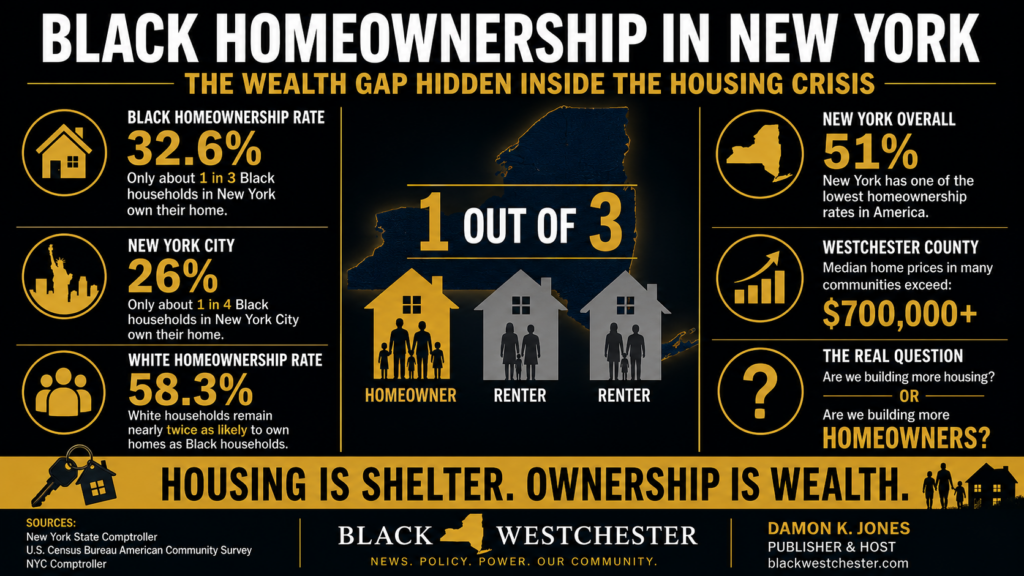
When only one in three Black households statewide owns a home, the conversation should not simply focus on creating more housing units. The conversation should focus on increasing the number of homeowners. In a state where most Black families remain, renters face a challenge that extends far beyond housing policy. It is a challenge of wealth creation, economic mobility, and generational opportunity.
This is why New York’s housing debate needs to become more sophisticated. The conversation cannot stop at the number of units being built. Politicians often announce housing projects as if every new unit represents economic progress. But from a wealth-building perspective, the type of housing matters just as much as the quantity.
A city can build thousands of affordable apartments while simultaneously producing very few new homeowners.
For communities concerned with wealth creation, the most important metrics should not be simply how many housing units were approved or how many apartments were constructed. The real measure of success should be how many first-time buyers purchased homes, how many working families moved from renting to owning, and how many children will inherit property rather than housing insecurity.
This issue is especially important in communities such as Mount Vernon, Yonkers, New Rochelle, and other parts of Westchester County, where rising housing costs continue to make homeownership more difficult. The challenge facing these communities is not merely finding a place to live. The challenge is creating pathways to ownership that allow families to build long-term wealth.
For decades, political leaders have measured success by the number of affordable housing units created. Yet affordable housing and wealth building are not the same thing. A family living in a subsidized apartment may have a roof over its head, but it is not necessarily building equity. A homeowner, on the other hand, has the opportunity to benefit from appreciation, borrow against an asset, start a business using home equity, or leave property to the next generation.
That is why many Black families are asking a different question than Albany policymakers.
They are not asking where they can rent.
They are asking where they can buy.
The current reforms may increase housing supply. They may ease some pressure on rents. They may help address shortages. But they are not primarily designed to create a new generation of homeowners.
That is the conversation Albany has largely avoided.
New York does not simply need more housing. New York needs more ownership. It needs starter homes that working families can afford. It needs stronger support for first-time homebuyers. It needs policies that make it easier for middle-income families to purchase homes rather than compete against institutional investors and rising prices. It needs to ask why a nurse practitioner, a teacher, a police officer, or a municipal employee can earn a respectable income and still find homeownership out of reach in many communities.
Because at the end of the day, housing policy should not be measured solely by how many people are housed. It should also be measured by the number of people building wealth.
The real question facing New York is not whether it can build more apartments. The real question is whether it can build more owners.
Until that happens, the state’s housing reforms may succeed in creating more housing units while failing to solve the deeper problem of wealth creation. And for Black New Yorkers, a state where only one in three households owns a home does not merely have a housing problem.
It has a wealth-building problem.