








By Larnez Kinsey
Westchester County, let’s be very clear about something: when we talk about opportunity, we cannot pretend it lands evenly. It doesn’t. Not in a county where Metro-North can take you from Yonkers to Grand Central in under 35 minutes, yet access to elite academic pipelines can still feel miles away depending on your zip code. That is the contradiction, and it is exactly the kind of gap Environmental Leaders of Color (ELOC) is working to close.
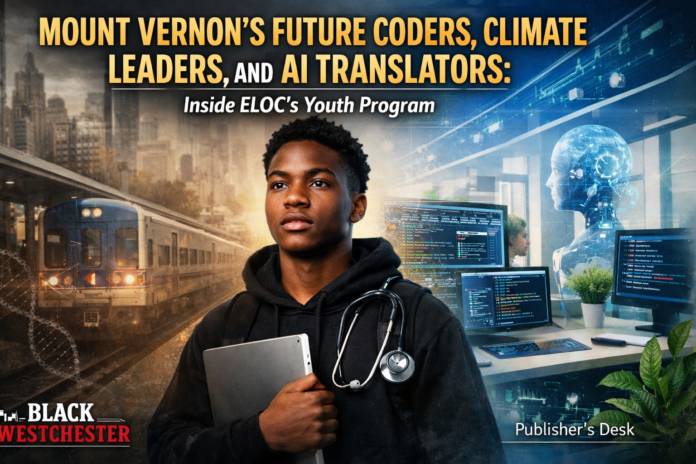
Based in Mount Vernon, the nonprofit has built a reputation for connecting environmental justice, technology education, and youth leadership across Westchester County. Through programs that introduce students to artificial intelligence, coding, environmental science, and workforce development, ELOC is preparing young people for a future defined by technology and global challenges. And now the organization is helping connect local students to a powerful new opportunity, a national HBCU-centered pathway into careers in medicine and dentistry. Because talent is everywhere, but exposure is not.
On February 20, 2026, ELOC, under the leadership of Board Chair Talbert Thomas, announced a competitive national opportunity for high school seniors interested in pursuing careers in medicine or dentistry through an HBCU-based academic track. The opportunity was brought directly to ELOC by Board Member Dr. Keith C. Norris, a professor at the University of California, Los Angeles and a graduate of Howard University College of Medicine. Dr. Norris is internationally recognized for his work in chronic kidney disease research and advancing health equity, and his career reflects the power of the HBCU educational pipeline, from Howard-trained physician to national leader in medicine and research. When he identifies a program as an exceptional pathway for future healthcare professionals, it carries weight. This is not simply about college admission. It is about structured preparation for competitive careers in healthcare, built within the unique academic and cultural environment of an HBCU.
An HBCU experience is not just about campus tradition. It is about academic rigor with high expectations, cultural affirmation without apology, faculty mentorship grounded in lived understanding, leadership development rooted in legacy, and a powerful alumni network spanning medicine, research, public policy, and public health. For many students, HBCUs provide an environment where identity is not an obstacle but a foundation. For others, it is about focused preparation and strong mentorship within a supportive academic community. Either way, historically Black colleges and universities have produced generations of leaders across industries, including medicine and dentistry, and as Dr. Norris’ career demonstrates, that pipeline works.
Westchester is a county of contrasts, filled with top-ranked school districts and corporate headquarters, waterfront developments in New Rochelle, and historic neighborhoods throughout the region. It is also a place where some schools have advanced STEM labs while others offer far fewer advanced technology courses. Across the county, there are seniors who meet the eligibility benchmarks of a 3.5 GPA, a 1310 SAT or 28 ACT score, and current high school senior status. The excellence is here, but not every student has equal exposure to accelerated healthcare pathways, especially those tied to the HBCU experience. That is not about ability. It is about information flow, and information flow can determine life trajectory.
ELOC’s work goes beyond connecting students to academic opportunities. The organization is also preparing young people for the rapidly evolving technology landscape. Through its youth programming, students learn coding, environmental science, and digital data tools that are reshaping industries worldwide. In many ways, today’s students must become bilingual in artificial intelligence. Just as earlier generations had to learn the language of the internet, the next generation must learn how to work alongside AI systems that are transforming fields from healthcare to environmental research. Doctors increasingly rely on predictive diagnostics powered by machine learning, environmental scientists analyze climate data using advanced algorithms, and public health researchers depend on digital modeling tools. Understanding these technologies will be essential for tomorrow’s workforce, and programs like ELOC’s ensure that students are not just consumers of technology but creators and leaders in the industries shaping the future.
What sets ELOC apart is its ability to connect technology education with environmental leadership. Students in the program explore real issues affecting their own communities, including urban heat islands, air pollution patterns, water quality concerns, and climate impacts on local neighborhoods. Using tools like geographic information systems and digital data platforms, they learn to analyze environmental challenges and develop community-driven solutions. There is a guiding principle behind that work: the people closest to the challenges are often the ones closest to the solutions. By giving students the technical knowledge to analyze environmental data and the leadership skills to advocate for change, ELOC is cultivating the next generation of environmental and technology leaders.
ELOC’s work is gaining increasing recognition across the region. On February 14, 2026, the organization was featured in Westchester Magazine for its efforts to expand access to artificial intelligence and computer science education for young people. The coverage reinforced its growing role as a leader in equitable STEM education and youth leadership development. Since its founding, ELOC has graduated more than 500 students and continues to train over 100 students each year through its environmental leadership initiatives. That is not just a program. It is a pipeline.
For students interested in the HBCU healthcare pathway, the application deadline is March 30, 2026.


It’s important to address those uneven opportunities, especially with such easy access to the city nearby.