


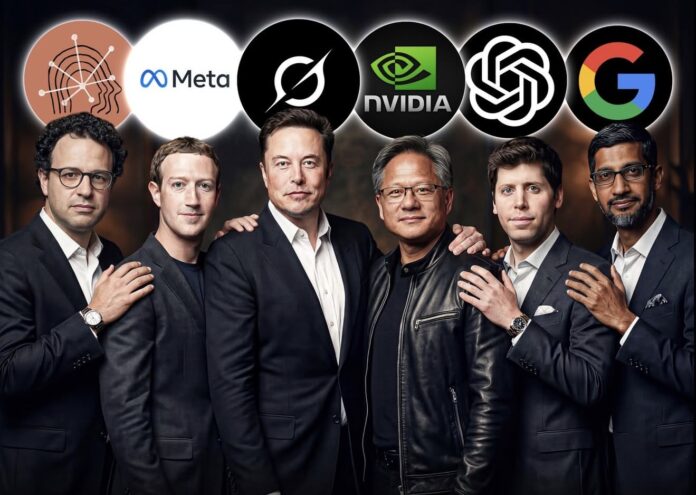





The question being asked across boardrooms, classrooms, and political circles is whether we are ready for the AI economy.
That question assumes preparation is a matter of awareness.
It is not.
Preparation is a matter of position.
And by that standard, most people are not ready—especially not the communities that have historically been positioned at the bottom of every major economic shift in American history.
The AI economy is not a future event. It is a present reality. The companies shaping it—Google, Microsoft, Nvidia, Meta, OpenAI, Anthropic, and xAI—are not experimenting. They are deploying. They are scaling. And more importantly, they are consolidating control.
This is not the first time America has experienced a technological shift. The Industrial Revolution replaced manual labor with machines. The Information Age replaced factory work with knowledge work. Each time, those who owned the tools prospered, and those who supplied only labor were forced to adapt—or were left behind.
Artificial intelligence represents a third shift. But unlike previous transitions, this one is moving at a speed that does not allow for generational adjustment. It is happening in real time.
The conversation around AI is often framed in terms of innovation and opportunity. But economics is not driven by intentions. It is driven by incentives and outcomes.
AI reduces the need for labor.
That is not speculation. It is the business model.
Companies are not investing billions of dollars into artificial intelligence to create more jobs. They are investing to increase efficiency, reduce costs, and eliminate redundancies. When a machine can perform the work of ten people faster and cheaper, the economic incentive is clear.
This does not mean all jobs will disappear. It means the value of certain skills will decline rapidly. Writing, coding, customer service, and research—fields once considered stable—are now being automated at scale.
What replaces them is not simply new jobs, but a new hierarchy.
In the AI economy, value shifts from those who do the work to those who own the systems that do the work.
That distinction is critical.
Much of the current excitement around AI focuses on usage—how individuals can use tools like ChatGPT, Claude, or Grok to improve productivity. But using a tool is not the same as owning the system that generates value.
A worker who uses AI may become more efficient.
An owner who deploys AI becomes more profitable.
Those are not the same outcomes.
History offers a clear lesson. During the rise of industrial capitalism, workers who learned to operate machines improved their wages temporarily. But the long-term wealth was accumulated by those who owned the factories.
Today, the “factories” are digital.
They are powered by Nvidia chips, hosted on Microsoft Azure and Amazon Web Services, and trained by companies like OpenAI, Google, and Anthropic. These systems are not being built in local communities. They are being built in centralized hubs of capital and control.
This concentration matters.
Because when power is concentrated, opportunity is not evenly distributed.
There are now hundreds of thousands of AI-related companies worldwide. But the overwhelming majority of influence, capital, and infrastructure is controlled by a small group of firms. This is not a decentralized revolution. It is a consolidation.
What makes this moment different is that artificial intelligence is not only reshaping digital work. It is beginning to reshape physical infrastructure as well.
One of the clearest examples of this is energy.
For years, nuclear power has been treated as a political liability. Concerns over safety, cost, and public perception pushed it to the margins of long-term energy planning. But artificial intelligence is changing that calculation in ways that have little to do with politics and everything to do with demand.
AI systems require enormous amounts of electricity. Data centers powering these models operate continuously, processing vast amounts of information without interruption. This level of demand cannot be met by aspiration. It must be met by reliable energy.
Artificial intelligence is now being used to monitor reactor performance, predict mechanical failures before they occur, and optimize output with a level of precision that was not previously possible. In economic terms, it reduces uncertainty.
And when uncertainty is reduced, investment follows.
What was once considered too risky or too expensive becomes viable again.
Nuclear energy, once in decline, is now being reconsidered not as an alternative, but as a necessity for sustaining the AI economy. This is not a shift driven by environmental idealism. It is driven by economic reality.
Solar and wind have their place, but they are intermittent. Artificial intelligence does not operate intermittently. It requires consistent, uninterrupted power.
That requirement is forcing a reevaluation of the entire energy landscape.
And it reveals something deeper about the nature of technological change.
Revolutions in one sector do not remain contained. They expand outward, reshaping industries that appear unrelated. AI is not just changing how people work. It is changing what powers the work.
For Black Americans, the importance of this moment cannot be overstated.
Every major economic shift in this country has produced winners and losers. And too often, Black communities have entered those shifts late, without ownership, without control, and without a strategy rooted in economic outcomes.
After slavery, Black Americans built independent economies—land ownership, businesses, and institutions. But over time, integration without economic control led to participation without power. The result was access without ownership.
The AI economy threatens to repeat that pattern at a much faster pace.
Because this time, the barrier is not just physical capital. It is intellectual capital, technical infrastructure, and system ownership.
If Black Americans approach AI only as users—asking questions, generating content, improving resumes—then the benefits will remain limited.
But if the approach shifts to ownership—building platforms, automating businesses, creating AI-driven services, and controlling digital assets—then the outcomes change entirely.
This is why readiness matters.
It is not about keeping up with technology. It is about not being locked out of the wealth it creates.
AI is projected to generate trillions of dollars in economic value. But wealth does not distribute itself. It flows to those who build, own, and control.
Without intentional positioning, the gap between those who own AI systems and those who are replaced by them will widen.
That gap will not be explained by discrimination alone. It will be explained by economics.
Education systems are not preparing young people for this reality. They are still training students for jobs that are being automated, rather than teaching them how to build within the systems that are replacing those jobs.
This creates a dangerous illusion of progress.
People believe they are preparing for the future, when in reality, they are preparing for a past that no longer exists.
It is often said that technology is neutral. That is true in a narrow sense. But the outcomes produced by technology are not neutral. They reflect the distribution of knowledge, capital, and decision-making power.
If AI continues to develop under the control of a small number of corporations, the benefits will accrue primarily to those corporations and their shareholders.
That is not pessimism. That is precedent.
The question, then, is not whether AI will create wealth. It will.
The question is who will own it.
Communities that approach AI as consumers will benefit differently than those who approach it as producers.
Communities that learn to use AI will see incremental gains.
Communities that build systems on top of AI will see exponential ones.
There is a difference between adapting to an economy and shaping it.
At present, most people are focused on adaptation.
That may not be enough.
The AI economy is not simply another industry. It is an infrastructure that will influence every industry—healthcare, education, finance, media, and beyond.
To be unprepared for it is not to miss an opportunity. It is to risk irrelevance in the systems that determine economic outcomes.
For Black America, that risk carries a historical weight.
Because the cost of being late to an economic shift is not just lost income.
It is lost influence, lost ownership, and lost control over the future.
So, are we ready?
If readiness is defined by awareness, then perhaps.
If readiness is defined by ownership, control, and strategic positioning, then the answer is far less certain.
And in economics, it is not awareness that determines outcomes.
It is position.