


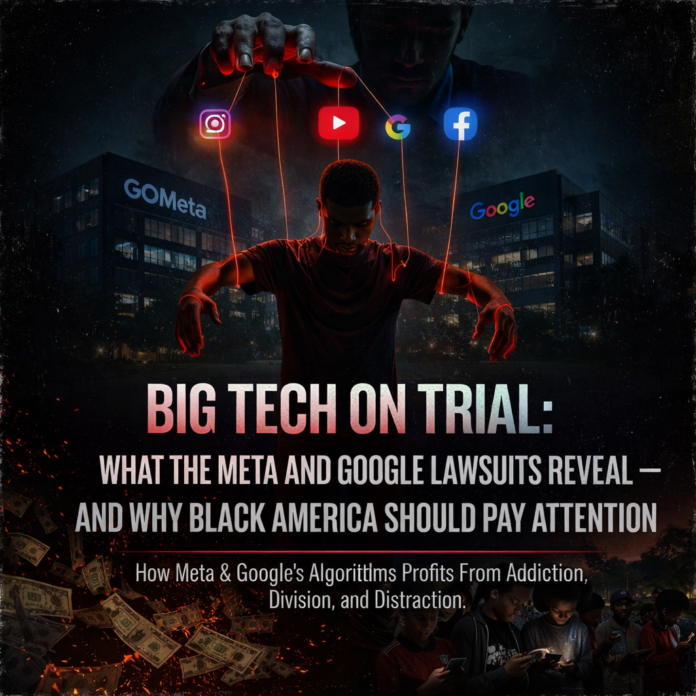





There is a growing belief that the lawsuits against Big Tech represent accountability. That, finally, companies like Meta Platforms and Google are being forced to answer for the damage they have caused.
That belief is premature.
What we are witnessing is not a restructuring of power, but a negotiation over consequences. The courts are beginning to acknowledge harm, but they have not yet imposed outcomes that fundamentally change behavior. And if history is any guide, Black America will once again feel the consequences of that gap between recognition and action.
The recent $375 million judgment against Meta in New Mexico for failing to protect children from exploitation is being called historic. But historic compared to what? Meta generates over $100 billion in annual revenue. A fine of that size is not a correction. It is a cost of doing business.
Google, on the other hand, is a search monopoly. That is a significant legal finding. But what followed was not a breakup, not a restructuring, but limited remedies that leave its dominance largely intact. A monopoly that remains in place is not a solved problem. It is a recognized problem without enforcement.
This pattern is not new.
Black America has seen this before.
When cigarettes were marketed aggressively in Black communities, it took decades before meaningful legal action occurred. Even then, the result was not the dismantling of tobacco companies, but settlements that allowed them to continue operating while shifting public messaging. The damage—addiction, cancer rates, generational health decline—was already done.
When liquor stores were concentrated in urban neighborhoods, the issue was framed as access and demand rather than long-term outcomes. The result was not fewer stores, but normalization of overexposure.
When pharmaceutical companies flooded communities with opioids, lawsuits followed. Billions were paid in settlements. Yet the communities most affected are still dealing with the aftermath—addiction, broken families, and economic instability.
Now we are watching the same cycle unfold with digital platforms.
The harm is different in form, but similar in structure.
Algorithms reward outrage, conflict, and emotional instability because those behaviors drive engagement. Engagement drives advertising revenue. The longer a user stays on the platform, the more profitable they become. This is not speculation. This is the business model.
For Black users, particularly Black youth, the outcomes are measurable and ongoing, underscoring the persistent digital exploitation that demands urgent attention.
Higher exposure to violent content.
Higher exposure to hypersexualized imagery.
Higher exposure to conflict-driven narratives about race, gender, and identity.
And most importantly, lower exposure to content that produces economic advancement, skill development, or ownership.
This is not about intent. It is about incentives.
A system designed to maximize engagement will not prioritize stability. It will prioritize whatever keeps attention. And in many cases, what keeps attention is dysfunction.
The lawsuits currently moving through the courts—focused on youth addiction, mental health, and platform design—are beginning to expose this reality. But exposure is not the same as correction.
Even when Meta or Google face legal losses, the outcomes tend to be financial penalties rather than systemic reform, highlighting that lawsuits alone rarely drive the structural change needed for true accountability.
No major platform has been forced to change its algorithm at scale.
No major executive has been held personally accountable.
No dominant platform has been broken up despite findings of monopoly.
The result is predictable.
The behavior continues.
This is where Black America must shift its thinking.
The question is not whether Big Tech is harmful. The courts are already beginning to answer that. The real question is whether relying on lawsuits will produce protection.
History suggests otherwise.
Legal victories without structural change tend to arrive after the damage is widespread. They compensate for harm already done, but they rarely prevent future harm. And communities with the least economic leverage are often the last to recover.
If the incentive structure remains unchanged, the outcomes will remain unchanged.
That is the pattern.
The solution, therefore, must go beyond regulation to inspire a sense of agency-ownership of platforms and control over content are essential for meaningful change.
Ownership of platforms.
Control over content distribution.
Intentional use of technology for economic gain rather than passive consumption.
Because in the absence of control, participation becomes exposure.
And exposure, when driven by someone else’s incentives, rarely produces long-term benefit.
The lawsuits against Meta and Google are not meaningless. They are signals. They show that the system recognizes a problem.
But recognition alone is not reform, and this reality should motivate us to pursue deeper, structural change rather than rely solely on legal victories.
And if Black America waits for the courts to solve a problem rooted in incentives, it will be waiting after the next generation has already paid the cost.