


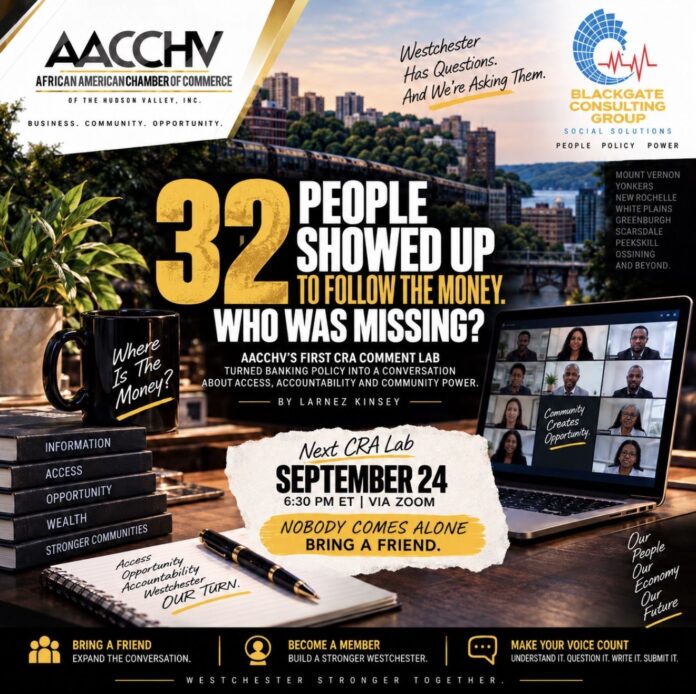




Thirty-two people logged onto Zoom Thursday night for the first African American Chamber of Commerce of the Hudson Valley CRA Comment Lab, presented in partnership with BlackGate Consulting Group LLC. People had worked all day. Some were running businesses. Some were leading nonprofits. Some were balancing families, community responsibilities, and everything else life asks of us.
Still, at 6:30 at night, they made time to learn about something most people aren’t discussing at the cookout, beauty salon, barbershop, church, networking breakfast or kitchen table: The Community Reinvestment Act. But once we stripped away the government language, CRA started sounding a whole lot like Westchester. It sounded like the entrepreneur in Mount Vernon who has been in business for years but still doesn’t understand what makes them “bankable.”
The Yonkers business owner hearing about millions being committed to small businesses but wondering where the application is. The nonprofit leader doing real work in the community but trying to figure out how organizations actually get connected to community-development dollars. And the first-time homebuyer watching the cost of living climb while wondering what resources exist for them. Suddenly, CRA wasn’t just banking policy.
It became a familiar question: Where is the money? And then the better questions followed: Where did it go? Who qualified? Who benefited? How do I access it? And where can I see the information for myself?
THE NUMBERS EXPLAIN WHY THIS LAB WAS NEEDED
Before the Lab, 18 registrants completed our initial data collection. 83.3% had never submitted a federal public comment. At the same time, 88.9% rated improving banking access and financial resources in their communities as highly important. That gap caught my attention. People care deeply about what happens economically in their communities, yet many have never been shown how to participate when policies affecting those systems are actually being considered. Sometimes what gets labeled as disengagement isn’t disengagement. Sometimes nobody showed you the door. That’s what this Lab was designed to change.
WE DIDN’T NEED ANOTHER PANEL
Westchester knows how to do panels. We know how to put people behind tables, pass microphones, take pictures in front of step-and-repeats, and announce millions of dollars in economic development. I’m interested in what happens after the announcement. If a bank says it supports small businesses, what does “support” mean?
If community-development dollars are available, where does someone find them? What qualifies? Who received the investment? And could a new business owner or nonprofit without an insider relationship find the same opportunity? Access isn’t truly access if you need somebody’s private cell number to find the front door. That’s why this was a Lab.
Participants weren’t there simply to listen. We broke CRA down into plain language, connected it to real experiences, and gave people a framework for developing their own public comments. We weren’t telling anyone what to think. We were helping people understand enough to decide what they think and articulate why.
“I GOT DENIED.” BUT DO YOU KNOW WHY?
That question became one of the most tangible parts of the conversation. A business owner can submit an application, provide documents, wait, and eventually receive a denial. But what happens next? Do you understand what part of your financial profile didn’t meet the lender’s requirements? Was it credit? Cash flow? Debt? Time in business? Documentation? What would need to change before you applied again?
A denial can close a door. Information can tell you which door to try next. CRA doesn’t guarantee anyone a loan, and we were careful not to suggest that it does. What it gives us is another framework for examining how financial institutions are helping meet community credit needs. And once people understand the framework, the conversation changes. Instead of only saying, “Nobody is helping us,” we can begin asking specific, informed questions about lending, investment, access, and outcomes. That is where economic literacy starts becoming economic agency.
THEN THERE WAS ANOTHER NUMBER: ZERO
A number of elected officials were invited to join us. None attended. I don’t know why each person couldn’t attend, and I’m not going to manufacture motives. Elected officials have schedules, constituent responsibilities, and competing commitments. But I won’t pretend I didn’t notice the contrast either. Thirty-two people found the time.
Business owners came. Nonprofit leaders came. Community members came. People who had never participated in a federal public-comment process came because they wanted to understand something that could affect their communities. I would like to see elected leadership in those rooms too. Not necessarily giving a speech. Listening. Because sometimes leadership is hearing a business owner say, “I’ve been trying to access capital, and I still don’t understand what I’m doing wrong.”
Sometimes it’s hearing a nonprofit leader ask, “Everybody says community-development resources exist. Where do we find them?” Economic development isn’t only standing beside a giant check once the money has been awarded. It’s also making sure the people you represent can find the opportunity before the money is gone. So to the elected officials who couldn’t make the first conversation, the invitation remains open. Come September 24. No podium necessary.

SEPTEMBER 24: NOBODY COMES ALONE
Our next CRA Comment Lab is Thursday, September 24 at 6:30 PM ET, ahead of the October 13 public-comment deadline. And this time, I have one request: Bring somebody. Bring the sister trying to expand her catering business. Bring the brother buying equipment for his company out of his own pocket. Bring the nonprofit founder doing community work while trying to figure out how to fund it.
Bring the young entrepreneur building something from their phone. Bring your neighbor. Bring your elected official. Bring the person who keeps hearing about millions of dollars being invested and quietly wondering: “Okay… but how do I get to it?” If 32 people came the first time, let’s put 64 in the next room. Not for optics. For information.
Because one person learns something and tells another business owner. A nonprofit leader takes it back to their board. Somebody shares it at church. Someone tells their neighbor. That’s how information starts moving through a community instead of remaining concentrated among the people who already know where to look.
IF THIS MATTERS TO YOU, BUILD WITH US
And if you believe these conversations need to continue, I encourage you to become a member of the African American Chamber of Commerce of the Hudson Valley, email Info@aacchudsonvalley.org or call 845-570-2367.
A Chamber should be more than business cards and networking events. It should help shorten the distance between people and opportunity. Between businesses and resources. Between community needs and institutions with capital. Between hearing that money exists and knowing where to start looking for it.
We cannot keep asking, “Who’s building something for us?” without eventually asking: “What are we willing to build together?” The stronger that network becomes, the more information we can circulate and the more people we can bring into these conversations. Access should create more access, not ownership of the doorway.
THE ZOOM WASN’T THE WIN
Thirty-two people attending matters. But attendance isn’t the outcome I’m most interested in. We are still collecting our post-Lab impact surveys and public-comment submission receipts. Remember: 83.3% of the people who completed our initial survey had never submitted a federal public comment before.
So now I want to know: How many did? How many people understood CRA better? How many now feel more confident asking financial institutions questions? How many put their experience and recommendations into the federal record for the first time?
Because success isn’t being able to say: “We had a great Zoom.” Success is somebody entering that room thinking: “I don’t understand any of this.” And leaving knowing: I know what to ask. I know where to look. And I know my voice belongs in this conversation. That’s the culture I want us building from Mount Vernon to Yonkers, New Rochelle, White Plains, and throughout Westchester and the Hudson Valley.
Not outrage without information. Economic literacy. Not waiting until every decision has already been made. Economic agency.
So September 24, don’t come alone. Come with the question that’s been sitting in your chest. Come with the denial you never fully understood. Come wondering where the money went. We’ll start there. Understand It. Question It. Write It. Submit It. Because the numbers are the beginning. The questions are the point.
This version is stronger because the 83.3%/88.9% statistics appear once, the 32-person attendance is established rather than repeatedly celebrated, the “access” argument gets one primary section, and the ending introduces the impact measurement rather than re-explaining the Lab. It keeps the cultural intimacy without circling the same point.