


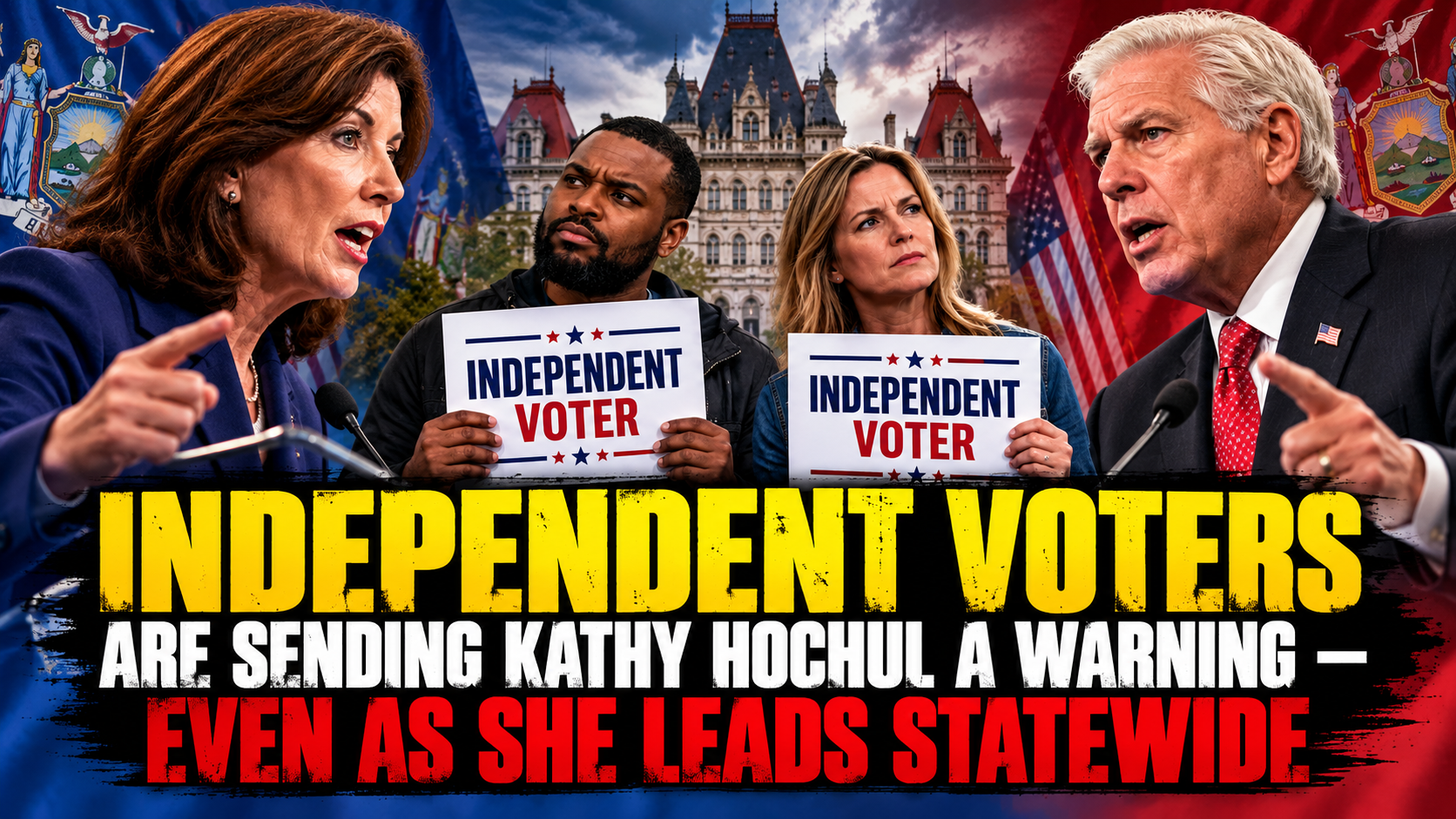




Before examining any of the polls in the 2026 race for governor, New Yorkers should realize just how significant the role of voters who do not belong to a major political party has become. The state refers to people who do not enroll with a recognized political party as ‘blank’ or unaffiliated voters, not as members of the ‘Independent Party’. The state’s election law expressly permits voters to stay unaffiliated with any political party.
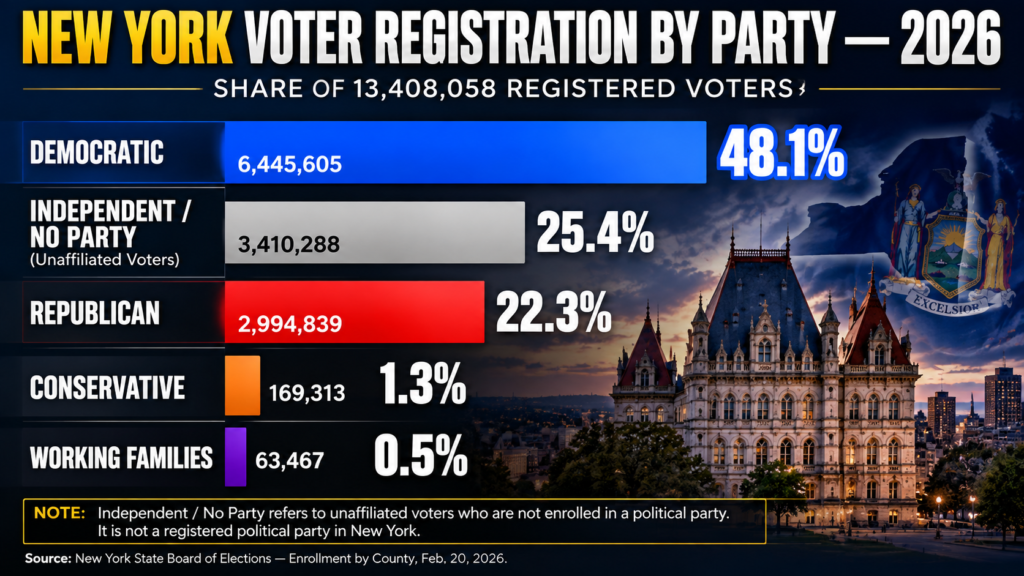
This is no minor political constituency; recent registration figures from New York show that unaffiliated voters make up about one-quarter of all registered voters in the state, making them a significant portion of the electorate. In October 2024, around 3.3 million people in New York were unaffiliated, making them the state’s second-largest group of registered voters after the Democrats and more than the registered Republicans.
The difference between registration and polling is significant. A person who has registered without declaring a party affiliation is not necessarily the same as someone who identifies as an independent when responding to a poll. Yet both figures show that voters outside the conventional Democratic and Republican groups deserve close consideration in the race for governor.
And now we come to Governor Kathy Hochul.
Although Hochul is still ahead of Republican Bruce Blakeman in statewide polls, those figures carry a warning that should not be ignored. Independent voters are expressing considerably greater dissatisfaction with Hochul than Democratic voters, and one large poll covering the state shows that a majority of independents have an unfavorable view of the governor.
It doesn’t mean independent voters as a group have decided to vote against Hochul; it does show that one of New York’s most significant voter groups is far less satisfied with the incumbent governor than the overall statewide race figures might at first suggest.
Independents View Hochul Unfavorably
The September poll by Quinnipiac University perhaps illustrates most clearly the complicated relationship that Hochul has with independent voters; the survey, which interviewed 1,026 likely voters from New York between September 17 and September 20, showed Hochul ahead of Blakeman at the state level, 58% to 39%.
Hochul led independent voters in the Quinnipiac ballot question, with 51% supporting her to 45% for Blakeman.
However, one figure certainly deserves more attention.
Of the independents, 36 percent said they had a favorable opinion of Hochul, while 52 percent said they had an unfavorable one.
Consider what the two figures together indicate. Although Hochul obtained 51% of the independent votes in the ballot head-to-head contest, only 36% of independents held a favorable opinion of her.
These results suggest that some independent voters may be willing to vote for Hochul even though they do not favor her, indicating that voting intention and favourability are distinct measures and that it is important to understand this difference when assessing this election.
People need not like a candidate to vote for them; they may dislike the other candidate more, agree with a candidate on a particular issue, vote strategically, or return to their normal partisan preference.
A governor who is currently in office and has a majority of independents rating him unfavorably should nevertheless attract attention.
Siena Gives Us Another Picture
The September Siena poll makes the issue of independent voters even more interesting.
Siena showed Hochul ahead of Blakeman statewide by 50% to 41%, a much smaller lead than Quinnipiac found. However, among independent voters, the opposite was true, with Blakeman at 44% and Hochul at 39%.
It wasn’t a one-month result; in August, the Siena poll showed Blakeman leading the independents 45% to 40%, so his five-point lead among independents was still five points in September.
Two well-respected statewide polls currently show different results for independent voters: Quinnipiac indicates that Hochul wins with 51% compared to 45%, whereas Siena shows Blakeman leading with 44% to 39%.
The disagreement should not lead anyone to say independent voters have already picked one candidate.
Polling gives only a snapshot, not the actual election result, and subgroup samples are usually smaller, so uncertainty is greater than in the overall statewide figures. Yet both polls give us good reasons to watch voters outside the Democratic and Republican bases.
Dissatisfaction Does Not Automatically Mean Blakeman Support
Another significant aspect of the Quinnipiac poll deserves attention. People’s dissatisfaction with Hochul doesn’t mean they must support Blakeman.
28 percent of independents said they held a favorable view of Blakeman, 34 percent said they held an unfavorable view of him, and another 37 percent stated that they had not heard enough about him to form an opinion.
By contrast, 36% of independents held favorable views of Hochul, while 52% held unfavorable ones.
Hochul’s problem is therefore not necessarily that independent voters have fallen in love with her Republican opponent; the figures indicate that many independents have serious reservations about the incumbent and that many still know little about the challenger.
It sets up a completely different political situation.
What Matters to Independent Voters?
The priorities independents identify may explain why this group deserves more attention.
In the Quinnipiac survey, 26 percent of independent voters said that the cost of living was their most important issue when deciding how to vote for governor. In comparison, 22 percent chose the economy, and 12 percent picked health care.
Those are kitchen-table concerns.
For people in New York, the cost of living is not something that can be discussed in an academic or political context; it means the amount they have to pay for groceries, their rent, their mortgage payments, their property taxes, their utility bills, transportation and insurance, and whether or not a working family can still afford to live in the community where it resides.
The economy is not just a matter of figures provided by Albany or Washington; voters experience it through their paychecks and household expenses.
That situation poses a special challenge for an incumbent governor since voters aren’t assessing a hypothetical administration. Hochul has been governor since 2021, so when New Yorkers decide whether the state is moving in the direction they want, they have several years of her administration to judge it.
The NY-23 Poll Adds Another Data Point
The latest Cygnal poll from New York’s 23rd Congressional District adds another element to this discussion, even though the figures must be interpreted carefully.
From September 19th through September 21st, Cygnal conducted live telephone interviews and SMS contacts with 400 people likely to vote in the 2026 general election in NY-23. The poll has a margin of error of plus or minus 4.9 percentage points.
The figures for Hochul in that area are remarkable: her positive rating is just 28%, while 68% find her unfavorable. In the gubernatorial race, Blakeman has 61% compared to Hochul’s 35%.
However, you must be intellectually consistent when discussing polling: NY-23 is a single congressional district, not New York State, and the Cygnal memo does not provide Hochul’s favorable and unfavorable figures specifically among independents.
We therefore have no right to say that 68% of independent voters disapprove of Hochul since that 68% refers to respondents in the entire district.
The part of the poll that covers Congress gives an independent breakdown: Republican Congressman Nick Langworthy has 45% support among independents, compared with Democrat Aaron Gies at 31%, while 24% are undecided.
It doesn’t show how those independents will vote for governor, but it does show that independent voters are still a group worth watching.
The Warning Beneath the Statewide Lead
The more important point is that Kathy Hochul is not losing the election, since current statewide polling does not support that assertion.
The reason given is that Hochul can govern across the state even though she faces considerable dissatisfaction among independent voters.
In two successive polls, Siena has Blakeman ahead among independents. While Quinnipiac’s poll shows Hochul winning the ballot matchup among independents, the same poll indicates that 52% of independents view her negatively, compared with only 36% who view her favorably.
The figures shouldn’t just vanish under a headline that covers the entire state.
There are millions of voters in New York who are not registered with either of the two major parties, and they have no obligation to protect a Democratic incumbent, nor are they automatically voting for a Republican candidate; instead, their choice may be based on affordability, the state of the economy, taxes, public safety, education, health care, or on their view of how the state government is performing.
Which is why the independent figures are worth looking at.
The question that will be facing people in November is not just whether Kathy Hochul will be able to keep her lead in the statewide polls; it is also what will become of the independent voters who currently hold an unfavorable view of her, especially those who at present say that they would still vote for her.
Will they stay with Hochul? Might some of them move towards Blakeman as they find out more about him? Or will others go with a different candidate or just decide not to vote?
The polls haven’t answered those questions yet.
Since about a quarter of registered voters in New York do not belong to any political party, failing to account for them would be like ignoring a major part of the state’s political landscape. Although the overall figures show the race’s current position, the figures for independents reveal where some of the uncertainties still