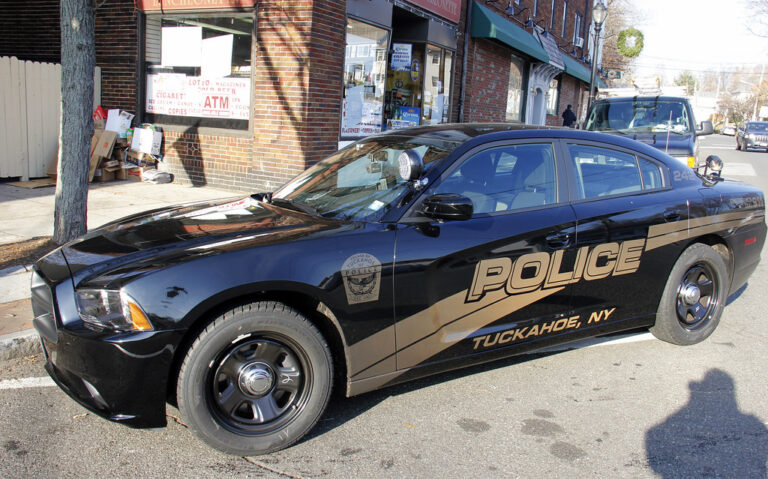
Black Westchester reported Tuesday, Sept. 22, that the District Attorney’s Office had completed its criminal review of the incident, which allegedly began in Yonkers and ended in Tuckahoe, and referred the matter back to Tuckahoe for any administrative or disciplinary action it deemed appropriate.
On Wednesday, Sept. 23, Tuckahoe Police Chief Larry Rotta provided Black Westchester with a statement outlining the Village’s next steps.
“The Tuckahoe Police Department has received the report from the Public Integrity Bureau of the Westchester County District Attorney’s Office regarding its investigation of the motor vehicle accident that occurred on August 14, 2026.
“From the outset, the Village referred the matter to the Public Integrity Bureau to ensure an independent review and maintain transparency throughout the process.
“Now that the District Attorney’s Office has completed its review, the Village has chosen to have an external independent investigator conduct a disciplinary review of the matter. They will review the facts and circumstances surrounding the incident, including whether any departmental policies, procedures, or rules may have been violated and whether disciplinary action may be warranted.
“This disciplinary review is a process that must be followed before any determinations are made or further action is taken. We ask the public to respect the process and allow the independent investigator to complete a thorough and fair review. Additional information will be shared with the public at the appropriate time, consistent with applicable laws and personnel confidentiality requirements.
“The Village and the Tuckahoe Police Department remain committed to accountability, transparency, and maintaining the highest professional standards.”
The Criminal Review Is Over. The Accountability Questions Are Not.
Black Westchester believes the District Attorney’s findings speak directly to the central question we raised when we first reported on this case one month ago. The criminal investigation may be over, but the public-accountability question remains: Would someone without those connections have been treated the same way? That was the question then, and it remains the question now.
According to the findings released by the District Attorney’s Office, police had been alerted to two previous alleged hit-and-run incidents before responding to another collision involving Costanzo. The DA’s review also established that no sobriety investigation was conducted, no documented explanation was provided for why such an investigation was not conducted, a responding officer knew Costanzo was the former police chief’s wife, and an officer ultimately drove her home.
Those circumstances did not result in criminal charges against the officers. But whether officers followed departmental policies and procedures, exercised appropriate judgment, or provided preferential treatment is a separate question — and that is now the subject of the independent disciplinary review.
Chief Rotta told Black Westchester that additional information could become available after that process is finished.
“Once the internal investigation is complete, I can release more details regarding the further facts we find out,” Rotta informed Black Westchester.
That review will now be critical.
Black Westchester will wait for the independent investigator to complete the disciplinary process, but we will also continue watching, asking questions, and following this case closely. Because while the criminal investigation has concluded, the larger questions surrounding police procedure, discretion, accountability, and equal treatment have not.
For now, the public is still left with more questions than answers.
Written by Derek H. Suite, MD, MS, with editorial contributions from Taiwo Alonge, MD, MPH
Author’s note: The child, the school record, and the surrounding circumstances are a composite drawn from clinical and community experience. Identifying details have been changed, and dialogue has been reconstructed.
It was about three in the morning when my phone rang. I happened to be awake. It was a pastor, a great friend of mine, someone I am very close to. He apologized over and over for calling so late. It was not the first time he had called me at this hour, so I smiled a little and told him it was all right.
He was worried about a 12-year-old boy in the congregation who had been expressing what the pastor called dark thoughts. When I asked him what he meant by dark, he said it was hard to describe, but he quickly added that the boy had never said that he wanted to hurt himself. He was just down on everything, especially on himself. He did not make the basketball team and now was saying he was no good at sports. Everything he said seemed to end up with the feeling that something was wrong with him.
Over the past two or three days, the pastor had noticed that the boy seemed different. Something about the way he had said good night a few evenings earlier did not sit right with him. He could not explain it any better, but said it troubled his spirit and was now keeping him awake at night.
The pastor had just gotten off the phone with the boy’s parents. He said they had checked on him and, though he seemed fine to them, they would continue checking on him through the night. The boy had acted out before and was seen by a mental health provider, but no received no diagnosis. The pastor wondered whether he was overreacting. He cared deeply about everyone in his congregation and knew that sometimes he carried their problems home with him. Still, he told me he would never have called at that hour in the morning unless something felt wrong.
I asked whether he believed the boy was safe. He said the boy was home with his parents; they were watching him, and he had not said anything directly about hurting himself. “But I just can’t sleep, doc,” he told me. “I feel like the Spirit of the Lord is telling me something might happen.” We prayed together, and I told him not to wait until morning. We needed to act on what he was hearing even though neither of us could name it yet.
Over the years, I have wrestled with that part of the call. What the pastor heard may not have been something formal or clinical. He was hearing something underneath what the boy was saying. The fact that there was no diagnosis was true, but it did not answer the question he was asking. It did not settle his spirit, and when I thought about it more, it troubled mine as well.
I knew from my training and from what I had seen over the years that “I’m fine,” or “he looks fine,” doesn’t always tell us enough, particularly with Black youth.
A federal report to Congress examined non-Hispanic Black and White youth ages 10 to 17 who died by suicide from 2014 through 2017. Compared with White youth, Black youth were less likely to have a known mental health problem, a documented depressed mood, a known history of suicidal thoughts or plans, or a history of mental health treatment. Although the report measured what was documented, it could not tell us what these young people had experienced privately.
The same report found that, among these young people who died by suicide, Black youth were more likely to have experienced a crisis during the two weeks before their death, maybe an argument or family conflict. A prior suicide attempt was also recorded slightly more often: 23 percent, compared with 21 percent of White youth. That can look contradictory at first. A prior attempt could be somewhere in the history, and the record could still show no known suicidal thinking, diagnosis, or treatment. The report does not show how those histories overlapped in individual children.
Contact with a provider only tells us that an encounter occurred. It doesn’t tell us whether somebody asked the right questions, in the right way, and understood the answer when it came. Even when a provider asks the right questions, a child may not disclose what he is thinking. Stigma and mistrust may make it harder for some Black youth to talk openly. A child may also feel disconnected from a provider who does not understand his racial, ethnic, or cultural experience.
The fact that this boy had been evaluated and had no diagnosis meant only that no diagnosis had been made.
His age caught my attention. He was only 12. Still young enough that most adults would hear disappointment about basketball, some acting out, and a few dark comments and think that he was just having a hard time or misbehaving. Not that his life could be in danger. We tend to think of suicide as occurring later in the teenage years.
When researchers examined deaths from 2001 through 2015, they found that Black children ages five to 12 died by suicide at nearly twice the rate of White children the same age. Among teenagers ages 13 to 17, the Black rate was about half the White rate. Later data showed the broader pattern was changing, with the suicide rate among Black youth ages 10 to 17 rising by 144 percent from 2007 to 2020. Although these studies covered different periods and overlapping ages and are not a continuous set of numbers, they leave me with the same concern that by the time we begin paying closer attention, some Black children may have already been struggling for years.
That question about what had gone unrecognized was on my mind in a school meeting. His folder was almost three-quarters of an inch thick and so little in there was clinical. Mostly attendance printouts, two cafeteria incident reports, and a referral form with the word “defiant” written as the presenting concern. And someone had underlined it twice and added an exclamation point. A school folder is not a clinical chart, and its contents alone could not tell me what care he had received.
He sat with his hood up and answered most questions with one syllable. When his grandmother began talking about the death in the family and her voice cracked, he put his hand on her back without turning his head. That small movement told me more about him than much of what was in the folder. He was grieving, but grief in a Black boy does not always look like sadness. It may present as irritability, silence, missed school, or a refusal to answer another adult’s questions. These responses are not unique to Black children. Those behaviors may be read as attitude and be met with discipline, which generates administrative papers while the clinical record stays thin, except possibly for an occasional diagnosis of oppositional defiant disorder or conduct disorder.
In a retrospective study of 1995 through 1998 records from one hospital, Black adolescents ages 12 to 18 were diagnosed with conduct disorder more often than White adolescents. The study did not establish why or whether those diagnoses were accurate, so I am still working through that. My concern is what can happen when a description such as “defiant” matters more than the question of what the behavior means. If a child later dies by suicide, someone may open the file, find no history of depression or suicidal thinking, and mistake the absence of documentation for evidence that the distress was never there.
Families are often left with the question of what they missed. But it’s not on them, in my mind. The records raise another question: what happened after they brought the child through the door? In one study of young people ages 10 to 24 across nine health systems, 88 percent of those who died by suicide had been seen somewhere in the health system during the previous year, and 42 percent had been seen during the month before their death. The study was not limited to Black youth. The contact was there. Those figures do not tell us whether care continued. Even after emergency treatment for deliberate self-harm, fewer than half of Medicaid-covered young people ages 10 to 19 who were discharged to the community in another study received outpatient mental health follow-up within 30 days. In an interview published by Pew, researcher Michael Lindsey noted that follow-up was lower for Black youth than for White youth.
A family can recognize that something is wrong, make the appointment, sit in the emergency room and leave with instructions, and still lose the connection between one part of the system and the next. That is difficult to explain simply as a lack of concern at home. The problem can be what happens (or doesn’t happen) between one door and the next.
Many crises still begin outside a clinic. They happen in a pastor’s office, after practice with a coach, or in the barber’s chair when a young person says something that does not sound quite right. Pastors, coaches, and barbers do not need a diagnosis before they act. Like my pastor friend, they need to take the change seriously, stay with the young person, and help make the call.
Families should know that the signal may be a behavior change, not only sadness. It could be something as straightforward as different sleep patterns, withdrawal, sudden anger, giving things away, or a way of saying good night that leaves you uneasy. Contrary to popular belief, asking straightforwardly, “Are you thinking about suicide?” does not plant the idea. It may give the child permission to answer honestly. At school, words such as “defiant” or “oppositional” should raise a clinical question before they become only a disciplinary issue.
None of this guarantees that we will recognize every child in time. We have lost young people even when people cared and tried to do the right things. What I can offer is somewhere to begin. Stay with the child while getting help, and make sure firearms, medications, and other potential means of self-harm are secured. Call or text 988 at any hour. In Westchester, call the Crisis Prevention and Response Team at 914-925-5959 for 24-hour telephone support and in-person community evaluations seven days a week.
If someone is in immediate danger, call 911. Don’t wait until tomorrow.
Before we hung up that night, the pastor told me he had already been sitting with this for three hours and almost did not call because he thought a doctor might tell him he was overreacting. There was a diagnosis that night, and the person who noticed a change was moving by spirit and had nearly talked himself out of trusting what he felt.
What stays with me is how close he came to deciding that there was not enough to call about and what that could have meant for this young boy.
ABOUT THE AUTHORS
Derek H. Suite, MD, MS, is board-certified by the American Board of Psychiatry and Neurology and the American Board of Sports & Performance Psychiatry. He is the Founder and CEO of Full Circle Health, an award-winning, multidisciplinary, holistic mental health practice established in 1999. He is a regular health and wellness contributor to Black Westchester Magazine and hosts the weekly podcast The SuiteSpot.
Taiwo Alonge, MD, MPH, is a board-certified psychiatrist who works with children, adolescents, and adults. His work brings together child and adolescent mental health, community care, and health equity. He earned his medical and public health degrees at Columbia University, trained in psychiatry at Yale, and completed child and adolescent subspecialty training at New York-Presbyterian across the Columbia and Weill Cornell Medical Centers in New York City.
Elected officials, business leaders, and entrepreneurs gathered to celebrate minority and women-owned businesses while discussing the challenges of taking a business to the next level.
MID-HUDSON, NY — The Business Outreach Center (BOC) Network and the New York State Division of Minority and Women’s Business Development celebrated the 2026 graduates of the Business Growth Accelerator (BGA) Mid-Hudson program, bringing together entrepreneurs, business leaders, government representatives, and elected officials for an event focused on business growth and economic opportunity.
The Business Growth Accelerator is designed to help Minority and Women-Owned Business Enterprises move beyond simply starting a company toward building sustainable businesses capable of competing for larger contracts. The program provides entrepreneurs with technical assistance, business-development strategies, networking opportunities, and guidance to strengthen their operations.
The celebration recognized the graduates’ accomplishments and gave entrepreneurs a chance to hear directly from business owners and government leaders about what it takes to grow a company in today’s economy.
ELECTED OFFICIALS AND BUSINESS LEADERS JOIN THE CELEBRATION
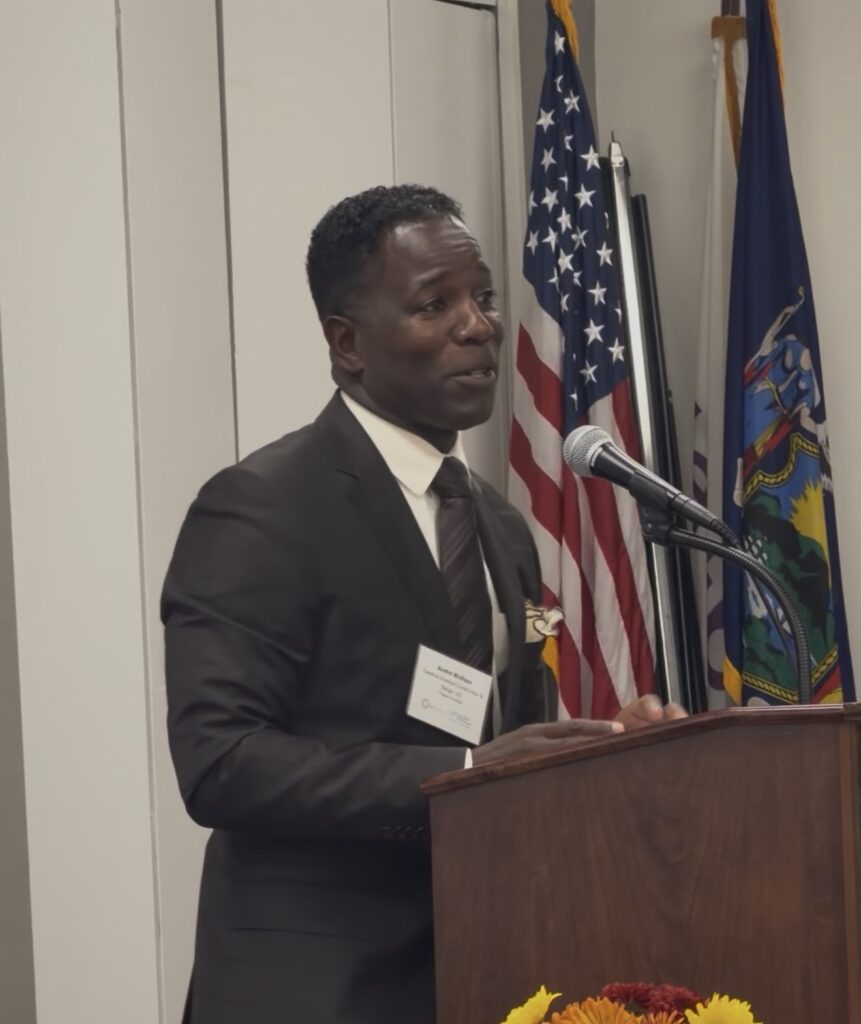
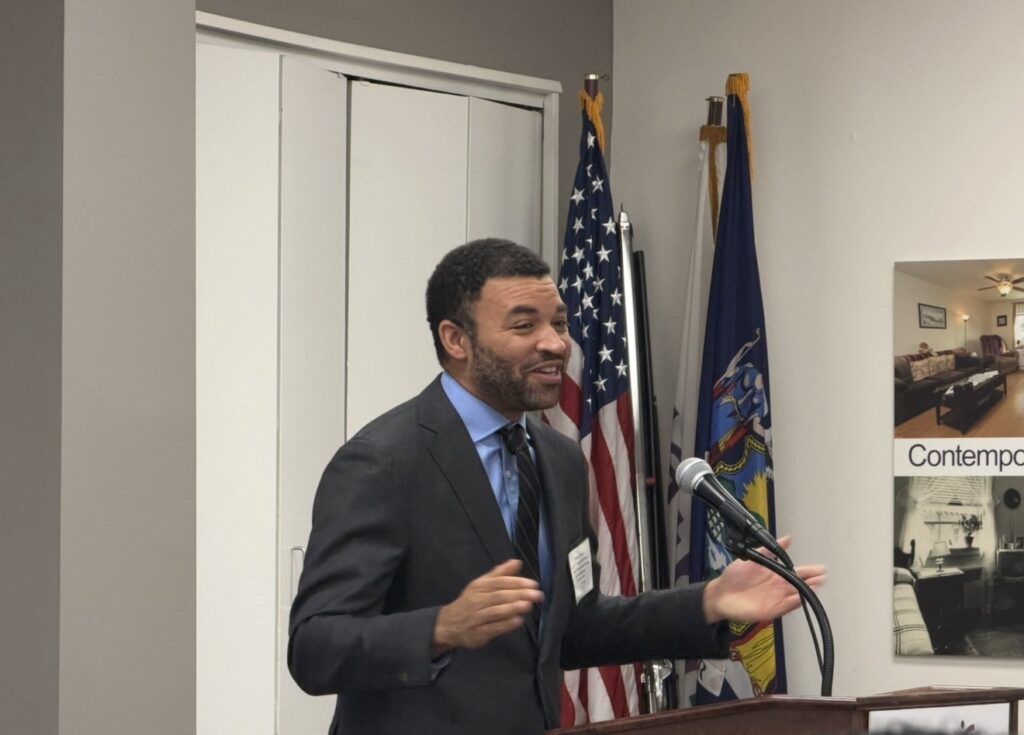
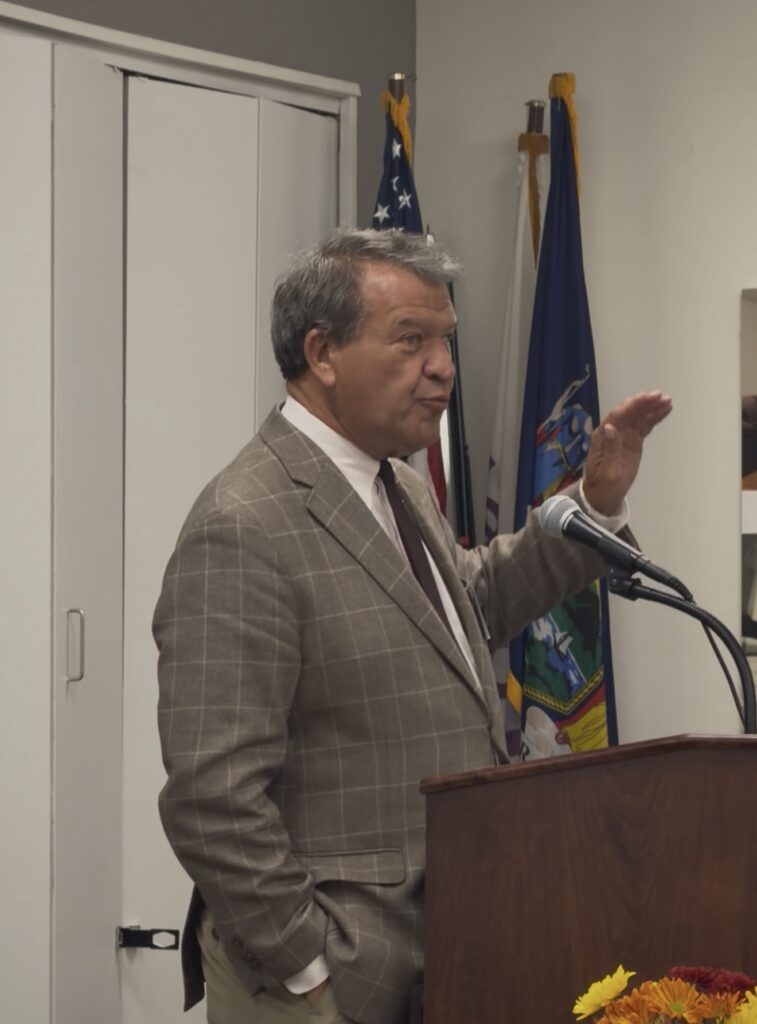
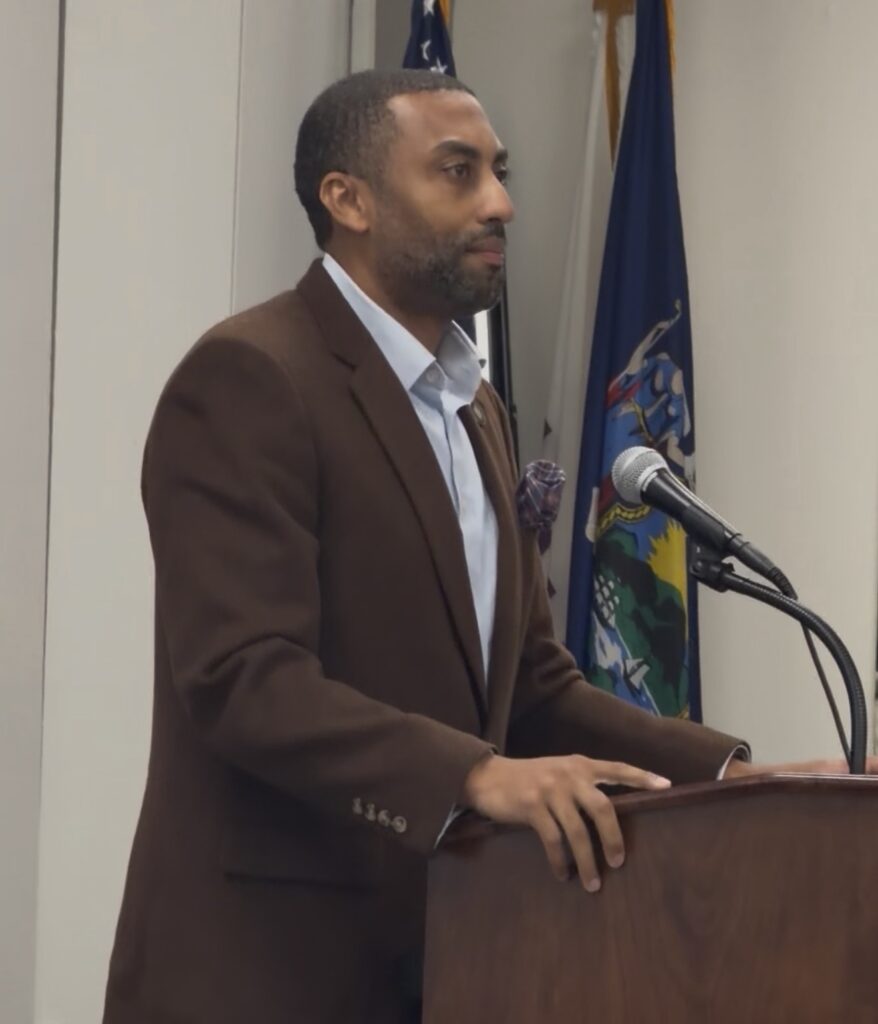
The program featured several prominent guest speakers, including U.S. Representative George Latimer, representing New York’s 16th Congressional District; New York State Senator Jamaal T. Bailey, representing the 36th Senate District; and Westchester County Executive Kenneth W. Jenkins as keynote speakers.
Mount Vernon Councilman André Wallace, President of Creative Direction Construction & Design, LLC, delivered graduate remarks, bringing a strong Mount Vernon presence to the program as both an elected official and entrepreneur.
Nancy Carin, Executive Director of BOC Network and BOC Capital, welcomed attendees. Jason M. Clark, Executive Director of the New York State Division of Minority and Women’s Business Development, also delivered remarks, along with Doniphan Soro of the division’s Business Development Unit.
BOC Network representatives Kevin Chu, Senior Business Development Officer, and John Frias, Senior Program Manager, were also recognized for their work with the program.
“BEYOND BGA” PANEL FOCUSES ON THE NEXT LEVEL
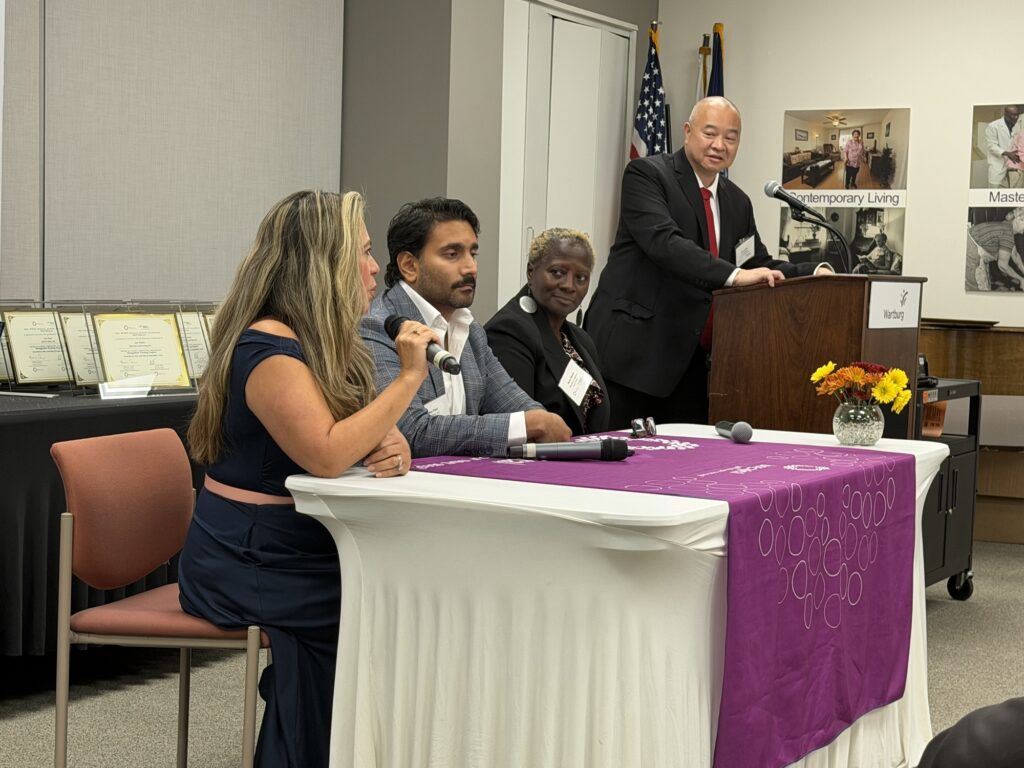
An important part of the event was the panel discussion, “Beyond BGA: Accelerating the Next Stage of Growth,” featuring Diane Moore, CEO of CleanWork Solutions; Roxanne Guerrero, President of KCM Contracting Inc.; and Elton Paul, co-founder and principal of GIP & Sons.
The discussion focused on a critical issue for entrepreneurs: what happens after the training ends. Starting a business and receiving MWBE certification can open doors, but growing a company requires entrepreneurs to think about capacity, relationships, financing, contracting opportunities, and long-term sustainability.
The panel gave graduates a chance to hear from business owners about the realities of moving from entrepreneurship to business growth. That means learning how to compete for larger contracts, strengthen internal operations, build professional relationships, and prepare a company to handle opportunities when they arrive.
That conversation matters because certification alone does not guarantee contracts. A company still must be prepared to compete, manage cash flow, meet insurance and contracting requirements, hire workers when necessary, and deliver quality services on schedule.
TURNING TRAINING INTO CONTRACTS
According to Empire State Development, the Business Growth Accelerator provides assistance in areas including procurement, financial management, business administration and marketing, along with mentoring and technical assistance.
In October 2025, the state reported that BGA 3.0 had enrolled 168 MWBE firms across eight regions, with 25 participating businesses securing 55 contracts totaling more than $34.8 million.
Those numbers demonstrate why the conversation must eventually move beyond certification and graduation toward measurable economic results. The question is not simply how many entrepreneurs complete a program, but how many eventually secure contracts, increase revenues, hire employees, and build sustainable companies.
BUILDING BUSINESSES THAT BUILD COMMUNITIES
For Black and other historically underserved communities, business development should be about more than encouraging entrepreneurship. The larger objective should be creating companies capable of employing people, purchasing property, competing for major contracts, and circulating economic resources throughout their communities.
Small businesses already represent approximately 98 percent of businesses in New York State and employ roughly 40 percent of the state’s private-sector workforce, according to Empire State Development. That makes small-business development as much a workforce and community-development issue as an entrepreneurship issue.
The 2026 BGA Mid-Hudson graduation therefore represents both an accomplishment and a beginning. The next chapter will be determined by what graduates do with the knowledge, relationships, and opportunities they developed through the program.
The goal should not simply be producing more minority- and women-owned businesses. It should be developing stronger businesses that can compete, grow, create jobs, and build generational economic opportunity.
Black Westchester congratulates the 2026 BGA Mid-Hudson graduates and all the entrepreneurs working to build stronger businesses throughout Westchester County and the Mid-Hudson region.
Westchester DA’s Office Finds No Provable Criminal Conduct in Tuckahoe Police Response — But Preferential Treatment of Former Tuckahoe Police Chief’s Wife, Donna Costanzo, Questions Remain
TUCKAHOE, N.Y. — Exactly one month after Black Westchester first reported that the Westchester County District Attorney’s Office was reviewing the Tuckahoe Police Department’s handling of an incident involving the wife of its former police chief, the DA’s office announced Tuesday, Sept. 22, that the available evidence was insufficient to support criminal charges against any of the officers involved.
But while the criminal investigation may be closed, the District Attorney’s own findings raise many of the same questions Black Westchester asked when we first reported the story on Aug. 22 — particularly whether Donna Costanzo received the same treatment another person would have received under similar circumstances. Costanzo is the wife of retired Tuckahoe Police Chief John Costanzo, who currently serves as Executive Director of the Westchester County Chiefs of Police Association.
The District Attorney’s Office said its Public and Law Enforcement Integrity Bureau conducted a comprehensive review that included examining police body-worn camera footage and surveillance video, interviewing Tuckahoe and Yonkers police officers, and speaking with civilian eyewitnesses, including the driver of an Amazon delivery truck struck during the Tuckahoe incident.
Following that review, the DA’s Office determined “that all of the available evidence that was accumulated is insufficient to establish provable criminal conduct by any one of the Tuckahoe police officers involved in the incident and, therefore, does not establish probable cause required to support the filing of criminal charges.”
Three Collisions in Less Than 25 Minutes
According to the District Attorney’s findings, Costanzo was allegedly operating a black Infiniti sedan in Yonkers on Aug. 14 when she struck a parked vehicle on Falmouth Road at approximately 2:53 p.m. and left the scene. Approximately 17 minutes later, she allegedly struck another vehicle in a Central Avenue parking lot in Yonkers and again left the scene. About five minutes later, Costanzo allegedly struck an Amazon delivery truck legally parked near Columbus Avenue and Main Street in Tuckahoe.
Following the two Yonkers incidents, the Yonkers Police Department notified Tuckahoe police about the alleged hit-and-runs and asked officers to be on the lookout for Costanzo’s vehicle. Two Tuckahoe police officers subsequently responded to the Tuckahoe accident scene.
Body Cameras Stop Recording
The DA’s review found that the available body-worn camera footage from the officers was limited. According to the District Attorney’s Office, Motorola data indicated that one responding officer appeared to deactivate his body-worn camera moments after approaching Costanzo, who was seated in the driver’s seat of her vehicle. The officer denied intentionally turning off the camera.
The second responding officer’s body-worn camera stopped recording approximately one minute and 45 seconds after the officer arrived. Motorola records confirmed that camera’s battery had died. A Tuckahoe detective and an off-duty lieutenant also responded. The lieutenant arrived after Costanzo had already left and did not interact with her.
No Sobriety Investigation Conducted
Perhaps the most significant finding involved what officers did not do. According to the DA’s Office, witness testimony indicated that Costanzo exhibited signs that could have been consistent with intoxication. However, neither responding officers nor civilian witnesses reported smelling alcohol on her breath or observing other definitive signs of intoxication. But Tuckahoe officers never investigated whether she was impaired.
The DA’s review found that none of the Tuckahoe officers who responded evaluated Costanzo’s sobriety or investigated whether she was impaired. The review also found that the department did not document a reason for failing to conduct such an investigation. Instead, one responding officer acknowledged during the DA’s review that he knew Costanzo was the wife of the former Tuckahoe Police Chief. That officer then drove Costanzo home following the accident.
Yonkers Police Later Issued Two Summonses
Following Black Westchester’s original report, we contacted both the Yonkers and Tuckahoe police departments seeking additional information. The Tuckahoe Police Department has yet to respond to Black Westchester.
The Yonkers Police Department did respond, confirming that officers investigated two hit-and-run crashes in Yonkers involving a 2018 Infiniti on Aug. 14th. In both cases, the vehicle had left before Yonkers officers arrived. YPD told Black Westchester that because its officers never personally observed Costanzo operating the vehicle and did not encounter her at either collision, they had no opportunity to assess her physical condition, conduct field sobriety tests, or administer chemical testing.
During the follow-up investigation, Yonkers police identified the vehicle and its registered owner and later went to the owner’s Tuckahoe residence. Officers subsequently identified the individual who had been driving during the two Yonkers incidents. Costanzo was issued two summonses for Leaving the Scene of an Accident Involving Property Damage Without Reporting, one for each Yonkers incident.
No Criminal Charges Does Not Answer the Question We Asked
When Black Westchester first reported this story on Aug. 22, we asked several questions. Who responded to the scene? Were standard police procedures followed? Why was Costanzo reportedly driven home rather than subjected to further investigation? Did her relationship to the former Tuckahoe Police Chief influence the way she was treated? And perhaps most importantly: Did Donna Costanzo receive the same treatment that any other person would have received under the same circumstances? One month later, we now know considerably more than we did when we first asked that question.
According to the District Attorney’s own findings, police had been notified that the vehicle was connected to two alleged hit-and-run incidents in Yonkers. Costanzo then allegedly struck a third vehicle in Tuckahoe. Witnesses described behavior that could have been consistent with intoxication. Officers conducted no sobriety investigation. The department documented no reason why no impairment investigation was conducted. One responding officer knew Costanzo was the wife of the former police chief. And rather than investigating her for possible impairment, that officer drove her home.
The District Attorney’s Office concluded there was insufficient evidence to establish criminal conduct by the officers. That is an important legal determination. But criminal conduct was never the only question. The question Black Westchester asked was whether Costanzo received the same treatment an ordinary motorist would have received after allegedly leaving the scene of two crashes, becoming involved in a third collision, and displaying behavior witnesses believed could have been consistent with intoxication.
The District Attorney’s investigation focused on whether the actions of the Tuckahoe police officers amounted to provable criminal conduct. The DA’s Office also clarified the jurisdictional issue, explaining that the individual motor vehicle incidents fell within the jurisdictions where they occurred — Yonkers for the first two collisions and Tuckahoe for the third.
But whether prosecutors could establish criminal conduct by the responding officers is a considerably different question from whether those officers exercised appropriate judgment, followed departmental procedures, or afforded Donna Costanzo preferential treatment because of her relationship to former Tuckahoe Police Chief John Costanzo.
The DA’s investigation has now established several facts that were still allegations when Black Westchester first reported this story on Aug. 22nd. There was no sobriety investigation. There was no documented explanation for why no sobriety investigation was conducted. One of the responding officers acknowledged that he knew Costanzo was the wife of the former Tuckahoe Police Chief. And that officer drove her home following the accident.
The DA’s review also raised concerns about the handling of body-worn cameras at the scene. Although prosecutors emphasized that the issue was not the primary focus of their investigation, the office recommended that the Tuckahoe Police Department revise its body-worn camera policy.
According to the DA’s Office:
“Although not the primary focus of this review, our office recommended that the Tuckahoe Police Department modify its body-worn camera policy to make clear that officers must keep their body-worn cameras activated upon responding to a motor vehicle accident and until the individual involved has been cleared of any potential criminal wrongdoing.”
The DA’s Office further announced that it had referred the matter back to Tuckahoe Police Chief Larry Rotta for an internal investigation. That is significant. Because while prosecutors determined there was insufficient evidence to establish probable cause for criminal charges against any of the officers, the matter has not simply disappeared. Questions surrounding departmental policy, officer conduct, judgment, and accountability have now been placed back in the hands of the Tuckahoe Police Department itself.
The DA also noted that the Yonkers Police Department has filed two charges of Leaving the Scene of a Property Damage Accident under Vehicle and Traffic Law § 600(1)(a) against Costanzo stemming from the two incidents in Yonkers. Those matters are currently pending in Yonkers City Court.
The District Attorney’s Office closed its statement with a message that should not be overlooked: “We urge all law enforcement agencies in Westchester County to ensure that their officers’ conduct is consistent with their obligation to protect public safety, regardless of the circumstances or individuals involved.”
The DA’s Office also released all known body-worn camera footage recorded after Tuckahoe officers arrived at the scene of the Tuckahoe accident and collected during its review. The footage can be viewed below.
Black Westchester believes the findings speak loudly to the central question we raised one month ago. The criminal investigation may be over, but the public accountability question remains: Would someone without those connections have been treated the same way? That was the question then.
After learning that police had been alerted to two previous alleged hit-and-run incidents, that no sobriety investigation was conducted following a third collision, that no reason for that decision was documented, that a responding officer knew Costanzo was the former police chief’s wife, and that the officer ultimately drove her home, it remains the question now.
And while the District Attorney’s Office has completed its criminal review and referred the matter back to Tuckahoe for an internal investigation, the Tuckahoe Police Department has yet to respond to Black Westchester’s questions.
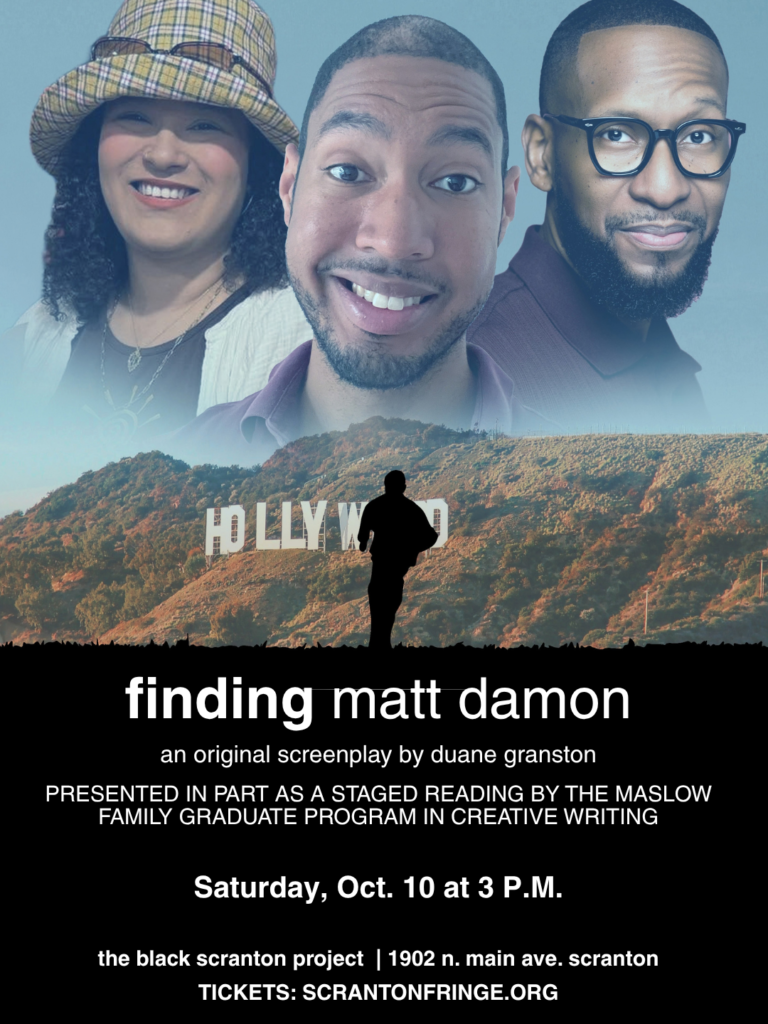
MOUNT VERNON, NY — Mount Vernon native and Mount Vernon High School Class of 2003 graduate Duane Granston will have his original screenplay, Finding Matt Damon, featured at the 2026 Scranton Fringe Festival in Pennsylvania this October.
Granston, an actor and writer and a descendant of Jamaican immigrants, wrote Finding Matt Damon as his capstone project in the Maslow Family Graduate Program in Creative Writing at Wilkes University. The screenplay will receive a staged reading on Saturday, October 10, at 3 p.m. at the Black Scranton Project Cultural Center in Scranton. In addition to writing the screenplay, Granston will step into the lead role of Sean.
Finding Matt Damon is a romantic comedy centered on Sean, an insecure software genius trying to recover from a broken heart. After telling aspiring screenwriter Jasmine that he knows Hollywood star Matt Damon, what begins as a small lie quickly grows into an increasingly complicated effort to turn his fiction into reality. When the deception finally unravels, Sean is forced to confront his insecurities, abandon the image he has created and discover the confidence to be himself.
“This witty rom-com will resonate with anyone who has ever found themselves over their head,” said Mandy Pennington, board chair of the Scranton Fringe Festival and director of the staged reading. “Duane has created something truly special in this screenplay. You can’t help but love these characters and see yourself in their hopes, fears, and missteps. That’s the magic of a great story.”
A Story About Vulnerability and Finding Your Voice
For Granston, the screenplay explores something much deeper than the outrageous situation at the center of its comedy.
“I think people will really connect with the ups and downs of these characters,” Granston said. “Even if you’ve never done something as extreme as Sean does, you know what it’s like to maybe fake it a little bit in a moment when you are afraid you are not enough. Getting over that fear of vulnerability and just letting ourselves be who we are is something that we all have to come to terms with at some point.”
Granston said representation was also an important part of his approach to the screenplay. Rather than centering Black characters solely around hardship, he wanted to tell a story filled with humor, romance, friendship, and joy.
“It’s important to me to create stories that aren’t just focused on Black characters’ trauma and pain, but ones that express light and joy and friendship and love in fun ways that we’re not used to seeing,” he said.
From Mount Vernon to Stage and Screen
Granston’s creative work spans theater, film and voiceover. Most recently, he starred in the award-winning short film The Finish, with his performance earning a nomination for Best Acting in a Leading Role. Now, portraying a character he created himself adds another dimension to his journey as both an actor and writer.
“Stepping into Sean’s shoes is a full-circle moment,” Granston said. “The story has been a fun exploration of the parts of ourselves that want to hide and what it truly means to discover your genuine voice.”
The presentation is part of an ongoing partnership between the Scranton Fringe Festival and Wilkes University’s Maslow Family Graduate Program in Creative Writing. Now in its fourth year, the collaboration provides emerging writers with an opportunity to see their work move beyond the page and into a live production setting. This year will mark the first time the partnership has featured a screenplay.
“Both Wilkes and Scranton Fringe do an incredible job of nurturing writers at every stage of the creative process,” Pennington said. “When creative writers participate in Scranton Fringe, not only do they have a platform to showcase their incredible storytelling abilities, but they learn what goes into producing an original work from start to finish. That’s experiential learning at its best.”
For Mount Vernon, Granston’s appearance at the festival is another example of a hometown creative carrying his talents beyond the city while continuing a journey that began long before graduate school.
Finding Matt Damon will be presented Saturday, October 10, at 3 p.m. at the Black Scranton Project Cultural Center in Scranton, Pennsylvania. The PG-13 staged reading will run approximately 60 minutes and will be followed by a brief audience talkback. Tickets are $15 and are available through the Scranton Fringe Festival.
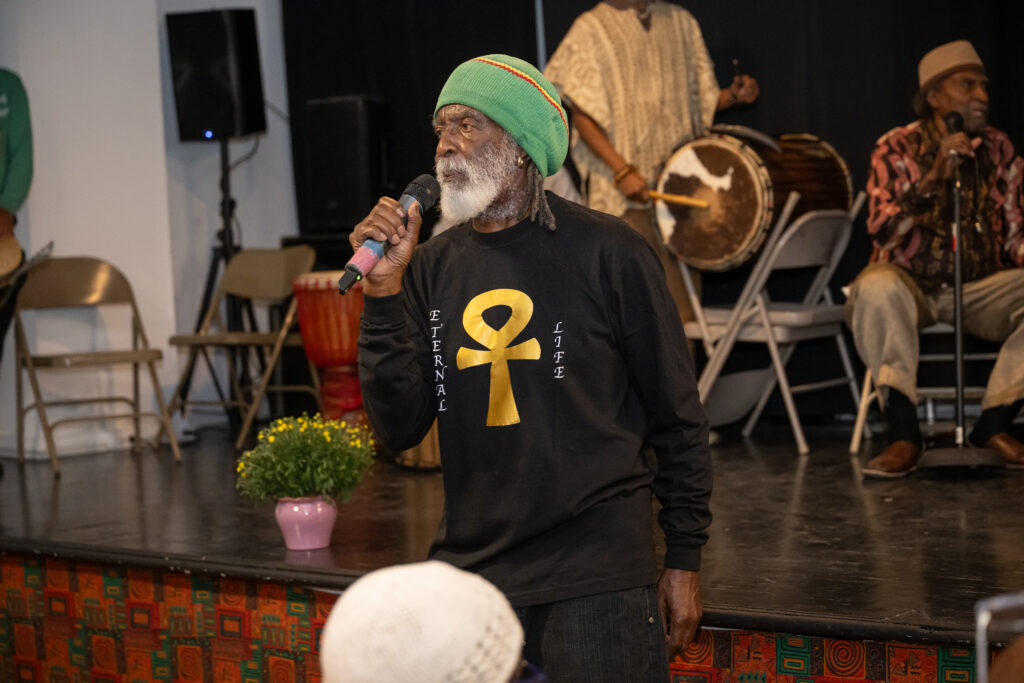
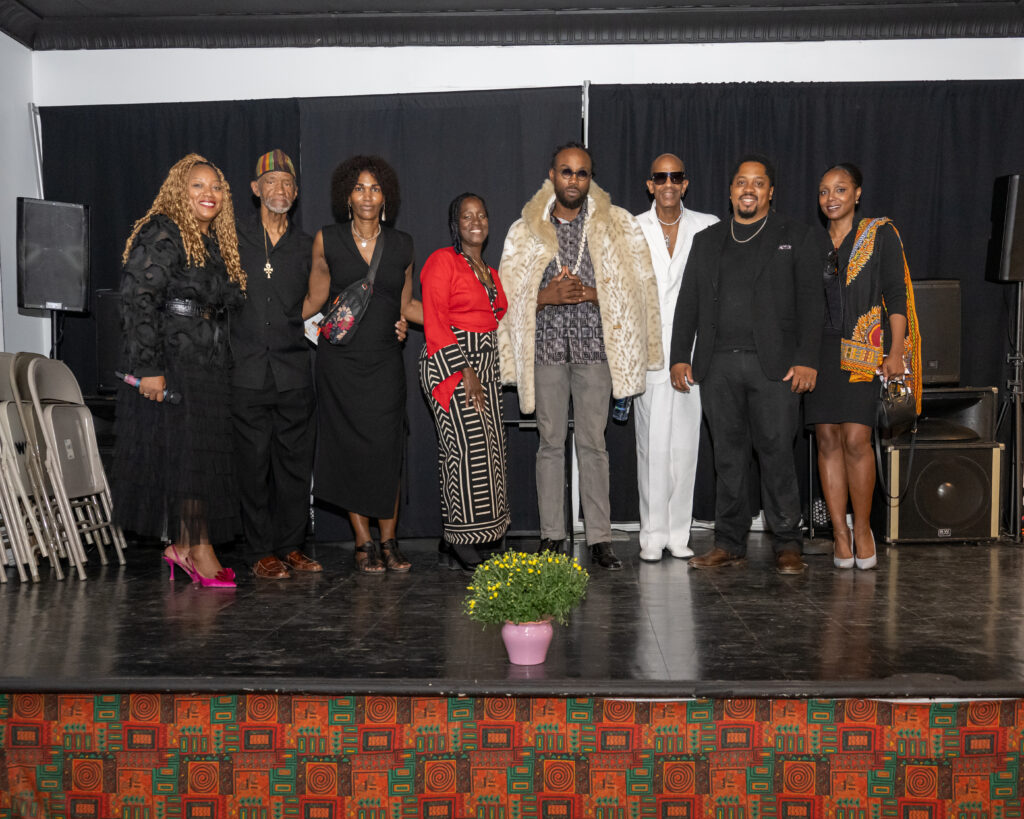
MOUNT VERNON, NY — The AC-BAW Center for the Arts celebrated its grand reopening and 50th anniversary on Saturday, September 19, 2026, marking a major milestone for one of Mount Vernon’s longest-standing cultural institutions and ushering in a new chapter for the arts in the city’s downtown.
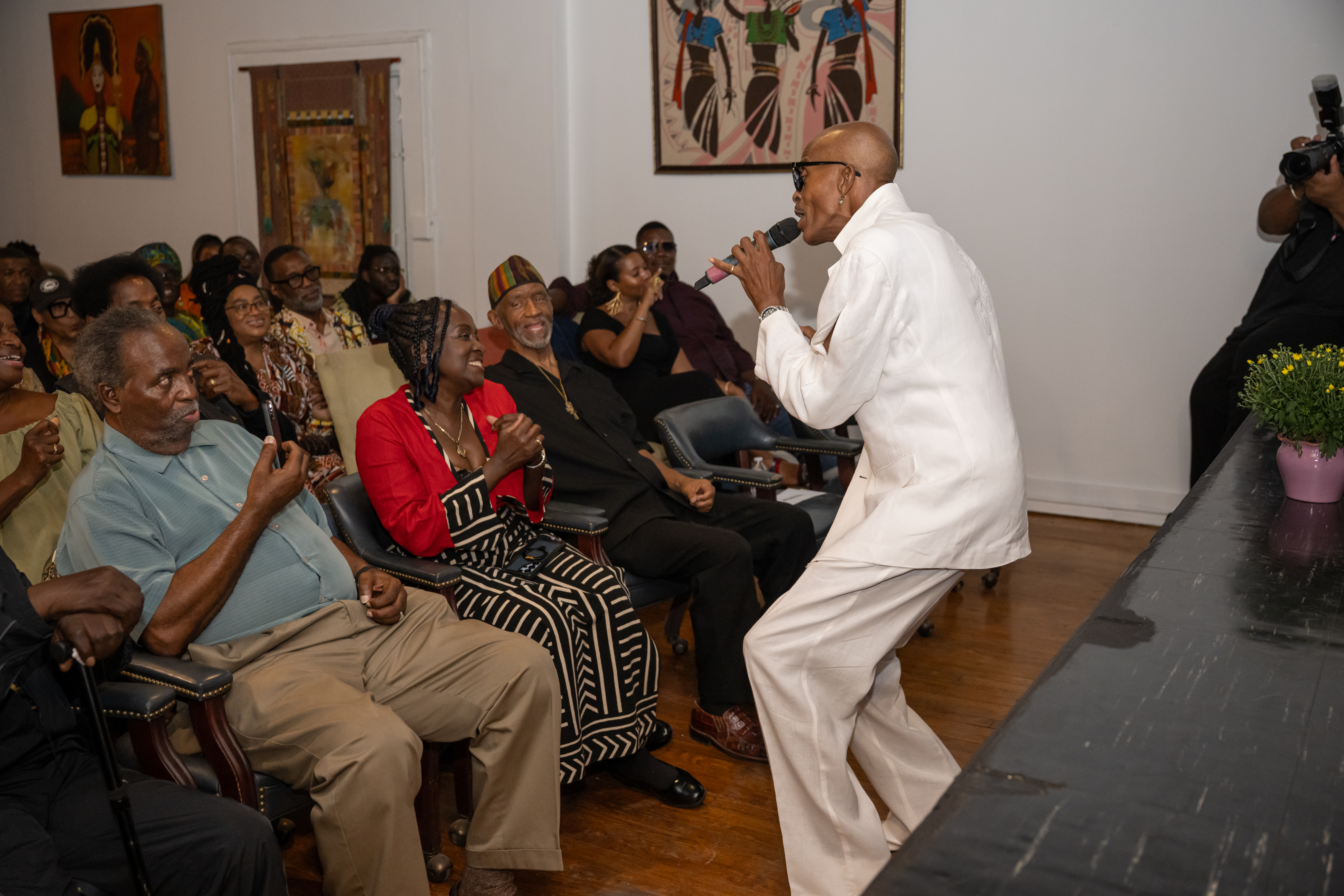
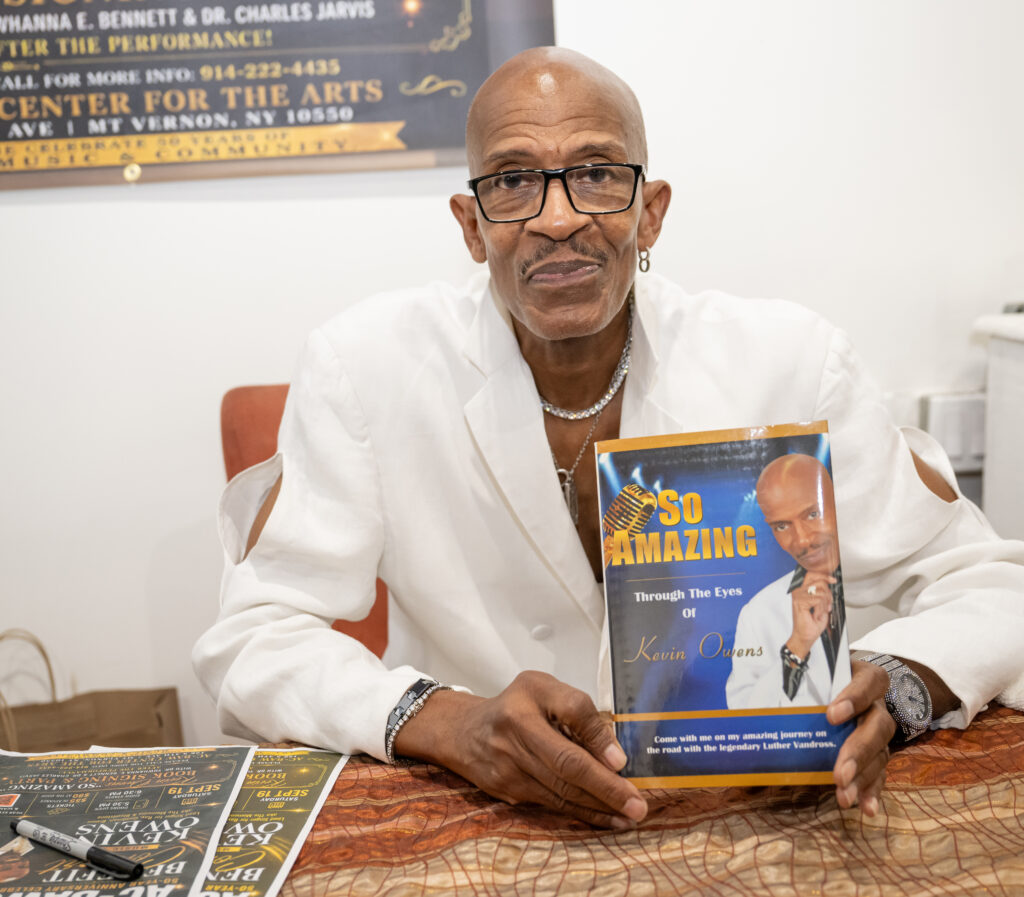
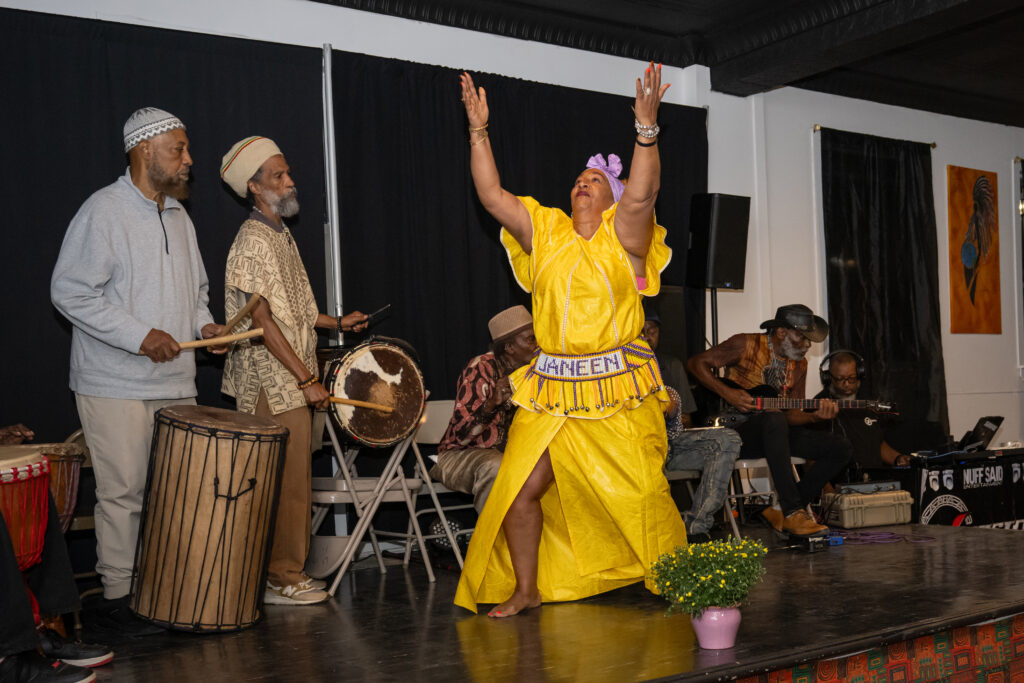
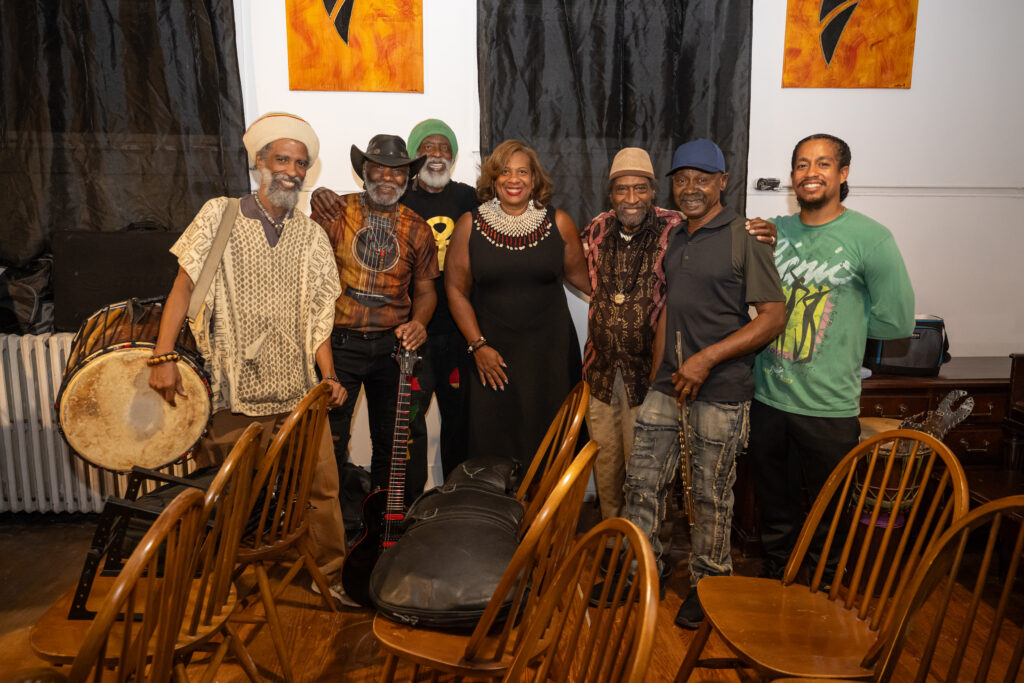
The anniversary celebration featured a special benefit concert by Kevin Owens, whose performance included a soulful Motown medley and a tribute to the late Luther Vandross. Owens spent more than 25 years performing as a background vocalist with Vandross, bringing a personal connection to the tribute and an added sense of musical history to the evening.
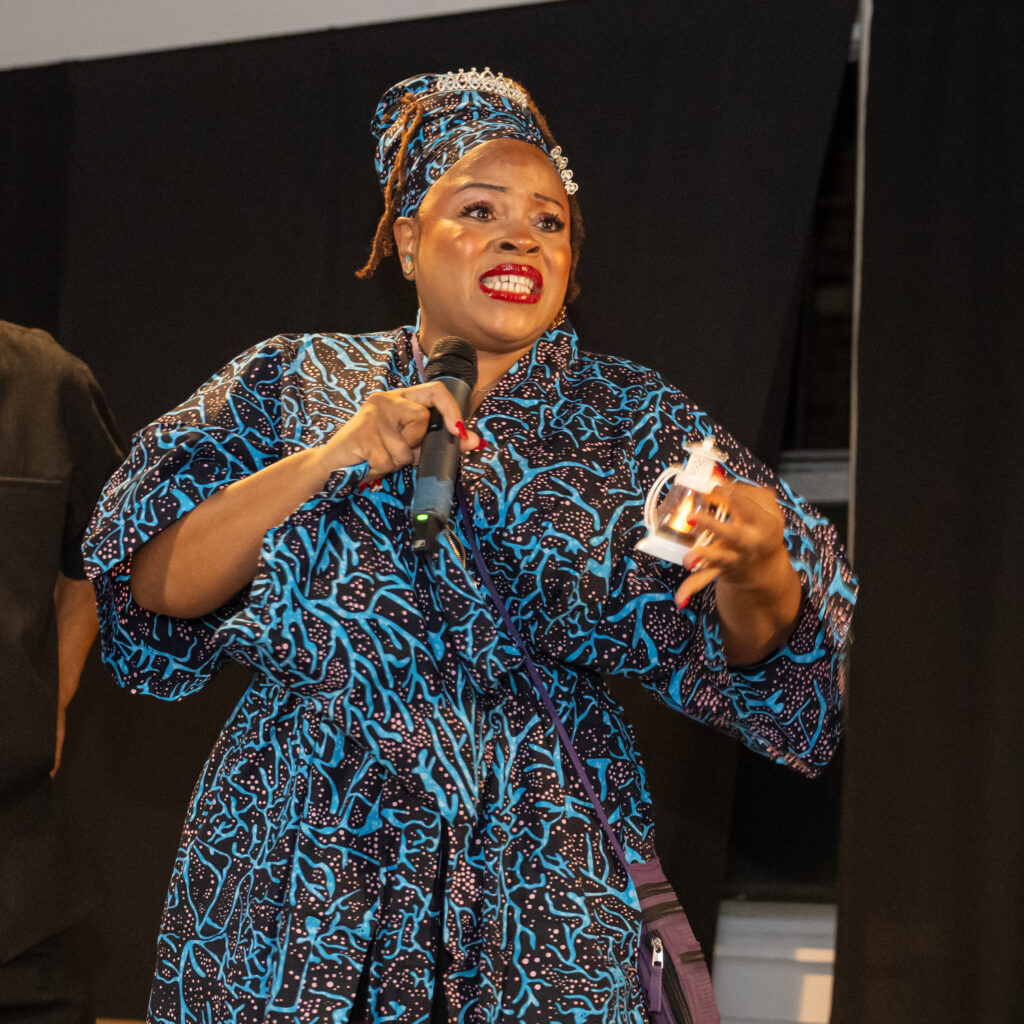
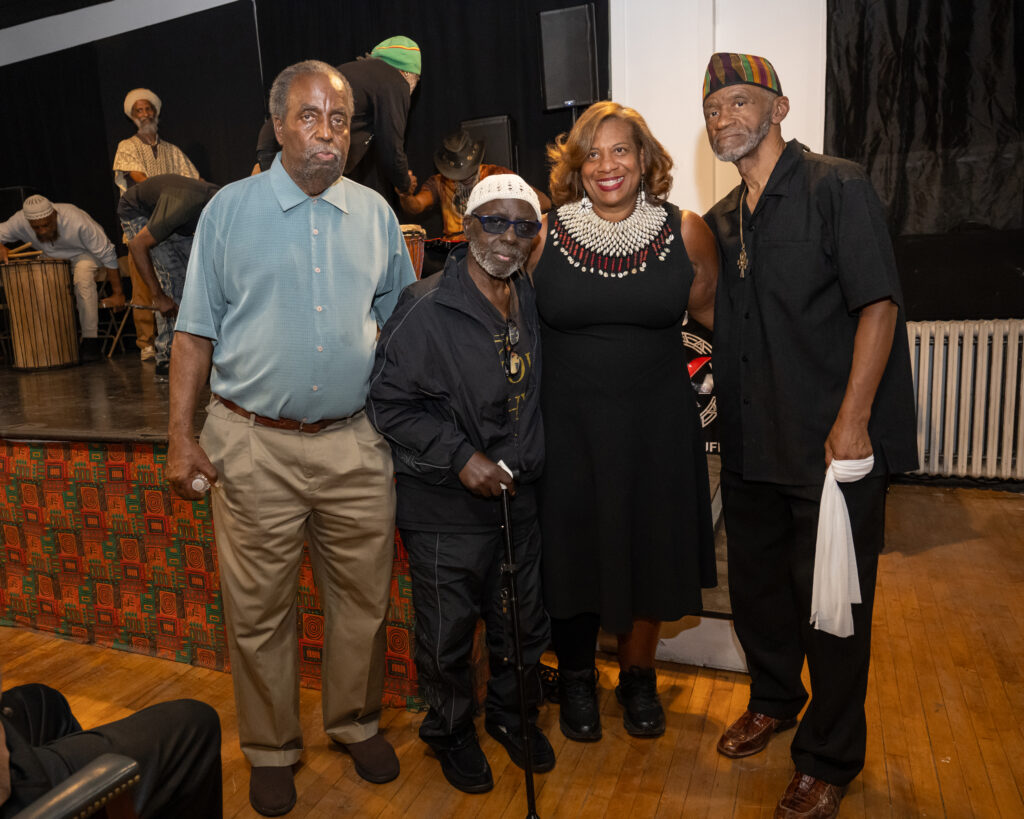
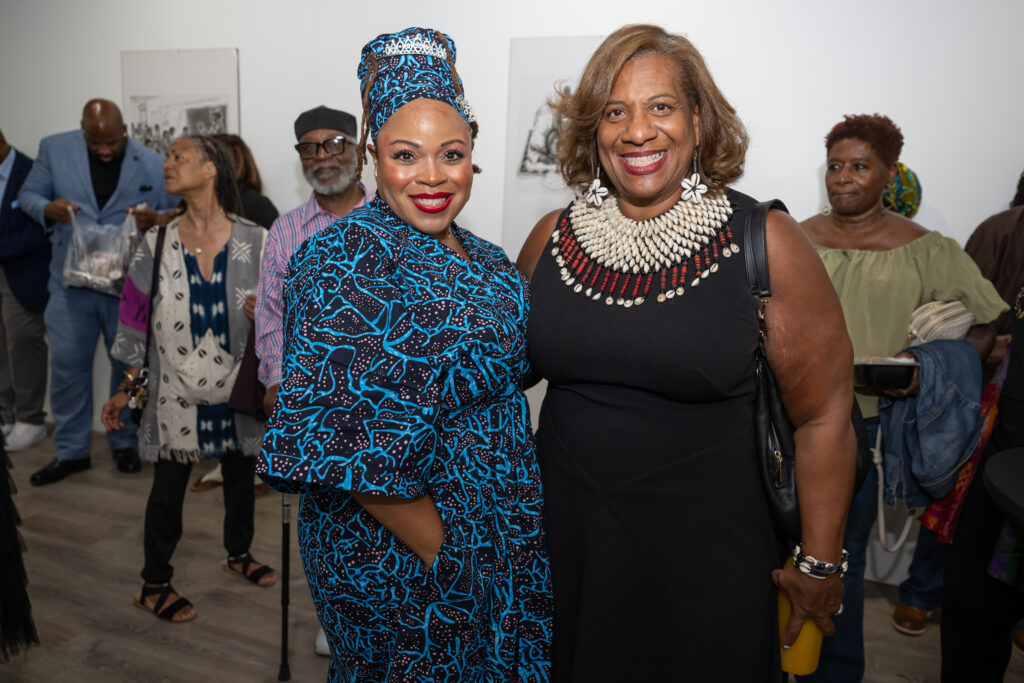
The concert brought together artists, community members, supporters, and longtime friends of AC-BAW to celebrate not only the organization’s five decades of service, but the restoration of a space that has played an important role in Mount Vernon’s cultural life.
Located at 128 South 4th Avenue, the AC-BAW Center for the Arts has long provided a home for artists, musicians, performers, exhibitions, concerts, lectures, and community programming.
Fifty Years of Art and Community
The Association of Community-Based Artists of Westchester, Inc., known as AC-BAW, was founded in 1976 by Mount Vernon artists with a mission to bring art and cultural programming into communities that historically had limited access to such opportunities. One of the organization’s earliest initiatives was Westchester Artists In The Streets, a summer arts program created to serve some of the county’s most underserved communities.
In 1980, AC-BAW rented an abandoned furniture store on Fourth Avenue and began transforming it into what would become an important cultural center in downtown Mount Vernon. The organization entered into a collaborative effort with the City of Mount Vernon, local banks and the Gannett Foundation, using arts and culture as part of a broader strategy to support commercial redevelopment in the community. The renovation itself reflected AC-BAW’s community-based mission. High school dropouts helped rebuild the facility, turning a vacant commercial space into a thriving arts institution. The gallery would later earn recognition as an arts critics’ choice for Gallery of the Year.
That same spirit of volunteerism and community service was on display during AC-BAW’s 50th-anniversary celebration. Davida Doso, Sarah Littlejohn, Sarija Terelonge and Leah LoBlack, four young women from the Mount Vernon Youth Bureau, volunteered throughout the benefit concert, taking on a variety of responsibilities and helping ensure that guests were welcomed and the evening ran smoothly.
“These remarkable young ladies volunteered at the AC-BAW concert and demonstrated true leadership, professionalism and community service,” AC-BAW Board Member Beverly Dohere shared with Black Westchester. “They took responsibility for several areas—from the front of the house to the upstairs and back sections—welcoming guests, offering assistance, escorting attendees to their seats, providing directions and helping the event run smoothly.”
“Their willingness to step forward, take the lead and serve others with kindness and confidence made a meaningful difference and reflected the very best of our community,” Dohere added.
Their participation provided a fitting connection between AC-BAW’s past and its future. More than four decades after young people helped physically rebuild the center, another generation of Mount Vernon youth was there to volunteer, serve and help carry forward the institution’s tradition of community involvement, leadership and cultural service.
Over the decades, AC-BAW brought world-class exhibitions, concerts, and lectures to downtown Mount Vernon while providing opportunities for local artists and creating a gathering place for creative expression. The center came to be regarded by its supporters as the cultural heart and hope of downtown Mount Vernon.
Rebuilding the Center — Again
That history made Saturday’s grand reopening particularly significant.
Ahead of the 50th-anniversary celebration, the historic center underwent extensive renovations, with much of the restoration carried out through a volunteer-led effort. Supporters and community members worked by hand to rebuild and revitalize the facility so it could once again serve artists and residents.
In many ways, the effort echoed the spirit in which the original Fourth Avenue center was created decades ago — people coming together, investing their own labor and believing that arts and culture have a place in the redevelopment and future of Mount Vernon.
The reopening, therefore, represents more than the restoration of a building.
It represents the continuation of a vision that began in 1976: using art, culture, and community engagement as tools for education, opportunity, economic development, and neighborhood revitalization.
A New Chapter on the Avenue
As AC-BAW enters its next era, the organization is again looking toward partnerships with artists, schools, community organizations, arts patrons and the City of Mount Vernon to expand its cultural programming and strengthen its role downtown.
Its longtime vision of blending culture and commerce “On The Avenue” remains particularly relevant as Mount Vernon continues conversations about revitalizing its downtown business district.
Fifty years after a group of Mount Vernon artists first came together to create the Association of Community-Based Artists of Westchester, AC-BAW is still standing — and, following its restoration, once again opening its doors to the community.
Saturday’s celebration was both a tribute to what came before and a declaration that the story is not finished.
After 50 years of exhibitions, music, education, community building, and cultural advocacy, the AC-BAW Center for the Arts is beginning its next chapter in the heart of Mount Vernon.
All Photos by Barry Mason. Barry Mason is a photographer and painter living in Mount Vernon. He was educated at The Corcoran School of Art and Indiana State University. His commercial photography clients include: GE, L’Oreal, American Legacy Magazine. He has taught photography at Horace Mann School, ArtsWestchester, UJAMMA, and for many years worked at CBS Corporation.
As Westchester Looks Toward Its 2027 Budget, Nonprofits Are Preparing for Greater Demand, Federal Policy Changes, and Harder Choices
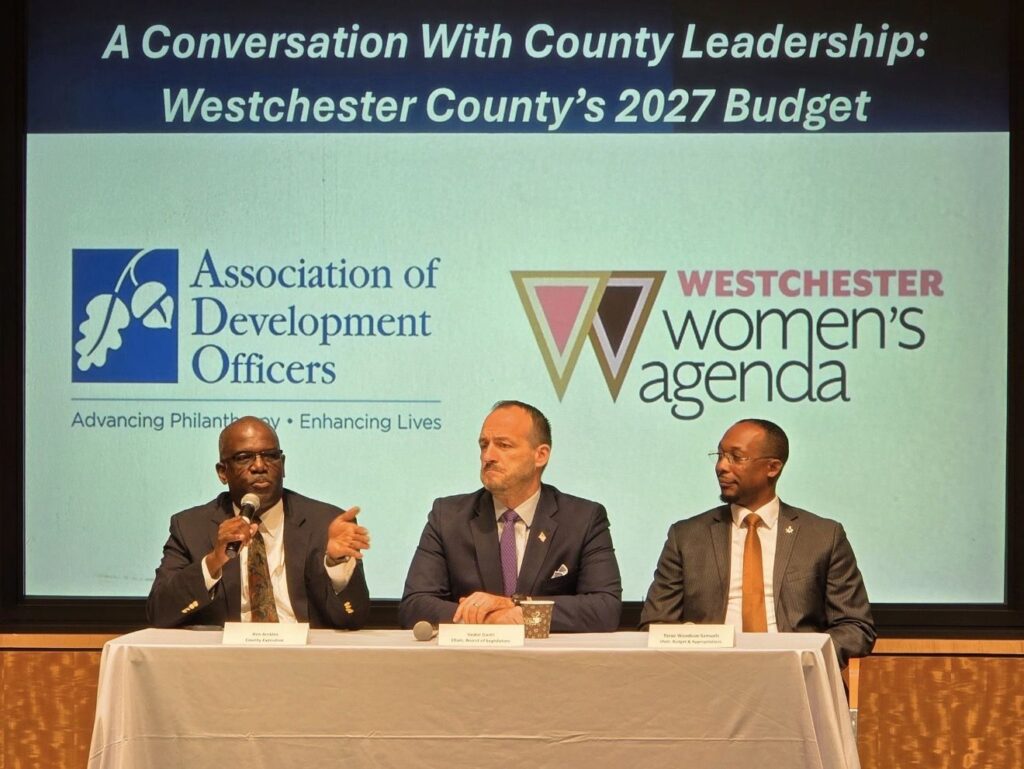
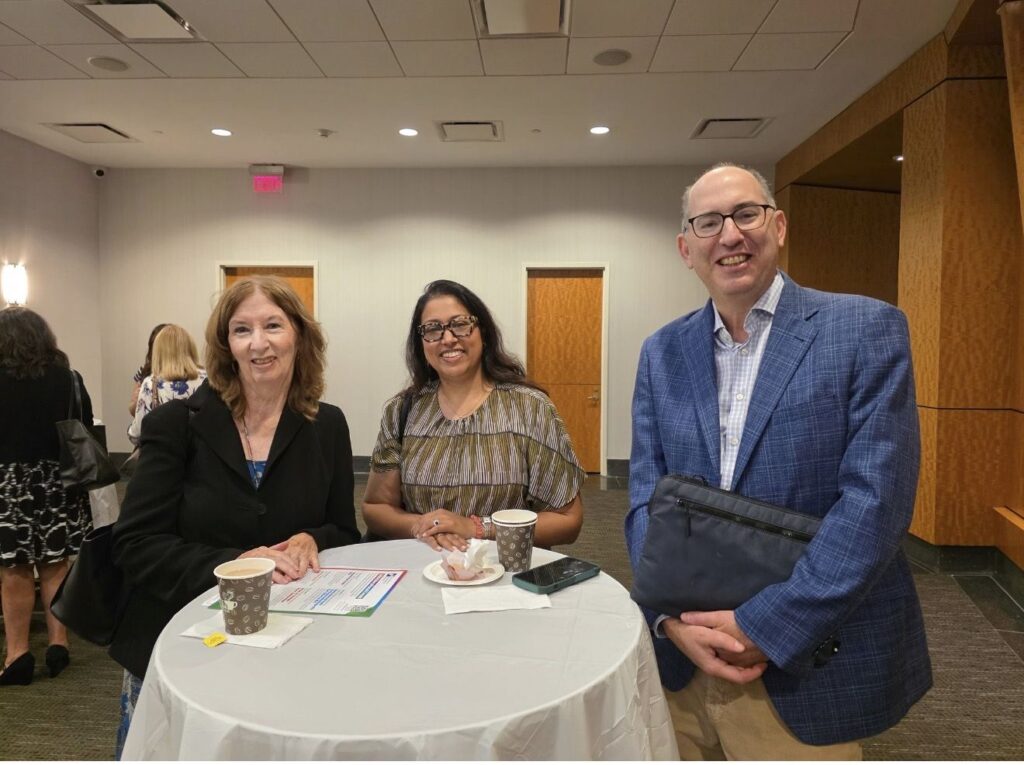
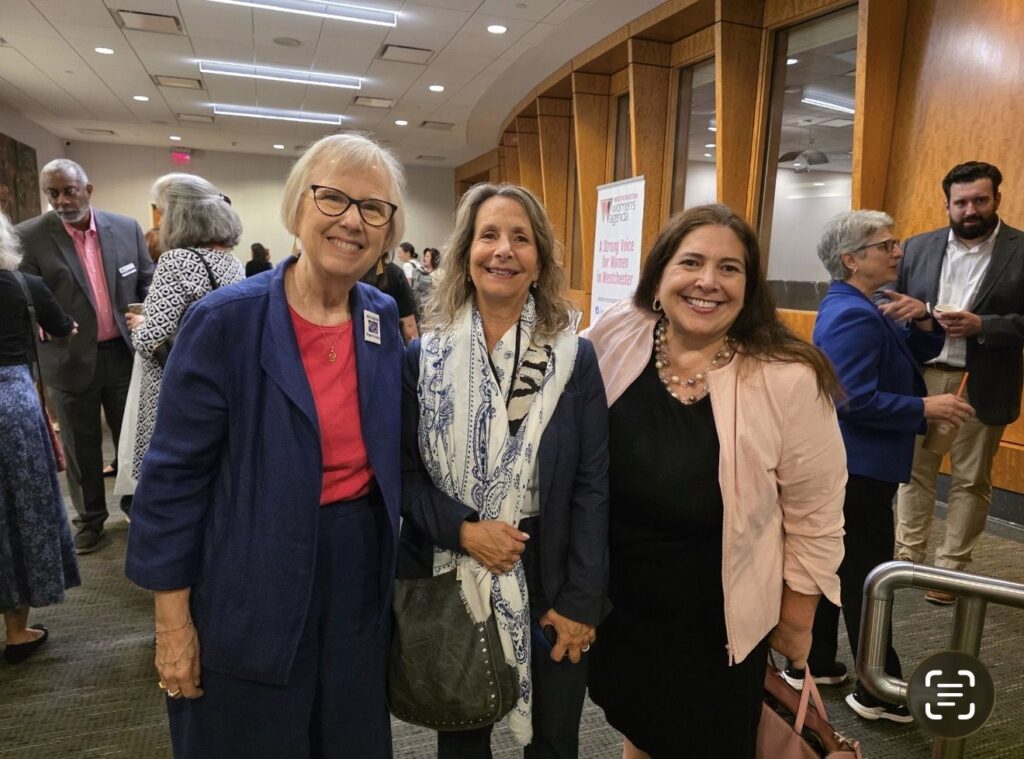
All Words by Larnez Kinsey – All Photos by Hillary Millman, Executive Director of Association of Development Officers (ADO)
The government has a remarkable way of giving a cut a respectable name. A cost shift. An eligibility change. An administrative adjustment. A reduction in federal expenditures. Those phrases sound clean in a budget document, but they sound very different when you are standing in a food pantry trying to figure out how you are going to feed your family. Government calls it policy. You call it groceries.
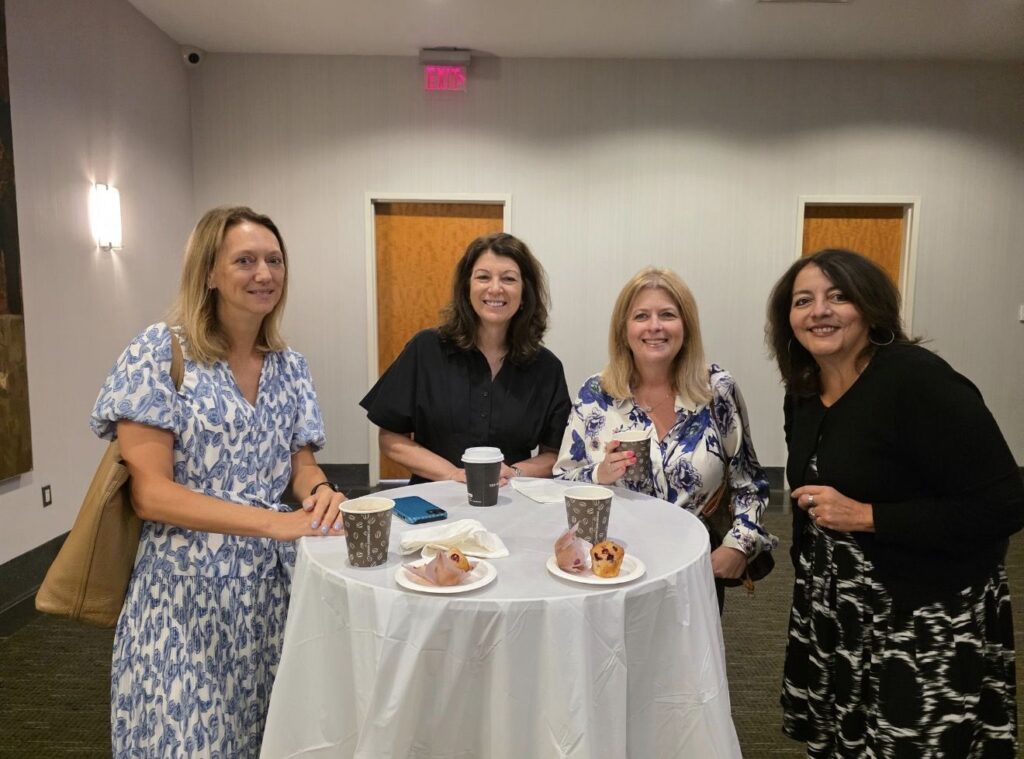
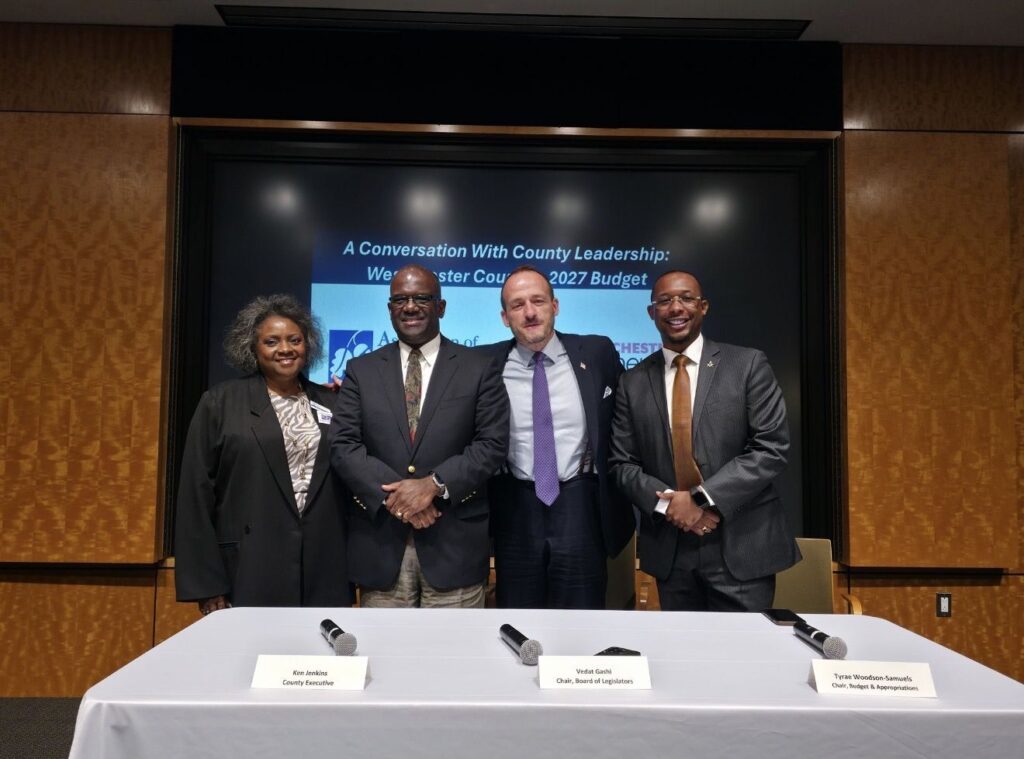
That was what stayed with me after attending “Westchester’s 2027 Budget: A Conversation with County Leadership” on September 18 in White Plains, co-sponsored by the Westchester Women’s Agenda (WWA) Public Policy Committee and the Association of Development Officers (ADO). The organizations created space for nonprofit leaders to sit directly with Westchester County Executive Kenneth W. Jenkins, Board of Legislators Chairman Vedat Gashi, and Budget & Appropriations Committee Chair Tyrae Woodson-Samuels to discuss the pressures facing the nonprofit sector as Westchester looks toward its 2027 budget. Rising demand, operating costs, and uncertainty surrounding public and private funding were not side conversations. They were the reason for bringing these sectors into the same room.
The numbers explain why that conversation matters. The Congressional Budget Office projects that the 2025 federal reconciliation law will reduce federal SNAP spending by approximately $211 billion through 2035 through provisions expected to reduce participation and average benefits while shifting additional costs to states. The law also expanded work requirements and increased states’ share of SNAP administrative expenses from 50 percent to 75 percent.
A federal government can reduce an expenditure on paper. It cannot eliminate the human need attached to it. A family with less money for food still has to eat. A resident experiencing housing instability still needs somewhere to sleep. Eventually, some of that pressure reaches food pantries, churches, shelters, and community organizations.
Jenkins spoke about Westchester’s work around SNAP, recertification, and communication with residents, while also addressing food insecurity, homelessness, and shelter capacity. What stood out was the recognition that there is no magical pot of money waiting to replace every resource that becomes constrained. When funding shifts at one level of government, somebody further down the line has to confront the consequences.
That is where we need to stop using the word “partner” so casually. We call nonprofits community partners when we need them to feed families, mentor children, support survivors, train workers, and reach residents government sometimes struggles to reach. Partnership cannot mean handing those organizations more human need while expecting them to absorb the cost. They have payroll, rent, insurance, technology expenses, and employees with families of their own. Compassion does not exempt anybody from an electric bill.
There is accountability on the nonprofit side too. Jenkins raised the importance of organizations working together and making limited resources go further. Collaboration, shared services, and reducing unnecessary duplication should be part of the conversation. But efficiency cannot become a polite word for abandonment. Working smarter does not manufacture resources that do not exist.
What WWA and ADO created was more than another nonprofit meeting. They created an opportunity for organizations seeing community needs up close to speak with county officials responsible for making difficult fiscal decisions. That kind of access matters, but its value will ultimately be measured by what happens after everybody leaves the room.
As I listened, I kept thinking about another federal conversation happening right now: the Community Reinvestment Act. Before leaving, I personally invited County Executive Jenkins to participate in the African American Chamber of Commerce of the Hudson Valley’s CRA Comment Lab. If county leaders are preparing for tighter public resources, I want them in the room while communities still have an opportunity to influence another important part of the community-investment system.
CRA is not SNAP, and bank investment cannot replace government benefits. But the Community Reinvestment Act addresses how federally regulated banks help meet credit needs in their communities, including low- and moderate-income neighborhoods. Federal regulators are currently considering changes to CRA regulations, and the official public-comment deadline is October 13, 2026.
That deadline matters. Westchester nonprofits, chambers, housing advocates, small-business organizations, and residents have an opportunity to tell federal regulators what community investment looks like from the ground. If we are discussing how communities will withstand increasing economic pressure, then we need to understand the major systems through which resources reach them, not just the county budget.
Westchester’s 2027 budget conversation also has to move beyond organizations simply saying they need more money. Which programs are preventing residents from reaching a crisis? Where are services being duplicated? What government requirements consume nonprofit resources without improving outcomes? Where could an investment today prevent a more expensive intervention tomorrow?
Nonprofits should bring receipts. If your pantry served 600 households last year and 850 this year, document it. If your waiting list doubled, show it. If reimbursement delays create cash-flow problems, explain the impact. If an investment in prevention keeps residents from entering a far more expensive emergency system, demonstrate the return. Government should bring its receipts too. When leaders say resources are limited, residents deserve to understand how priorities are being determined and which investments are producing measurable results.
The county budget process and the federal CRA rulemaking are separate conversations involving different laws, responsibilities, and resources. But both lead to a question communities should ask before somebody else answers it for us: Who gets invested in?
That question matters across Westchester, especially where nonprofits may be one grant away from cutting a program while receiving more calls from residents asking for help. The next year cannot simply be about surviving federal policy changes. It has to be about identifying resources, removing barriers to accessing them, demanding measurable outcomes, and ensuring communities are present when investment decisions are made.
The most expensive point to discover that the safety net has a hole is after somebody has already fallen through it. Washington can change the rules. Albany can inherit new obligations. Westchester can establish its priorities. Banks can determine where capital flows. Nonprofits can collaborate and innovate. But none of those institutions can budget human need out of existence. If we already know the pressure is coming, waiting for families to reach crisis may be the most expensive decision of all.
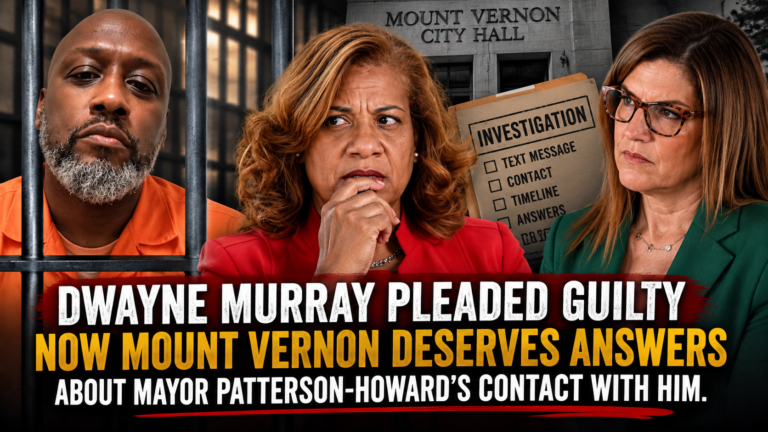
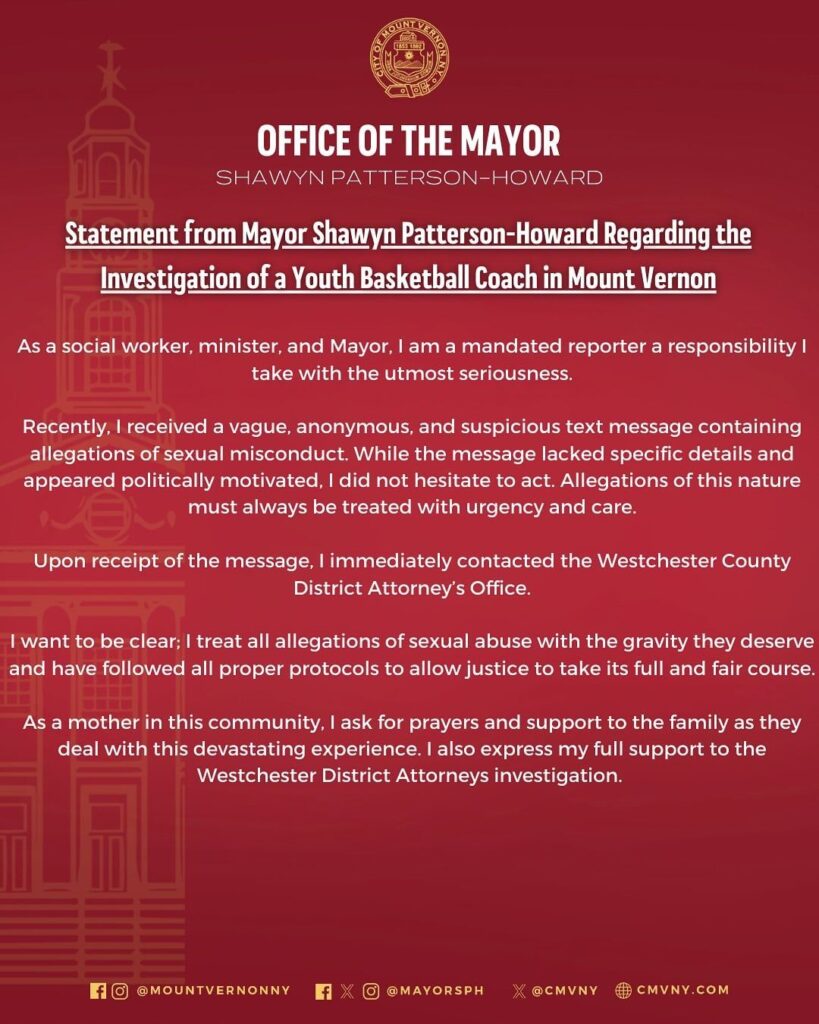
Murray has admitted to having sexually abused a child. Although his guilty plea settles the criminal issue, it once again raises the question at the heart of this story: why did Mayor Shawyn Patterson-Howard contact Dwayne Murray after receiving a message that did not mention him?
Dwayne Murray had continued to publicly deny the accusations that affected Mount Vernon for over a year. On 18th September 2026, the criminal issue concerning the well-known youth basketball figure was settled in court, where Murray admitted to committing the crime of Course of Sexual Conduct Against a Child in the First Degree, a Class B violent felony involving a girl who was under the age of 13. He is expected to receive 18 years’ imprisonment in state prison, followed by 20 years of post-release supervision, when he is sentenced in November.
Murray’s guilty plea shows he accepts responsibility for the crime he pleaded guilty to, but it does not address another question that has arisen about this case since 2025. Specifically, what happened on April 28, 2025, between Mayor Shawyn Patterson-Howard receiving a message about an unnamed individual and her acknowledged contact with Dwayne Murray? More than a year after the event, Mount Vernon voters and taxpayers still deserve a full explanation.
THE MESSAGE DID NOT NAME DWAYNE MURRAY
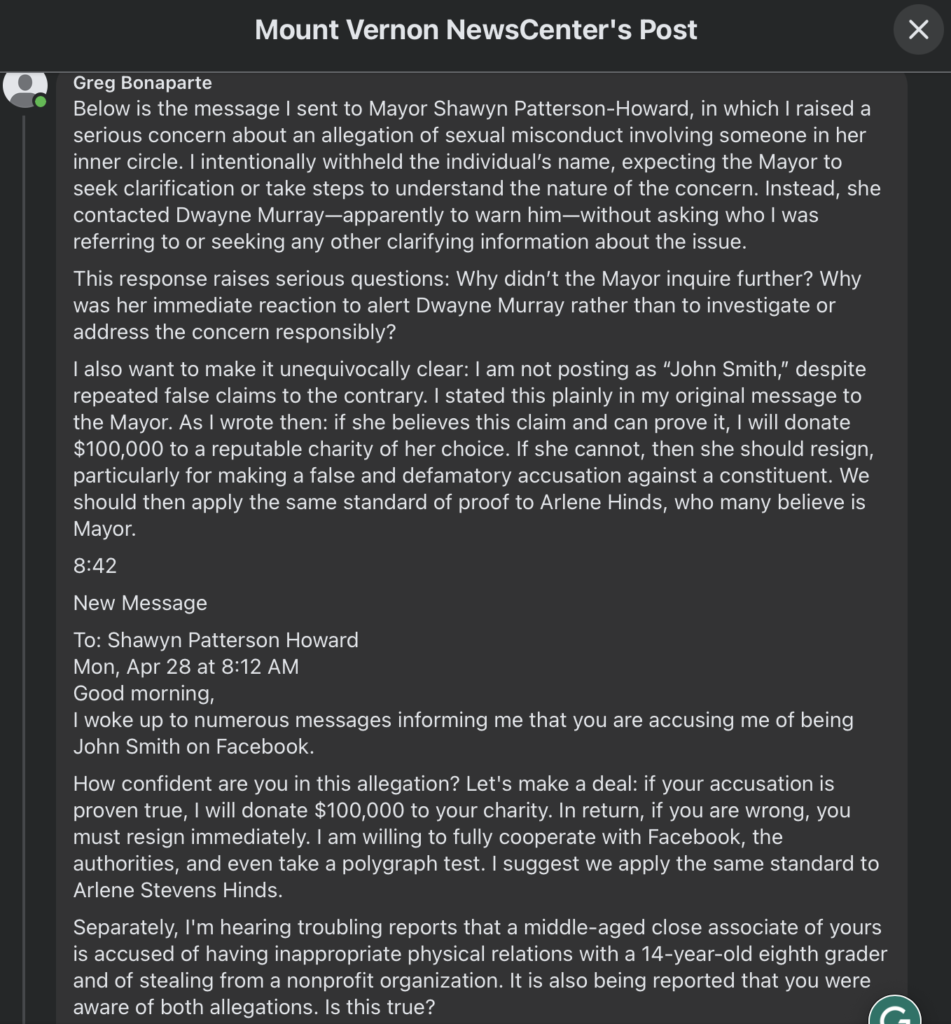
Greg Bonaparte has made public the message he says he sent to Patterson-Howard at 8:12 a.m. on April 28, 2025. In the screenshot, Bonaparte said that he had heard serious reports concerning a ‘middle-aged close associate’ of the mayor who was accused of having inappropriate physical relations with a 14-year-old eighth grader and also referred to an allegation involving a nonprofit organization, asking Patterson-Howard if she was aware of the allegations.
The message does not mention Dwayne Murray’s name. Bonaparte has already said he deliberately omitted the person’s name because he expected the mayor to ask who was being referred to or to request clarification about the information he had given.
Bonaparte goes further in his public statement by claiming that Patterson-Howard contacted Murray to warn him. That is Bonaparte’s claim, and it must be presented as such since the available evidence on its own does not prove the mayor’s intention. Nevertheless, we need not accept Bonaparte’s interpretation of the mayor’s motives to see the clear question the message raises: if Bonaparte had not told Mayor Patterson-Howard the conversation was about Dwayne Murray, how did she link that message specifically to Dwayne Murray?
DWAYNE MURRAY SAID IT IN HIS OWN WORDS
This is where the story becomes even more significant: Patterson-Howard’s communication with Murray doesn’t stem solely from Bonaparte or the lawsuit; Murray confirmed it in his own words. Before his arrest, he said publicly that on April 28 he “had a chat with Mayor Shawyn Patterson-Howard” and that “she told me she got a text message.”
This acknowledgment matters because it links Murray directly to the April 28 incidents. Although the message Bonaparte displayed does not name Murray, Murray said Patterson-Howard spoke to him and told him he had received a text message. Together, these two facts fill a gap in the timeline that has never been properly explained to the people of Mount Vernon.
Had Patterson-Howard already had information linking Murray to the allegations of sexual misconduct? Was it someone other than Bonaparte who told her about Murray after his message had arrived? Has she had further information which has never been made public? Did she get in touch with Murray and ask him whether the allegation was about him? Although there may be a completely reasonable explanation, the public still doesn’t know it more than a year later.
THE MAYOR’S OWN STATEMENT DOESN’T ANSWER THE QUESTION
Following Murray’s arrest, Mayor Patterson-Howard released an official statement about the inquiry. She described herself as a social worker, a minister, a mayor, and a mandated reporter, and said she takes this duty with “utmost seriousness”. She explained that she had received a “vague, anonymous and suspicious text message with accusations of sexual misconduct”. She added that the message lacked specific details and seemed politically motivated.
The mayor then made a statement essential to understanding this timeline. “As soon as I received the message, I got in touch with the Westchester County District Attorney’s Office,” Patterson-Howard said, adding that she had adhered to the proper procedures and had expressed her support for the District Attorney’s investigation.
That is how the mayor has presented her official version of the situation, and it should be given a fair hearing. However, her statement does not clarify her dealings with Murray. If Patterson-Howard had contacted the District Attorney’s Office right away, when was she in contact with Murray? Was the District Attorney contacted first and Murray contacted afterward, or was Murray contacted before the District Attorney? The use of the word ‘immediately’ means that it is all the more important to establish the actual order of events.
Even if Patterson-Howard contacted the prosecutors first, one question remains: why did she then contact Murray? If the case had been handed over to law enforcement, did anyone from the District Attorney’s Office tell her to speak to Murray? If she had not been instructed to contact him, what was the point of the conversation? Most important of all, how did she know that the person mentioned in Bonaparte’s message, the one not named, was Murray?
THE DISTRICT ATTORNEY WAS ALREADY INVESTIGATING MURRAY
The importance of the timeline is increased by the fact that Patterson-Howard’s communication on April 28 did not initiate the criminal investigation into Murray; District Attorney Susan Cacace made it public after Murray was arrested that her office had received a tip about Murray on April 12, 2025, more than two weeks prior to Bonaparte sending his message to Patterson-Howard on April 28.
That distinction matters because it would be wrong to say the mayor received the complaint and then passed it on to the prosecutors, thereby starting the investigation. The DA had already been looking into Murray on his own. Later, Patterson-Howard got another message that didn’t mention Murray, went to the District Attorney’s Office, as she herself stated, and also talked to Murray, as Murray has publicly stated.
On May 5, Murray came forward and denied the accusations, calling them false and saying he was willing to answer investigators’ questions. He was arrested on May 14, and at the press conference held by the District Attorney the next day, Cacace said that Murray had made statements about his involvement in the crime during an interview with the investigators. Over a year later, Murray has now entered a formal guilty plea.
THE LAWSUIT MADE AN EVEN MORE SERIOUS ALLEGATION
The lawsuit filed in 2025 went beyond what Murray had publicly admitted about his communications with Patterson-Howard; it claimed the mayor called Murray to City Hall and showed him Bonaparte’s message before his arrest. Patterson-Howard denied the lawsuit and described it as being politically motivated. The allegations about her behavior remain disputed, and Murray’s guilty plea does not prove the claims against Patterson-Howard in the lawsuit.
That distinction matters because Murray’s criminal behavior and Patterson-Howard’s actions are separate issues, and each requires independent evidence. Murray’s guilty plea shows he is responsible for the offense to which he pleaded guilty; it does not show what Patterson-Howard knew on April 28, what her intentions were, why she contacted Murray, or what information she gave him.
Accountability functions in both directions. It is not proper to take Murray’s guilty plea as automatic proof against Patterson-Howard, nor should the contested status of the lawsuit be used as an excuse to ignore valid questions regarding her admitted communications with Murray. A clear distinction exists between accusing the mayor of wrongdoing and asking the mayor to explain what took place.
THE DISTRICT ATTORNEY SHOULD CLARIFY THE TIMELINE
Now the Westchester County District Attorney’s Office is in a special position to make clear the law-enforcement aspect of this timeline; it knows when its investigation started, has already stated that it received its first tip on April 12 and should have the records showing when Patterson-Howard or someone acting on behalf of City Hall contacted the prosecutors on April 28.
The public does not need confidential details concerning the child victim, and no information should be made public that infringes on her privacy or breaches information that is legally protected. However, Mount Vernon voters and taxpayers have a right to know—so far as the law allows—whether the mayor contacted the District Attorney’s Office and whether the prosecutors instructed, advised, or otherwise expected her to speak to Murray.
The court should establish whether the mayor contacted the DA first or whether Murray was contacted first. If the prosecutors were contacted first but did not advise Patterson-Howard to speak to Murray, the mayor should explain why the contact with Murray then took place. The public shouldn’t have to guess about a matter that timestamps, telephone records, emails, or other documentation could establish.
RELEASE THE APRIL 28 TIMELINE
That is why the full April 28 timeline matters. The screenshot Bonaparte took indicates he sent his message at 8.12 a.m. The time when Patterson-Howard contacted the District Attorney’s Office should be identifiable. Likewise, the time she communicated with Murray should be identifiable, as should the means of communication—whether by telephone, text, an in-person meeting, or a combination of those methods.
It is just as important to consider the content of the communication. Was Murray merely informed that the mayor had received a complaint, or was he given specific details? Was he told who sent the message? Was he shown the message? Did Patterson-Howard ask Murray if Bonaparte was referring to him? Such questions are fundamental when assessing the actions of a public official during an extremely serious criminal investigation.
If the records show that Patterson-Howard contacted the prosecutors first and then spoke with Murray without disclosing anything that could have compromised the investigation, then those facts should be made public. If the records show something else, residents also have a right to be told. Transparency must not be based on whether the information makes City Hall look good or bad; it is about revealing what actually took place.
THIS IS ABOUT ACCOUNTABILITY, NOT POLITICAL TEAMS
Mount Vernon has spent too many years turning reasonable questions regarding government into political conflicts. When you ask a question about an elected official, someone immediately wants to know which side you’re on; when you request records, someone says you have an agenda; and when you challenge an official explanation, the discussion soon turns into one about personalities and politics rather than facts.
It must not happen here. A child had been sexually abused, and a well-known member of the community who worked with young people had publicly denied the accusations before eventually pleading guilty to a violent felony involving a child. People from all political backgrounds should want an accurate historical record of this case.
We aren’t interested in the one put forward by the Democrats, the one by the Republicans, the one from City Hall, or the one on social media. We want the version based on documentation. Bonaparte has made clear what he claims to be his original message. Murray, in his own words, admitted that he had correspondence with Patterson-Howard. Patterson-Howard, in her own words, said that she got in touch with the District Attorney at once. The District Attorney said its investigation began more than two weeks earlier.
MOUNT VERNON DESERVES THE ANSWERS
If you combine all the facts, the questions then become simple: How did Mayor Patterson-Howard know that the unnamed ‘middle-aged close associate’ of Bonaparte was Dwayne Murray? Why did she talk to Murray about the message? What specific information was passed on to him? And which one of them was contacted first on April 28, 2025—the Westchester County District Attorney’s Office or Dwayne Murray?
The questions do not assume that the answers are known, nor do they claim that Patterson-Howard acted improperly. They are questions voters and taxpayers are fully entitled to ask when an elected official says he reported the allegations to the authorities and the person at the heart of the later criminal prosecution says she told him she received a text message.
Although Dwayne Murray’s criminal case is drawing to a close, Mount Vernon should not let its questions about April 28, 2025, vanish as a result. The mayor should explain her communications with Murray, the District Attorney should make clear the law-enforcement timeline as far as the law allows, and the records must show the order of events. Provide the voters and taxpayers with the facts and let the people of Mount Vernon come to their own conclusions.
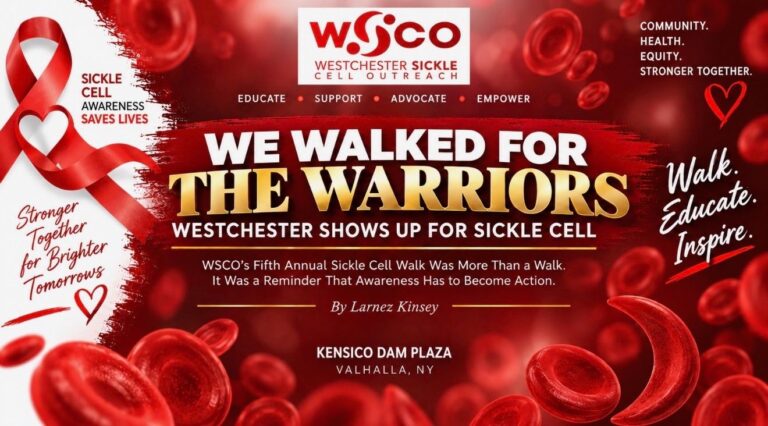
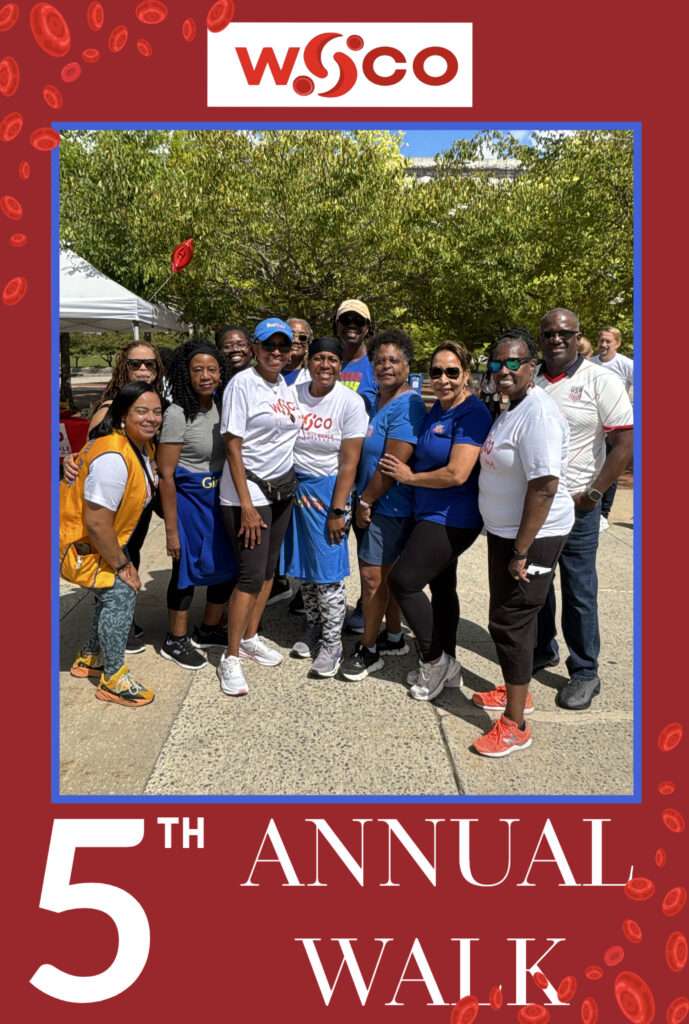
WSCO’s Fifth Annual Sickle Cell Walk Was More Than a Walk. It Was a Reminder That Awareness Has to Become Action
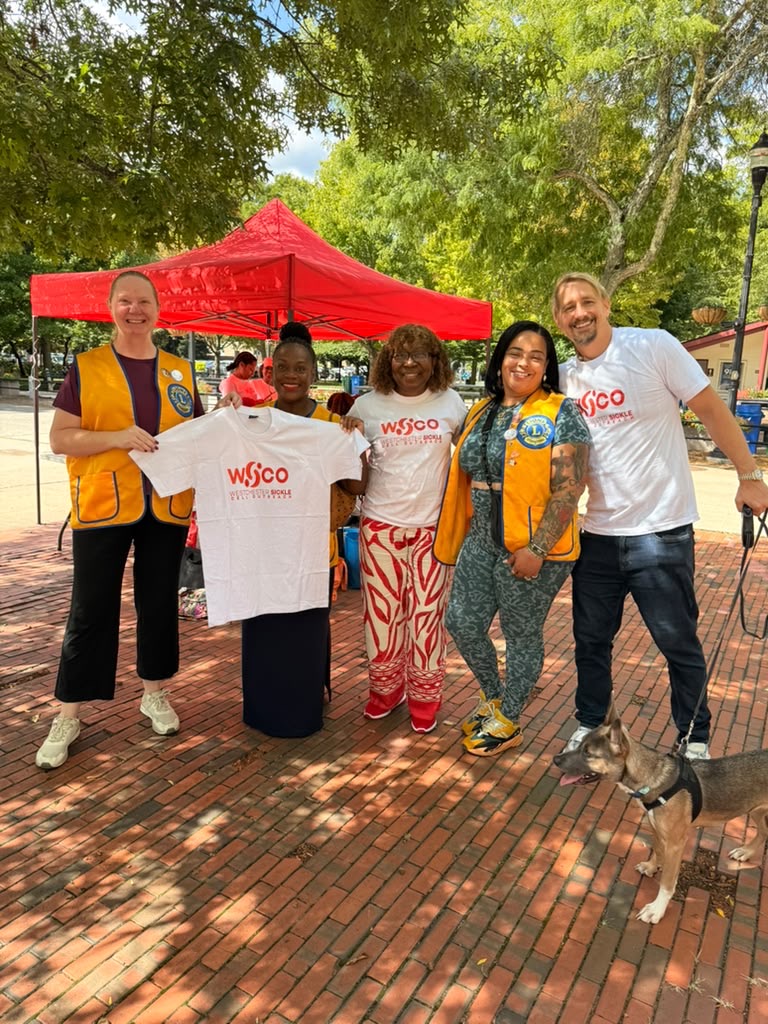
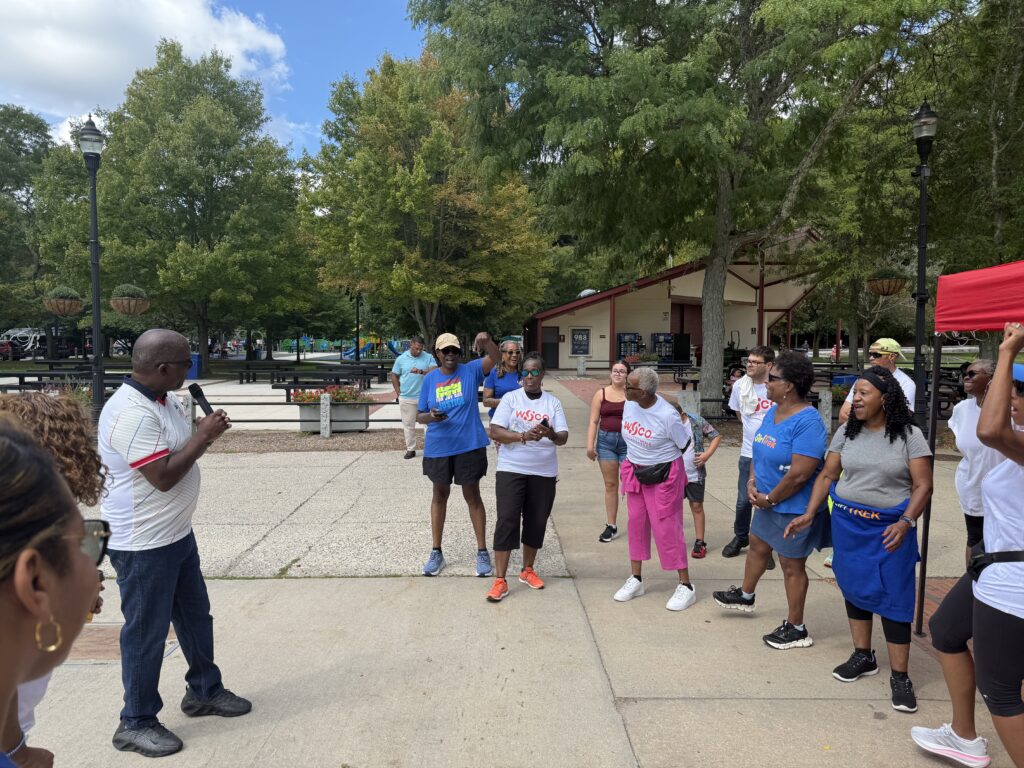
There are some Saturdays when you get up, handle your errands, catch up on life, and keep it moving. Then there are Saturdays when showing up means something. On Saturday, September 5, 2026, from 11 a.m. to 3 p.m., at Kensico Dam Plaza, 1 Bronx River Parkway in Valhalla, New York, families, advocates, elected officials, community organizations, and neighbors gathered for the Westchester Sickle Cell Outreach Fifth Annual Sickle Cell Walk for Education. The assignment was bigger than getting our steps in. We were walking for people living with sickle cell disease, for families who have learned how to navigate pain other people cannot see, and for a community that deserves to be seen, heard, funded, and supported.
Sometimes we hear the words sickle cell so often that we forget there are actual people behind them. Somebody’s daughter. Somebody’s son. Somebody’s mother. Somebody trying to get through a workday while managing pain. Somebody sitting in an emergency room trying to explain what their body is experiencing. Somebody exhausted from having to educate other people about an illness they already have to live with. Awareness cannot simply mean knowing sickle cell exists. Awareness should move us toward caring about the people living with it.
That is why leadership showing up mattered. Westchester County Executive Kenneth W. Jenkins and U.S. Representative Mike Lawler were among the elected officials in attendance, while White Plains was represented by Common Council Members Jeremiah Frei-Pearson and Valerie Simmons. Their presence created something more important than another photo opportunity: an opportunity for people closest to this issue to be in the same space as people positioned to influence public priorities.
They were joined by Symra Brandon, former Westchester County Legislator for District 16 and Director of Community Affairs for New York State Senate Majority Leader Andrea Stewart-Cousins, as well as Rev. Kym McNair, Westchester County Director of Faith-Based Initiatives. Community leadership was equally present, including Dr. Cheryl Brannan of Sister to Sister International, the Ann Sullivan White Plains Lions Club and GirlTrek Westchester. Government, service organizations, health advocates and residents were occupying the same space around an issue that deserves sustained attention.
Sickle cell awareness cannot live only inside hospitals and doctors’ offices. The conversation has to reach our churches, schools, barbershops, beauty salons, civic organizations and family gatherings. Sometimes the first person who encourages somebody to ask another question, learn their family history, or seek additional information isn’t wearing a white coat. Sometimes it’s your walking partner, your Lion, your neighbor, or somebody who loves you enough to say, “Please go get checked.”
For the Ann Sullivan White Plains Lions Club, service is supposed to leave the meeting room. For GirlTrek Westchester, whose work centers movement, wellness, and community among Black women, there is something especially meaningful about putting actual footsteps behind a health cause. When civic organizations stand beside advocates, families, healthcare professionals, and government representatives, a walk becomes more than symbolic. It becomes an example of what community partnership can look like when everybody brings their lane to the same mission.
The presence of elected officials should mean listening, too. Listen to the person living with sickle cell. Listen to the parent who has navigated the healthcare system. Listen to the advocate trying to keep a community organization funded. Listen to the family that knows what a crisis looks like at two o’clock in the morning. The people closest to a problem often understand things that will never fit neatly into a briefing memo, and events like this create an opportunity for those experiences to reach decision-makers directly.
That is also why the work of Westchester Sickle Cell Outreach deserves support beyond one September afternoon. The walk creates visibility and brings new people into the conversation, but people living with sickle cell wake up the next morning still living with sickle cell. Families still need information. Advocacy still requires resources. Programs still need funding, and organizations doing this work need partners who remain engaged after Kensico Dam Plaza gets quiet again.
So here is the call to Westchester: turn awareness into something tangible. Donate what you can. If you own a business, explore sponsorship. If you belong to a church, union, fraternity, sorority, chamber, civic organization, or professional network, introduce WSCO to people who should know its work. If you have expertise in healthcare, fundraising, communications, advocacy, or community engagement, ask how your skills can help. Caring becomes powerful when somebody can actually use it.
What happened on September 5 at Kensico Dam Plaza was a reminder of what Westchester can look like when government, civic organizations, advocates, and residents move around a common purpose. The walk may have ended that afternoon, but the responsibility didn’t.
Keep educating. Keep advocating. Keep opening doors and investing in the organizations doing the work. People living with sickle cell don’t get to take the disease off when the event ends, so our commitment to them shouldn’t end there either.
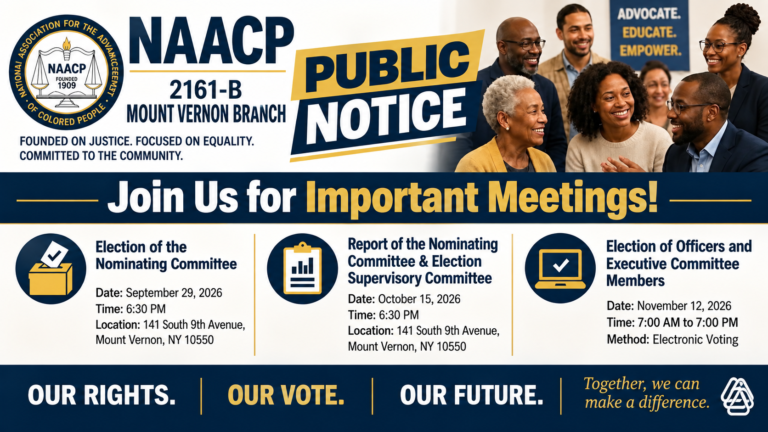
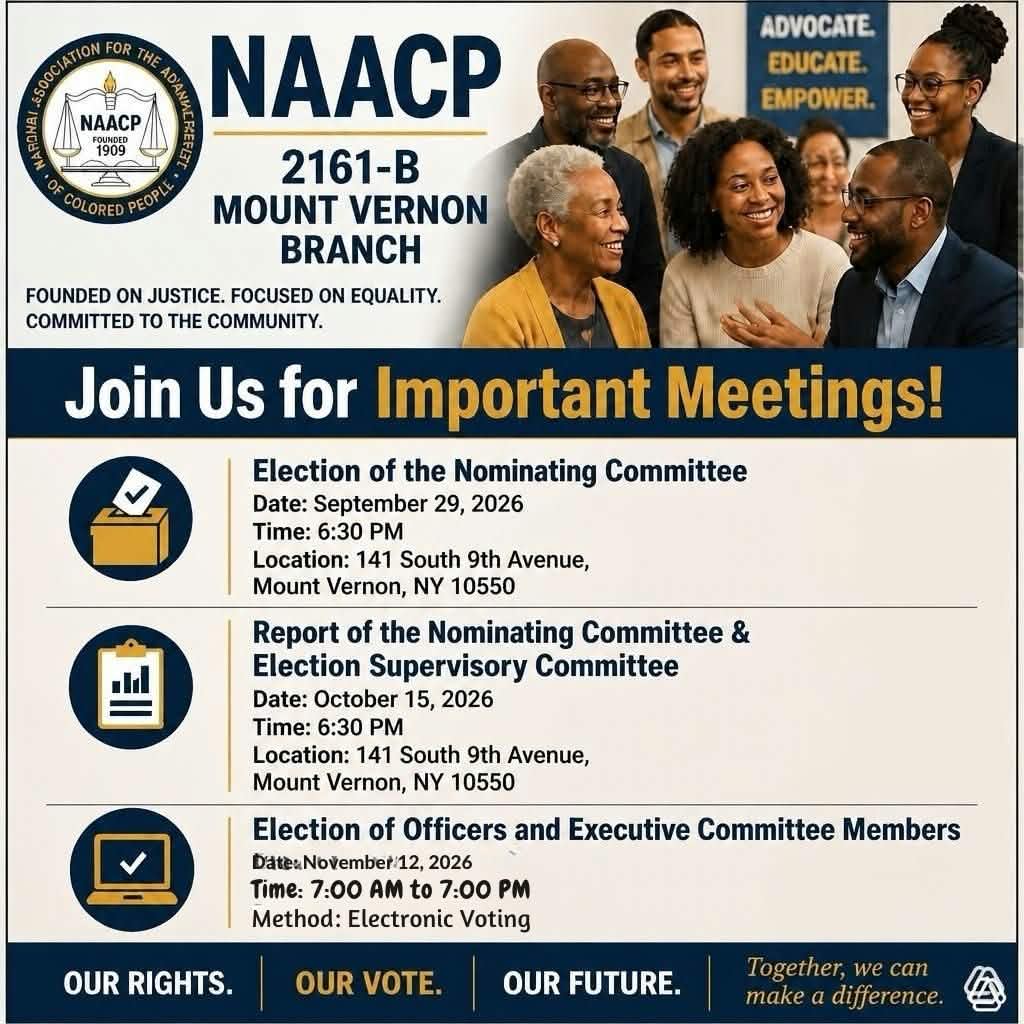
Please note the following General Membership meetings of the 2161-B NAACP Mount Vernon Branch, set forth for the purpose of the election of officers and at-large members of the Executive Committee:
All members whose memberships are current as of 30 days prior to the meeting date may be elected to the Nominating Committee (not more than 2 being officers of the unit).
Report of the Nominating Committee & Election Supervisory Committee
All members whose memberships are current as of April 1st, 2026, have remained continuous throughout the election process, and live and/or work within Mount Vernon, may be nominated for office or as an at-large member of the Executive Committee. In order to sign a nominating petition or be elected to the Election Supervisory Committee, a member must be current as of 30 days prior to the October meeting.
Election of Officers and At-Large Members of the Executive Committee
Date: November 12, 2026
Time: 7:00 AM to 7:00 PM
Method: Electronic Voting
NOTE: In order to vote in the Mount Vernon Branch’s election, one must be a member in good standing of the Branch 30 days prior to the election. We will send notification via text and email. An updated mobile number and email address must be on file in order to receive a ballot. Please contact MountVernonNAACP@gmail.com to update or check to make sure the branch has your updated contact information!
We look forward to your participation in these important activities.