Home Blog Page 7

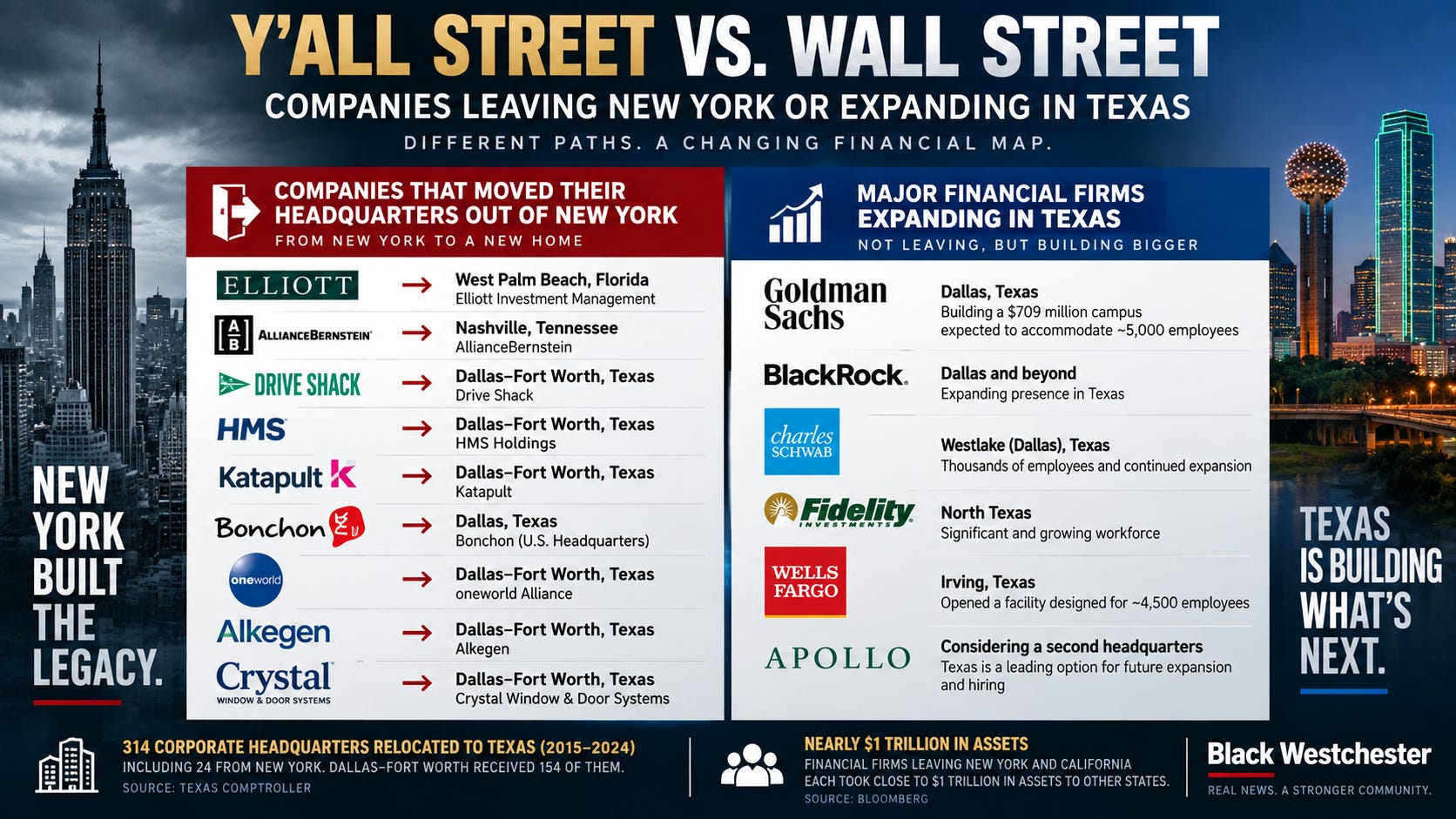
The Quiet Shift: Are Big Banks Moving the Center of Finance South?

Economic shifts are interconnected outcomes rather than isolated events, and recognizing this is crucial to understanding institutional responses.


When Wells Fargo relocates its wealth management headquarters out of New York, it reflects a response to incentives rather than abandonment, illustrating a broader pattern.


But the most revealing development is not a bank. It is the emergence of competition itself.


The Texas Stock Exchange, preparing to trade, signals a direct challenge to New York’s dominance, marking a rare effort to decentralize a long-concentrated system.


This is not occurring in isolation. Financial institutions that built their identities in New York are now supporting, expanding, or positioning themselves in states like Texas and Florida. Even existing exchanges are adapting, expanding into these markets rather than assuming New York will remain the default center.
This is what competition looks like when incentives change.


Rising costs, increasing tax burdens, and regulatory complexity are not abstract debates; they directly influence where institutions choose to operate, affecting their future.


Capital does not debate policy. It responds to it.


And what is moving is not the entire financial system, but its most decisive layer. Wealth management, advisory functions, and capital allocation are shifting closer to where clients now live. States like Florida and Texas are not simply gaining residents. They are gaining influence.


Meanwhile, New York retains the visible architecture of finance—its offices, its trading floors, its legacy institutions. But visibility is not control. Executing transactions is not the same as directing them.


There is a difference between being the place where money passes through and the place where money decisions are made.


The emergence of a Texas-based exchange underscores that distinction. It signals that financial power is no longer fixed in place. It can be replicated, relocated, and competed for.


This is not a collapse; it is a redistribution that offers a chance for strategic realignment and new leadership in the financial landscape.
But redistribution has consequences.


If current trends continue, New York will not lose its financial sector entirely. It will lose its exclusivity. And once exclusivity is lost, influence follows.

This should be understood as a warning to New York policymakers, as recognizing these changes can help them adapt and remain influential.
You cannot continue to increase the cost of operating, increase the cost of living, and increase the cost of capital, and assume the institutions that generate wealth will remain indefinitely. There is no historical evidence to support that assumption.


Banks do not remain loyal. They remain at an advantage.


If that advantage disappears, they will not stay.


And if they do not stay, New York will not remain the center of finance—not because it was taken, but because it was surrendered through policy decisions that ignored incentives and underestimated mobility.

The Honorable NYS Senator Andrea Stewart Cousins the First Female Legislative Conference Leader in NY State History

With nearly 30 years of working in government behind her, New York State Senator Andrea Stewart-Cousins continues to be a force for change, as well as the county’s most powerful politician, claiming the top spot on the 2020 City & State NY Magazine Power 100 List for Westchester.

In 2019, after a historic ascent, she became the first woman, and Black woman, in the state’s history to be elected Senate Majority Leader. In 2019, Stewart-Cousins was also named to the Crain’s New York Business biennial list of the “Most Powerful Women in New York.”

Andrea Stewart-Cousins officially broke the long-standing “three men in a room” tradition in New York politics when she became the first woman and first African-American woman to lead a legislative chamber in the state’s history. 

Taking over as Senate Majority Leader in January 2019 following a “blue wave” that gave Democrats control of the Senate, she immediately shifted the power structure that had historically consisted of the Governor, Senate Majority Leader, and Assembly Speaker—all men—negotiating behind closed doors.

Andrea Stewart-Cousins is also the first Black woman to serve as the New York lieutenant governor, when former Governor Andrew Cuomo resigned. Under Governor Kathy Hochul, she served as acting lieutenant governor of New York for 16 days in 2021 and from April 12, 2022, to May 5, 2022. It is also the first time the state is led by two women. She is the first woman and first Black woman in the history of New York State to lead a conference in the New York State Legislature and is also the first female Senate Majority Leader in New York history.

Members of her own party delayed but could not deny Senator Stewart-Cousin’s moment in history. Top Democrats from NYC and Westchester rallied in front of the Harriet Tubman statue in Harlem on Monday, August 14, 2017, to say State Senator Andrea Stewart-Cousins “will become the first black female Senate Majority Leader.”

Through disrespectful racial remarks and the formation of the breakaway Independent Democratic Conference (IDC), a renegade group of 8 Democrats who collaborate with Republicans, Stewart-Cousins remained unscathed. She continued to chip away at the glass ceiling of the New York State Legislature, even though it seemed they had stacked the deck against her. She has remained strong throughout the adversity while remaining regal throughout – she is the embodiment of beauty in the struggle.   

Before becoming the first woman Senate Minority Leader in 2019, and her election to the New York State Senate in 2006, Andrea Stewart-Cousins served for a decade as a Westchester County Legislator representing Yonkers. During her tenure (from 1996 to 2006), she was elected Majority Whip and Vice-Chair. She authored and passed landmark legislation, including Westchester County’s first human rights laws, living wage laws, smoke-free workplace laws, tougher gun laws, laws that prosecute “predatory lenders”, and laws that have provided tax cuts for seniors and veterans. As Chair of the Health Committee, Legislator Stewart-Cousins brought the “Sexual Assault Nurse Examiner Program” to Westchester County.

Sen. Stewart-Cousins was inducted into the Westchester Women’s Hall of Fame during the 7th Annual “In The Company of Women” Luncheon at the Westchester Marriott, 670 White Plains Rd., Tarrytown, Friday, May 6, 2016.

In 1992, Sen. Stewart-Cousins became the first African-American to serve as Director of Community Affairs for the City of Yonkers

This Yonkers resident has represented the 35th State Senate District in NY (Ardsley, Dobbs Ferry, Elmsford, Greenburgh, Hastings-on-Hudson, Irvington, Tarrytown, Scarsdale, and parts of Yonkers, White Plains, and New Rochelle) with distinction for the past 20 years.

We wanted to acknowledge her historic achievement and thank you for her continuous support. When Black Westchester first started the radio show People Before Politics and was trying to make a name for ourselves, Senator Andrea Stewart-Cousins appeared on the 10th Episode on Sunday, October 12, 2014, along with then County Legislator Ken Jenkins, which really put Black Westchester and our new radio show on everyone’s radar. She truly understands the importance of free and independent community-based Black Media and has been a strong supporter since our inception.

Black Westchester proudly celebrates and salutes New York State Senate Majority Leader Andrea Stewart-Cousins, a true Black Westchester legend.

New York Is Pricing Out the Black Middle Class — And Black Leadership Won’t Say It

New York is pricing out the Black middle class — and Black leadership won’t say it, despite the clear impact on social justice and economic equity.

Intentions often judge public policy. It is better judged by results.

By that standard, New York is failing its Black middle class.

This is not a matter of rhetoric. It is measurable.

Households earning between $75,000 and $150,000—traditionally considered middle class—now fall into a gap in New York’s economy, making homeownership and stability harder for Black families.

The cost structure explains why.

Recent estimates show that a single adult in New York City needs roughly $180,000 annually to live comfortably. A family of four requires well over $250,000. Black households, with lower average incomes, face an even wider gap between earnings and expenses, which should inspire concern for racial equity.

Housing is not just a cost issue. It is a wealth issue.

The data makes that clear.

Black homeownership in New York State is approximately 32 to 34 percent. In New York City, it drops even lower, ranging from roughly 26 to 30 percent. Nationally, Black homeownership is closer to 44 to 45 percent.

That is not a marginal difference.

It is a structural gap.

New York is not just below the national average—it is near the bottom in overall ownership. The state’s total homeownership rate, across all races, is roughly 51 percent, the lowest in the country. By comparison, many Southern and Midwestern states report homeownership rates between 65 and 75 percent or higher.

The contrast is not accidental.

States such as Texas, Georgia, Florida, and South Carolina tend to have higher Black homeownership rates, greater availability of single-family housing, and fewer barriers to entry. Lower costs, more land, and less restrictive development policies expand access to ownership.

New York produces the opposite outcome.

High prices, limited supply, and regulatory constraints reduce the number of people who can buy. The result is fewer homeowners and more long-term renters.

Ownership is not simply a preference.

It is the primary mechanism for building equity and transferring wealth across generations. When ownership rates remain low, wealth accumulation remains limited.

This is not a housing issue in isolation.

It is a wealth gap reinforced by policy outcomes.

Migration patterns confirm it.

New York has experienced significant domestic outmigration over the past several years, losing hundreds of thousands of residents to states like Texas, Florida, Georgia, and North Carolina. This pattern, driven by policies that favor lower costs elsewhere, should motivate the audience to consider the long-term consequences for the city’s Black communities.

People relocate to environments where their income retains value.

New York increasingly fails that test.

The explanation lies in policy design, which directly influences housing affordability, energy costs, and economic mobility for Black middle-income families.

Housing policy has focused heavily on tenant protection. The Housing Stability and Tenant Protection Act of 2019 expanded rent regulations and strengthened tenant rights across the state. These measures may reduce displacement in the short term, but they also reduce incentives to build and maintain housing at scale.

When supply is constrained, and demand remains high, prices rise.

This is not ideological. It is arithmetic.

At the same time, zoning restrictions and lengthy approval processes increase the cost and time required to build new housing. Developers respond accordingly—by building less, or by building at higher price points where margins remain viable.

The intended goal is affordability.

The observed outcome is scarcity.

Property taxation adds another layer of pressure that is often overlooked in public discussion.

New York already ranks among the highest in the nation in property taxes, particularly in downstate regions such as Westchester County and parts of New York City. For homeowners, these are not optional costs. They rise regardless of income growth, and they compound over time.

In addition, proposals to increase or expand estate-related taxes introduce further uncertainty for families attempting to build and transfer wealth. A home is often the largest asset a family owns. When the cost of holding that asset continues to rise—and the cost of passing it down is threatened—long-term ownership becomes more difficult to sustain.

The effect is predictable.

Higher property taxes increase monthly carrying costs, pricing out potential buyers and straining existing homeowners. Over time, this leads to forced sales, reduced ownership stability, and the gradual loss of generational assets.

One of the least discussed drivers of wealth loss is property tax foreclosure.

For many older homeowners—particularly Black seniors—property taxes become the final pressure point. Homes that were owned outright for decades can still be lost, not because of a mortgage, but because of unpaid taxes, penalties, and interest. In many jurisdictions, property tax foreclosure has been a leading cause of involuntary property loss, disproportionately affecting elderly homeowners on fixed incomes.

The consequence is severe.

A home that took decades to pay off can be lost over a relatively small tax debt. In those cases, families do not just lose housing—they lose equity. They lose the primary asset that could have been passed down to the next generation.

This is not a marginal issue.

It is one of the most direct ways generational wealth is erased.

A system that makes it difficult to acquire property—and more difficult to keep it—is not expanding ownership. It is quietly reversing it.

Energy policy produces similar results.

New York has moved to phase out certain forms of reliable energy production while transitioning toward renewable sources. However, replacement capacity has not fully matched the reliability or scale of what has been removed. As a result, energy costs remain among the highest in the country.

Energy is not an isolated expense.

It affects rent, transportation, food prices, and business operations. When energy costs rise, those costs are passed through the economy. Landlords raise rents. Businesses raise prices. Consumers absorb the difference.

The burden falls most heavily on those without excess income.

In other words, the middle class.

New York’s energy policy also raises a forward-looking concern about competitiveness.

As electricity demand increases—driven in part by data centers and the rapid expansion of artificial intelligence—states are prioritizing reliable, large-scale power generation. Several are expanding nuclear capacity or exploring advanced reactor technologies to meet that demand. Nuclear energy provides consistent baseload power at scale, something intermittent sources alone have not yet matched.

By contrast, New York has reduced its nuclear footprint and is pursuing a transition that has yet to replace that lost capacity with equally reliable alternatives fully. If electricity remains both expensive and constrained, industries that depend on a large, stable energy supply—including AI infrastructure—will continue to locate elsewhere.

Over time, this is not just an energy issue.

It becomes an economic one.

States that can generate affordable, dependable power will attract investment, jobs, and technological growth—those who cannot will fall behind.

Reliable energy is not a luxury in a modern economy. It is a prerequisite for participation.

This extends beyond households.

Black-owned small businesses—barbershops, restaurants, service providers—operate on thin margins. Rising rent, rising utilities, and increased compliance costs further reduce those margins. Some raise prices. Others close. Many relocate.

When businesses leave, economic ecosystems weaken.

The issue is not whether these policies are well-intentioned.

The issue is whether they produce the intended results.

New York’s policy framework provides significant protection for renters. It provides far less support for becoming owners. There is no comparable legislative push to scale up the transition of middle-income families from renting to ownership.

Stability without mobility is not progress.

It maintains conditions without improving them.

The political dimension is equally clear.

Black voters in New York have consistently supported one party at high levels, often exceeding 85 to 90 percent. That level of alignment has contributed to sustained control of city, county, and state governments by that party.

In such an environment, accountability is not diffuse.

It is concentrated.

When outcomes deteriorate under unified control, those outcomes cannot be attributed elsewhere. They reflect the policies in place.

Yet the public conversation often avoids this conclusion.

Discussion centers on intentions—equity, fairness, protection—rather than results. Meanwhile, the measurable indicators move in the opposite direction: rising costs, declining ownership, and increasing outmigration.

The consequences are cumulative.

As middle-income Black families leave, they take with them income, skills, and long-term investment potential. They take future homeowners, business owners, and community anchors. Population loss reduces political influence. Reduced ownership limits wealth accumulation.

Over time, this is not simply displacement.

It is a contraction.

A system that cannot retain its middle class is not expanding opportunity. It is narrowing it.

If current trends continue, the long-term effects are straightforward. The Black middle class in New York will shrink. The gap between renters and owners will widen. Economic mobility will decline.

None of these outcomes is accidental.

They follow directly from the incentives created by policy.

The question is not whether the goals sound reasonable.

The question is whether the results justify the approach.

So far, the answer is evident in the numbers—and in the growing number of families choosing to leave.

The U.S. Didn’t Contradict Itself at the UN — It Reflected Its Domestic Policy on Slavery

There is a growing conversation about the United States opposing international efforts at the United Nations to recognize slavery as an ongoing justice issue formally. For some, this raises outrage. For others, confusion. But before looking outward, it is worth asking a more uncomfortable question: what has been done inward?


If slavery is to be treated as a present-day policy issue rather than a historical fact, then it must show up in legislation, executive action, or funding. That is how governments demonstrate priorities—not through statements, but through outcomes.


And by that standard, the record is clear.


The most frequently cited legislative effort tied to slavery is H.R. 40, a bill to study the impact of slavery and explore potential remedies. It has been introduced repeatedly over the past decades. It has never become law. Not once.
This is not due to a lack of opportunity. During the presidency of Barack Obama, there was a period when one party controlled both chambers of Congress and the White House; if there was ever a moment for alignment between rhetoric and action, that was it.


Yet no reparations bill was passed. No executive order was issued. No federal program was created specifically addressing slavery as an active policy concern.
That absence is not symbolic. It is measurable.


In politics, what is funded gets done. What is legislated gets enforced. What is signed into law becomes reality. Everything else is a discussion.


This is where the conversation becomes uncomfortable. Many political organizations, including the Congressional Black Caucus, publicly acknowledge the historical impact of slavery. But acknowledgment is not policy.


The same pattern extends beyond Congress. Major national organizations such as the NAACP, the National Urban League, and the National Action Network have all addressed inequality in various forms. But there is no unified, enforceable national reparations agenda—no coordinated policy framework with legislative backing, funding mechanisms, and measurable outcomes tied specifically to slavery.


That distinction matters.


Advocacy is not the same as execution. Statements are not the same as statutes. And without a defined, actionable agenda that moves through the legislative and executive process, the issue remains in the realm of discussion rather than governance.


The most recent example reinforces the pattern. In Maryland, Wes Moore vetoed a reparations-related bill. That is not an international decision. That is a domestic one—made at the state level, within reach of the very communities and leaders who say this issue matters.


Yet there was no sustained national outrage. No coordinated response. No measurable political consequence.


That silence is just as telling as any vote.


It raises a hard question: if there is no consistent pressure at the local or state level, why would we expect a different outcome at the federal level—or on the international stage?


I have said many times that our struggle has been hijacked. Political energy is often redirected toward a wide range of issues affecting multiple groups. At the same time, there is no sustained, outcome-driven push for policies directly tied to the historical condition of Black Americans—specifically the recompensation for over 400 years of unpaid labor that was not just a social reality, but codified and enforced under U.S. law.


This is the deeper problem within Black politics in America. There has been a gradual shift where the specific legal and economic claims of the descendants of slavery have been absorbed into broader ideological movements. In that process, a distinct historical claim risks being diluted into broader conversations about equity, diversity, and inclusion—frameworks not designed to address a specific, legally defined historical harm.


When a specific claim becomes generalized, it becomes easier to ignore.
And when it is not clearly defined in policy, it becomes easier for other groups to dismiss, reinterpret, or compete with it.


That has real consequences.


Consider the contrast in legislative behavior. Across many Democratic-led cities, counties, and states, there has been a clear and coordinated effort to pass laws and policies limiting cooperation with federal immigration enforcement, particularly around ICE. Whether one agrees with those policies or not, the outcome is undeniable: when an issue is prioritized, legislation is written, passed, and enforced.


Black Americans, who overwhelmingly support the Democratic Party in elections, have not seen a comparable level of legislative urgency when it comes to policies addressing slavery, its economic impact, or recompensation tied to that history. There are no widespread state-level frameworks, no coordinated municipal strategies, and no consistent legislative push matching the scale or intensity seen in other policy areas.


That contrast is not about opinion. It is about observable outcomes.
When the United States resists international language that frames slavery as an ongoing legal or financial obligation, it is not acting in contradiction to domestic policy—it is acting consistently with it. A government cannot be expected to adopt a stronger position abroad than it is willing to implement at home.
This is not a moral argument. It is a structural one.


Governments operate within constraints: political capital, coalition support, legal exposure, and economic cost. Issues that do not clear those thresholds remain in perpetual discussion. Slavery, as a modern policy issue, has remained in that category.


The result is a disconnect between narrative and action.


Public discourse often treats slavery as unfinished business. Policy outcomes treat it as settled history. Until those two align, the expectation of international leadership on the issue will continue to collide with domestic reality.
The question is not whether slavery happened. That is documented and undisputed.


The question is whether it is being treated as a current policy priority.
So far, the answer is found not in speeches or statements—but in what has not been done.

From Podcast to Proclamations: Watching Earn Your Leisure Become History

3

Greenburgh Town Clerk Hosts Fireside Chat with Greenburgh’s Own Troy Millings & Rashad Bilal, Founders of Earn Your Leisure

On Saturday, March 21, 2026, I showed up to Greenburgh Town Hall for a Fireside Chat called “You Deserve to Be Rich,” and I already knew I was not sitting in the back like this was something to casually observe.

No.

I was front row. Centered. Ten toes down in my chair, coat still half on because I got there early and wasn’t about to lose that seat. Close enough to hear the mic crackle before anyone spoke. Close enough to see the intention before it turned into words.

I didn’t come to spectate, I came to receive.

And the setting? Greenburgh Town Hall. Not some exclusive rooftop. Not a “members only” situation. A town hall. Which already told me: this conversation about wealth wasn’t being gatekept, it was being given back.

Now, Rashad Bilal and Troy Millings, co-creators of Earn Your Leisure and New York Times bestselling authors of You Deserve to Be Rich, came in with a presence that wasn’t loud, but it was grounded. Like, “we’ve lived this, we’ve studied this, and we’re here to translate it.”

And from where I was sitting? You feel that kind of energy differently.

You catch the pauses. The looks. The way they lean into certain points like, no, don’t just clap, apply this.

They weren’t just talking about money. They were talking about behavior. About how we’ve been conditioned to survive instead of build. About ownership in a way that made you check yourself without feeling shamed.

And I had a moment, front row, pen hovering, not even writing, where something hit me a little too clean:

I’ve been thinking about money like something to manage… not something to multiply.

And I didn’t like how true that felt.

Because nobody teaches you that survival thinking can follow you even when you’re no longer just surviving.

And let’s talk about the book for a second.

Because You Deserve to Be Rich isn’t just a catchy title, it’s a confrontation.

Like, do you actually believe that?

Or do you believe you’re supposed to struggle, just make enough, just get by?

They were breaking down what it means to master the inner game of wealth. Not just external strategies, but mindset. And let’s be real, if your mindset is still rooted in lack, you can sabotage abundance before it even hits your account.

And sitting there, front row, I had to check myself again.

Because it’s one thing to hear “you deserve more.”

It’s another thing to realize you might not be moving like you believe it.

Now, Greenburgh Town Clerk Lisa Maria Nero, MPA, was moderating, and I appreciated that she wasn’t just there to keep time; she was there to ground the conversation. She made sure it stayed connected to the people in the room. Like, okay, this sounds good, but how does this apply right here, right now?

That matters.

Because theory without application is just entertainment.

And let’s be clear, this didn’t just “happen.”

There was intention behind this entire setup.

County Executive Ken Jenkins, part of the setup team, helping ensure this kind of conversation actually reached the community. Danielle Millings. Abdoulaye Sow. Sara Bracey White from the Arts Council making sure culture had a presence. Greenburgh Town Councilmembers Hon. Gina Jackson, Hon. Ellen Hendrickx, Hon. Francis Sheehan, and Town Supervisor Paul Feiner coordinated this.

You could feel that this was built on purpose.

And honestly, sitting there, it hit me:

The people closest to the challenges in our community are often the ones closest to the solutions that actually make an impact.

And Earn Your Leisure is proof of that.

Because this didn’t come from theory. This came from lived experience, from navigating the same systems, the same gaps in information, the same questions so many of us have had, and deciding to turn that into access for everybody else.

That’s why it lands.

That’s why it resonates.

Now here’s where it shifted.

Because toward the end, after all the conversation, after all the knowledge dropped, the room moved into something else entirely.

Recognition.

And not light recognition, institutional recognition.

A Black History Award from the Greenburgh Town Clerk.

Proclamations from U.S. Congressman George Latimer, with a U.S. flag flown over the Capitol. A letter from Governor Kathy Hochul. Recognition from NYS Senate Majority Leader Andrea Stewart-Cousins and Senator Shelley Mayer, naming March 21st their day.

And I’m sitting there, hands folded now, pen down, just watching it stack up, thinking…

This is what it looks like when impact gets documented.

Not just celebrated, but recorded.

Then more:

A proclamation from County Legislator Jewel Williams-Johnson and the 17-member Board of Legislators.

The Mayor of White Plains Justin Brasch, named March 21st Earn Your Leisure Day.

And I had to pause internally like…

a whole day?

Because again, this started as a podcast.

And then it kept building.

A Jumbotron Day is set for April 4, 2026.

Inclusion in a Greenburgh Bicentennial history book.

A street name change.

And the promise of an honorary street naming: EYL Way.

Now listen… a street name?

That’s permanence.

That’s people giving directions using your impact.

That’s history you can literally walk on.

And sitting front row, I didn’t miss any of it.

I saw the pride before it turned into applause. The quiet disbelief. The side glances that said, we really did this. The kind of moments that don’t always make it into recap videos but matter the most.

And I had this realization, clear, uncomfortable, necessary:

This wasn’t just about wealth.

This was about what happens when you stop playing small with information that could change your life.

Because yes, they talked about money. Ownership. Mindset.

But what I witnessed?

Was what it looks like when that knowledge turns into something so impactful that it can’t be ignored, by the people or the institutions around them.

So no, I didn’t walk out with a new investment portfolio magically set up.

Let’s stay grounded.

But I walked out with something just as important:

A shift.

A sharper awareness that wealth isn’t just about what you earn, it’s about what you build, what you multiply, and what outlives you.

And I’m glad I sat in the front row.

Because I didn’t miss a single drop.

Big Tech on Trial: What the Meta and Google Lawsuits Reveal — And Why Black America Should Pay Attention

There is a growing belief that the lawsuits against Big Tech represent accountability. That, finally, companies like Meta Platforms and Google are being forced to answer for the damage they have caused.

That belief is premature.

What we are witnessing is not a restructuring of power, but a negotiation over consequences. The courts are beginning to acknowledge harm, but they have not yet imposed outcomes that fundamentally change behavior. And if history is any guide, Black America will once again feel the consequences of that gap between recognition and action.

The recent $375 million judgment against Meta in New Mexico for failing to protect children from exploitation is being called historic. But historic compared to what? Meta generates over $100 billion in annual revenue. A fine of that size is not a correction. It is a cost of doing business.

Google, on the other hand, is a search monopoly. That is a significant legal finding. But what followed was not a breakup, not a restructuring, but limited remedies that leave its dominance largely intact. A monopoly that remains in place is not a solved problem. It is a recognized problem without enforcement.

This pattern is not new.

Black America has seen this before.

When cigarettes were marketed aggressively in Black communities, it took decades before meaningful legal action occurred. Even then, the result was not the dismantling of tobacco companies, but settlements that allowed them to continue operating while shifting public messaging. The damage—addiction, cancer rates, generational health decline—was already done.

When liquor stores were concentrated in urban neighborhoods, the issue was framed as access and demand rather than long-term outcomes. The result was not fewer stores, but normalization of overexposure.

When pharmaceutical companies flooded communities with opioids, lawsuits followed. Billions were paid in settlements. Yet the communities most affected are still dealing with the aftermath—addiction, broken families, and economic instability.

Now we are watching the same cycle unfold with digital platforms.

The harm is different in form, but similar in structure.

Algorithms reward outrage, conflict, and emotional instability because those behaviors drive engagement. Engagement drives advertising revenue. The longer a user stays on the platform, the more profitable they become. This is not speculation. This is the business model.

For Black users, particularly Black youth, the outcomes are measurable and ongoing, underscoring the persistent digital exploitation that demands urgent attention.

Higher exposure to violent content.

Higher exposure to hypersexualized imagery.

Higher exposure to conflict-driven narratives about race, gender, and identity.

And most importantly, lower exposure to content that produces economic advancement, skill development, or ownership.

This is not about intent. It is about incentives.

A system designed to maximize engagement will not prioritize stability. It will prioritize whatever keeps attention. And in many cases, what keeps attention is dysfunction.

The lawsuits currently moving through the courts—focused on youth addiction, mental health, and platform design—are beginning to expose this reality. But exposure is not the same as correction.

Even when Meta or Google face legal losses, the outcomes tend to be financial penalties rather than systemic reform, highlighting that lawsuits alone rarely drive the structural change needed for true accountability.

No major platform has been forced to change its algorithm at scale.

No major executive has been held personally accountable.

No dominant platform has been broken up despite findings of monopoly.

The result is predictable.

The behavior continues.

This is where Black America must shift its thinking.

The question is not whether Big Tech is harmful. The courts are already beginning to answer that. The real question is whether relying on lawsuits will produce protection.

History suggests otherwise.

Legal victories without structural change tend to arrive after the damage is widespread. They compensate for harm already done, but they rarely prevent future harm. And communities with the least economic leverage are often the last to recover.

If the incentive structure remains unchanged, the outcomes will remain unchanged.

That is the pattern.

The solution, therefore, must go beyond regulation to inspire a sense of agency-ownership of platforms and control over content are essential for meaningful change.

Ownership of platforms.

Control over content distribution.

Intentional use of technology for economic gain rather than passive consumption.

Because in the absence of control, participation becomes exposure.

And exposure, when driven by someone else’s incentives, rarely produces long-term benefit.

The lawsuits against Meta and Google are not meaningless. They are signals. They show that the system recognizes a problem.

But recognition alone is not reform, and this reality should motivate us to pursue deeper, structural change rather than rely solely on legal victories.

And if Black America waits for the courts to solve a problem rooted in incentives, it will be waiting after the next generation has already paid the cost.

The lesson is not new. Only the industry has changed.

Is Black America Ready for the AI Economy?

The question being asked across boardrooms, classrooms, and political circles is whether we are ready for the AI economy.

That question assumes preparation is a matter of awareness.

It is not.

Preparation is a matter of position.

And by that standard, most people are not ready—especially not the communities that have historically been positioned at the bottom of every major economic shift in American history.

The AI economy is not a future event. It is a present reality. The companies shaping it—Google, Microsoft, Nvidia, Meta, OpenAI, Anthropic, and xAI—are not experimenting. They are deploying. They are scaling. And more importantly, they are consolidating control.

This is not the first time America has experienced a technological shift. The Industrial Revolution replaced manual labor with machines. The Information Age replaced factory work with knowledge work. Each time, those who owned the tools prospered, and those who supplied only labor were forced to adapt—or were left behind.

Artificial intelligence represents a third shift. But unlike previous transitions, this one is moving at a speed that does not allow for generational adjustment. It is happening in real time.

The conversation around AI is often framed in terms of innovation and opportunity. But economics is not driven by intentions. It is driven by incentives and outcomes.

AI reduces the need for labor.

That is not speculation. It is the business model.

Companies are not investing billions of dollars into artificial intelligence to create more jobs. They are investing to increase efficiency, reduce costs, and eliminate redundancies. When a machine can perform the work of ten people faster and cheaper, the economic incentive is clear.

This does not mean all jobs will disappear. It means the value of certain skills will decline rapidly. Writing, coding, customer service, and research—fields once considered stable—are now being automated at scale.

What replaces them is not simply new jobs, but a new hierarchy.

In the AI economy, value shifts from those who do the work to those who own the systems that do the work.

That distinction is critical.

Much of the current excitement around AI focuses on usage—how individuals can use tools like ChatGPT, Claude, or Grok to improve productivity. But using a tool is not the same as owning the system that generates value.

A worker who uses AI may become more efficient.

An owner who deploys AI becomes more profitable.

Those are not the same outcomes.

History offers a clear lesson. During the rise of industrial capitalism, workers who learned to operate machines improved their wages temporarily. But the long-term wealth was accumulated by those who owned the factories.

Today, the “factories” are digital.

They are powered by Nvidia chips, hosted on Microsoft Azure and Amazon Web Services, and trained by companies like OpenAI, Google, and Anthropic. These systems are not being built in local communities. They are being built in centralized hubs of capital and control.

This concentration matters.

Because when power is concentrated, opportunity is not evenly distributed.

There are now hundreds of thousands of AI-related companies worldwide. But the overwhelming majority of influence, capital, and infrastructure is controlled by a small group of firms. This is not a decentralized revolution. It is a consolidation.

What makes this moment different is that artificial intelligence is not only reshaping digital work. It is beginning to reshape physical infrastructure as well.

One of the clearest examples of this is energy.

For years, nuclear power has been treated as a political liability. Concerns over safety, cost, and public perception pushed it to the margins of long-term energy planning. But artificial intelligence is changing that calculation in ways that have little to do with politics and everything to do with demand.

AI systems require enormous amounts of electricity. Data centers powering these models operate continuously, processing vast amounts of information without interruption. This level of demand cannot be met by aspiration. It must be met by reliable energy.

Artificial intelligence is now being used to monitor reactor performance, predict mechanical failures before they occur, and optimize output with a level of precision that was not previously possible. In economic terms, it reduces uncertainty.

And when uncertainty is reduced, investment follows.

What was once considered too risky or too expensive becomes viable again.

Nuclear energy, once in decline, is now being reconsidered not as an alternative, but as a necessity for sustaining the AI economy. This is not a shift driven by environmental idealism. It is driven by economic reality.

Solar and wind have their place, but they are intermittent. Artificial intelligence does not operate intermittently. It requires consistent, uninterrupted power.

That requirement is forcing a reevaluation of the entire energy landscape.

And it reveals something deeper about the nature of technological change.

Revolutions in one sector do not remain contained. They expand outward, reshaping industries that appear unrelated. AI is not just changing how people work. It is changing what powers the work.

For Black Americans, the importance of this moment cannot be overstated.

Every major economic shift in this country has produced winners and losers. And too often, Black communities have entered those shifts late, without ownership, without control, and without a strategy rooted in economic outcomes.

After slavery, Black Americans built independent economies—land ownership, businesses, and institutions. But over time, integration without economic control led to participation without power. The result was access without ownership.

The AI economy threatens to repeat that pattern at a much faster pace.

Because this time, the barrier is not just physical capital. It is intellectual capital, technical infrastructure, and system ownership.

If Black Americans approach AI only as users—asking questions, generating content, improving resumes—then the benefits will remain limited.

But if the approach shifts to ownership—building platforms, automating businesses, creating AI-driven services, and controlling digital assets—then the outcomes change entirely.

This is why readiness matters.

It is not about keeping up with technology. It is about not being locked out of the wealth it creates.

AI is projected to generate trillions of dollars in economic value. But wealth does not distribute itself. It flows to those who build, own, and control.

Without intentional positioning, the gap between those who own AI systems and those who are replaced by them will widen.

That gap will not be explained by discrimination alone. It will be explained by economics.

Education systems are not preparing young people for this reality. They are still training students for jobs that are being automated, rather than teaching them how to build within the systems that are replacing those jobs.

This creates a dangerous illusion of progress.

People believe they are preparing for the future, when in reality, they are preparing for a past that no longer exists.

It is often said that technology is neutral. That is true in a narrow sense. But the outcomes produced by technology are not neutral. They reflect the distribution of knowledge, capital, and decision-making power.

If AI continues to develop under the control of a small number of corporations, the benefits will accrue primarily to those corporations and their shareholders.

That is not pessimism. That is precedent.

The question, then, is not whether AI will create wealth. It will.

The question is who will own it.

Communities that approach AI as consumers will benefit differently than those who approach it as producers.

Communities that learn to use AI will see incremental gains.

Communities that build systems on top of AI will see exponential ones.

There is a difference between adapting to an economy and shaping it.

At present, most people are focused on adaptation.

That may not be enough.

The AI economy is not simply another industry. It is an infrastructure that will influence every industry—healthcare, education, finance, media, and beyond.

To be unprepared for it is not to miss an opportunity. It is to risk irrelevance in the systems that determine economic outcomes.

For Black America, that risk carries a historical weight.

Because the cost of being late to an economic shift is not just lost income.

It is lost influence, lost ownership, and lost control over the future.

So, are we ready?

If readiness is defined by awareness, then perhaps.

If readiness is defined by ownership, control, and strategic positioning, then the answer is far less certain.

And in economics, it is not awareness that determines outcomes.

It is position.

Lincoln School Principal selected for Legacy of Leadership Award by Empire State Supervisors and Administrators Association

MOUNT VERNON — The Empire State Supervisors and Administrators Association (ESSAA) has bestowed the esteemed Legacy of Leadership Award upon Lincoln School Principal Rebecca Jones, a longstanding educational leader renowned for her steadfast dedication to children and staff. 

Mrs. Jones was chosen from a prestigious group of contenders from all throughout New York State. This award honors a seasoned leader whose unwavering excellence, service, and mentoring have had a long-lasting influence on their school community and the public education sector.

“I’m extremely honored and grateful to receive the Legacy of Leadership Award from the Empire State Supervisors and Administrators Association,” she said. “It’s a powerful reminder that the years I’ve dedicated to this work truly matter, and that despite the many challenges in education today, we still have the ability to make a real and lasting impact on students’ lives.” 

The Empire State Supervisors and Administrators Association (ESSAA) Legacy of Leadership Award recognizes outstanding school administrators in New York State for their exceptional leadership, innovation, and lasting impact on education. Honorees, such as Middletown’s Mrs. Pace, are recognized for their dedication to students, staff, and the educational community.

As Lincoln School’s principal for sixteen years, Mrs. Jones has guided the institution through years of high academic performance and a persistent emphasis on the complete child.

The school was named a Recognition School by New York State in 2019 under her direction, a title given for notable academic achievements. Students at Lincoln not only met but also exceeded district and state requirements; this pattern has persisted.

“Even today, I’m proud to share that Lincoln continues to earn top scores in both ELA and math, consistently surpassing district and state benchmarks,” the principal said. “It speaks to our teachers’ steadfast dedication to our students and the way they motivate them each and every day to work hard and reach their full potential.” 

Mrs. Jones attributes much of the school’s success to a deeply collaborative culture and a shared sense of purpose among all members of the school community. 

“I have such great respect and admiration for my teaching staff and the pupil support staff and really, everyone in the building,” she said. “I don’t think anyone is more important than anyone else, from the lead teacher to the school nurse to the administrative assistants to the safety monitors and custodial team. I believe that we’re a family and each of us plays an important role in shaping our students’ daily lives.” 

That philosophy has helped shape Lincoln into what Mrs. Jones describes as a “home away from home” for students, a place where academic success is paired with strong social and emotional support. 

“It’s a safe haven where students can turn to teachers and feel comfortable talking with them,” she said. “They know we’re here not only to support their academic needs, but also to help them grow socially and emotionally.” 

Mrs. Jones also emphasizes empowering her staff through trust, resources, and an open-door leadership style. 

“I encourage teachers to use their creative license, to challenge their students and to think outside of the box,” she said.  

“Whatever I can do to help a teacher—whether they want a particular book, a poster or a rug for their classroom, or an online program or resource–whatever it is, I’m happy to give them so that they can shine,” she added. 

Her approach is rooted in listening and shared leadership. 

“I believe in distributive leadership,” Mrs. Jones said. “Teachers, after many years in the classroom, have a great deal of experience and expertise, and I glean from them. I listen to their concerns and what it is they would like to do, and I think we work together very nicely as a team.” 

Mrs. Jones was nominated for the award by her colleagues, a gesture she views with humility. 

“I think for one, I’ve been around a long time and have a wealth of experience,” she said. “I also strive to be kind, fair-minded, and reasonable in all that I do. Above all, people know that I genuinely care about children and have a deep passion for teaching and learning. As an educator, my mission has always been to ensure that every child has access to an exceptional education so that they not only achieve their dreams, but in the words of Marian Wright Edelman, leave this world better than they found it.” 

She added that Lincoln’s culture of high expectations and intrinsic motivation sets it apart. 

“At Lincoln, everyone here holds themselves to the highest expectations,” she said. “They’re not influenced by anything else except their own internal desire to do the right thing by children.” 

Mrs. Jones will be formally honored at ESSAA’s Annual Meeting and Gala Celebration of School Leadership on Friday, April 17th at the Pearl River Hilton, where she will join a select group of educational leaders from across the state. 

Reflecting on her career, the principal expressed gratitude for the opportunity to serve generations of students and families. 

“I’m incredibly grateful for the opportunity to have served this district for the past 37 years and to have touched the lives of so many children and their families,” she said. It’s just a wonderful, wonderful recognition. I’m deeply humbled and sincerely appreciative.” 

Black Westchester congratulates Rebecca Jones, a lifelong educator who began as an English Teacher at Nelson Mandela High School in the Mount Vernon City School District upon her graduation from Stony Brook University, for being recognized for her exceptional leadership, innovation, and lasting impact on education.

Women’s History Month Spotlight: Tami Wilson – Feeding Westchester’s First Ever COO

On Thursday, March 19, 2026, Tami Wilson, the Chief Operating Officer (COO) of Feeding Westchester, the primary hunger-relief organization in Westchester County, was the Women’s History Month speaker at the Mount Vernon NAACP monthly membership meeting. She discussed his historic appointment, being a Black Women is spaces that weren’t originally designed for her to be in, and so much more.

There was so much I didn’t know about the amazing sister. This month, we celebrate many powerful and amazing Black women who have consistently shaped history and driven change. This veteran food bank executive is most definitely one of these Black Women worthy of celebrating, so allow me to introduce you to Tami Wilson, Feeding Westchester’s first-ever Chief Operating Officer (COO).

Tami Wilson is a senior executive leader with more than 20 years of experience guiding complex nonprofit organizations at the intersection of strategy, operations, and capital stewardship. She currently serves as Chief Operating Officer of Feeding Westchester, where she provides executive leadership across operations, programs, finance, human resources, and business solutions for the county’s largest hunger-relief organization.

Tami is known for her ability to translate community need into sustainable systems, aligning mission, funding, people, and infrastructure to deliver measurable impact. Her work centers on strengthening organizational resilience, improving accountability, and ensuring that resources are deployed thoughtfully and equitably.

Her career spans human services, national health organizations, food systems, and legal advocacy. She began her leadership journey at the North American Family Institute – Westchester Wraparound, overseeing government contracts, compliance, and real estate operations for specialized foster care and therapeutic services. She later served at the Crohn’s & Colitis Foundation, managing enterprise-wide risk, compliance, finance, procurement, and systems across a national network of 41 chapters.

Tami’s food systems leadership includes serving as Vice President of Operations and Administrative Services at the Food Bank For New York City, where she led logistics, disaster response, facilities, and procurement. During the COVID-19 pandemic, she helped guide the distribution of more than 96 million meals while overseeing capital investments to expand infrastructure and community kitchen capacity.

Tami Wilson, Feeding Westchester’s first-ever COO with the Executive Committee of the Mount Vernon branch of the NAACP [Black Westchester]

Most recently, Tami served as the first Chief Facilities and Administration Officer at the Legal Aid Society, supporting over 2,200 staff across 23 locations and strengthening operational alignment in a complex, mission-critical environment.

Tami brings a practitioner’s understanding of how philanthropic capital, public funding, and community partnerships intersect—and how decisions made upstream affect real outcomes downstream. She holds a Bachelor of Architecture from Texas Tech University and a Master’s degree in Facilities and Operations Management from the Rochester Institute of Technology. She is a proud member of Zeta Phi Beta Sorority, Incorporated.

Born and raised in Brooklyn, Tami lives in New Rochelle with her two children and their dog, Cinnamon.

We proudly celebrate Tami Wilson, a true Black Westchester Legend!!!

When Mommy Loses Her Job—Who Feeds the Kids? By Dr. Charise Breeden-Balaam, LSW

The U.S. economy may appear steady on the surface, but Black women are being pushed out of the workforce at alarming rates, and our children are paying the price.

In July 2025, the unemployment rate for Black women aged 20 and older rose to 6.3%, up from 5.8% just a month earlier, according to the U.S. Bureau of Labor Statistics. Even more concerning, from February to April, Black women lost over 304,000 jobs, despite the overall U.S. workforce adding 175,000 jobs during that same period. These numbers mark the largest month-over-month increase in unemployment for any race or gender (The Root, 2025).

This isn’t a coincidence. It’s a consequence of systemic inequities, federal job cuts, and the widespread dismantling of DEI programs across sectors that once offered Black women pathways to stability and advancement.

Black women comprise 12% of the federal workforce—the highest of any minority group (EEOC, 2021). With over 84,000 federal jobs cut since January, and the removal of DEI roles in industries like tech, retail, and healthcare, Black women are experiencing disproportionate economic loss.

And when Black women lose their jobs, their children are at greater risk of hunger.

I’ve spent my career as a social worker, educator, researcher, and mother, and I know this reality all too well: when a parent—especially a single mother—loses income, the ripple effect hits the kitchen table first.

Food insecurity is not just about empty stomachs. It’s about mental health, academic performance, physical development, and long-term opportunity. Hungry children struggle to focus in school. They face higher rates of anxiety and depression. They are less likely to graduate and more likely to fall through systemic cracks.

Cuts to food programs, school meal initiatives, and local farm partnerships—paired with job loss among primary caregivers—create a perfect storm. And it’s our children who are left in the wreckage.

This moment demands more than concern. It requires a reckoning with how we value the lives and labor of Black women—and how we protect the children who depend on them.

We must tell the full story: Unemployment isn’t just an economic indicator—it’s a child welfare crisis. And when mothers lose jobs, it’s not just a household budget that suffers. It’s a child’s next meal, their ability to learn, and their chance to thrive.

Let’s stop treating food insecurity and joblessness as separate problems. They are deeply connected, and both must be addressed with urgency, equity, and compassion.

#WhenMommyLosesHerJob #FoodJustice #BlackWomenAtWork #SocialWork #EducationEquity #PolicyMatters #DEIRollback #FoodInsecurity #ChildWellbeing #EquityInAction #BlackMothersMatter #LinkedInVoices

This article originally appeared in the August 2025 issue of Black Westchester Newspaper and is being reshared now for Women’s Month.

Editor’s Note: Over 300,000 Black women left the workforce or lost their jobs in the first half of 2025, marking a significant economic downturn for this demographic. Reports indicate a 7.3% unemployment rate for Black women, with sharp job losses in the public sector, a retreat from diversity initiatives, and increased automation. 

Here are some key details regarding the high numbers of job losses for Black women include:

  • Massive Workforce Exit: Between February and April 2025, approximately 300,000–320,000 Black women left the labor force.
  • Disproportionate Impact: While the overall U.S. unemployment rate hovered around 4.4%, the rate for Black women increased to 7.3%. In some periods, Black women accounted for over 50% of all female job losses.
  • Public Sector Layoffs: Job losses are heavily linked to cuts in government positions, where Black women are frequently employed.
  • Factors Contributing to Losses: Key factors driving this trend include corporate retreats from DEI (Diversity, Equity, and Inclusion) initiatives, AI automation, and potential targeting of roles, say experts per Forbes.
  • Long-Term Impact: As 69% of Black mothers are primary earners, this trend significantly impacts household financial stability.

Experts note that Black women often serve as “economic shock absorbers” and that these employment trends act as a warning signal for the broader economy, according to the Economic Policy Institute.

Unemployment for Black women has reached critical levels, with rates rising significantly to over 7% by late 2025 and early 2026, marking a sharp contrast to earlier, lower figures. This trend indicates a widening disparity, as their unemployment rate is nearly double that of white women and is driven by high job losses.