The ordinance, a summary of which is published herewith, has been adopted on May 29, 2026, and approved by the Mayor on June 4, 2026, and the validity of the obligations authorized by such ordinance may be hereafter contested only if such obligations were authorized for an object or purpose for which the CITY OF YONKERS, in the County of Westchester, New York, is not authorized to expend money or if the provisions of law which should have been complied with as of the date of publication of this Notice were not substantially complied with, and an action, suit or proceeding contesting such validity is commenced within twenty days after the publication of this Notice, or such obligations were authorized in violation of the provisions of the constitution.
SPECIAL ORDINANCE 30-2026
BOND ORDINANCE OF THE CITY OF YONKERS, NEW YORK AUTHORIZING THE ACQUISITION OF BOOKS AND EQUIPMENT FOR USE BY THE BOARD OF EDUCATION; STATING THE ESTIMATED MAXIMUM COST THEREOF IS $6,500,000; APPROPRIATING SAID AMOUNT THEREFOR; AND AUTHORIZING THE ISSUANCE OF BONDS OF SAID CITY IN THE PRINCIPAL AMOUNT OF NOT TO EXCEED $6,500,000 TO FINANCE SAID APPROPRIATION
The bonds are authorized to finance the acquisition of books and equipment for use by the Board of Education.
The amount of obligations to be issued is not to exceed $6,500,000.
The period of probable usefulness of the acquisition of books, software, and equipment for use by the Board of Education is five (5) years.
Pursuant to the provisions of Section 17 of the Special Local Finance and Budget Act of the City of Yonkers, constituting Chapters 488 and 489 of the Laws of 1976 of the State of New York (herein called the “Act”), the City is authorized and directed to include the pledge and agreement of the State of New York (herein called the “State”) contained in said Section 17 of the Act, in the ordinance, and the Act provides that upon payment for the bonds or notes by the original and all subsequent holders thereof the inclusion of such pledge and agreement shall be deemed conclusive evidence of valuable consideration received by the State and City for such pledge and agreement and of reliance upon such pledge and agreement by any holder and that any action by the State contrary to or inconsistent with the provisions of such pledge and agreement shall be void.
A complete copy of the Bond Ordinance summarized above shall be available for public inspection during normal business hours at the office of the City Clerk, 40 South Broadway, Yonkers, New York 10701.
The ordinance, a summary of which is published herewith, has been adopted on May 29, 2026, and approved by the Mayor on June 4, 2026, and the validity of the obligations authorized by such ordinance may be hereafter contested only if such obligations were authorized for an object or purpose for which the CITY OF YONKERS, in the County of Westchester, New York, is not authorized to expend money or if the provisions of law which should have been complied with as of the date of publication of this Notice were not substantially complied with, and an action, suit or proceeding contesting such validity is commenced within twenty days after the publication of this Notice, or such obligations were authorized in violation of the provisions of the constitution.
Vincent E. Spano City Clerk City of Yonkers, New York
SPECIAL ORDINANCE NO. 24 – 2026
BOND ORDINANCE OF THE CITY OF YONKERS, NEW YORK, AUTHORIZING THE PAYMENT OF VARIOUS TAX CERTIORARI JUDGMENTS, COMPROMISED CLAIMS AND SETTLED CLAIMS APPROVED BY THE CITY COUNCIL DURING FISCAL YEAR 2026-2027, STATING THE ESTIMATED MAXIMUM COST THEREOF IS $15,000,000, APPROPRIATING SAID AMOUNT THEREFOR, AND AUTHORIZING THE ISSUANCE OF BONDS OF SAID CITY IN THE PRINCIPAL AMOUNT OF NOT TO EXCEED $15,000,000 TO FINANCE SAID APPROPRIATION.
The bonds are authorized to finance various tax certiorari judgments, compromised claims and settled claims against the City.
The period of probable usefulness is a minimum five (5) years and maximum twenty (20) years, dependent on the total amount of tax certiorari claims paid in a single fiscal year.
The amount of obligations to be issued is $15,000,000.
A complete copy of the Bond Ordinance summarized above shall be available for public inspection during normal business hours at the office of the Clerk of the City at City Hall, in Yonkers, New York.
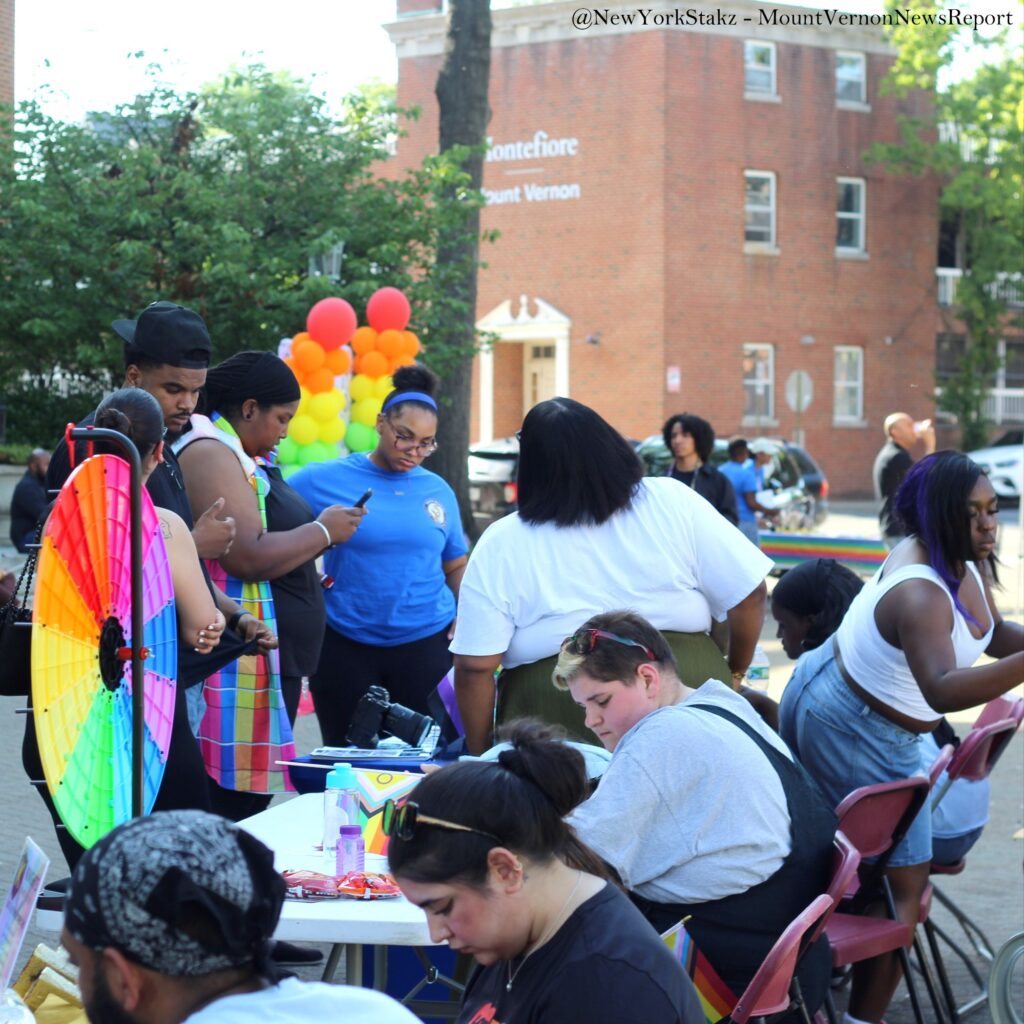
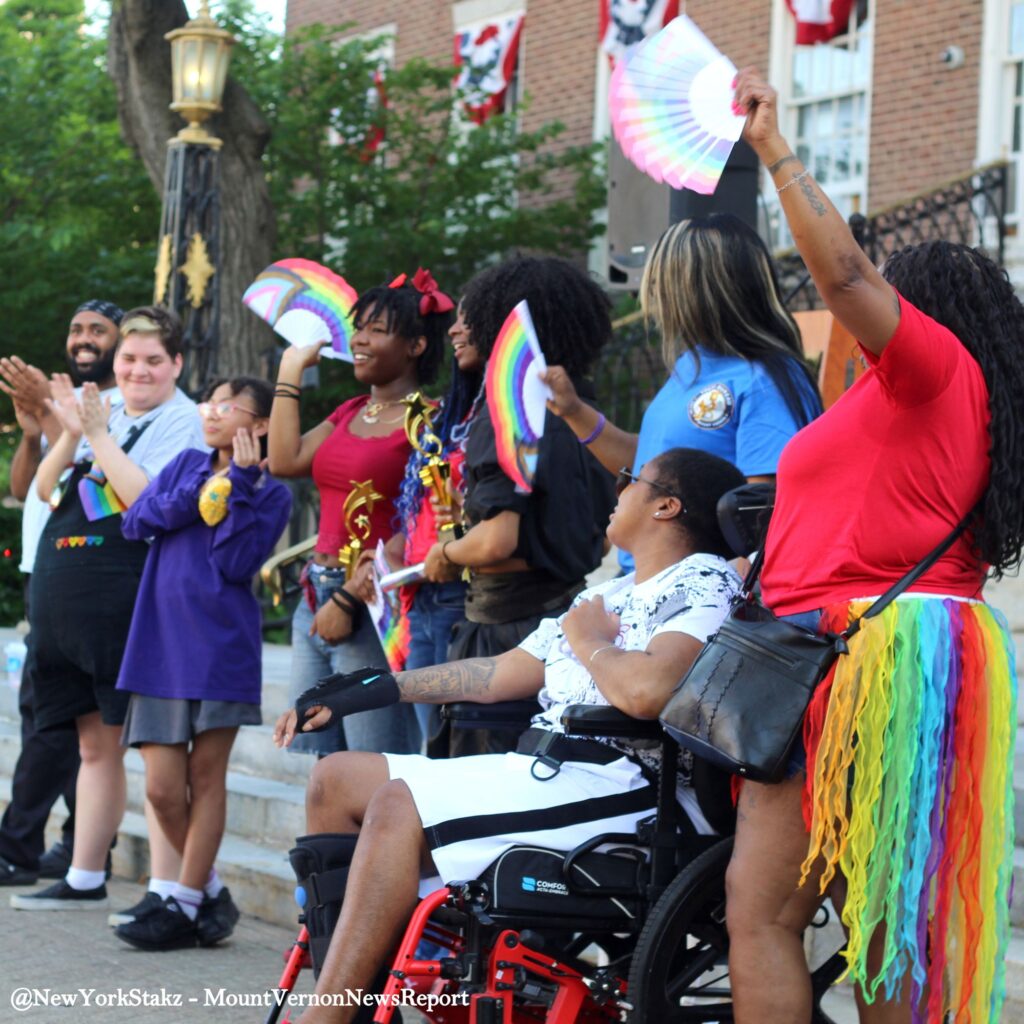
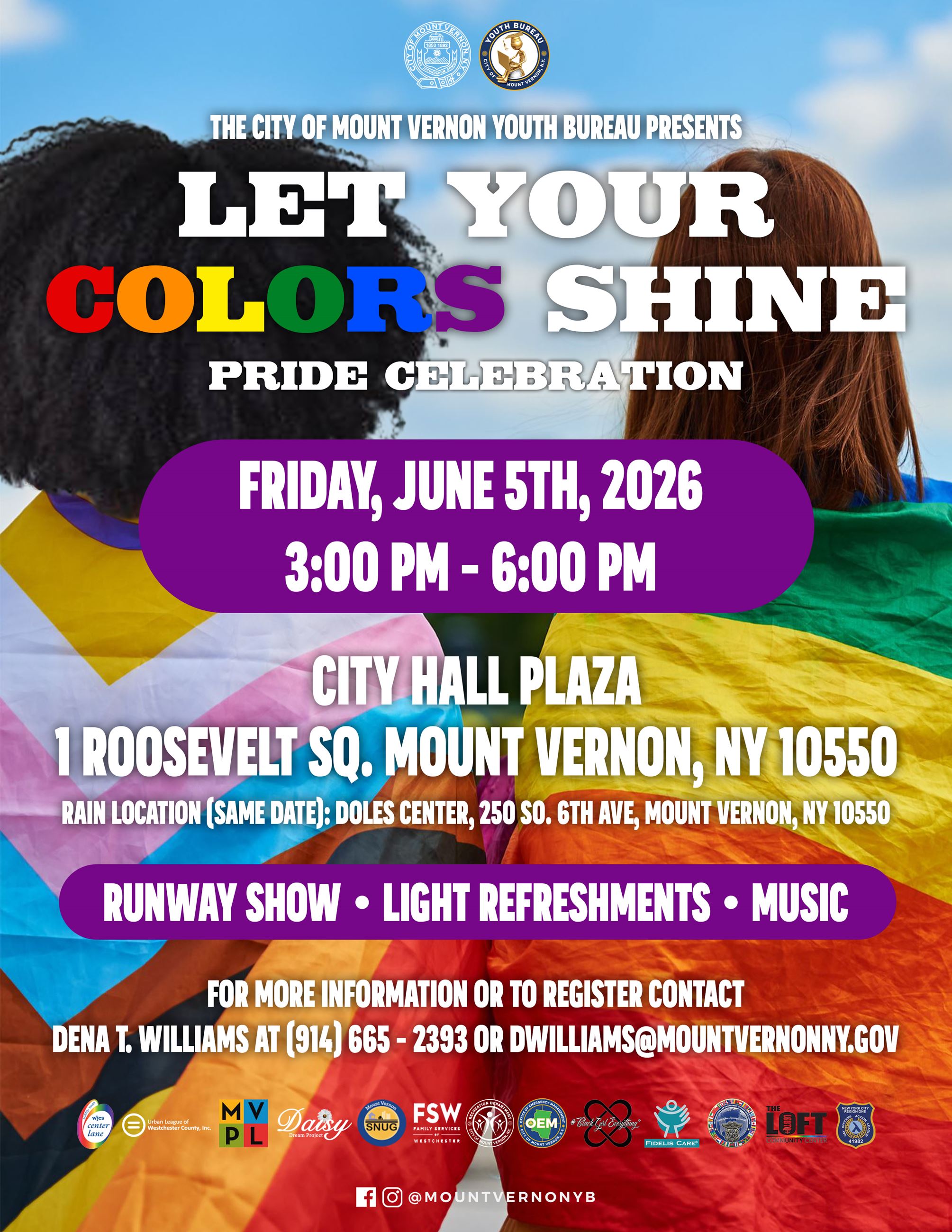
On Friday, June 5, 2026, the City of Mount Vernon Youth Bureau hosted its 6th Annual “Let Your Colors Shine” Pride Celebration at City Hall Plaza, bringing together residents from across the city for an afternoon centered on visibility, acceptance, and community.
From students and parents to seniors and community advocates, people from all walks of life gathered in downtown Mount Vernon to celebrate Pride Month and support one another. The event featured music, performances, refreshments, community resources, and opportunities for residents to connect with organizations serving youth and families throughout the city.
As residents celebrated, connected with local organizations, and enjoyed performances throughout the afternoon, the event reflected the mission of the Mount Vernon Youth Bureau and its leadership. Executive Director Debbie Burrell-Butler, a Mount Vernon High School graduate and longtime Youth Bureau employee who has served the department in various roles since 2001, has dedicated much of her career to supporting the city’s young people and families. Under her leadership, programs and events such as Let Your Colors Shine continue to create spaces where residents feel welcomed, valued, and seen. For many in attendance, the celebration served as a reminder that Mount Vernon is strongest when every member of the community is embraced and included.
“So as we celebrate Pride with glitter, with flags, and with joy, let us also recognize the quiet strength of our allies from all over,“ Burrell-Butler shared with Black Westchester.
Community-Based Organizations were on hand sharing information and resources with attendees, while performances by Cupid’s Arrow, Iden.t.T, and Miss Alexa Dumont helped energize the crowd and create a welcoming atmosphere. Families, teens, and children could be seen enjoying the festivities while learning about services available within the community.
According to Dena T. Williams, Deputy Director of the Mount Vernon Youth Bureau, the event represented more than just a celebration.
“Today the Mount Vernon Youth Bureau held its 6th annual ‘Let Your Colors Shine’ event,” Williams said. “We had Community-Based Organizations sharing important resources, teens, children, and parents all there showing support for one another, as well as the amazing performances by Cupid’s Arrow, Iden.t.T, and Miss Alexa Dumont.”
Williams also recognized the many individuals and organizations who helped make the event possible.
“I’d like to give a special thanks to Pride Committee members Dr. Gloria Pope, City Council President Derrick Thompson, Commissioner Walker-Pinckney and her staff, Jade Hackett, Sharon Thomas, Dennis Richmond, the CBOs, and Youth Bureau staff for their time and support in making this a successful event,” she said.
While the event highlighted the progress made toward greater inclusion and acceptance, Williams emphasized that the work does not end when Pride Month is over.
“Today was amazing, but we must all remember inclusion is a year-round commitment that requires ongoing, daily effort,” Williams said. “We all deserve to be seen, no matter who you are.” Williams has dedicated much of her professional career to serving Mount Vernon’s youth. After joining the Youth Bureau in 2009 as a Youth Program Coordinator, she became Deputy Director two years later. Over the years, she has supported thousands of young folks and families through various programs.
As music filled the plaza, one message remained clear. Mount Vernon continues to be a city where people from different backgrounds can come together, support one another, and, seriously, let their colors shine.
[Editor’s Note: The Let Your Colors Shine Pride Celebration is an annual event, typically held in early June, hosted by the City of Mount Vernon Youth Bureau to celebrate the LGBTQ+ community, allies, and youth. The event features a Kiki Runway, lively music, light refreshments, and a supportive environment promoting love, diversity, and self-expression. “The celebration operates as a safe, welcoming space for youth and families to stand together in solidarity and equality. Whether you are a member of the LGBTQ+ community or an ally, the Youth Bureau encourages Mount Vernon residents to come out and show their support,” Mount Vernon Mayor Shawyn Patterson-Howard shared on IG]
Leading by Example: MVCSD Trustees Erica Peterson, Christopher McDonough & Donna Marable’s Commitment to Educational Excellence Recognized Statewide
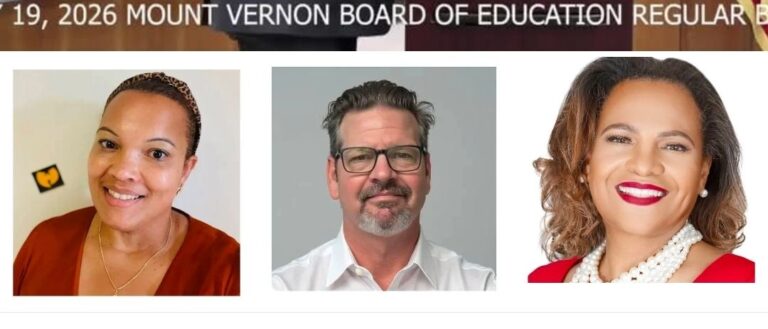
Mount Vernon City School District (MVCSD) Trustee Erica Peterson, Trustee Dr. Christopher McDonough, and President Trustee Dr. Donna Marable received New York State School Boards Association (NYSSBA) Recognition Achievement Awards!
The NYSSBA Recognition Achievement Awards were presented by Mount Vernon City School District Superintendent Dr. Demario A. Strickland during the Mount Vernon Board of Education’s Regular Business Meeting on May 19, 2026 (see video below).
Trustee Erica Peterson earned the Level 1: Board Achievement Award, receiving a Certificate of Recognition for her commitment to professional development and board service. Trustee Christopher McDonough was honored with the Level 2: Board Excellence Award, which includes a Certificate of Recognition and recognition in On Board, NYSSBA’s award-winning official publication. Board President Dr. Donna Marable received the Level 3: Board Mastery Award, which includes a Certificate of Recognition, acknowledgment in On Board, complimentary registration to a one-day NYSSBA seminar, and a commemorative padfolio in recognition of her continued dedication to educational leadership and governance.
The NYSSBA’s Board Excellence Recognition Program acknowledges the extensive time and effort required of school board members who continually strive to expand their knowledge and skills for better board governance. NYSSBA members earn points for participating in NYSSBA training opportunities, including the Annual Convention and regional workshops, and for taking on board-related roles such as Board President and NYSSBA’s Advocacy Liaison.
The New York State School Boards Association (NYSSBA) is a member-driven organization that serves as the statewide advocate and voice for more than 670 boards of education and roughly 5,000 elected school board officials across New York State. Founded in 1896 and headquartered in Latham, New York, NYSSBA provides leadership development, legal advice, policy updates, and legislative advocacy to support public elementary and secondary education.
The Mount Vernon City School District (MVCSD) Board of Education (BOE) consists of nine trustees serving staggered three-year terms.
Early voting starts June 13. Primary day is June 23. And right now, neither candidate for Greenburgh Town Supervisor has presented a specific, written, accountable plan for the Black residents of Fairview.
That is not an opinion. That is a documented fact. And before one vote is cast in this primary, Fairview deserves to know it.
My name is Mechelle Brown. I am a community advocate and the author of the Greenburgh Black Lives Matter resolution, which I conceived, drafted, and brought to the White Plains/Greenburgh NAACP for partnership. That resolution was adopted by the Greenburgh Town Board on November 22, 2021. I have been fighting for the residents of this community for years — through housing battles, through the fight to protect the Black Lives Matter sign on Knollwood Road after it was vandalized, and through organizing alongside the NAACP on issues that directly affect Black families in Greenburgh.
I am not writing this to tell you who to vote for. I am writing this because Fairview residents have something rare this June — a real choice. And to make an informed choice, voters need to know where both candidates actually stand on the issues that affect this community most directly.
The Race: Who Is Running and What Are They Running On
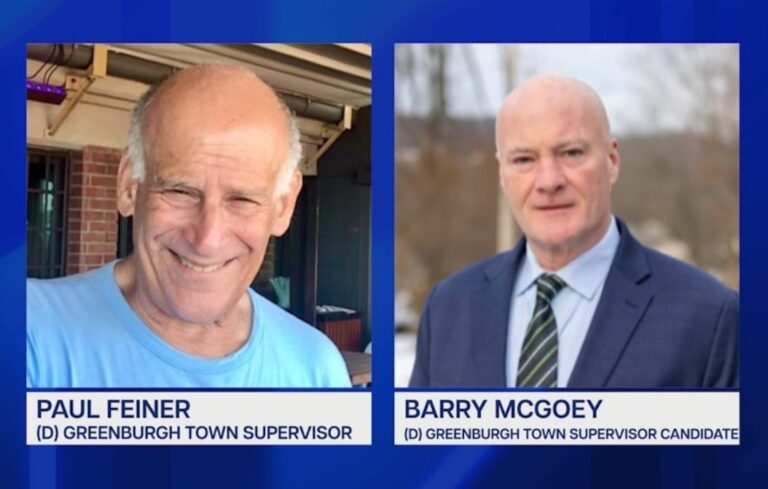
Paul Feiner has served as Greenburgh Town Supervisor since 1991 — 34 years. He is running on his record of constituent service and personal accessibility, stating on his campaign website that he has handled over 20,000 matters personally and invites residents to call him directly. He has received the endorsement of the Working Families Party. His campaign website is www.paulfeiner.com.
Barry McGoey is an Ardsley Village Trustee and attorney who is challenging Feiner for the first time anyone has held this office since 1992. He entered the race, citing a water main break and a report showing nearly $30 million in uncollected taxes as evidence that Greenburgh needs new leadership. He received the endorsement of the Greenburgh Democratic Town Committee with over 83% of the vote. More than 56% of his campaign funding has come from labor unions and donors based in Yonkers — not Greenburgh. His campaign website is www.barryforgreenburgh.com.
McGoey announced his candidacy to Black Westchester in January 2026. In that announcement, he spoke about the water main break. He said nothing about Black residents. He said nothing about Fairview.
His campaign platform covers fiscal responsibility, flood mitigation, Edgemont incorporation, and Central Park Avenue. Fairview is mentioned once — listed alongside other unincorporated communities in a general geographic description of the town. There is no policy commitment directed at Fairview. There is no mention of racial equity. Not one word.
Feiner’s record in office spans 34 years. In that time, Greenburgh paid a $9.5 million federal fair housing settlement — one of the largest of its kind in the country — after fighting a lawsuit over affordable housing placement. Former Greenburgh Town Clerk and Westchester County Legislator Alfreda Williams publicly described the Town’s pattern of placing nearly all of its affordable housing projects in Fairview as the deliberate “ghettoizing” of the area. Fairview also carries an Urban Renewal District designation dating to the 1960s — a legacy of federal policies that displaced Black communities across America — that has never been formally addressed or remedied by the Town.
In 34 years, no comprehensive racial equity plan for Fairview has been produced.
What Fairview Needs — And What I Am Asking Both Candidates to Produce
This week I formally challenged both candidates — in writing, on a documented email chain — to present a real racial equity plan for Fairview before early voting begins. I asked for something specific, written, and accountable. Not a list of programs. Not symbolic gestures. A plan.
That plan must include:
Affordable housing access and tenant protections — ensuring Fairview residents are never displaced from their community and always have the right to return.
Homeownership opportunity — the active removal of zoning and policy barriers that have historically prevented Black residents from buying, building, and investing in property in Greenburgh.
Small business creation and a real pathway to growth for Black entrepreneurs in Greenburgh.
Black vendors and contractors are included in all Town hiring and procurement — every dollar Greenburgh spends is an opportunity to invest in this community.
Financial partnership and support for nonprofit business creation in Fairview.
Equal access to every opportunity afforded to any Greenburgh resident — in employment, contracting, development, and civic life.
Infrastructure equity — a documented assessment of gaps in Fairview compared to other parts of Greenburgh, with a funded plan and specific timelines to close them.
Public safety and community relations — a specific plan addressing the relationship between law enforcement and the Black community in Fairview.
Youth programs and educational support with measurable goals and annual reporting.
Cultural recognition that goes beyond symbols — a commitment to completing and protecting projects that reflect the history of Black residents in this community.
Community oversight — every board and committee affecting Fairview must include Black residents from Fairview as voting members with real authority.
A dedicated point person within the Supervisor’s office accountable to Fairview residents.
Annual public reporting on measurable outcomes — not a list of programs, but data showing whether conditions for Black residents in Greenburgh are actually improving.
These are not radical demands. These are the basic elements of equitable governance. Towns and municipalities across this country produce plans exactly like this. There is no reason Greenburgh cannot — except for the absence of political will to do it.
What Happened When I Asked
I sent a direct written challenge to both candidates this week, asking for exactly this. Supervisor Feiner responded — with a list of 23 programs and initiatives. Sidewalks, clothing drives, snow shoveling, a Black history museum proposal, and a pickleball court. These are constituent services. Some are meaningful. None of them are a racial equity plan with measurable goals, hard deadlines, and public accountability.
When I pointed that out directly, Feiner responded again — this time describing 34 years of listening circles, advisory committees, and community conversations. I appreciate the engagement. But 34 years of listening without a written plan and measurable outcomes is not racial equity leadership. It is process without product.
As of the publication of this article, Barry McGoey has not responded to my challenge. He came to Black Westchester for coverage. He has not come to Black Greenburgh with a plan.
This Is Not About Choosing a Side
I want to be clear about something. I am not telling Fairview how to vote. I am not endorsing either candidate. I am on the side of the candidate — either candidate — who produces a real, written, specific, accountable racial equity plan for this community. Whoever that is will have earned the vote. Whoever does not will have answered the question themselves.
Fairview residents have the power this June to demand something real before they cast a ballot. This community has fought for everything it has — through housing battles, through vandalized signs, through broken promises. That history of fighting is also a history of winning when we are organized and informed.
We are organized. We are informed. And we have six days before early voting begins.
Both candidates have been challenged. Both candidates know what is being asked. What happens next is up to them — and up to you.
Mechelle Brown is a Greenburgh community advocate and the author of the original Greenburgh Black Lives Matter resolution, adopted by the Greenburgh Town Board on November 22, 2021, in partnership with the White Plains/Greenburgh NAACP.
As New York continues to rally behind the Knicks’ first NBA Finals appearance since 1999, Westchester County is giving local fans a chance to experience the excitement together. County officials announced plans to host public watch parties for Games 3 and 4 of the NBA Finals as the Knicks return home with a 2-0 series lead over the San Antonio Spurs, two games away from winning their first championship since 1973.
The Westchester County Center, home of the Westchester Knicks, will welcome basketball fans for NBA Finals watch parties on Monday, June 8, and Wednesday, June 10, as the New York Knicks continue their historic quest for a championship against the San Antonio Spurs in Games Three and Four of the series. Tickets are on sale now for $10 per person, plus Ticketmaster fees, and will also be available at the door on the night of each event based on availability.
The watch parties will include a DJ, food and drink for purchase, and the viewing of the game on a large screen in the main hall. Doors open at 7 p.m.; game begins at 8:30 p.m. Parking is $10 per car.
“Excitement across New York is at an all-time high as the New York Knicks make their first NBA Finals appearance since 1999. I’m thrilled that we can bring fans together at the Westchester County Center, home of the Westchester Knicks, to share in the excitement and cheer them on during this historic championship run. Let’s go, Knicks!” Westchester County Executive Ken Jenkins shared with Black Westchester.
The watch parties are expected to bring together Knicks fans from across Westchester to cheer on Jalen Brunson, Karl-Anthony Towns, Josh Hart, and the rest of the team as they pursue the franchise’s first NBA championship since 1973. With Knicks fever sweeping the region, county leaders hope the events will provide a safe, family-friendly atmosphere for fans to celebrate one of the most exciting moments in New York sports history.
“The Westchester County Center is the Mecca of all things basketball in Westchester County. By hosting these watch parties, we are adding another layer of excitement and community spirit to an already historic NBA Finals run for the New York Knicks. There is nothing quite like experiencing the energy of a big game surrounded by fellow fans,” Westchester County Parks Acting Commissioner Peter Tartaglia shared.
The Knicks have already captured Games 1 and 2 on the road and will return to Madison Square Garden looking to move one step closer to ending a 53-year championship drought.
The Westchester County Center is located at 198 Central Ave in White Plains.
Early voting plays a vital role in strengthening our democracy by giving voters greater flexibility and convenience in casting their ballots. Instead of being limited to a single Election Day, early voting allows citizens to vote on a schedule that works best for them, helping to reduce long lines, scheduling conflicts, and last-minute emergencies that might otherwise prevent participation.
Early voting also helps ensure that more voices are heard. Many voters juggle work, family responsibilities, school, transportation challenges, or health concerns. By providing multiple days to vote, communities can increase voter participation and make the electoral process more accessible to everyone, including seniors, people with disabilities, and those with demanding work schedules.
Another benefit of early voting is that it reduces congestion at polling places on Election Day. When voters take advantage of early voting opportunities, election officials can better manage turnout, shorten wait times, and improve the overall voting experience. This helps make the process more efficient for voters and poll workers alike.
Most importantly, early voting empowers citizens to make their voices heard. Every election impacts our schools, neighborhoods, public safety, housing, taxes, and the future of our communities. Early voting gives voters more opportunities to participate in those decisions and ensures that unforeseen circumstances don’t prevent them from exercising one of their most fundamental rights.
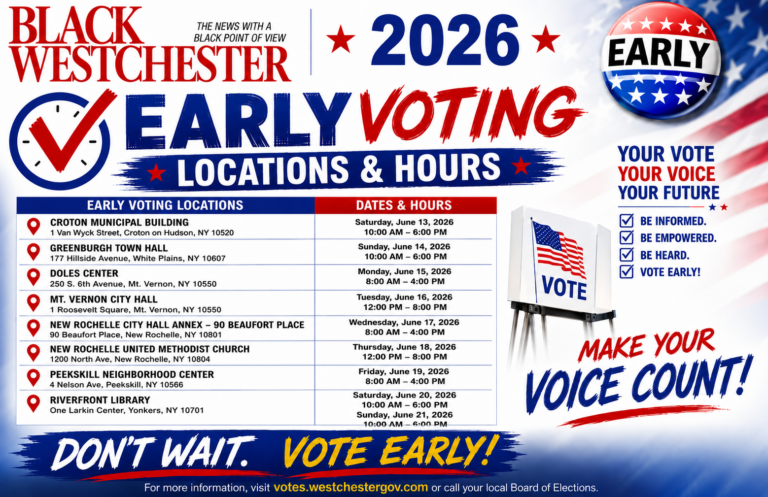
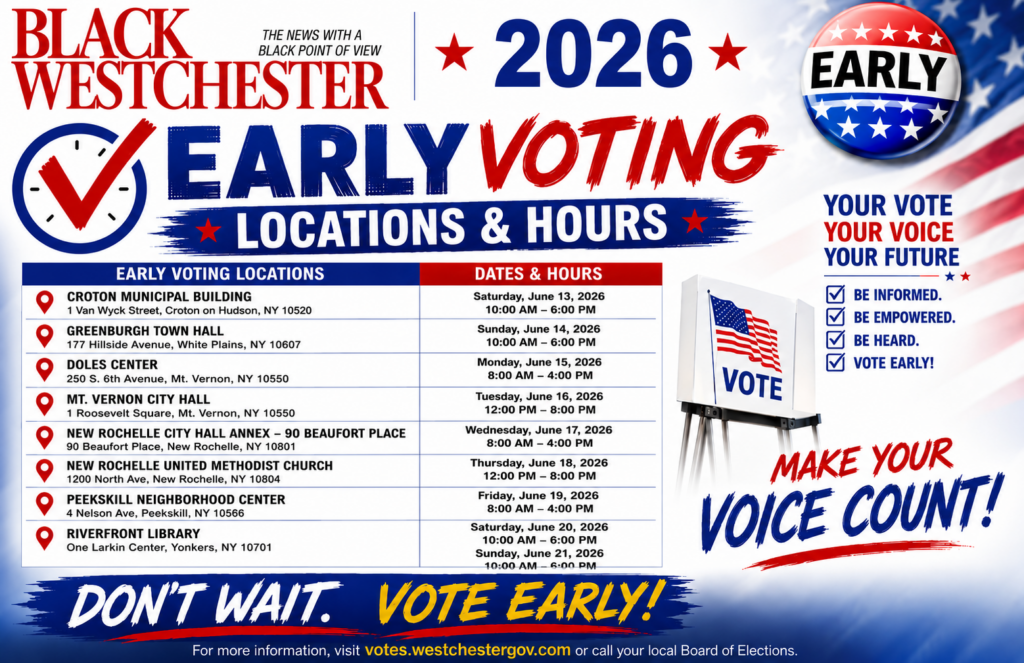
Early Voting in Westchester County will begin prior to the June 23rd Federal/State/Local Primary Election. The early voting period will be from Saturday, June 13, 2026, through Sunday, June 21, 2026.
Voting during early voting is the same as voting on Election Day. When you get to the early voting center, you will check in to vote, receive your ballot, and vote as in any other election.
There will be instructions available at the early voting centers to familiarize you with the ballot. There will also be a notice to voters and a bill of rights. You may ask an election inspector to explain how to vote or if you need any assistance.
All registered voters enrolled in the Democratic Party are eligible to vote. If you vote during the early voting period, you are not eligible to vote on Election Day.
The 2026 Federal/State/Local Primary Election is Tuesday, June 23, 2026. On Election Day, you must vote at your regular polling location.
There are Primary Elections for the following offices: Comptroller, Representative in Congress – 17th District, Member of Assembly – 90th District, County Legislator – Districts 15 & 17, Supervisor – Town of Greenburgh & Town of North Castle, Mayor – Village of Larchmont, Member of County Committee in the City of Yonkers: Ward 3 Election District 11, Ward 4 Election Districts 1, 10, & 11, Ward 8 Election Districts 5 & 7, and Ward 12 Election District 13. Click here to see the complete list of candidates.
Days and Hours as follows:
Saturday, June 13, 2026, from 10 a.m. until 6 p.m. Sunday, June 14, 2026, from 10 a.m. until 6 p.m. Monday, June 15, 2026, from 8 a.m. until 4 p.m. Tuesday, June 16, 2026, from 12 p.m. until 8 p.m. Wednesday, June 17, 2026, from 8 a.m. until 4 p.m. Thursday, June 18, 2026, from 12 p.m. until 8 p.m. Friday, June 19, 2026, from 8 a.m. until 4 p.m. Saturday, June 20, 2026, from 10 a.m. until 6 p.m. Sunday, June 21, 2026, from 10 a.m. until 6 p.m
Westchester County Early Voting Centers
You can vote at any of the twenty-five (25) designated Early Voting sites throughout Westchester County. These Early Voting centers are listed below:
Westchester County Early Voting Centers (Subject to Change Pending New York Attorney General’s Preclearance) **Please note: The Joseph G. Caputo Community Center has been replaced with St. Ann’s School for this year.
Croton Municipal Building, 1 Van Wyck Street, Croton on Hudson, NY 10520 Eastchester Public Library, 11 Oakridge Place, Eastchester Greenburgh Town Hall, 177 Hillside Avenue, White Plains Hastings-on-Hudson Public Library, 7 Maple Avenue, Hastings-on-Hudson, NY 10706 St. Gregory The Great Church, 215 Halstead Avenue, Harrison, NY 10528 Mamaroneck Town Center, 740 W. Boston Post Road, Mamaroneck, NY 10543 Mt. Kisco Public Library, 100 E. Main Street, Mt. Kisco, NY Mt. Pleasant Community Center, 125 Lozza Drive, Valhalla St. Ann’s School, 16 Elizabeth Street, Ossining, NY 10562** Pound Ridge Town House, 179 Westchester Avenue, Pound Ridge, NY 10576 Rye Brook Firehouse, 940 King Street, Rye Brook, NY Somers Town House, 335 Route 202, Somers, NY 10589 Jefferson Village Annex, 3500 Hill Blvd. Yorktown Heights, Yorktown Cultural Center, 1974 Commerce Street, Yorktown Heights, NY 10598 Doles Center, 250 S. 6th Avenue, Mt. Vernon, NY 10550 Mt. Vernon City Hall, 1 Roosevelt Square, Mt. Vernon, NY New Rochelle City Hall Annex – 90 Beaufort Place, 90 Beaufort Place, New Rochelle, NY 10801 New Rochelle United Methodist Church, 1200 North Ave, New Rochelle, NY 10804 Peekskill Lincoln Depot Museum, 10 S. Water Street, Peekskill, NY 10566 Peekskill Neighborhood Center, 4 Nelson Ave, Peekskill Rye City- Resurrection- Early Childhood Education Center, 88 Milton Road, Rye, NY 10580 Grinton I. Will Library, 1500 Central Park Avenue, Yonkers, Nodine Hill Community Center, 140 Fillmore Street, Yonkers, NY 10701 Riverfront Library, One Larkin Center, Yonkers, NY 10701
Don’t wait until Election Day. Make a plan, know your polling location, and vote early. Your vote is your voice, and your voice matters.
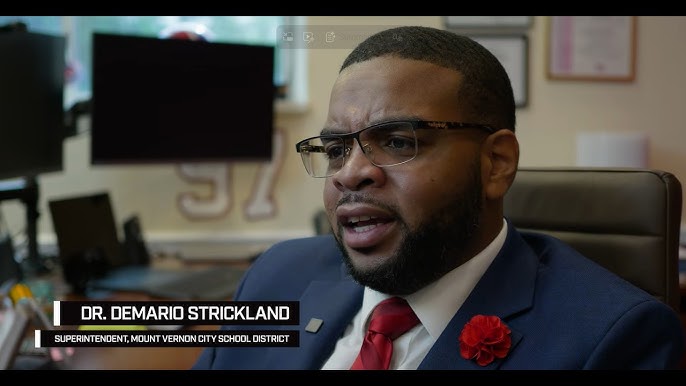
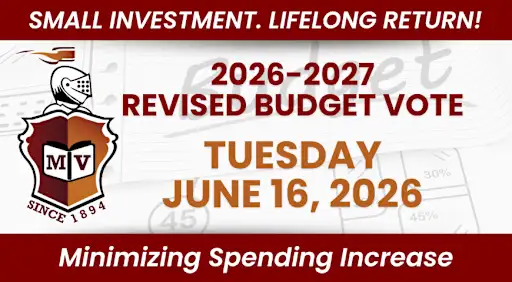
On June 16th, our community returns to the polls for a budget revote. I am not here to tell you how to cast your ballot – that sacred right belongs to you and you alone. But I will not stand before you and pretend to be neutral. I am an educator. I am a neighbor. I am someone who has looked into the eyes of the children of this city and made them a promise. And I will not be silent when everything we promised them is on the line.
This is about a 1.5% levy. It is also about everything.
When a school budget fails, the cuts that follow are not abstract. They have names. They have faces. They sit in our classrooms. They ride our buses. They wear our colors on Friday nights.
Let me tell you what hangs in the balance.
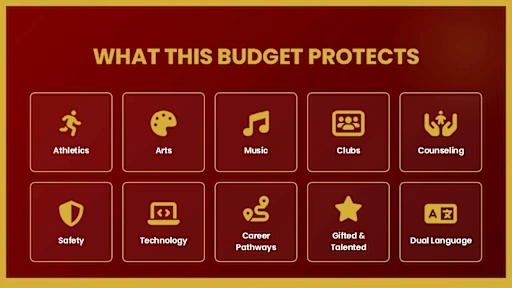
Our children’s futures are at stake. The programs that identify and nurture gifted students, that provide early intervention for those who are struggling, that give our young people a fighting chance in a competitive world are not luxuries. They are not extras. They are the floor beneath our children’s feet. And when budgets collapse, that floor gives way first for the children who can least afford the fall.
Our educators are at stake. Mount Vernon’s teachers and support staff show up every single day for our students. Rain or shine. Underpaid and overextended. Still showing up. Positions eliminated in a budget crisis do not always come back. Experienced teachers leave. Class sizes balloon. The relationship between a child and a trusted adult in that building gets stretched thinner and thinner. Until it breaks.
Our most vulnerable students are at stake. After school programs. Special education services. Guidance counselors. These are not line items. These are lifelines for children navigating learning differences, trauma, and the very real weight of growing up in an under-resourced city. Budget failure does not impact every child equally – it falls hardest on those who were already carrying the heaviest loads.
Our extracurriculars are at stake. For some of our children, the band rehearsal, the debate team, and the athletic field are the reasons they walk through that door every morning. The research is clear: students engaged in after-school activities have higher graduation rates, lower rates of involvement in the juvenile justice system, and stronger social-emotional outcomes. We cannot afford to take those doors away.
Our community’s trajectory is at stake. The quality of our schools shapes who stays in Mount Vernon. Who invests here? Who builds here? Who raises their children here? Every generation that passes through these buildings either lifts this city or quietly signals that we gave up on it.
I refuse to give up on it.
I know you do too.
Mount Vernon has always been a city that fights. We fight for our families. We fight for our block. We fight for each other. June 16th is not just a vote. It is a declaration. A declaration that we see our children. That we value our children. That we will not let our children down.
The children are watching.
They always are.
Dr. Demario A. Strickland Superintendent of Schools Mount Vernon City School District
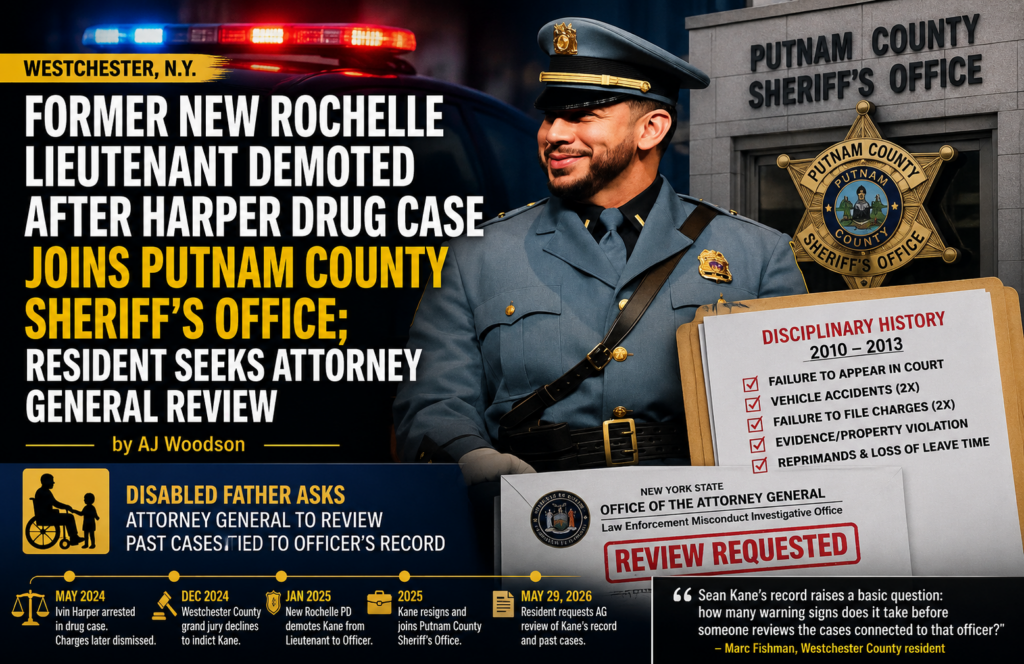
Disabled father asks Attorney General to review past cases tied to officer’s record
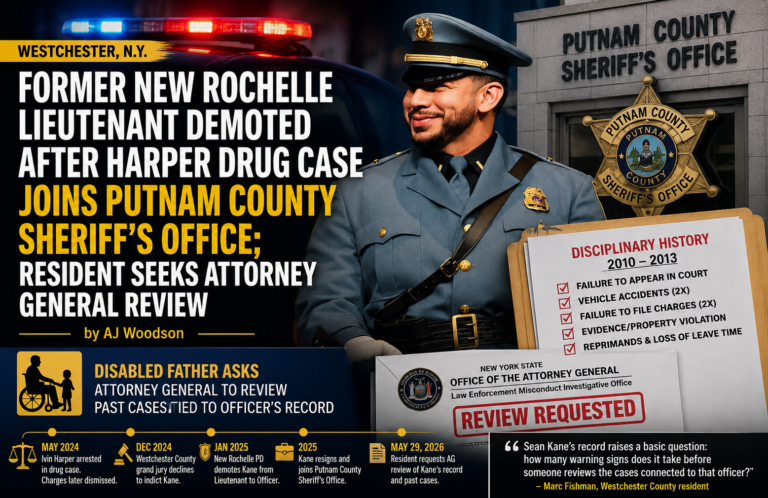
WESTCHESTER, N.Y. — Former New Rochelle Police Lieutenant Sean Kane, who was demoted following an internal disciplinary investigation tied to the high-profile May 2024 arrest of Irvin Harper, has secured a new law enforcement position with the Putnam County Sheriff’s Office, prompting renewed calls for state officials to review cases connected to his disciplinary record.
Multiple reports state Sean Kane resigned from the New Rochelle Police Department shortly after being demoted from lieutenant to police officer in connection with the arrest of Ivin Harper, a Black former New Rochelle resident whose charges were later dismissed after questions arose about the evidence and body-camera footage. Reporting indicates Kane accumulated multiple command disciplines before the Harper incident.
A Westchester County grand jury declined to indict Kane in December 2024 after reviewing evidence related to the incident. The New Rochelle Police Department subsequently continued its internal disciplinary review, which resulted in Kane’s demotion
“The disciplinary proceeding against Lieutenant Sean Kane has been resolved. After consideration and full review of the matter, Kane has been demoted two ranks to the position of Police Officer. Police Officer Kane is presently assigned to re-training, re-orientation, and review of all department rules, regulations, policies, and procedures. Upon completion of his re-training, future assignment will be determined at the discretion of the Police Commissioner. The New Rochelle Police Department maintains the highest standards of professionalism and accountability. The resolution of this case is consistent with those principles. This is a personnel matter; the City will have no further statement.” New Rochelle Police Commissioner Neil Reynolds said in a statement to Black Westchester.
“Body-camera footage reviewed by multiple news organizations appeared to show Kane handling a baggie containing a white substance before later reporting that drugs had been recovered beneath Harper’s vehicle.”
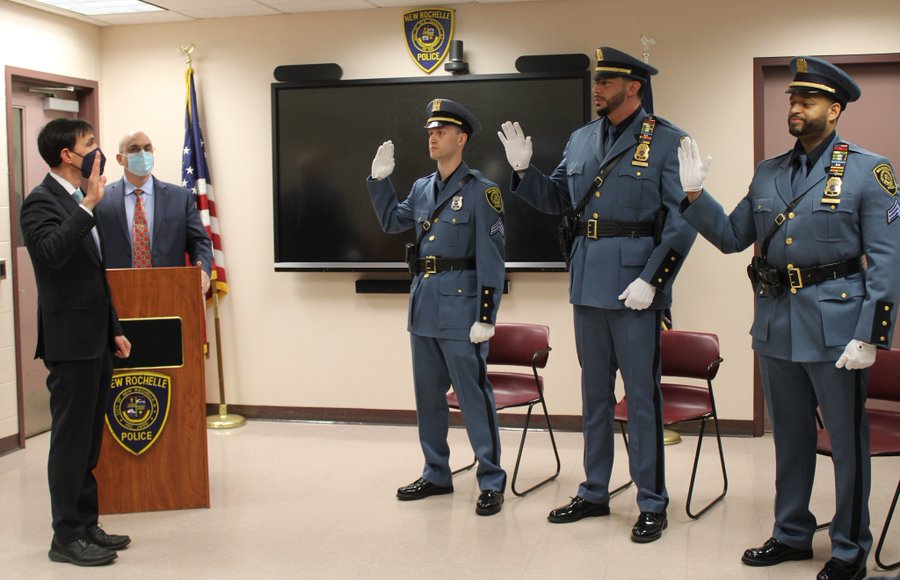
Sgt. Sean Kane (center) being promoted to Detective Sergeant, Apr 8, 2022 [photo courtesy of City of New Rochelle Social Media]
A New Job After a High-Profile Demotion
Kane’s move to Putnam County has intensified questions about whether officers disciplined for serious misconduct can leave one department and continue working elsewhere without a public review of their record or the cases in which they played a role.
Public records also show that Kane had accumulated multiple command disciplines before the Harper incident, including reprimands and loss of leave days tied to failures to appear in court, file charges, and follow department procedures.
Disabled Father Seeks Attorney General Review
Marc Fishman, a disabled father who says Kane was involved in his own 2018 arrest in Westchester County, has submitted a formal request to the Attorney General’s Law Enforcement Misconduct Investigative Office asking the state to examine whether Kane’s law enforcement history warrants a broader review.
“Sean Kane’s record raises a basic question: how many warning signs does it take before someone reviews the cases connected to that officer?” Fishman said. “If the public only learns about these problems after a scandal, the oversight system is already failing.”
Documents obtained by Black Westchester show a pattern of sustained disciplinary findings involving procedural violations dating back to 2010. Those records include failures to appear in court, two separate incidents involving the failure to timely file criminal charges, vehicle-related disciplinary matters, and a violation involving the handling of recovered property. Disciplinary penalties ranged from letters of reprimand to the loss of leave time.
Fishman’s request cites prior disciplinary matters, including complaint numbers 2010-51, 2012-32, 2013-16, 2013-42, and 2013-49, and asks state officials to determine whether cases involving Kane should be reviewed for potential due process, disclosure, or accountability concerns.
Broader Scrutiny in New Rochelle
Kane’s case comes amid renewed scrutiny of police oversight in New Rochelle and across Westchester County. Residents and civil-rights groups have repeatedly questioned whether misconduct complaints are reviewed independently, whether disciplinary histories are meaningfully considered before officers are promoted or reassigned, and whether repeat warning signs trigger intervention before a public scandal.
Those concerns are not limited to Kane. In 2025, reporting on an Attorney General review found that former New Rochelle officer Lane Schlesinger had engaged in a pattern of misconduct involving abuse of authority after years of prior complaints and discipline.
“People are asking a simple question,” Fishman said. “If the warning signs were there for years, why does serious review only happen after a public scandal?”
Requests for Comment Not Returned
Requests for comment from the Attorney General’s office and the Putnam County Sheriff’s Office regarding whether Kane’s record or related cases will be reviewed were not returned at the time of this release.
Recent media reports have raised serious questions regarding Kane’s demotion, resignation from the New Rochelle Police Department, and subsequent employment with the Putnam County Sheriff’s Office. On May 29, 2026 Fishman’s representative requested that the Law Enforcement Misconduct Investigative Office review whether former New Rochelle Police Department Lieutenant Sean Kane’s law enforcement record reflects a pattern of serious misconduct warranting independent examination.
It’s That Time Again, Election Season Is Here: Meet the Candidates Seeking Your Vote in Westchester County
Westchester County voters heading to the polls for the 2026 Democratic Primary will have several important races to consider at the federal, state, county, and local levels. This year’s ballot includes contests that will help shape the future of government representation throughout Westchester County, from Congress and the New York State Legislature to county and municipal offices. Primary elections will be held for the following offices: New York State Comptroller, Representative in Congress – 17th Congressional District, Member of the New York State Assembly – 90th Assembly District, Westchester County Legislator – Districts 15 and 17, Supervisor – Town of Greenburgh, Supervisor – Town of North Castle, Mayor – Village of Larchmont, and Member of the Westchester County Democratic Committee in the City of Yonkers.
As Westchester County voters prepare to head to the polls, Black Westchester is committed to helping residents make informed decisions about the candidates seeking to represent them. From local races that directly impact our neighborhoods to countywide contests that shape policy and priorities for years to come, every election matters. The 2026 Primary Election presents voters with important choices about the future leadership of our communities, making it more important than ever to know who is on the ballot, what offices are being contested, and who is asking for your vote. To help our readers navigate the election season, with the help of the Westchester County Board of Elections, Black Westchester has compiled a list of candidates appearing on the ballot throughout Westchester County in this year’s primary election.
Here is Your Complete Guide to the 2026 Westchester County Primary Election
Kicking things off with the New York State Comptroller’s Office, you have the incumbent Thomas P. DiNapoli (1A), who is the 54th Comptroller of the State of New York, running for re-election. He will face Drew Warshaw (2A)and Raj Goyle (3A) in the Democratic Primary. The NYS Comptroller race is one of the most important contests on the ballot because the Comptroller serves as the state’s chief fiscal officer, overseeing the finances of one of the largest economies in the world. The office is responsible for auditing state agencies, local governments, and public authorities to ensure taxpayer dollars are being spent appropriately and efficiently. The Comptroller also manages the New York State Common Retirement Fund, one of the largest public pension funds in the nation, which impacts the retirement security of more than one million state and local government employees, retirees, and beneficiaries.
Beyond managing billions of dollars in public funds, the Comptroller serves as an independent watchdog tasked with promoting transparency, accountability, and fiscal responsibility throughout state government. The office has the authority to investigate waste, fraud, and abuse, review government contracts, and provide oversight that helps ensure public resources are being used in the best interests of New Yorkers. Decisions made by the Comptroller can affect everything from local school districts and municipalities to statewide infrastructure projects and economic development initiatives. For voters, the Comptroller’s race may not receive as much attention as races for Governor or Congress, but the individual elected to the position will have a direct impact on how taxpayer money is managed and how effectively government agencies are held accountable. In many ways, the Comptroller serves as the financial guardian of New York State, making the office one of the most influential and consequential positions in state government.
One of the most closely watched races in Westchester County this election cycle is the Democratic primary for New York’s 17th Congressional District. Five candidates—Effie Guadalupe Phillips-Staley (4A), Cait Conley (5A), Beth Davidson (6A), John Cappello (7A), and Michael Sacks (8A)—are competing for the opportunity to represent the Democratic Party in November and challenge incumbent Republican Congressman Mike Lawler, who currently holds the seat. With control of Congress expected to once again be a major issue in the upcoming election, the race has attracted significant attention from voters, political leaders, and party activists throughout the district. As each candidate makes their case to Democratic voters, the primary will determine who emerges as the party’s standard-bearer in one of the most closely watched congressional races in New York State.
For New York State Assembly District 90, Democratic voters will have a choice between Frank Jereis (4A) and Jeannette M. Garcia (5A), who are facing off in a closely watched Democratic primary. With the winner advancing to the general election, the race offers voters two candidates seeking the opportunity to represent the district in Albany and address the issues impacting residents throughout the community. As the campaign enters its final stretch, both candidates are making their case to voters on topics ranging from public safety and economic development to education, housing, and quality-of-life concerns. The outcome of the primary will determine who carries the Democratic banner into November and could play a significant role in shaping the future direction of Assembly District 90, which is located entirely within Westchester County and covers a large portion of the City of Yonkers. The district includes much of central, southwest, northwest, and northeast Yonkers, encompassing many of the city’s diverse residential neighborhoods and commercial corridors. It is currently represented by Assemblyman Nader Sayegh, who announced earlier this year that he would not seek re-election.
Moving on to countywide races, the Westchester County Board of Legislators is the legislative, policy-making branch of Westchester County. The powers of the Board are enumerated in the county’s charter. A key power of the Board concerns finances: appropriating funds, approving the budget, and levying taxes. It also approves appointments by the County Executive and passes local laws, acts, and resolutions. The Board’s seventeen members, known as Legislators, are elected every two years, and each represents a district of approximately 56,000 residents. Two of the seventeen seats have primaries, and the other fifteen are running unopposed.
Westchester County Legislative District 15 features a Democratic primary between Kisha D. Skipper (6A) and Anthony Nicodemo (7A), with the winner earning the opportunity to represent the Democratic Party in November and challenge incumbent Republican Legislator James Nolan. The race is expected to draw significant attention as Democrats seek to reclaim a seat in a district that has become increasingly competitive in recent election cycles. Legislative District 15 serves approximately 56,000 residents across several communities in southern Westchester County, including the northeast section of Yonkers, the Village of Bronxville, and the Town of Eastchester. The district encompasses a diverse mix of urban, suburban, and village communities, each with its own unique priorities and concerns. Issues such as property taxes, public safety, economic development, infrastructure, housing, and quality-of-life concerns are expected to play major roles in the campaign as both candidates make their case to Democratic voters.
For Westchester County Legislative District 17, which covers Southwest Yonkers, Democratic voters will choose between Wilson A. Terrero (6A) and Leslye A. Oquendo-Thomas (7A) in a Democratic primary that will determine who carries the party’s banner into the general election. The race became open after Legislator José I. Alvarado (D-Yonkers) announced in January that he would not seek re-election, creating an opportunity for new leadership in one of Yonkers’ most influential legislative districts. District 17 represents a significant portion of Southwest Yonkers and includes diverse neighborhoods whose residents depend on county government for a wide range of services and programs. The next legislator will be tasked with addressing issues such as public safety, affordable housing, economic development, youth services, infrastructure improvements, and ensuring that Yonkers residents receive their fair share of county resources and investments.
One of the most closely watched municipal races in the 2026 Westchester Democratic Primary is the contest for Greenburgh Town Supervisor, where longtime incumbent Paul Feiner (9A) faces challenger Barry B. McGoey (10A). The race has drawn considerable attention because it pits one of Westchester County’s most recognizable and longest-serving elected officials against a candidate seeking to bring new leadership to the town. Feiner, who was first elected Town Supervisor in 1991, is currently the longest-serving chief elected official of any municipality in Westchester County. Challenger Barry B. McGoey is seeking to convince Democratic voters that it is time for a new direction in Greenburgh. As voters weigh experience against the desire for fresh leadership, the race presents a choice between continuity and change in the governance of Westchester County’s largest town. As the largest town in Westchester County, Greenburgh is home to a diverse population and includes six incorporated villages—Ardsley, Dobbs Ferry, Elmsford, Hastings-on-Hudson, Irvington, and Tarrytown—as well as the unincorporated communities of Hartsdale, Edgemont (Greenville), Fairview, North Elmsford, South Ardsley, and East Irvington. The Town Supervisor’s office plays a key role in overseeing services and policies affecting residents in the town’s unincorporated areas while working closely with village governments on matters of mutual concern. Issues such as economic development, infrastructure, housing, public services, taxes, and quality-of-life concerns are expected to be central themes throughout the campaign. Given Greenburgh’s size, diversity, and political significance, the outcome of this primary will be closely monitored not only by residents but by political observers across Westchester County. Whether voters choose to extend Feiner’s historic tenure or chart a new course with McGoey, the race is shaping up to be one of the most significant local contests on the Democratic primary ballot.
The race for Mayor of the Village of Larchmont will feature a Democratic primary between Jonathan Silvers (4A) and Brigid T. Brennan (5A), with voters deciding who will succeed outgoing Mayor Sarah Bauer, who announced in January that she will not seek re-election. With no incumbent in the race, the contest presents voters with an opportunity to choose the next leader of one of Westchester County’s most historic and vibrant waterfront communities. As the Village of Larchmont looks toward its future, residents will be evaluating the candidates’ visions for addressing local priorities such as infrastructure improvements, environmental sustainability, fiscal responsibility, public safety, downtown development, and maintaining the quality of life that has made the village one of Westchester’s most desirable communities. Both candidates are expected to make their case to voters on how best to preserve Larchmont’s character while addressing the challenges and opportunities facing the village. This is the first Democratic Party primary for mayor in the Village’s 135-year history.
In the Democratic primary for Supervisor of the Town of North Castle, incumbent Joseph A. Rende (9A) will face challenger Jose L. Berra (10A) in a race that will determine who will lead one of Westchester County’s most prominent suburban communities. As the town’s chief elected official, the Supervisor plays a critical role in overseeing municipal operations, managing the town budget, and helping shape policies that impact residents and businesses throughout North Castle. The Town of North Castle encompasses the hamlets of Armonk, Banksville, and North White Plains and is known for its strong residential communities, business development, and quality of life.
There are also several individuals running to serve as Westchester Democratic Committee Members, positions that often receive less attention than races for public office but play an important role within the Democratic Party. Democratic Committee Members serve as the grassroots foundation of the party, representing voters within their election districts and helping shape the direction of the local Democratic organization. Committee Members are responsible for electing party leadership, endorsing candidates, participating in the selection of judicial candidates, helping recruit and support Democratic candidates for office, and assisting with voter outreach and voter registration efforts. They also serve as a direct link between local residents and the Democratic Party, helping ensure that community concerns and priorities are heard and addressed. While these positions may not receive the same level of publicity as races for Congress, State Legislature, County Legislator, or local government offices, the individuals elected as Democratic Committee Members can have a significant impact on the future of the party and the candidates who ultimately appear on the ballot. For voters looking to become more involved in the political process, these races offer an opportunity to help shape the Democratic Party from the ground up and influence the direction of local politics in Westchester County.
Voters in Precinct 250311 will have the opportunity to elect two Democratic Committee Members. Running for the two available seats are Desiree Dismore (8A), Bianca Abraham (9A), and Lorraine Rabadi (10A).
Voters in Precinct 250401 will have the opportunity to elect two Democratic Committee Members. Running for the two available seats are David J. King (8A), German A. Santana (9A), Dana M. Johnson (10A), and Victoria Harris (11A).
Voters in Precinct 250410 will have the opportunity to elect two Democratic Committee Members. Running for the two available seats are Jency A. Feliz (8A), Adalgisa M. Diez (9A), Stephen Koffler (10A), and Marcella K. Koffler (11A).
Voters in Precinct 250411 will have the opportunity to elect two Democratic Committee Members. Running for the two available seats are Catherine T. Marshall (8A), Molly E. Sewalk (9A), Christian M. Fitch (10A), and Claudia N. Ruiz (11A).
Voters in Precinct 250805 will have the opportunity to elect two Democratic Committee Members. Running for the two available seats are Jamal Thomas (8A), Jayla Thomas (9A), Vanessa E. Lorenzo (10A), and Karina C. Polanco-Black (11A).
Voters in Precinct 250807 will have the opportunity to elect two Democratic Committee Members. Running for the two available seats are Leslye A. Oquendo-Thomas (8A), Leah Thomas (9A), Maria N. Terrero (10A), and Justin Caparelli (11A).
Voters in Precinct 251213 will have the opportunity to elect two Democratic Committee Members. Running for the two available seats are Vanise Prien (8A), Peter L. Spano (9A), Kisha D. Skipper (10A), and Mary Simon (11A).
The 2026 Primary Election – Tuesday, June 23, 2026. Early voting for the Primary Election is a nine (9) day period where voters can vote in-person before Election Day in Westchester County, from Saturday, June 13, 2026, through Sunday, June 21, 2026. All registered voters enrolled in the Democratic Party are eligible to vote.
From determining who will challenge incumbent officeholders in November to selecting grassroots party leaders who help shape the Democratic Party’s future, voters will have the opportunity to make their voices heard in several competitive races. Whether casting a ballot for Congress, County Legislator, Town Supervisor, Mayor, or Democratic Committee Member, every vote will play a role in determining the political direction of Westchester County and its communities.