




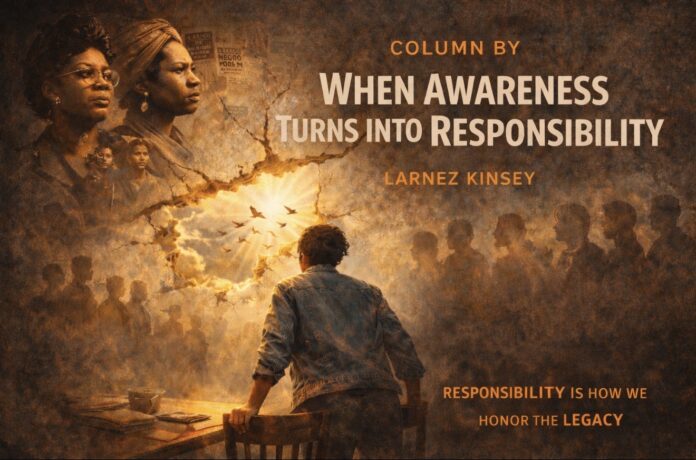






There’s a moment that comes after clarity.
After the patterns have been named.
After the language has been given.
After the silence has cracked.
It’s the moment when awareness stops feeling comforting and starts feeling heavy.
You feel it in your chest first.
In the pause before you forward something.
In the hesitation before you speak up in a meeting.
In the way you reread a text three times before deciding whether to send it.
Because once you see something clearly, you don’t get to unknow it.
You don’t get to say, “I didn’t realize.”
You don’t get to pretend it’s someone else’s problem.
You don’t get to hide behind good intentions.
You’re in it now.
And this matters especially right now.
Because we are standing in the 100th anniversary of Black History Month.
A century of documented struggle.
A century of recorded resilience.
A century of people who didn’t have the luxury of silence.
People who spoke when it was dangerous.
Who organized when it was illegal.
Who taught when they weren’t supposed to.
Who protected each other when systems wouldn’t.
They didn’t always have microphones.
They didn’t always have safety.
They didn’t always have recognition.
But they had responsibility.
And they understood something we can’t afford to forget:
Awareness without action is just memory without meaning.
Over these past weeks, we’ve talked about how systems train us. How silence gets rewarded. How survival gets tied to compliance. How courage often has to fight through payroll, politics, and pressure.
And many of you recognized yourselves in that.
You told me quietly:
“I’ve been carrying this.”
“I’ve been navigating that.”
“I thought it was just me.”
I felt those messages.
Because recognition is powerful.
But it’s also unsettling.
It forces you to ask:
Now that I know this… what am I going to do with it?
This is where a lot of movements stall.
People love awareness.
They love validation.
They love finally having words for what they’ve been feeling.
But responsibility?
Responsibility asks more.
Responsibility asks:
Who are you willing to stand beside when it costs you something?
Who are you willing to correct when it would be easier to stay quiet?
Who are you willing to protect when no one is watching?
Responsibility is where comfort gets interrupted.
It’s when you realize community isn’t just shared language, it’s shared labor.
Real community is built in small, unglamorous moments.
It’s built when you check on someone after the meeting, not just during it.
When you follow up instead of assuming someone else will.
When you pass information instead of guarding access.
When you speak a name in a room where decisions are being made.
When you interrupt harm gently but firmly.
It’s built when you ask yourself:
“Who does this cost if I don’t act?”
That question changes everything.
We live in a culture that celebrates moments, not maintenance.
We love statements.
We love anniversaries.
We love hashtags.
But our ancestors didn’t survive on moments.
They survived on consistency.
On showing up again.
And again.
And again.
On being tired and still caring.
On being scared and still speaking.
On being underestimated and still building.
That is the inheritance of Black history.
Not just brilliance.
Not just resilience.
But responsibility to each other.
So in this 100th year of Black History Month, the question isn’t just:
“What do we remember?”
It’s:
“How are we living what they taught us?”
Because responsibility doesn’t require perfection.
It requires presence.
It requires choosing not to disappear when things get uncomfortable.
Not to outsource justice to someone braver.
Not to wait for permission to care.
It requires deciding:
I’m going to be part of the infrastructure of my community.
Not just the commentary.
Unity isn’t passive.
It’s practiced.
In how we listen.
In how we disagree.
In how we repair.
In how we stay.
That’s grown work.
And systems would rather we never learn how to do it because informed, connected, accountable people are harder to manage.
But here you are.
Still reading.
Still reflecting.
Still choosing to stay in the conversation.
That matters.
Because awareness was the doorway.
Responsibility is the room.
And what we build in this room, together, will decide what kind of legacy we leave behind.
Not through perfection.
Through commitment.
Community Reminder
This column was created with one purpose: to empower our community.
And when we say community, we mean come together and unify.
We mean sharing information, naming patterns, and building understanding across neighborhoods, so no one is left carrying these realities alone.
This is not about blame.
It’s about clarity.
Because shared truth is a shared lens. Sometimes we move through life so close to our own experiences that we can’t see the full picture. This column offers one vantage point, not the only one, but a necessary one, to widen how we understand what’s happening around us.
Clarity brings us together.
Unity strengthens our voice.
And a unified community, grounded in shared truth, is better positioned to create change that is meaningful, practical, and lasting.
Unity doesn’t require sameness.
It requires shared perspective.
And shared perspective is how real change begins.

Larnez Kinsey is a writer for Black Westchester Magazine, a public-health advocate, and a seasoned New York State civil servant with two decades of service, including the last ten years as a Security Hospital Treatment Assistant in a maximum-security forensic psychiatric facility. With deep expertise in crisis management inside one of the state’s most demanding environments, she brings unmatched frontline insight into trauma, safety, human behavior, and the systemic gaps that influence community outcomes.
A lifelong supercreative, Larnez is also the Co-Founder and CEO of BlackGate Consulting Group, where she uses her multidisciplinary skill set to drive transformative change for businesses, nonprofits, and community-based organizations. Her work bridges policy, protection, and healing, grounded in a clear understanding of cybernetic ecology, New York’s cultural landscape, and the interplay between mental health and community resilience.
Larnez is additionally a co-host on Black Westchester Magazine’s flagship shows, People Before Politics and The Sunday Rundown, where she elevates community voices and engages in conversations that challenge systems and amplify truth.
She also serves as the Economic Development Chair for the Yonkers NAACP and is a Reiki Master Teacher, integrating holistic wellness with strategic advocacy. Through every role, Larnez remains committed to empowering individuals, strengthening communities, and moving resources to the places where they can create the greatest impact.


Very efficiently written story. It will be useful to anybody who utilizes it, including me. Keep doing what you are doing – i will definitely read more posts.