




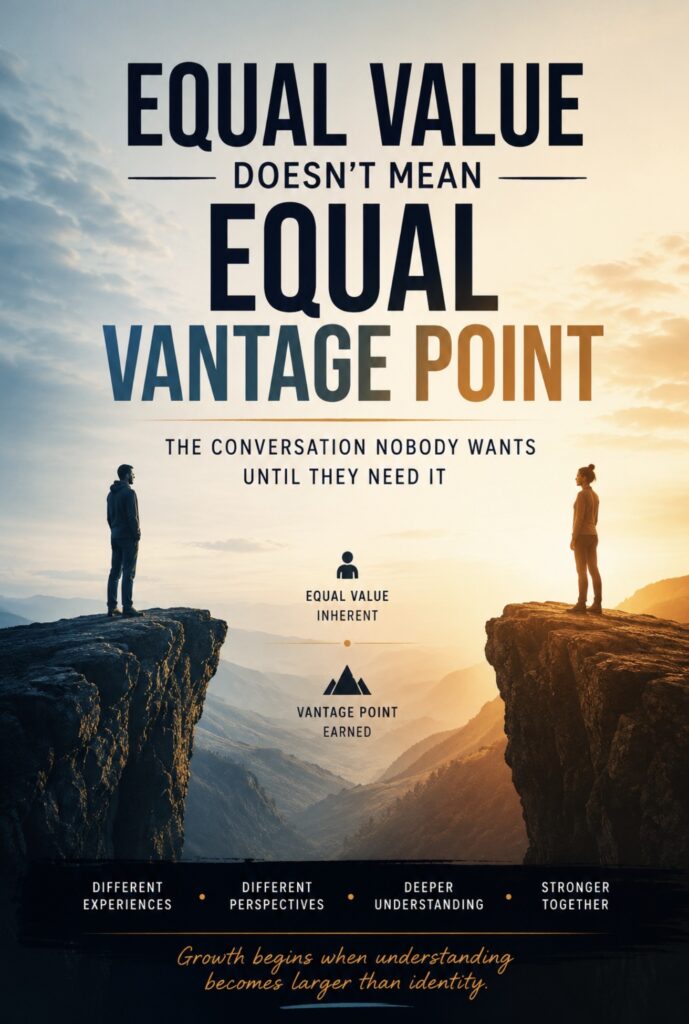
The Conversation Nobody Wants Until They Need It
Neuroscientists estimate that the human brain contains approximately 86 billion neurons, each shaped by a lifetime of experiences, relationships, successes, failures, lessons, and memories.
No two people stand in exactly the same place when they look at reality.
Research in cognitive science has repeatedly shown that perception is not a passive recording of the world. The brain actively filters, predicts, and interprets information through the lens of prior experience.
Different families.
Different cultures.
Different opportunities.
Different wounds.
Different information.
Yet somehow we’ve convinced ourselves that acknowledging different vantage points is a threat to equality.
So let me ask a question:
When did acknowledging expertise become the same thing as creating hierarchy?
At what point did we decide that recognizing someone knows more than we do about a particular subject was somehow an attack on human dignity?
Because that’s the conversation hiding underneath much of our public discourse.
We’ve spent generations fighting against systems that treated certain people as inherently more valuable than others.
Good.
We should.
But somewhere along the way, many of us started confusing equal human worth with equal understanding.
And those are not the same thing.
Every person deserves dignity.
Every person deserves respect.
Every person deserves the opportunity to be heard.
None of that means every person possesses the same knowledge, experience, training, or perspective.
The fact that this feels controversial says more about our relationship with identity than it does about knowledge.
Several years ago, I watched a senior leader reject a solution that would have saved his team months of frustration.
The solution wasn’t the problem.
The source was.
It came from someone younger.
Someone with less status.
Someone he didn’t expect to teach him anything.
The room knew the idea was sound.
He knew it too.
But accepting it would have required him to release a story about who he was.
Six months later, the problem became a crisis.
That’s when I realized something important:
People rarely resist information.
They resist what the information threatens.
The Hidden Threat Nobody Talks About
What if the greatest threat to learning isn’t ignorance?
What if it’s identity?
I’ve spent years watching intelligent people reject useful information.
Not because the information was wrong.
Because accepting it required them to release a story about themselves.
The executive who could lead a company but couldn’t receive feedback.
The activist who could identify systemic problems but couldn’t recognize personal blind spots.
The entrepreneur who understood markets but not relationships.
The academic who possessed expertise but lacked curiosity.
Different people.
Same pattern.
The moment information threatened identity, learning stopped.
We say we want growth.
We say we value truth.
We say we believe in learning.
Yet many of us unconsciously translate:
“You have something to learn.”
Into:
“You are less than.”
The emotional distance between those two statements is the distance between wisdom and defensiveness.
Because once self-worth becomes attached to being right, curiosity becomes dangerous.
Correction feels like rejection.
Guidance feels like judgment.
Expertise feels like hierarchy.
And curiosity quietly leaves the room.
People aren’t protecting their ideas.
They’re protecting their identities.
And identities are often survival structures.
They help us answer fundamental questions:
Who am I?
Where do I belong?
What makes me valuable?
What keeps me safe?
When information challenges an opinion, we can adapt.
When information challenges an identity, we become defensive.
That’s why so many conversations fail before they begin.
Value Is Inherent. Vantage Point Is Earned.
Let’s be clear.
Expertise does not make someone better than you.
But pretending expertise doesn’t exist doesn’t make you enlightened.
It makes you difficult to teach.
There’s a difference.
A surgeon sees patterns you don’t see.
A mediator hears tensions you don’t hear.
A teacher recognizes misunderstandings you don’t recognize.
An elder notices consequences you haven’t lived long enough to understand.
This doesn’t make them superior.
It means they have access to a different vantage point.
What we call expertise is often misunderstood.
Many people imagine expertise as superior intelligence.
More often, it is accumulated memory.
The surgeon carries thousands of procedures.
The mediator carries thousands of conversations.
The teacher carries thousands of moments of misunderstanding and breakthrough.
The elder carries decades of observing human nature repeat itself in different forms.
What appears to be wisdom is often memory organized into pattern recognition.
Not superiority.
Perspective.
Perhaps wisdom is not intelligence operating at a higher level.
Perhaps wisdom is memory operating across a longer timeline.
Value is inherent.
Vantage point is earned.
Value belongs to your humanity.
Vantage point belongs to your experience.
One is given.
The other is accumulated.
Confusing the two creates fragile identities.
Understanding the difference creates growth.
Humility as a Technology of Learning
What if humility is not primarily a moral virtue?
What if humility is a perceptual technology?
What if its purpose is not to make us smaller, but to make us teachable?
Arrogance prevents reality from updating us.
Humility allows reality to revise us.
Arrogance insists understanding has already arrived.
Humility remains available to what has not yet been seen.
Viewed this way, humility is not self-rejection.
It is openness to information.
Each of us sees through a particular window.
Each of us carries a particular memory.
Each of us inhabits a particular vantage point.
Learning occurs when those windows begin to overlap.
Growth occurs when understanding becomes larger than identity.
And wisdom may simply be the ability to keep expanding that horizon throughout a lifetime.
The Real Question
So perhaps the real question isn’t whether someone knows more than you.
Perhaps the real question is:
Why does that possibility make you uncomfortable?
What happens inside you when someone else’s expertise enters the room?
What story do you immediately tell yourself?
What wound gets touched?
What fear gets activated?
Because the answer to those questions will reveal something far more important than whether you’re right.
It will reveal whether you’re teachable.
And teachability may be one of the most underrated forms of intelligence we have.
The opposite of arrogance is not humility.
It is teachability.
The deepest form of confidence is not believing you know everything.
It is knowing your worth remains intact when you discover you don’t.
Equal value.
Different vantage points.
The moment we stop treating those ideas as enemies, we create the possibility for real learning, real dialogue, and real growth.
Because growth begins the moment understanding becomes larger than identity.This version is likely the strongest balance of depth, readability, authority, and shareability. It has a memorable framework, a human story, multiple quotable lines, and a clear intellectual through-line without becoming overly long.










Ty for addressing this crucial issue that has contributed towards the division and disempowerment of our community. It gives voice to how to neutralize the crabs in a barrel mindset. I hope this helps to raise our awareness and creates a space for us to support and empower each other rather than continue to compete and tear each other down.