

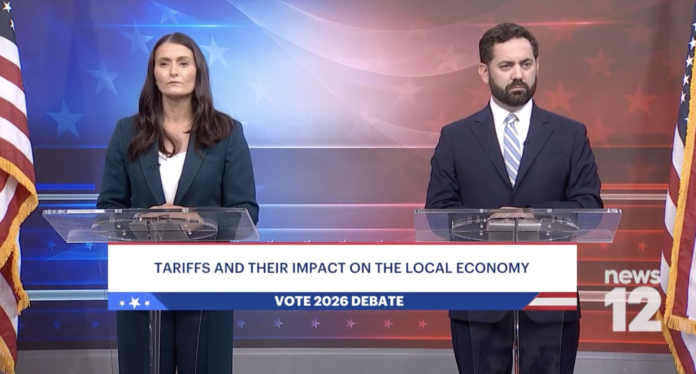




The recent televised debate between Republican Congressman Mike Lawler and Democratic challenger Cait Conley covered a tremendous amount of ground. For nearly an hour, the candidates debated the cost of living, housing, utility bills, Social Security, tariffs, college costs, Israel, antisemitism, immigration, reproductive rights, health care, artificial intelligence, data centers and public safety.
For Black voters in New York’s 17th Congressional District, though, there is another approach to looking at the debate. Rather than wondering which candidate used the word “Black” the most—or whether or not one of the candidates made a specific appeal to Black voters—the more significant question is what actual policies each candidate put forward that could have an economic and social impact on Black families.
This leads to a more complicated answer since neither Lawler nor Conley devoted a significant amount of time to treating Black New Yorkers as a separate group or to directly dealing with racial disparities in employment, education, homeownership, business ownership, or wealth. However, both candidates did talk about policies in a number of areas that have a direct connection with the concerns of Black families. The differences between them were generally in the way they suggested tackling those problems.
JOBS, TRADES AND THE PATH TO THE MIDDLE CLASS
A statement by Lawler that was particularly relevant took place when the topic of the increasing cost of higher education was under discussion; he maintained that the nation should reconsider its education system and expressly advocated for more focus on vocational education.
During the debate Lawler said that we need to reform our education system, including the establishment of vocational schools.
That is important since the economic discussion can’t start and stop with four-year college degrees; electricians, plumbers, HVAC technicians, construction workers and other skilled tradespeople can offer routes to middle-class status without requiring students to take on huge amounts of college debt.
Conley advanced the same point of view, stating that America should invest in routes which do not demand a four-year degree and specifically citing BOCES programmes, trade skills, and apprenticeships.
There was therefore a degree of substantial overlap among the candidates, since both of them admitted that it is not the only economic route open to young people.
For Black New Yorkers, however, one question is still without an answer: how would either candidate ensure that Black students become connected with those opportunities? Not a single candidate spoke about the disparities in access to apprenticeships, vocational education, or well-paid skilled trades, and neither offered an explanation of how federal policy could link young people from economically distressed communities with those careers.
The debate therefore gave voters two broad approaches to workforce development, but not a Black-specific workforce strategy.
EDUCATION: COLLEGE COSTS GOT ATTENTION, K-12 OUTCOMES DID NOT
The conversation about education placed a strong emphasis on affordability following graduation. Lawler stated that he had worked alongside Democratic Member of Congress Jared Moskowitz on legislation aimed at setting the interest rates on federal student loans at 2 per cent. Similarly, Conley backed the idea of capping the interest rates on federal student loans while at the same time expanding the range of alternatives to the conventional four-year college.
The plans deal with a significant issue, which is the vast quantity of debt that young Americans can end up with before they have even taken on a professional career of their own.
However, there was almost no serious talk regarding what takes place before college.
For Black families this omission should be noted; neither of the candidates gave a detailed statement in this debate about improving struggling public schools, literacy, mathematics performance, career preparation, school discipline, vocational education starting in high school, or federal accountability for educational outcomes.
Only a part of the problem is solved if college loans are made cheaper since children may graduate without the skills needed to compete. In the same way, apprenticeships can only be made useful if students know about these opportunities and have the academic and technical preparation required to join them.
The discussion was about the cost of higher education and did not properly look into whether or not each community is properly preparing children to enter higher education or the skilled workforce.
HOMEOWNERSHIP: TWO VERY DIFFERENT APPROACHES
One of the most evident differences in policy was produced by housing.
Lawler stressed the need to increase the supply of housing. He stated that he had played a role in promoting housing legislation that was supported by both parties and which was designed to reduce red tape, boost the supply, and extend access to capital for both homebuilders and homebuyers. His main point was that housing prices can ultimately be lowered by increasing the supply and reducing the obstacles to construction.
She looked at the problem from the point of view of both supply and purchasing power; her most concrete suggestion was for the establishment of an American Public Service Home Loan Program, this being similar in format to the VA home-loan program. According to her proposal, individuals who have worked for 10 years as first responders, law-enforcement officers, nurses, or teachers would get help with buying homes in the communities where they serve.
This could be important for working families who have respectable salaries yet end up being priced out of housing in the Hudson Valley.
Neither of the candidates dealt with one of the major economic issues facing Black America, namely the gap in homeownership and wealth.
No one discussed increasing Black homeownership, assisting first-generation homeowners with down payments, expanding access to capital in historically underserved areas, or whether discriminatory barriers still exist in lending and appraisal systems.
Lawler mainly focused on increasing the supply and lowering regulatory barriers, while Conley suggested providing help to public servants. Although both of these approaches might have an impact on Black families, neither of them was put forward as a strategy specifically aimed at eliminating racial disparities in homeownership.
HEALTH CARE: A MAJOR FIGHT, BUT NOT ABOUT RACIAL HEALTH DISPARITIES
Health care was one of the night’s most controversial topics.
Conley criticized Lawler over Medicaid, saying the legislation he supported would cause hundreds of thousands of New Yorkers to lose coverage. Lawler dismissed her description and maintained that the changes would involve eligibility verification, citizenship requirements, and work requirements for able-bodied adults without dependent children, adding that Medicaid would still be protected for seniors, children, people with disabilities, and working families who qualify.
Candidates clearly disagree on what the recent federal changes mean for Medicaid and access to healthcare, and their differing factual assertions should be independently verified beyond the debate transcript.
Neither candidate dealt substantially with the problem of racial disparity in health outcomes.
The topic of maternal mortality disparities, chronic disease, access to preventive health care in underserved communities, and other health outcomes which have a disproportionate effect on some Black communities was not significantly addressed.
The difference is important. It is not necessary for a policy to state “Black” in order to benefit Black families. Policies such as Medicaid, Medicare, the prescription-drug scheme, and insurance reform can have an impact on millions of Americans along racial lines. Yet if candidates want Black voters to assess the specific effects of their policies on their own communities, they should include measurable results in the discussion.
PUBLIC SAFETY: STRONG POSITIONS, DIFFERENT EMPHASIS
Both candidates positioned themselves as advocates of public safety, even though the topic was immigration.
She kept on referring to her time serving as a military police officer and stated that border security is a matter of national security. She said that immigration enforcement should focus on violent criminals, terrorist groups, drug cartels, and human traffickers, while criticizing the enforcement actions which she believes have caught nonviolent members of communities.
Lawler took a firmer stance on sanctuary policies; he said he opposed New York’s policy, which limits cooperation with federal immigration authorities, and that he would back federal legislation intended to end sanctuary jurisdictions.
Lawler also discussed reforms to ICE, including the use of body-worn cameras, uniforms, and a requirement that agents not hide their identities behind masks. Conley also supported the use of body cameras, clear identification, and greater accountability for federal agents.
The discussion never really dealt with another public safety issue which is important in many Black communities—namely, how the government can at the same time support effective law enforcement, reduce violent crime, improve relations between the police and the community, and hold government institutions accountable in cases when they fail.
The conversation was mostly not there.
ENERGY COSTS: AN ISSUE THAT HITS EVERY WORKING FAMILY
The energy policy showed another major difference in philosophy.
Lawler claimed that New York had reduced its energy supply by closing down its nuclear power plants, banning the extraction of natural gas and preventing the construction of pipelines. He advocated for rebuilding and reactivating Indian Point, increasing natural-gas production and pushing for reform of the federal permitting system.
She stressed the importance of renewable energy, such as solar and wind, and at the same time called for tighter regulation of utility companies. She stated that utilities should not be allowed to pass on to consumers certain costs—including those relating to lobbying, corporate off-sites and private jets. She also maintained that the government should provide incentives for the development of cleaner and more efficient energy.
Neither of them treated energy as a special concern of the Black community, since it should not be artificially made into such an issue. It is especially important for working-class households that expenses for electricity, heating and transportation take up money which could not then be spent on housing, food, education or savings.
For Black voters the real issue is not merely which energy source sounds better from a political point of view. It is which policies are able to provide affordable energy while at the same time ensuring an adequate supply and safeguarding communities against environmental and economic harm.
SMALL BUSINESS AND BLACK ENTREPRENEURSHIP: A MISSED OPPORTUNITY
A striking absence was Black business development.
Both candidates spoke at length about the economy and touched on tariffs, taxes, corporate interests, utilities, housing, and economic growth. However, they said little about entrepreneurship in underserved communities, access to capital, federal contracting opportunities, or expanding small-business ownership among people historically underrepresented in business ownership.
For Black voters interested in building wealth rather than relying on government services, this should be a key part of the discussion in Congress.
The importance of jobs cannot be overlooked, nor can that of wages or taxes; ownership is important as well.
A serious economic programme for Black communities should therefore inquire not only into the number of jobs which government policy might generate, but also into the number of businesses that can be set up, the number of families that will be able to buy homes, the number of contractors who will be able to bid for government work, and the amount of wealth that can stay within the communities.
That argument was not developed by either of the candidates during this debate.
SO WHAT DID BLACK VOTERS ACTUALLY HEAR?
Black voters who watched the debate did hear some policy suggestions that could affect their lives.
They heard Lawler support vocational education, lower interest rates on student loans, an increased supply of housing, tax relief, greater domestic energy production, and changes to health-care policy. They also heard Conley in favor of trade education and apprenticeships, caps on student-loan interest rates, a public-service home-loan scheme, the development of renewable energy, regulation of utilities, and the protection of health-care coverage.
Those are genuine policy differences voters can consider.
The fact that Black voters did not hear was a continuous discussion that linked those proposals to the specific economic situations facing Black New Yorkers.
The subject of Black unemployment was not seriously dealt with. Neither was there a significant discussion of BlackNo one discusseded examination of Black business ownership or in detailaccess to capital. Likewise, there was no substantial discussion of educational outcomes for Black children or of the racial disparities in health outcomes.
That doesn’t mean all policies have to be designed with race in mind; effective economic policy can benefit families regardless of race, and voters should evaluate proposals by results rather than political labels.
But Black voters have every right to ask a basic question of anyone seeking their vote:
What measurable outcomes will your policies produce for our families and our communities?
The News 12 debate provided NY-17 voters with a better understanding of where both Mike Lawler and Cait Conley stand on a number of key issues. The following discussion should go deeper.
For Black Westchester, this involves posing the same questions to both candidates and letting their answers speak for themselves—what steps will you take to increase employment and access to skilled trades? What steps will you take to improve educational outcomes? What steps will you take to increase homeownership? What steps will you take to expand small-business ownership and access to federal contracts? What steps will you take about health disparities? And what steps will you take to make communities not only safer but also economically stronger?
Black voters don’t need politicians to mention them during election season.
Policies should be designed so their results can be measured after Election Day.