


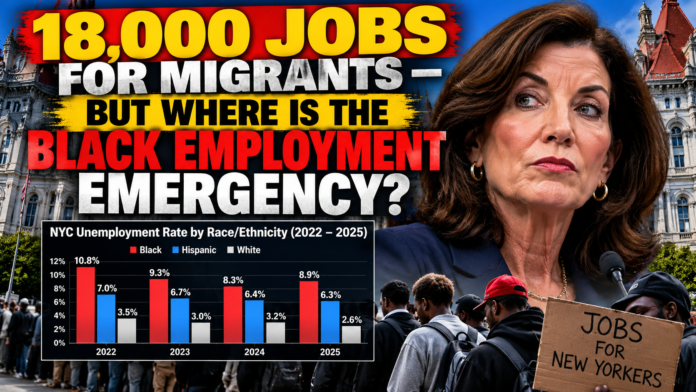





New York has shown us that when political leaders treat a problem as an emergency, government can act swiftly. Agencies can coordinate, workers can be assigned, employers can be recruited, barriers can be removed, money can be made available, and public campaigns can be launched. Once politicians decide that a particular issue warrants immediate attention, the machinery of government suddenly becomes remarkably efficient.
That is precisely what happened when Governor Kathy Hochul’s administration addressed the migrant crisis. In October 2023,, the governor declared that New York had found more than 18,000 job vacancies at 379 employers willing to hire migrants and asylum seekers with formal work authorization. The state set up a registration process, worked directly with employers, launched a public awareness campaign, and assigned 70 state employees from 16 different agencies to the initiative. Hochul described the policy in simple terms: “Migrants and asylum seekers came to this country to work — so let’s get them working.”
There is no inherent flaw in helping legally authorized migrants become self-sufficient, since moving them out of taxpayer-funded shelters and into work can cut public expenses while enabling them to support themselves. What Black New Yorkers ought to be asking is not why aid was given to migrants, but rather why the government has not shown the same level of focused urgency in addressing a Black employment problem that was present long before the migrant buses began to arrive in New York.
WHERE IS THE BLACK EMPLOYMENT EMERGENCY?
It’s not just a question of perception; the figures from New York itself show the issue.
In April 2026, the New York State Comptroller, Thomas DiNapoli, stated that Black unemployment in New York City was 8.9 percent in 2025, which is more than three times the unemployment rate for White New Yorkers; his office also pointed out that Black New Yorkers were one of the demographic groups suffering from persistently high unemployment.
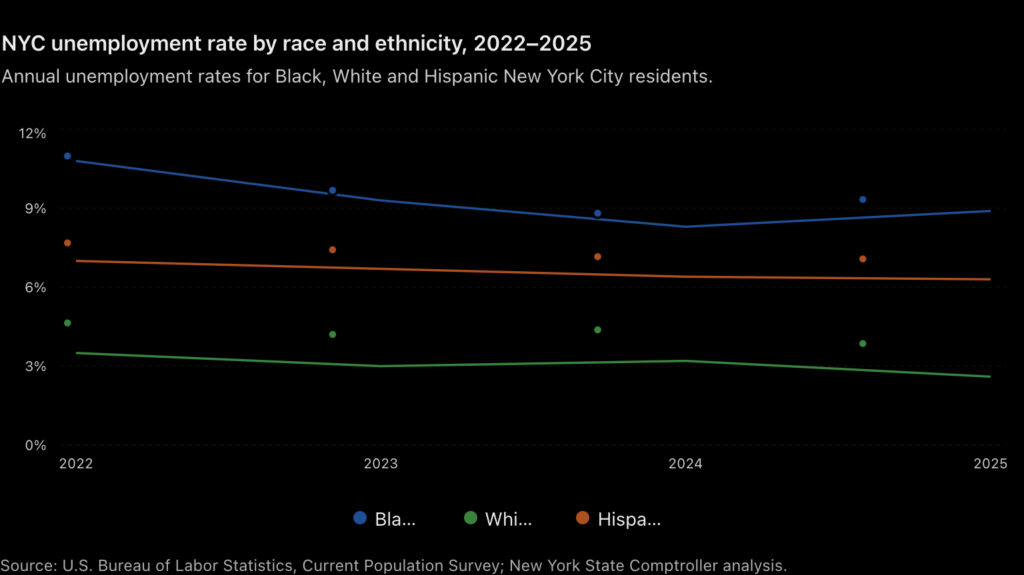
Consider this from a logical point of view: although thousands of migrants had a need for work, New York had identified employers, brought in 16 agencies, assigned 70 state employees and set up a system that linked people directly with jobs that were available; the unemployment rate among Black New Yorkers is more than three times that of White New Yorkers, so where then was a similar statewide employment initiative for Black people?
What about the 70 state employees who have been specifically assigned to closing that gap? What has become of the hundreds of employers who have been recruited as part of a campaign to promote Black employment? Where is the statewide portal that links unemployed Black New Yorkers with employers? And where is the governor standing in front of the podium declaring that Black unemployment is unacceptable and setting out measurable targets for reducing it?
Those questions are not anti-immigrant. They are pro-accountability.
NY HELPS PROVES GOVERNMENT CAN REMOVE BARRIERS
New York has also shown it can rethink how it hires government employees. In June 2026, Hochul extended NY HELPS until June 2028; the program facilitates hiring for many state and local government jobs by temporarily waiving normal civil-service examination requirements for eligible posts. The program has already made over 60,000 appointments.
Once more, NY HELPS is not a scheme for migrants. It offers posts to qualified members of the general public, including Black New Yorkers. Yet its existence shows a bigger truth: Albany knows how to identify obstacles to employment and will alter the system when it considers it necessary.
This raises another valid question: of those more than 60,000 appointments, how many were assigned to Black New Yorkers? How many were given to Black men? How many came from areas that have consistently experienced high unemployment? How many came from neighborhoods in which generations of families have paid taxes to New York but are still struggling to secure stable middle-class employment?
The government ought to make those results public. A program shouldn’t be assessed merely by how many people it has employed; we should also know whether it has reduced the employment disparities the government already knew about.
THIS IS BIGGER THAN JOBS
The frustration many Black people in New York feel is not separate from other issues. Employment is only one element of a much bigger affordability and opportunity problem.
On transportation, the New York congestion-charging scheme charges most E-ZPass passenger vehicles $9 when entering Manhattan below 60th Street during peak times. Discounts and exemptions are available for certain eligible drivers, and the administration says congestion pricing reduces traffic, improves air quality, and provides funds for mass transit. These are the benefits that the administration has stated.
Policy should also be viewed from the perspective of the ordinary worker who has to pay the bills. A home health aide, a tradesman, a small-business owner, a delivery worker, or anyone else who has to drive does not regard government policy as a press release; he experiences it through his E-ZPass account, his utility bill, his mortgage payment, his rent, and his property-tax bill.
The same problem applies to housing. Because property prices are so high, homeownership is increasingly out of reach for many working families. This matters greatly for Black families, since homeownership is still one of the main ways generational wealth is built and passed on. If housing costs rise faster than families can earn income and save, telling people the economy is growing becomes meaningless if they can’t buy an asset in the communities where they live.
Property taxes make the affordability problem worse. Energy costs make it even worse. Each extra recurring expense for a household means less money left for saving, investing, starting businesses, educating children, and passing on assets to the next generation.
This is where the government should evaluate its policies by their outcomes rather than their intentions.
FAMILY POLICY MATTERS TOO
The controversy surrounding the use of family terms is once again an example of Albany’s priorities causing debate. Presently, New York law permits each parent to decide whether to be listed on a birth certificate as “father”, “mother”, or “parent”.
Individual lawmakers also introduced legislation in 2026 that would have substituted gender-neutral terms, such as “gestating parent” and “non-gestating parent”, for the terms “mother”, “father” and others in certain parts of state law. Lawmakers opposed the proposal and asked Hochul to veto it.
People may disagree about that piece of legislation, but Black New Yorkers have the right to question why Albany can spare political energy on redefining the terms in the statute while the fundamental economic inequalities are still not being addressed.
For communities facing unemployment, poor schools, high housing costs, heavy property taxes, and rising household expenses, government priorities are not merely abstract cultural discussions; they show citizens which issues their government regards as urgent.
POLITICAL LOYALTY SHOULD PRODUCE POLITICAL ACCOUNTABILITY
Here we have an uncomfortable political question.
The Black voting public has long been one of the Democratic Party’s most reliable groups. This doesn’t imply that all Black voters are Democrats or that Black people in New York vote as a single block. What it does mean is that Democratic candidates have enjoyed strong support from Black voters in recent elections, which has led to the reasonable expectation that Democratic governments should give serious consideration to the issues that affect Black communities most.
Voting must never turn into a blank check.
Political support must lead to tangible political results. If unemployment is still much higher, then you should ask why. If homeownership remains difficult, consider what policies are being used to change that. If property taxes are overwhelming working homeowners, call for concrete relief. If rising energy costs are damaging households, ask for a strategy to ensure affordability. And if the government is building employment infrastructure for one group of people, you should ask why communities that have long suffered from unemployment disadvantages have not received similar attention.
These are not Republican questions or Democratic questions. They are questions about accountability.
Black voters ought to be able to question Hochul in the same way that they should be able to question a Republican governor, a Democratic mayor, a Republican county executive or anyone else who is exercising government power.
THE STANDARD MUST BE OUTCOMES
Governor Hochul should lay out her administration’s specific plan to reduce Black unemployment. Instead of setting up another commission, instead of holding another listening session, instead of making another diversity statement, she should say what the aim is, what the schedule will be, how many people will get jobs, how many of the apprenticeships will result in permanent careers, how many Black New Yorkers are entering state employment via NY HELPS, how many are becoming homeowners, and by how much has the Black unemployment gap in fact decreased?
New York has shown that the government can get things going when it decides to, as proven by the migrant employment initiative. Instead of taking the initiative themselves, seventy state employees and sixteen agencies did not act. The state had decided that coordinated action was necessary because of the situation.
Black people in New York have every right to expect the same level of seriousness about the disparities that have existed for decades.
This issue is more significant than the question of migrants. It concerns whether political loyalty is turning into real economic progress, and whether those who have lived in the country, worked in it, raised their families in it, and paid taxes in it can stay and build wealth here.
When people have to drive, tolls and congestion charges are important. If homeowners have difficulty staying in their homes, property taxes become a concern. Real estate prices matter when the younger generation can no longer afford to buy. When households must decide which bills to pay first, energy costs matter. Family policy is important whenever Albany alters its long-standing terminology while many families are asking the government to concentrate on their economic survival. Above all, employment matters because if there is no steady income, all the other problems become more difficult.
For Black New Yorkers, the issue must be whether or not someone else merits help, since that way politicians can shirk their responsibilities by pitting one struggling community against another. The more appropriate question is straightforward: if the New York government has the means and political will to devise targeted solutions in an emergency affecting another group, why has the ongoing disparity in Black employment not prompted a similarly focused response?
As long as Albany cannot answer that question with actual, measurable results rather than empty talk, the employment imbalance should be included in the wider discussion of affordability, taxation, housing, energy, and government priorities. Although these policies do not share the same causes or effects and reasonable people might still disagree about each one in isolation, the overall effect deserves examination by Black New Yorkers who have given substantial political support to Democratic candidates yet continue to face considerable economic disparities.
For Black New Yorkers and indeed for Black America as a whole, the criterion should no longer be speeches, symbolism, or allegiance to the party. It should be results. When a policy raises costs, it should be clear who bears them. When a jobs scheme creates opportunities, it should be made clear to whom those opportunities are given. When the government says it is promoting equity, we should check whether long-standing disparities actually decrease.
Political support without tangible progress is not an achievement; it remains an unanswered question.