


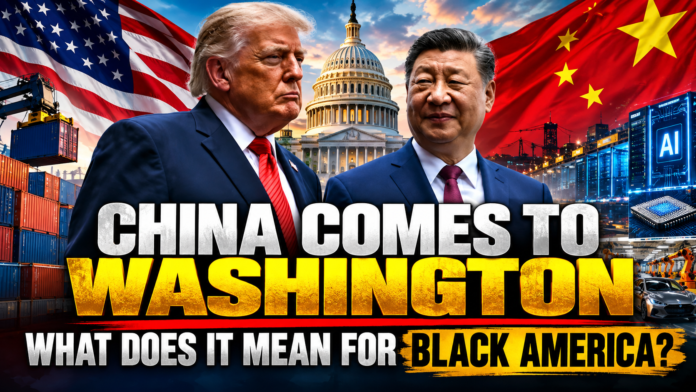





When President Xi Jinping of China visits Washington and takes seats across the table from the President of the United States, most Black Americans are unlikely to immediately associate that meeting with events taking place in their own communities. To them, China seems like something that belongs to foreign policy, tariffs appear to be a matter for Wall Street, rare-earth minerals sound like a topic that interests economists and engineers, and artificial intelligence is seen as being connected with Silicon Valley. Trade agreements can look like discussions between politicians who are thousands of miles away from Mount Vernon, Detroit, Baltimore, Memphis, Chicago, or Atlanta.
The distance may be misleading, since geopolitics ultimately turns into local economics. The way decisions concerning China affect the prices that Americans pay for products, the locations where companies set up factories, the technologies that will prevail in the future, the kinds of jobs that will be created and the skills that workers will need. Black America therefore has a direct economic interest in understanding what is going on between the United States and China.
The United States and China are not merely disputing tariffs; they are competing in manufacturing, artificial intelligence, critical minerals, energy, technology, supply chains, and global economic influence. What happens as a result of this competition will decide where industries are located, where capital is invested, and which countries end up controlling some of the most valuable industries of the twenty-first century.
For Black America, the issue should not be whether President Donald Trump will beat Xi Jinping, whether the Democrats support Trump’s policy toward China, or which political party will be credited with a political victory. The more significant economic question is what the negotiations and competition between America and China will mean for Black workers, Black businesses, Black students, and Black communities.
GEOPOLITICS EVENTUALLY REACHES YOUR BLOCK
Although geopolitics takes place between governments, its effects ultimately reach individual neighborhoods. If Washington alters its tariffs, companies have to decide where to manufacture their products, and when the United States limits Chinese technology, businesses then review their supply chains. When China restricts access to critical minerals, American manufacturers may have to face higher costs or shortages.
The principle applies just as well in the opposite direction: if the United States spends billions of dollars on semiconductor production, artificial intelligence, energy infrastructure and advanced manufacturing, new industries and jobs can come into being. It follows that a meeting between Washington and Beijing may eventually influence the price of an item at Walmart, the site of a factory, the availability of a construction job, the demand for an electrician or the opportunities open to a young person who has just finished high school.
That is the reason why Black America must go beyond political slogans when politicians claim that a particular policy will benefit “American workers”; we need to look into which industries will actually expand, where the investments will take place, what skills those industries will require, and which communities are in a position to take part.
WE HAVE SEEN WHAT HAPPENS WHEN THE ECONOMY CHANGES
For many years, America transferred large parts of its manufacturing capacity to other countries, and as a result China became one of the world’s major manufacturing centers while many industrial areas in the United States saw their factories close and their economic opportunities vanish. The changes were complex and cannot be attributed simply to China destroying American manufacturing, since automation, corporate decisions, technological change, and wider globalization also contributed.
The main point is that the results of major economic changes depend on who has the education, skills, capital, infrastructure and political strategy needed to take part; simply bringing factories back to the United States won’t automatically overcome the economic difficulties facing Black communities unless our people are ready for the jobs and business opportunities that result from such investments.
Economic growth can occur in a community without greatly improving the economic situation of the people who live there. If we are to achieve different results from the next phase of American industrial development, then we must understand that distinction.
IF MANUFACTURING COMES BACK, ARE WE READY?
Both the Democrats and the Republicans have in recent years spoken more about strengthening American manufacturing and about reducing America’s reliance on fragile foreign supply chains; yet the move to bring manufacturing back home will only bring benefits to Black communities if our people are given a chance to take part in the industries that are being set up.
Today’s manufacturing plant needn’t be the kind of factory our grandparents knew. Today, advanced manufacturing uses robotics, computers, electrical systems, precision equipment, data analytics, and workers’ intelligence. The kinds of workers who will benefit from the next phase of manufacturing expansion could be electricians, HVAC technicians, engineers, welders, programmers, machinists, cybersecurity professionals, and robotics technicians.
That means the discussion about China now becomes part of the debate concerning Black education. If the United States is going to aim at competing technologically with China, then Black communities should be questioning whether their schools are preparing Black children to compete economically within the United States.
Even though billions of dollars are invested in semiconductors, energy, AI infrastructure, data centers, and advanced manufacturing, this alone will not lead to economic advancement among Black people. If our children leave school without strong skills in mathematics, science, computers, and technical subjects, the opportunities from these investments will go to people who are better prepared to take advantage of them.
If people don’t prepare properly, economic opportunity will end up being someone else’s. This is something that Black America should aim to avoid before the next economic transformation is already finished.
AI COULD CREATE ANOTHER ECONOMIC DIVIDE
Artificial intelligence is now one of the key areas of technological competition between the United States and China, and Black America should take notice, since the outcome will have implications that go well beyond the technology companies in Silicon Valley.
It is not merely about ChatGPT or generating images on a phone. Artificial intelligence will begin to have a greater impact on fields such as medicine, finance, transportation, logistics, defense, manufacturing, education, communications and almost all of the other major industries. The nations and firms that take the lead in these technologies may enjoy huge economic benefits over the coming decades.
We should therefore not merely have the fear that AI will get rid of jobs. Although some occupations will change and some jobs may vanish, new industries, occupations and businesses will also appear. That is why Black America should consider what these new jobs will be, who will own the companies, who will control the infrastructure and the intellectual property, and what skills our children will need to take part.
All major technological changes create opportunities for wealth, but these opportunities are not automatically shared. Individuals who understand a transformation early can gain skills, set up businesses, build assets, and get established in the new economy. In contrast, those who realize the transformation later usually take years to catch up.
Black America doesn’t have the luxury of having to catch up in another gepreparestead; we should be planning for the economic effects of artificial intelligence while the industry is still in development, not wait until its seismic structures are already set.
CRITICAL MINERALS TEACH US SOMETHING ABOUT POWER
Rare-earth and critical minerals have become major points of contention between Washington and Beijing because they are essential to modern technology; China’s key role in processing many of these materials gives Beijing economic power, while the United States tries to reduce vulnerabilities in its critical supply chains.
There is a significant economic lesson for Black America: economic power usually arises from producing, controlling, or having access to something other people need, such as natural resources, technology, manufacturing capacity, intellectual property, energy, capital, or skilled labor.
Black America ought to apply that principle at home by considering what it produces, what it owns, and what industries it is entering. It should also examine what businesses it is setting up and what specialized skills our communities have that the wider economy requires.
The questions should be at the heart of Black political discussions since political representation and economic power are not identical. While voting for Black officials can lead to representation, representation alone is not enough to build businesses, industries, skilled workers, capital, or ownership.
TARIFFS EVENTUALLY REACH THE CHECKOUT COUNTER
Another aspect of America’s economic clash with China cannot be ignored. Although tariffs can help protect domestic industry and give the government some bargaining power, they can also raise costs when businesses pass the extra expenses on to consumers.
Working families feel those effects directly, since a family trying to pay rent, buy groceries, buy school clothes, and keep its car running doesn’t experience international trade as part of an academic discussion. Instead, families learn about economic policy through the prices they pay, the wages they receive, the jobs they have, and the amount of money left in their bank account at the end of each month.
Black America should therefore not simply assume that tariffs are good since one political party supports them or that they are bad because another political party opposes them. Instead, we must look at what kind of industry is being protected, what American production might replace imported goods, what jobs might be created, how consumers might be affected, and where actual new investment will take place.
We should also investigate who is awarded the contracts and who owns the businesses that benefit from government policy, since this analysis lets us evaluate economic policy on measurable results rather than political loyalty.
BLACK AMERICA NEEDS A FOREIGN ECONOMIC POLICY
For many years, when it came to black political discussion, foreign policy has usually been regarded as being separate from black life unless the United States is engaged in a military conflict. However, this view is less reasonable in an economy in which decisions taken thousands of miles away can affect employment, prices, technology, and investment within American cities.
It is important to consider China because trade and manufacturing matter, just as it is important to consider Africa because natural resources and emerging markets matter. Taiwan matters because semiconductor supply chains matter, and the Middle East matters because global energy markets matter. Artificial intelligence matters because technological leadership will help determine where much of future economic power and wealth will be located.
Foreign policy and domestic economics are becoming increasingly linked, so black political organizations, civil-rights organizations, business groups, churches, educational institutions, and elected officials should treat international economics as seriously as they treat voting rights, criminal justice, and social policy.
Whenever presidents negotiate international agreements, Black America ought to wonder how Black businesses can take part in the economic opportunities that result. And when the United States is building semiconductor plants, we should ask whether Black students are being prepared for those kinds of careers; and when billions are invested in AI infrastructure and data centers, we should ask whether Black contractors, electricians, engineers, and entrepreneurs have access to those investments.
We ought to look into whether communities suffering from unemployment and a lack of investment can benefit when manufacturing moves back to America. Such questions should not be the concern only of Democrats or Republicans since they relate to long-term economic interests that go beyond any one election.
WHEN THE WORLD IS AT THE TABLE, WHERE IS BLACK AMERICA?
Xi Jinping’s visit should serve as a reminder that many of the key decisions shaping Black America’s economic future will never have the phrase “Black America” included in them. While the headlines may focus on Trump, Xi, tariffs, China, Taiwan, AI, and presidential politics, beneath them is a much bigger struggle over who will manufacture the world’s products, develop its technology, control strategic resources, and dominate future industries.
It is no longer something that Black America can afford to watch another economic transformation take place without being involved and then wonder why it did not get its fair share of the opportunities. We need to understand where the economy is headed, prepare our children for the kinds of industries being developed, build businesses capable of bidding for contracts, and demand that economic policy create real opportunities for communities that have historically received little or no investment.
Rather than asking what the Democrats think about China or what the Republicans think about China, we should look at the implications of America’s relationship with China for our families, our businesses, our schools, and our communities. The world is undergoing economic and technological reorganization, and both the United States and China realize how important it is to prepare for what comes next.
Black America also needs to realize that this transformation will eventually affect the local economy; when the most powerful countries are at the table negotiating the future, our biggest error would be to think that what happens at that table is irrelevant to us.