



Is New York’s Political Direction Helping Dallas Become America’s New Financial Powerhouse?
For many generations the city that was regarded as the centre of financial power in America was New York; Wall Street became something more than just a street in Lower Manhattan and turned into a worldwide symbol of American banking, investment, capitalism and the creation of wealth.
Yet more than 1,500 miles to the southwest of Manhattan, a significant development is taking place. Dallas is creating a financial ecosystem that is strong enough to deserve its own nickname: “Y’all Street”. Although Wall Street is still America’s leading financial centre, New Yorkers would be making a serious error if they ignored what Texas is developing.
Texas Is Building Its Own Wall Street
The most striking example of this change is the Texas Stock Exchange (TXSE), which began trading in July 2026 having received support from major financial firms such as BlackRock, Citadel Securities and Charles Schwab. Texas is not any longer just aiming to draw in companies; it is now developing financial market infrastructure with the aim of competing for business that has traditionally been based in New York.
In September the companies—Energy Transfer, USA Compression Partners, Sunoco LP and SunocoCorp—announced their intention to transfer their main listings from the New York Stock Exchange to the TXSE in October; together they have a market capitalisation of nearly $100 billion.
It doesn’t follow that TXSE is now going to take the place of the NYSE or Nasdaq. The existing institutions have huge advantages which have been built up over many generations, but Texas needn’t replace Wall Street if this development is to be significant. Should Dallas secure even a larger share of future listings, investment and financial employment, the balance of financial power in America starts to become less concentrated in New York.
Texas’s increasing importance is acknowledged by the traditional stock exchanges. The NYSE set up its permanent headquarters in Dallas in August and Nasdaq has likewise expanded its operations in the state. Therefore, New York should take note when America’s major financial institutions decide that they need a greater presence in Texas.
Follow the Jobs and the Money
The Federal Reserve Bank of Dallas reported that financial-activities employment in Dallas had risen by about 23.2 per cent by June 2026 compared with February 2020, while New York City saw its financial-activities employment increase by around 6 per cent over that period.
Currently, Dallas has about 317,000 people employed in financial activities and at the same time major companies are still making large investments in the area. Goldman Sachs is building a Dallas campus with a projected cost of approximately $709 million and intended to house about 5,000 employees, and Charles Schwab, Fidelity and Wells Fargo have also set up considerable workforces in North Texas.
They are not merely symbolic positions involving a small number of executives; rather, they stand for thousands of jobs, billions of dollars worth of investment, and an increasing concentration of financial expertise outside of New York.
This Didn’t Start With the DSA
Before turning to the subject of New York politics, we must be intellectually honest on one point: the shift of businesses, residents and financial jobs to Texas did not start because of the Democratic Socialists of America, Mayor Zohran Mamdani or the present political discussion in New York City.
Texas has attracted companies over the years as a result of its population growth, low taxes, inexpensive housing, the availability of land, corporate incentives and an aggressive strategy for recruiting businesses. It therefore cannot properly be claimed that Dallas’s financial growth was due to one politician, political party or ideology.
Yet the fact that history is known does not mean that New York’s present political course should be left unexamined. The more pertinent question is if the policies currently under discussion could speed up an economic movement which was already in progress.
New York’s Political Direction Matters
Because of the increasing influence of the DSA, there are now more proposals in New York’s political discussion calling for higher taxes on wealthy individuals and companies, for an expansion of public programs, for stronger worker protections, and for a greater governmental role in the economy.
People say that rich residents and businesses are able to pay more for housing, transportation, childcare and public services. They also say that New York’s problem with affordability poses a threat to business since companies are unable to hire and keep workers who cannot afford to live in the city.
Business groups and those who oppose higher taxes give out another kind of warning. They say that capital, corporations, and high-income workers are becoming more mobile, which means that New York cannot be certain they will stay forever if states such as Texas, Florida, or others provide lower costs or policies that they find more appealing.
It shouldn’t be settled on the basis of political slogans put forward by either side, but rather it should be judged by the number of jobs created, the level of investment, the amount of new businesses established, the movement of taxpayers, and the degree ofeconomic growth.
New York Is Already Losing Taxpayers
The office of New York State Comptroller Thomas DiNapoli has stated that New York has seen a net out-migration of its resident tax filers each year since 2015; in 2024 around 121,251 taxpayers moved into the state while 134,913 moved out, resulting in a net decrease of about 13,662 filers.
Important background information is available. New York’s losses have improved considerably since the pandemic years, and the figures do not back up the simple claim that everyone is moving away from New York. Yet New York cannot just ignore the taxpayers who are leaving, especially since personal income taxes account for more than half of the state’s tax revenue.
The economic risk doesn’t necessarily lie in a large bank announcing tomorrow that it is giving up Manhattan; a more subtle change could be just as significant in that a company retains its headquarters in New York but decides to create its next 3,000 or 5,000 jobs in Dallas rather than in New York.
As time goes on, those decisions accumulate.
Capital Doesn’t Have Political Loyalty
When deciding where to invest, companies look at tax rates, regulations, labour costs, housing, transportation and the availability of talent. It is possible for executives to relocate, for employees to move, and for companies to set up large campuses hundreds or thousands of miles from their usual headquarters.
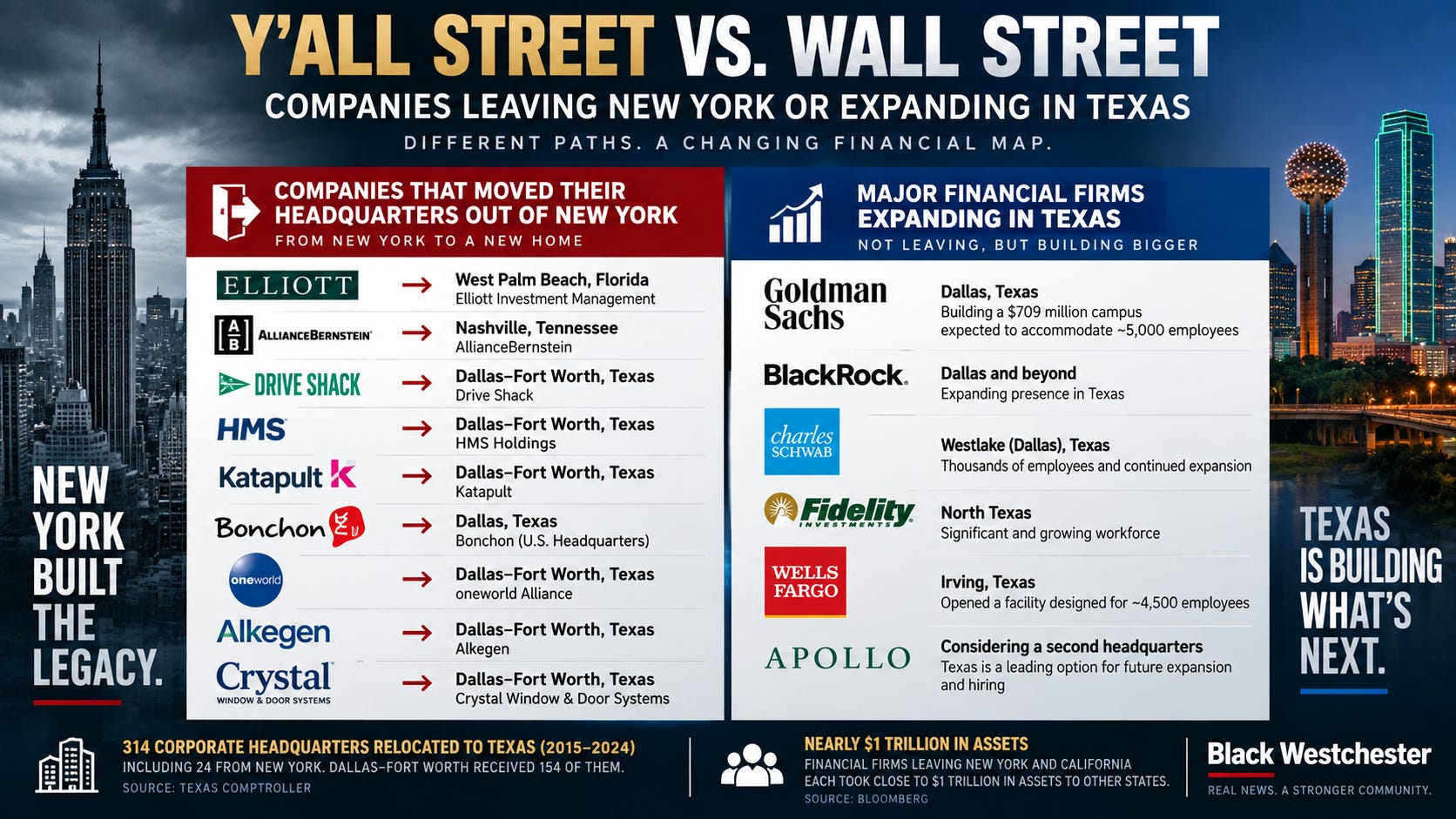
Texas recognises the nature of this competition and has actively promoted itself as a destination for businesses, investors and financial professionals. The fact that Dallas saw 125 corporate headquarters move there between 2015 and 2024 shows that the region’s growth is part of a wider economic strategy.
New York cannot therefore conclude that its historical position ensures it will continue to be dominant, since economic geography is subject to change whenever competing areas offer companies and workers sufficient reasons to move to another place.
New York Doesn’t Have to Lose for Dallas to Win
This is probably the most important section of the conversation, since Dallas needn’t take over from New York if Texas is to secure a huge economic win.
New York could continue to rank number one for many decades even if it received a smaller share of America’s new financial jobs, corporate expansions, investments, and wealthy residents. Although Wall Street could stay extremely powerful, cities such as Dallas, Miami, Charlotte and others could take advantage of opportunities that used to go almost automatically to New York.
It’s not just a matter of who has the most at the present time that determines economic power; it also has to do with where future growth is going to take place.
Why Westchester Should Pay Attention
The significance extends beyond the five boroughs since Westchester has in the past enjoyed the advantages resulting from its position near New York City’s financial economy; individuals such as executives, financial professionals, entrepreneurs and other high-income workers who are employed in Manhattan have bought houses, spent money and paid taxes in Westchester County.
If a greater proportion of future financial employment and investment shifts to the southern regions, the consequences could one day go beyond Manhattan; a reduction in high-income jobs located in New York might affect housing demand, local spending and the regional tax base.
The fact that Dallas is growing doesn’t indicate that Westchester is about to experience an economic crisis; rather, it shows that Westchester has a valid stake in whether New York stays competitive in attracting the jobs, businesses, and investment which help support the whole metropolitan economy.
Wall Street Still Has the Crown
Let us make it clear that Wall Street is not dead and that Dallas has not taken New York’s place. New York has an exceptional concentration of capital, financial talent, legal expertise, universities, global businesses and institutional knowledge that would be very hard to reproduce.
Yet New York ought not to regard its position as number one today as equivalent to possessing a permanent right to stay number one tomorrow. Texas is gathering financial workers, drawing in corporate investment and establishing institutions aimed at securing a larger share of America’s financial future.
It is not being asked whether Wall Street will vanish tomorrow. Rather, the issue is whether New York will wake up ten or twenty years from now and realize that, while it had been discussing ideology, taxes and economic policy, an increasing portion of America’s financial future had been developed elsewhere.
Wall Street still wears the crown, but down in Dallas, Y’all Street is building its own kingdom.