

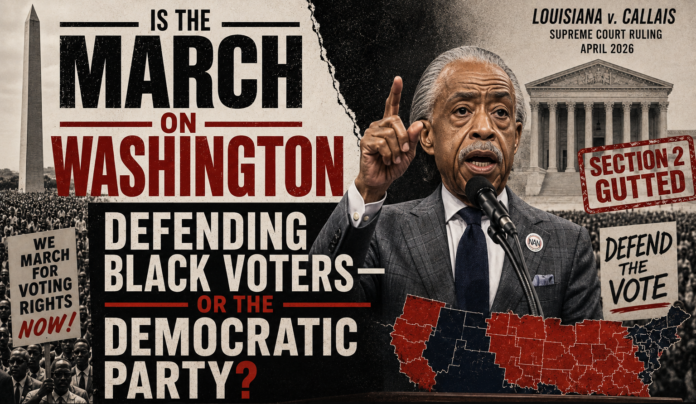




On August 28, 2026, Rev. Al Sharpton will lead thousands to the National Mall for the “March on Washington: Defend the Vote,” marking the 63rd anniversary of the original 1963 march. The occasion is the Supreme Court’s April ruling in Louisiana v. Callais, which gutted Section 2 of the Voting Rights Act and triggered a scramble across Southern states to redraw congressional maps in ways that will likely cost Black communities several House seats this cycle — possibly the largest single-election loss of Black representation since Reconstruction.
That is a real and consequential legal development. It deserves scrutiny, litigation, and organizing. What it doesn’t obviously deserve is another march — at least not without first asking a harder question: what, exactly, are we trying to protect, and does marching actually protect it?
Nobody is losing the right to vote.
Let’s be precise about language, because precision has been the first casualty of this debate. No Black citizen in Louisiana, Alabama, Tennessee, or anywhere else has been denied a ballot, turned away at a polling place, or stripped of the legal right to cast a vote. Even Alabama’s own attorney general has pointed out the state is seeing record turnout. What’s actually being contested is representation — whether a district’s lines let a bloc of voters elect the candidate of its choice. That’s a legitimate issue, but it is not the same issue as the one the marketing around these marches implies. Calling redistricting “the new Jim Crow” or “voter suppression” collapses two very different harms into one, and that conflation makes it harder, not easier, to have an honest conversation about what’s actually happening.
The selectivity problem.
If the principle is “protect Black political power from being displaced by the mechanics of redistricting,” then the principle should have applied in 2022 — because that single round of New York redistricting hit two Black members of Congress at once, and it undid something historic in the process. In 2020, Jamaal Bowman and Mondaire Jones became the first two Black members of Congress in Westchester County’s history, elected in the same cycle, representing neighboring, overlapping communities. Two years later, that same redistricting round took it apart.
Mondaire Jones — one of the first two openly gay Black members of Congress — was redistricted out of his own seat by a fellow Democrat, Sean Patrick Maloney, who used the newly drawn lines to move into Jones’s district rather than defend his own. Jones stepped aside. Maloney went on to lose the general election to Mike Lawler, a Republican, who holds the seat to this day.
In that same 2022 map, Jamaal Bowman’s neighboring 16th District lost Co-op City — a Bronx housing development with more than 40,000 mostly Black residents — while gaining more of white, suburban Westchester County. The district’s Black population dropped nine points in that single redraw, while its white population rose from a third to nearly half. Bowman survived that round; two years later, on a subsequent map, he lost his seat entirely to a white-primary challenger.
Two Black incumbents, hit by the same redistricting cycle at the same time by their own party — the first two Black congressmen Westchester County had ever had- were undone within two years of making that history. Where was the march for either of them? Where was the statement condemning a Democrat’s district-hopping that cost the party a Black member of Congress and, eventually, the seat itself, or condemning a map that stripped 30,000 Black, Hispanic and Asian residents out of another Black incumbent’s district? Neither the National Action Network nor the NAACP raised public alarm over it. If the silence in 2022 and the mobilization in 2026 are both genuine applications of the same principle, someone should be able to explain the difference between them. If they can’t, the honest conclusion is that the principle isn’t really “protect Black representation” — it’s “protect Democratic-held Black representation.” Those are not the same thing, and Black voters deserve an advocacy infrastructure that makes that clear.
Which power are we actually protecting?
That gap is worth naming directly, because it’s the real question underneath everything else here: is the current wave of marches and statements protecting Black political power, or Democratic political power? Those two things are treated as identical in much of the rhetoric from Black leadership right now, but they are not the same. The Democratic Party is not the Black party, any more than the Republican Party is the white party. But Black voters are the only ethnic group in America that votes roughly 90 percent for one party — and that fact has let political and civil rights leadership quietly collapse “protect Black voters” into “protect Democratic seats,” without ever having to say so out loud, and without much pushback from the communities being organized. When a Black seat is threatened by a Republican map, it’s a civil rights emergency. When a Black seat is threatened by a Democrat, as it was for Mondaire Jones and Jamaal Bowman, it’s a primary. That inconsistency isn’t really about race at all — it’s about party. And as long as Black political leadership keeps borrowing the language of one to defend the other, it will keep asking Black voters to treat every Democratic map as sacred and every Republican map as an attack, instead of asking the harder, more honest question: which candidates and which policies actually deliver for Black communities, regardless of the letter next to their name.
Representation is not the same as power.
Even setting selectivity aside, there’s a deeper question worth asking out loud: does descriptive representation — a Black face in the seat — reliably translate into better outcomes for Black communities? The evidence is mixed at best. Tire Nichols was killed by Memphis police officers who were themselves Black, serving under a Black police chief. Freddie Gray died in Baltimore police custody under a Black mayor and a Black police commissioner. Black-led cities have not been immune to the very harms that Black political representation is so often invoked to solve. That’s not an argument that representation never matters — it’s an argument that representation alone is not a strategy. It’s a precondition, at best, and a symbol, at worst.
What would actually hold everyone accountable?
If the goal is power rather than symbolism, the tool isn’t a march timed to a Supreme Court ruling that only implicates one party. It’s a published, specific policy agenda — on policing, school funding, economic development, housing, and criminal justice — against which every candidate, Democrat or Republican, incumbent or challenger, is scored and held accountable. Not “does this candidate share my identity,” but “does this candidate’s actual voting record move the needle on the outcomes I care about.” That kind of agenda doesn’t evaporate when a favored party loses a redistricting fight, and it doesn’t go silent when the party you favor is the one doing the displacing.
None of this is an argument that redistricting doesn’t matter, or that Callais was rightly decided, or that the concerns animating the August march are made up. Reasonable people, including serious legal scholars, think the ruling was a significant and damaging reinterpretation of the VRA. But a march organized around defending a particular set of maps is not the same as a movement organized around defending a set of outcomes — and Black voters, of all people, have earned the right to ask which one they’re actually being offered.