






MOUNT VERNON — A Mount Vernon police officer shot 58-year-old Ulysses McGhee, who was armed with two knives and had barricaded himself inside an apartment during an apparent mental health crisis Thursday night, according to police.
Members of the Mount Vernon Police Department’s (MVPD) Emergency Services Unit (ESC) responded shortly before 10 p.m. to serve court-ordered mental health commitment papers at an apartment near Columbus Avenue and East Fourth Street.
Police said the man was armed, refused to comply with the order, and barricaded himself inside the apartment. Hostage negotiators and mental health professionals attempted to de-escalate the situation, while officers also used non-lethal methods without success.
According to a statement released by the City of Mount Vernon, upon arrival, ESU officers encountered an armed individual who refused to comply with the court order or be taken into custody. Officers immediately employed non-lethal tools in an effort to safely gain compliance. Those efforts were unsuccessful, and the individual subsequently barricaded himself inside the apartment.
Hostage negotiators and the Mount Vernon Police Department’s Wellness Division were then called to the scene. For several hours, hostage negotiations, de-escalation techniques, and wellness interventions were utilized in an effort to execute the commitment order. Despite these sustained efforts, the individual remained noncompliant.
After obtaining a warrant and exhausting negotiation efforts, at about 2:06 a.m., ESU officers entered the apartment. Police said the man continued threatening to harm himself and responding officers. After additional non-lethal efforts failed, an officer discharged a firearm.
McGhee was transported to Jacobi Medical Center in the Bronx for treatment. His condition was not immediately released.
While this may ultimately prove to have been a justified shooting, the statement released by the City of Mount Vernon was vague and left many residents with more questions than answers.
We understand the city’s need to acknowledge the incident and get ahead of the story. However, when officials are intentionally vague about a police shooting, they create an information vacuum. That vacuum is quickly filled with speculation, social-media commentary and people rushing to judgment before all the facts are known.
Kenneth Chamberlain Jr., co-founder of the Westchester Coalition for Police Reform, cautioned against doing exactly that when he spoke with Black Westchester. He stressed the importance of waiting for a thorough, independent investigation before reaching conclusions, while also recognizing that transparency from public officials is essential to maintaining the community’s trust.
“I don’t think anyone should be rushing to judgment, but if you read the department’s statement, it raises more questions than it answers,” Chamberlain Jr shared with Black Westchester. “We know there was a mental health response, we know negotiations took place, and we know an officer discharged their firearm. What we don’t know are the circumstances that led to that decision, which is why transparency is so important. Far too often, people pick a side before they know the facts. If the facts support the actions that were taken, then let the facts speak, but if they don’t, then accountability must follow.”
Statement by officials leaves residents with more questions than answers
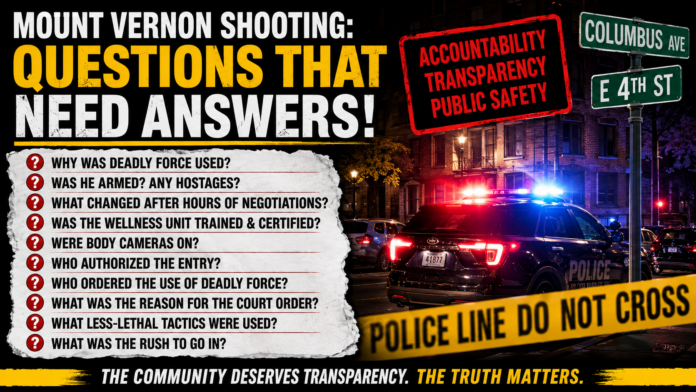
As the New York State Police investigates Thursday night’s officer-involved shooting during a court-ordered mental health response in Mount Vernon, several important questions deserve clear answers. These questions are not intended to assign blame or reach a premature conclusion. They are necessary to promote transparency, accountability, and public understanding.
Was the individual armed? If so, what type of weapon did he possess, and what immediate threat did it present to officers, other occupants, or the public? If he was unarmed, what specific actions led officers to believe deadly force was necessary? Sources have told us that after the first posting, the individual was armed with two knives, but we have not been giving confirmation from MVPD.
Was anyone else in immediate danger? Reports indicate that the individual had barricaded himself inside an apartment. Were there hostages or other occupants inside? If no one else was at risk, what circumstances made an immediate entry necessary? We were able to confirm he was alone; his family was there, but they were outside.
What role did the Mount Vernon Police Department’s Wellness Division play? If crisis negotiators, mental health professionals, and Wellness Division personnel had been working to resolve the situation peacefully, what changed? Why did the response move from negotiation and de-escalation to forced entry?
Why didn’t the Mount Vernon Police Department request assistance from Westchester County’s Project Alliance for crisis intervention? Project Alliance was created in the aftermath of the 2011 fatal shooting of Kenneth Chamberlain Sr. by White Plains police to provide specialized crisis response and de-escalation services. Based on the initial reports, this incident appears to be similar to the circumstances surrounding Mr. Chamberlain’s case. If that is true, why wasn’t Project Alliance activated or consulted before the situation escalated to the use of deadly force?
What crisis-intervention training had the responding officers received? Were members of the Wellness Division and Emergency Services Unit certified in Crisis Intervention Team training or another recognized de-escalation program? Who provided that training, and how frequently is it renewed?
Who made the decision to enter the apartment? Was the entry authorized by the incident commander, a supervising officer, or another official? What information and risk factors were considered before that decision was made?
What happened at the moment deadly force was used? Police officers generally do not wait for a separate command authorizing them to fire when they believe an immediate threat exists. Therefore, the public deserves to know which officer discharged the weapon, what threat that officer perceived, and whether the shooting was consistent with departmental policy and state law.
Were the officers’ body-worn cameras activated? If so, was all footage properly preserved, and will it be released in accordance with state law and departmental policy? Body-camera footage may provide crucial context that a written statement cannot.
What is the individual’s current condition? Is he still alive? How many times was he shot, and where on his body was he struck? As of the latest publicly available information, the City of Mount Vernon reported that the man was transported to a local hospital and was in stable condition, which indicates he was alive when that update was issued. However, officials have not publicly disclosed how many times he was shot, where he was struck, the extent of his injuries or whether his condition has changed since then. Those details are not insignificant. They could help the public better understand the level of force used, the nature of the perceived threat and what occurred when officers entered the apartment. Until the New York State Police or the City release more information, those questions remain unanswered.
What specific less-lethal methods were attempted? Police said non-lethal tactics were used before the officer fired. What tools or techniques were deployed, how many times were they attempted, and why did they fail? Mental health calls are among the most difficult and unpredictable situations officers face. They require officers to balance compassion, public safety and the safety of the person experiencing the crisis. That is precisely why transparency is essential.
Lastly and not least: Did the MVPD follow the recommendation of the DOJ Investigation
A thorough and independent investigation must answer not only what happened, but why officers made the decisions they made. Until those answers are provided, the public should avoid rushing to judgment—but the City of Mount Vernon must also understand that vague statements only create more questions, speculation, and distrust.
This is not the first time a resident experiencing a mental health crisis has been shot by the Mount Vernon Police Department. In 2014, Anthony Smith was shot multiple times during a mental health-related incident. More than a decade later, the public deserves to know: What lessons have been learned? What policies, training, or crisis intervention protocols have been implemented since then to prevent another tragedy? And if changes were made, why did this situation still end with the use of deadly force?
Black Westchester Magazine has previously reported that the U.S. Department of Justice’s 2024 investigation found systemic deficiencies within the Mount Vernon Police Department, including concerns involving training, supervision, accountability, and departmental policies. In fact, several findings in the DOJ report make these questions even more relevant—not because they prove anything about this incident, but because they identify systemic issues that warrant additional scrutiny. Those findings reinforce why the public deserves transparency and clear answers as the New York State Police conduct their independent investigation.
Stay tuned to Black Westchester for the latest developments. Continue checking back and refreshing this page, as we will update this story whenever new information becomes available.
****Update**** After our original report was published, the New York State Police released a more detailed statement regarding the officer-involved shooting. While the latest account answers several of the questions we raised, important questions remain. You can read the New York State Police’s full statement here.