

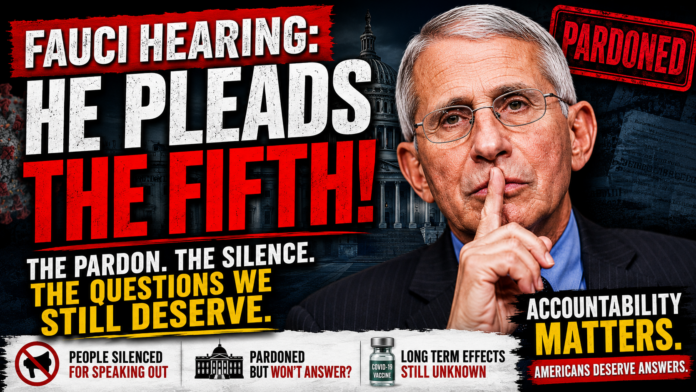




Dr. Anthony Fauci’s recent appearance before Congress did not bring the answers many Americans were hoping to hear. Instead, it raised new questions.
The longtime director of the National Institute of Allergy and Infectious Diseases and the public face of America’s COVID-19 response invoked his Fifth Amendment right against self-incrimination rather than answer questions before the Senate. Let us be clear from the beginning: the Fifth Amendment is a constitutional protection. Every American has the right to invoke it, and exercising that right is not, by itself, proof of guilt.
But constitutional rights do not eliminate public accountability.
For years, Dr. Fauci stood at the center of decisions that affected virtually every American. Businesses closed. Schools shut down. Churches suspended services. Millions of workers faced vaccine mandates. Families were divided over public health policies. The federal government, public health officials, technology companies, employers, and media organizations all played significant roles in shaping what Americans could say, question, and do during one of the most extraordinary periods in modern history.
Many Americans who questioned aspects of the government’s COVID-19 response paid a price. Some doctors and scientists who challenged prevailing public health guidance said they faced professional consequences. Countless individuals reported being criticized, deplatformed, or labeled as spreading misinformation for raising questions about lockdowns, mandates, vaccine policies, or the origins of the virus. Whether every criticism was valid is a separate question. The point is that public debate often became narrower than many Americans believed it should have been.
That is why many people see an irony today.
Citizens who questioned government policy often found themselves publicly condemned for asking questions. Now, one of the government’s most prominent officials has chosen not to answer questions under oath by invoking a constitutional protection. The Constitution protects that choice, but Americans are equally justified in asking why the questions remain unanswered.
The discussion becomes even more complicated when considering President Joe Biden’s pardon of Dr. Fauci. A presidential pardon is a lawful constitutional power. At the same time, it has fueled public debate. Critics ask why a pardon was necessary and why, after receiving one, Fauci would still decline to answer questions before Congress. Legal experts point out that a pardon does not necessarily eliminate every potential legal concern, including possible state matters or issues that could arise from future testimony. Even so, the combination of a pardon and the invocation of the Fifth Amendment has understandably become part of the national conversation.
The COVID-19 vaccines remain another area where Americans continue to seek transparency. Billions of doses have been administered worldwide, and years of research have identified known risks, including rare cases of myocarditis, certain clotting disorders associated with specific vaccine platforms, and severe allergic reactions. At the same time, no one can honestly claim to know every possible long-term effect decades into the future because the vaccines have not existed for that length of time. Continued monitoring and research are both appropriate and necessary.
Science is strengthened by transparency, not weakened by it. Asking questions is not anti-science. In fact, questioning, testing, challenging, and verifying are foundational to the scientific process itself.
The public debate surrounding the vaccines also became a debate about individual liberty, government authority, and social pressure. If there was one public figure who became the face of the vaccine mandate era, it was Kyrie Irving. His decision not to receive the COVID-19 vaccine cost him the ability to play home games in New York City, millions of dollars in salary, and subjected him to relentless public criticism. He was portrayed by many as reckless, selfish, and anti-science, despite maintaining that his decision was a personal medical choice.
Whether one agreed with Irving’s decision is beside the point. His experience demonstrated how government mandates, league policies, corporate decisions, media narratives, and public opinion could converge to pressure individuals into making a medical decision. For many Americans, Kyrie Irving became the most recognizable symbol of the vaccine mandate era—an example of how compliance was often rewarded. At the same time, dissent carried significant personal, professional, and financial consequences.
The larger issue extends far beyond Dr. Fauci or one athlete. It is about trust.
Public trust cannot be sustained if citizens are expected to accept extraordinary government authority while public officials decline to explain the decisions that shaped those extraordinary measures. During the pandemic, Americans sacrificed businesses, careers, education, family gatherings, religious worship, and personal freedoms in ways unseen in generations. Many accepted those sacrifices because they believed they were acting on the best available information.
Now those same Americans deserve answers.
Accountability is not vengeance. Transparency is not persecution. Congressional oversight is not political theater when it seeks to understand decisions that affected hundreds of millions of lives. In a constitutional republic, public officials are entrusted with enormous authority, but that authority carries a responsibility to explain their actions to the people they serve.
Regardless of where one stands on COVID-19 policy, one principle should unite us all: Americans deserve honest answers, open debate, and institutions willing to earn—not demand—the public’s trust. That trust is built through transparency, accountability, and the willingness to answer difficult questions, especially when the stakes have been as high as they were during the COVID-19 pandemic.