

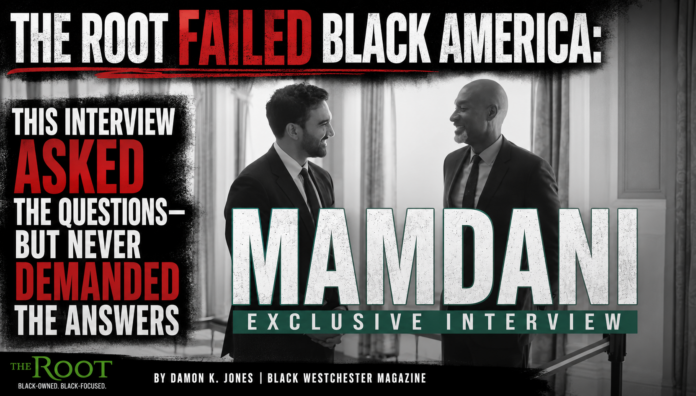




There is a unique responsibility that comes with being a Black-owned publication. It is not simply to interview elected officials or provide them another platform to repeat campaign promises. It is to ask the questions that millions of Black Americans would ask if they were sitting across the table themselves. That responsibility becomes even greater when the subject is the Mayor of New York City, whose policies will affect one of the largest urban Black populations in America. For that reason, I found Charles M. Blow’s recent interview with Mayor Zohran Mamdani to be a missed opportunity.
The interview covered many of the issues that dominate today’s political conversations. Affordability, universal child care, free bus service, housing, and public safety were all discussed at length. These are legitimate public policy issues, and no reasonable person would argue that they are unimportant. The problem is not that these subjects were discussed. The problem is that they were discussed almost entirely as universal policy goals rather than through the lens of what they specifically mean for Black Americans.
This distinction matters because every politician speaks about affordability. Every administration promises to make life easier for working families. Those are campaign themes, not a Black agenda. The question Black America has been asking for generations is much narrower and much more specific: How will your policies increase Black wealth, expand Black homeownership, grow Black-owned businesses, improve educational outcomes, and create safer communities where Black families can thrive? Those are not ideological questions. They are measurements of success.
Throughout the interview, Mayor Mamdani returned repeatedly to affordability as the answer to many of New York City’s problems. Charles M. Blow accepted that premise without demanding a more detailed explanation of how those policies would produce measurable gains for Black New Yorkers. Affordability may be part of the solution, but it is not, by itself, an economic strategy. It does not explain how wealth will be created. It does not explain how ownership will increase. It does not explain how Black businesses will gain greater access to capital or government contracts. Most importantly, it does not explain how the next generation of Black families will accumulate assets instead of simply reducing expenses.
That distinction is not academic. It goes to the heart of why Black Americans continue to trail the nation in household wealth despite decades of political promises. A family may receive temporary financial relief through government programs while never increasing its net worth. A renter may benefit from lower monthly housing costs while never acquiring the equity that transforms housing into generational wealth. A business owner, however, creates jobs. A homeowner builds equity. An investor builds assets. These are fundamentally different outcomes, and they require fundamentally different policies. Those questions should have driven the interview from beginning to end.
To Charles M. Blow’s credit, he asked Mayor Mamdani whether he would support cash reparations if New York City’s reparations commission ultimately recommended them. That was an important question. However, it also raises a larger one that was never explored. Mayor Mamdani is one of the Democratic Socialists of America’s highest-profile elected officials, and the DSA’s national politics have largely emphasized universal social and economic programs rather than a sustained, Black-specific reparations agenda in the way the interview framed it. While the organization has expressed support for reparations in various resolutions and statements, its broader platform is not centered on a comprehensive Black economic agenda built around homeownership, Black business development, or generational wealth.
That makes the exchange even more significant. If reparations warranted a direct question, then Charles M. Blow should also have pressed for equally direct answers on Black homeownership, access to capital, Black-owned businesses, educational outcomes, and measurable wealth creation. Those are the issues that will determine whether Black New Yorkers are better off four years from now. It is also worth acknowledging the political context. The DSA’s membership has been reported to be overwhelmingly white, with internal surveys and analyses indicating Black members make up only a small share of the organization. That reality makes it even more important to ask how a movement with relatively limited Black membership intends to address the specific needs and priorities of Black Americans
Charles M. Blow did ask whether there should be a Black agenda. In many respects, that was the strongest question of the interview. Yet when the mayor answered by returning to universal affordability policies, the obvious follow-up questions never came. If affordability is the Black agenda, what measurable improvements should Black New Yorkers expect to see four years from now? How many additional Black homeowners? How many new Black-owned businesses? How much growth in Black household wealth? Without measurable objectives, broad political themes remain exactly that—broad political themes.
Black Americans deserve more than reassurance that general government programs will eventually benefit everyone. We deserve to know whether our communities will own more, earn more, save more, invest more, and pass more wealth to the next generation. That is the standard by which every elected official should be judged, regardless of party or ideology. It is also the standard by which Black journalism should hold those elected officials accountable