


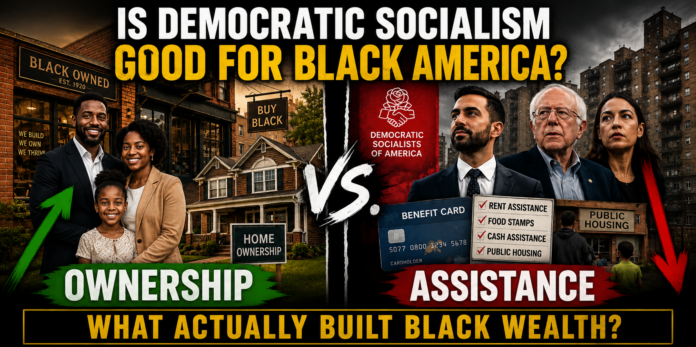




There’s a pattern in American politics where a movement adopts the language of racial justice and assumes that settles the question of whether its policies actually serve Black interests. Democratic socialism, and its leading vehicle, the Democratic Socialists of America, is the latest version of this. It’s worth asking, plainly and without deference to the rhetoric: does this platform actually build Black wealth and independence? The historical record — and the platform’s own design — suggests the answer is no, not in the way that matters most to Black Americans.
What Actually Built Black Wealth Before
After emancipation, Black Americans built a distinct economy almost entirely from nothing — no government safety net, no War on Poverty, no minimum wage law. Black-owned banks, insurance companies, hotels, newspapers, HBCUs, and thriving commercial districts like Tulsa’s Greenwood, Atlanta’s Sweet Auburn, Chicago’s Bronzeville, and Harlem emerged through private capital, mutual aid, and entrepreneurship, often under the weight of Jim Crow segregation and outright violence. This is the closest thing America has to a controlled experiment in what builds wealth for a community starting with almost none: ownership. Land, businesses, banks, and property — not transfer payments — is what generated fast, visible economic progress even under hostile conditions.
The tragedy of that era isn’t that conditions were good. They weren’t — this was a period of legal exclusion and, for much of it, slavery itself. The tragedy is that a real, working model of Black wealth-building was repeatedly destroyed, sometimes by mob violence with no legal recourse, and later by New Deal and postwar programs — FHA-backed mortgages, the GI Bill, union protections — that built enormous middle-class wealth for white America while structurally excluding Black Americans from the same tools.
What the Later Programs Actually Delivered
The next large-scale attempt to close the gap, Lyndon Johnson’s War on Poverty and Great Society, tells a more mixed story than either side likes to admit. Black poverty rates did fall substantially in the years after 1964. But the programs were built around income support and consumption — food stamps, cash assistance, Medicaid — not asset ownership. Six decades later, the wealth gap between Black and white Americans remains enormous, and some economists and historians argue the design of these programs, particularly benefit structures that penalized two-parent households, contributed to family instability without building the kind of durable, transferable wealth that homeownership or a business does. Whatever one concludes about that debate, one thing is clear: none of it closed the wealth gap the way the private, ownership-based institution-building of 1865–1920 did, dollar for dollar of effort.
Where DSA’s Platform Fits
This is the lens through which to evaluate what democratic socialism is actually offering now. Look at the flagship policies: rent control and expanded public housing, universal benefits, and a $30-an-hour minimum wage now moving through New York City’s Council. Each addresses affordability or income in the moment. None of them builds ownership.
The minimum wage proposal is the clearest case. Small businesses — where Black ownership is disproportionately concentrated — operate on some of the thinnest margins in the economy: 1–3% for grocery stores, 3–9% for restaurants, 3–8% for retail. A jump from $17 to $30 an hour, a 76% increase, isn’t a marginal cost adjustment for businesses like these; for many, it consumes the entire margin. Economists sympathetic to the policy, including the Economic Policy Institute, have acknowledged this proposal goes well beyond anything the existing research on minimum wage effects can confidently predict. The most likely outcomes for thin-margin, undercapitalized small businesses — disproportionately Black-owned, with less access to credit and cash reserves than their competitors — are hiring freezes, reduced hours, or closure. Larger, better-capitalized firms can absorb the cost far more easily, which risks squeezing out exactly the kind of independent Black-owned businesses that history shows are the actual engine of Black wealth-building.
New York City’s own numbers make the stakes concrete: the median white household in the city holds roughly $276,000 in wealth; the median Black household holds about $18,000. Mamdani’s administration has proposed a “Racial Equity Plan” naming this gap directly — a genuinely notable step. But as of this writing, it remains a plan still in public comment, with no implementation record, and it has already drawn skepticism from Black political commentators, including in the Black press, who’ve questioned whether Black interests are being prioritized in practice or simply invoked rhetorically.
The Immigration Question
There’s another piece of this that can’t be left out: the sense in some Black communities that migrants have been prioritized over them in the allocation of scarce city resources. This isn’t an abstract grievance. New York City has spent more than $7.5 billion on shelter and services for asylum seekers over the past three years, with annual spending peaking near $3.7 billion in a single fiscal year. That is real money, spent at real scale, in a city that simultaneously cannot find the funding to close a $276,000-to-$18,000 wealth gap between white and Black households. When city leadership — including DSA-aligned officials — treats one form of need as an emergency requiring billions in immediate, uncapped spending, while treating generational Black economic disparity as a plan still open for public comment, it’s fair to ask what that says about actual priorities versus stated ones.
Here, precision matters. National polling that shows “Black Americans” favor immigration typically treats Black America as one undifferentiated group — but that blends together descendants of American chattel slavery with a growing population of Black immigrants and their children, who now make up roughly a quarter of the Black population nationally and arrive, on average, with higher education and income levels. Those are two populations with different starting points and, often, different material interests. A poll showing broad favorability toward immigration doesn’t tell you what descendants of American slavery specifically think about competition for entry-level jobs, housing, and shelter resources in their own neighborhoods — because the sample isn’t asking that question.
That distinction is at the center of a real, if contested, current within Black political thought — sometimes organized under the banner of “Foundational Black Americans” or “American Descendants of Slavery” — which argues that lineage-based experience, not race alone, should shape how policy priorities and even reparative claims are defined. It’s a position some mainstream Black commentators and scholars have pushed back on, arguing it risks dividing Black communities rather than building solidarity. But the underlying grievance driving it is concrete and locally verifiable: Black elected officials and community organizers in New York have documented real strain — competition for entry-level jobs, shelter and housing resources stretched thin, and city contracts flowing to migrant-services nonprofits while long-promised investment in Black neighborhoods lags. Whatever one thinks of the broader framework, that specific tension is real, and it’s the one felt directly by the communities descended from American slavery — not an abstraction settled by a national poll. A movement that claims to center racial equity has an obligation to reckon with that tradeoff honestly, rather than assume solidarity by default because both groups are treated as marginalized under the same broad political framework.
Mamdani’s own words gave this critique a concrete anchor. In his November 2025 victory speech, he declared that “New York will remain a city of immigrants, a city built by immigrants, powered by immigrants, and as of tonight, led by an immigrant” — a line that made no mention of the enslaved Black New Yorkers who built the city’s early economy and infrastructure centuries before its major immigration waves. The omission didn’t go unnoticed. Months later, during Black History Month, Mamdani himself publicly apologized, acknowledging he had been “guilty” of overlooking Black New Yorkers’ role and that “when we tell a sweeping generalization like that, we lose sight of the fact that Black New Yorkers helped to build New York City.” The moment wasn’t an isolated slip — it echoed a nearly identical controversy involving a Grammy-winning artist’s acceptance speech around the same time, one significant enough that Martin Luther King Jr.’s daughter, Bernice King, publicly weighed in to insist Black Americans “have also built this country.” That this correction only came after visible public pressure from Black voices and outlets is itself the point: the default framing overlooked Black America, and it took Black America speaking up to correct it.
The Deeper Problem
There’s also a demographic reality worth naming without discomfort: DSA’s own membership is roughly two-thirds white and disproportionately college-educated — whiter than the country as a whole. That doesn’t automatically invalidate its policy positions. But it’s a fair basis for skepticism when an organization built primarily by a different demographic invokes “racism” and “white supremacy” as blanket explanatory frameworks while offering little in the way of ownership-focused, wealth-building policy specifically designed around what has historically worked for Black Americans. Treating every disparity as requiring the same redistributive answer isn’t just imprecise policy — it can be its own form of condescension, assuming Black Americans can’t distinguish a specific, documented instance of discrimination from a broad ideological narrative applied uniformly.
The faces at the front of the movement reinforce the same pattern. The most nationally visible DSA-aligned figures right now are Mamdani, an immigrant born in Uganda; Bernie Sanders, who is white; Alexandria Ocasio-Cortez, who is of Puerto Rican descent; and Rashida Tlaib, who is Palestinian-American. None are descendants of American slavery. That doesn’t prove any of them lack genuine concern for Black Americans specifically — intent is hard to prove either way, and it would be a mistake to assume bad faith just from a leadership photo. But it’s a legitimate basis to ask the movement to demonstrate, not just declare, that Black wealth-building is a real priority rather than a rhetorical one — and to ask why, in an organization that talks about race as often as DSA does, that leadership layer doesn’t yet include a prominent voice from the community most directly affected by the wealth gap it claims to be organizing around. Black voters delivered real margins for Mamdani and other DSA-backed candidates. Whether that translates into a leadership table that reflects those voters, or policy shaped with them at the table rather than just counted at the ballot box, is the question that will actually answer whether the interest is genuine or transactional.
What Would Actually Be Different
None of this means every individual policy on the democratic socialist platform is without merit — universal healthcare, for instance, addresses real and well-documented disparities in coverage and outcomes, and polls reasonably well among Black voters on its own terms. The point isn’t that everything the DSA proposes is bad. The point is narrower and more precise: as currently designed, this platform prioritizes income relief and cost-of-living support over ownership and asset-building, and that is a real mismatch with the model of wealth creation that has actually worked for Black Americans historically — one built on banks, businesses, land, and institutions, not benefit checks.
If Black communities want their next chapter of economic progress to look more like Greenwood than like the stalled wealth gap left behind by the Great Society, the platform to demand isn’t one that manages poverty more generously. It’s one that puts capital, credit, and ownership directly into Black hands — and judges itself by whether Black-owned businesses and Black household wealth actually grow, not by how loudly it names the problem.