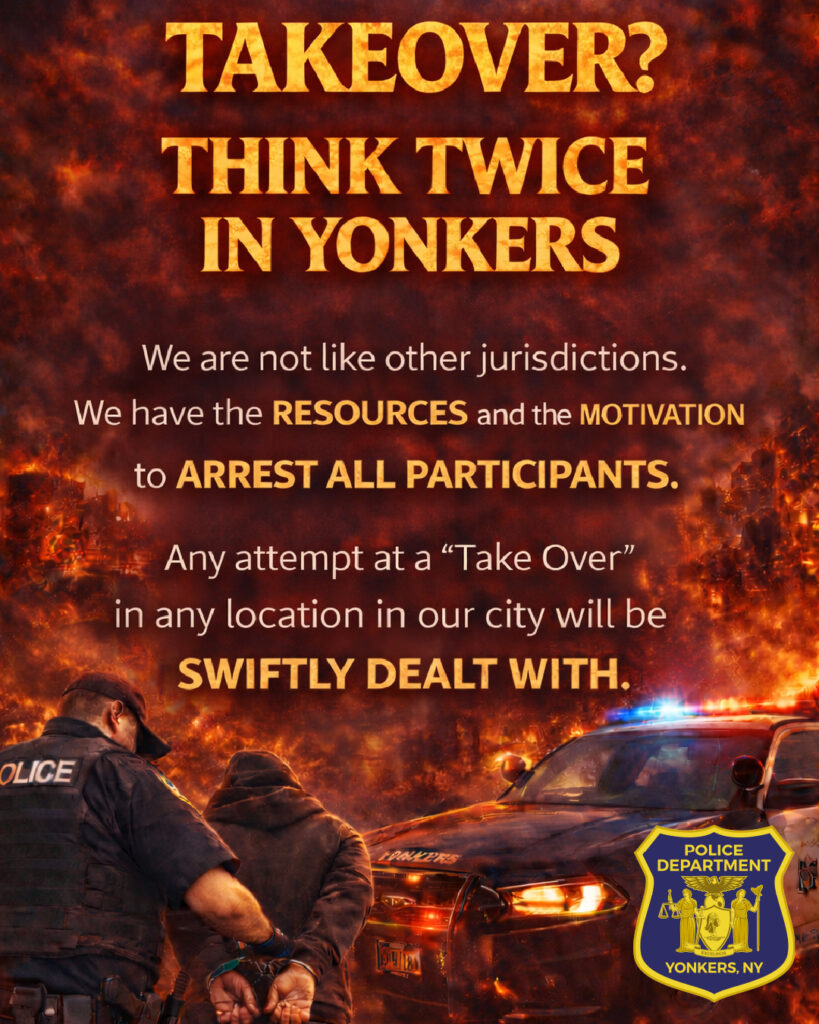
In response to the social media planned “Takeover” at Bay Plaza on President’s Day in the Bronx, the cities of Mount Vernon and Yonkers (which both border the Bronx) issued strongly worded warnings in response to suggesting a similar gathering could happen locally, Mount Vernon officials said they are taking the situation seriously.
With students out on Winter Break this week, the City of Mount Vernon sent the following statement to Black Westchester.
(Mount Vernon, NY) – We are aware of the social media postings circulating regarding a potential “takeover” similar to the incident reported at Bay Plaza on February 16, and the possibility of such activity occurring here in the City of Mount Vernon.
Please be assured that we are taking these posts seriously. The Mount Vernon Police Department is actively monitoring the situation and coordinating as necessary with regional partners to ensure public safety.
We will use every legal means available to protect the residents, businesses, and visitors of Mount Vernon. The safety of our community remains our top priority, and we are fully prepared to respond to any unlawful activity to the fullest extent of the law
Let us be clear: this is not being treated as youthful fun and games. Any effort that disrupts public safety, damage property, or negatively impacts the economic stability of our city will be addressed accordingly. We view any organized unlawful activity as a serious threat to both public safety and the economic well-being of Mount Vernon.
We are also asking parents and guardians to speak with their children and ensure they do not participate in any activity that could place them or others at risk.
We encourage residents and business owners to remain vigilant, avoid spreading unverified information, and report any credible concerns directly to local authorities.
Mount Vernon Police encourages anyone with additional information regarding this incident to contact the MVPD Detective Division at 914-665-2510. All calls will be kept confidential. You can also submit an anonymous tip via our “Text-A-Tip” by texting “MVPD” and your tip to 847411. You can also anonymously send information by utilizing the “Mount Vernon PD” app, available in the Google Play and Apple Store.
THING TWICE CITY OF YONKERS WARNS
Mount Vernon was not the only city to put out a warning to would-be disturbers of the peace — Yonkers Police also addressed the potential threat on Tuesday. The City of Yonkers also posted a strongly worded warning to deter any attempted takeover, basically telling anyone who even thinks about it: FAFO!
“Think Twice,” Yonkers Police Department shared. “We have long-established, well-practiced procedures in place for situations like this. These protocols have been developed, refined, and exercised over time, and we are fully prepared to respond to any level of unrest.
Our department has significant personnel, specialized units, and regional partnerships ready to deploy at a moment’s notice. We have a responsibility to protect our residents, our business owners, and their property – and we approach that responsibility with seriousness, resolve, and zero hesitation.”
The Westchester County Police Department stated, “The Department of Public Safety and its Real Time Crime intelligence center are monitoring social media activity and working with municipal law enforcement partners to discourage these planned teenager ‘takeovers’ of retail venues and other public spaces. In addition, the Department’s patrol officers are prepared to respond to assist any municipality if needed in the event of a disruptive takeover occurs.
“We are asking teens to take our advice about takeovers: do not participate in this kind of activity. You can get hurt, other people can get hurt, and you can be subject to arrest. We are also urging parents to speak with their children and advise them to ignore this dangerous ‘challenge’ being presented to youths via social media,” Commissioner Terrance Raynor shared with Black Westchester.
NYPD Officers responded shortly after 2 p.m. to a 911 call requesting crowd control at 200 Baychester Ave. Authorities said warnings were issued ordering the group to disperse. Officers responded to reports of as many as 200 teenagers acting disorderly outside Bay Plaza on Monday afternoon, where large crowds were seen scattering in different directions as police moved in. As many as 18 young people were taken into custody, we are told charges are pending.
Witnesses reported hundreds of youths gathering inside and around the shopping center. A nearby fast-food restaurant sustained a shattered window during the incident. Mall officials said there was no damage inside the mall itself and that it remained open during the disturbance.
TODAY: 500 youths stormed through Bronx Mall in "Bay Plaza Takeover" this afternoon, resulting in multiple detainements
Police helicopters were seen overhead as officers worked to clear the area. Authorities said the gathering had been promoted on social media and was intended to continue until participants were removed.
The City of New Rochelle says it is also monitoring the situation.
“The New Rochelle Police Department is taking these posts seriously and will continue to monitor the situation and coordinate with our Law Enforcement partners, as needed, to ensure public safety. Any activity that jeopardizes residents, businesses, or visitors to New Rochelle will be swiftly addressed to the fullest extent of the law,” said the New Rochelle Police Department in a statement.
An expanded article based on the transcript and historical record
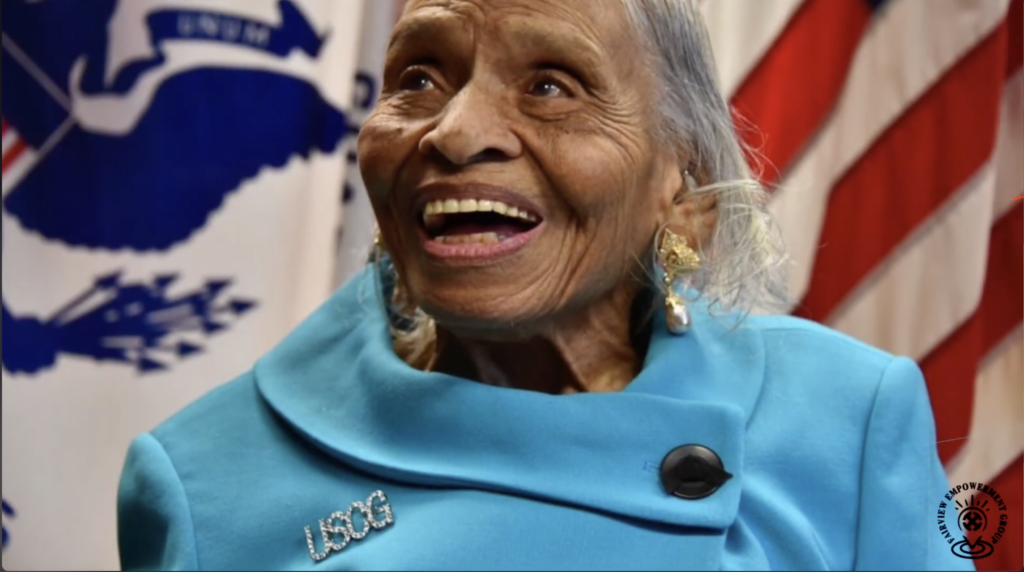
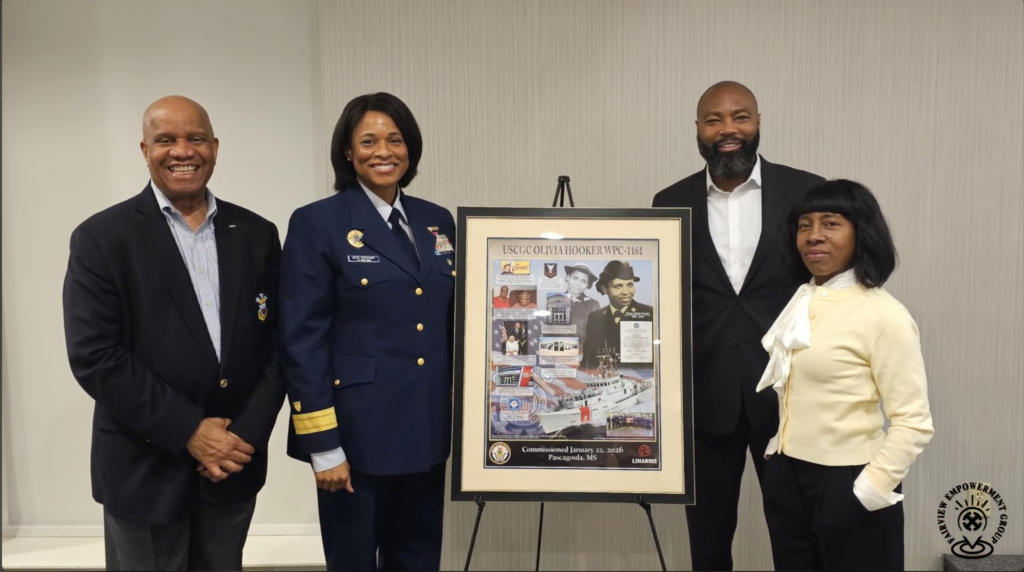
There are ceremonies meant for tradition — and then there are ceremonies meant for memory. The commissioning of the United States Coast Guard Cutter Olivia Hooker was not simply a military formality. It was a recognition of a life that stretched across tragedy, service, scholarship, and community — including right here in Westchester County.
The speaker in the ceremony spoke from personal experience, describing the rare privilege of knowing Dr. Olivia Hooker. She was remembered not merely as a historical figure, but as a person who believed learning, civic responsibility, and service were obligations to something greater than ourselves. Her philosophy was simple and enduring:
It is not about you or me — it is about what we give to the world.
That belief was not theoretical. It was forged in one of the darkest events in American history.
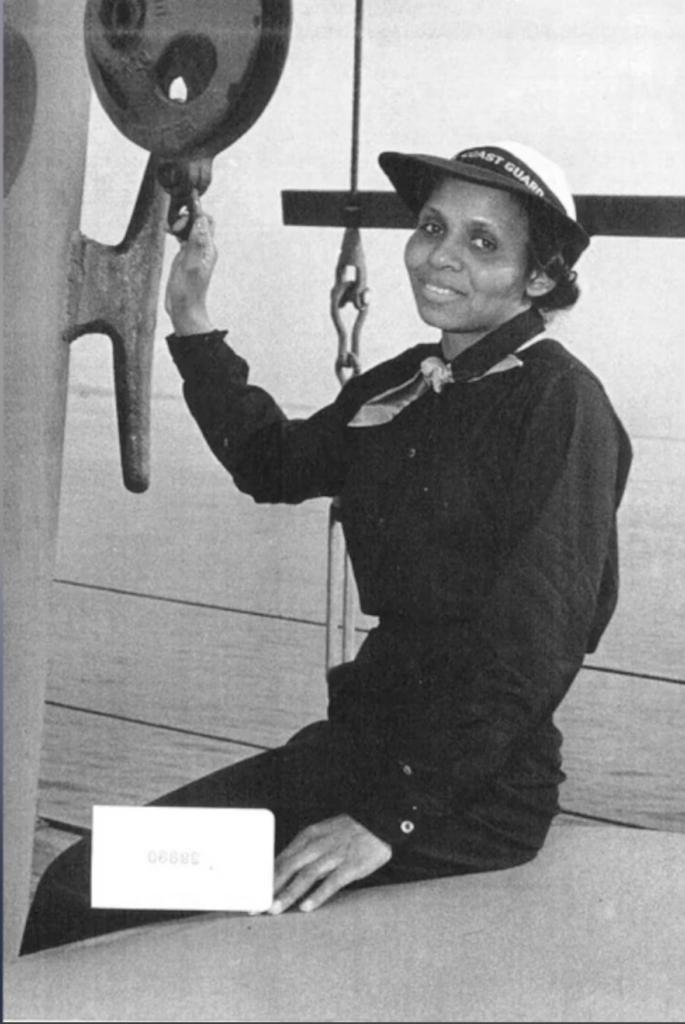
Born in 1915, Dr. Hooker grew up in Tulsa’s Greenwood District — the thriving Black economic center later known as Black Wall Street. At just six years old, she survived the 1921 Tulsa Race Massacre, when white mobs destroyed homes, businesses, and lives across the community. Many survivors carried bitterness for the rest of their lives. Dr. Hooker carried a purpose.
Instead of retreating from society, she committed herself to it.
During World War II, she became the first Black woman to enlist in the United States Coast Guard, joining the SPARS reserve in 1945 and breaking racial and gender barriers in military service. After the war, she used the GI Bill to pursue higher education, eventually earning a doctorate in psychology and dedicating her career to helping children with developmental and learning challenges reach their full potential.
She later taught at Fordham University and helped develop professional standards in psychology related to intellectual and developmental disabilities. But titles alone do not explain her impact.
For decades, Dr. Hooker lived in Greenburgh, New York, where she became known not just as a scholar or veteran, but as a neighbor — a steady presence, admired and loved by the community. Residents knew her not as a symbol, but as a person who embodied dignity, patience, and civic duty in everyday life.
That is what makes the naming of a Coast Guard cutter after her so fitting.
Ships are entrusted with vigilance, rescue, and protection. Dr. Hooker’s life reflected those same values — perseverance through injustice, service without bitterness, and commitment to improving a nation she had every reason to abandon but chose instead to help strengthen.
The crew of the cutter was reminded during the ceremony that they are now stewards of a legacy. Not a legacy of perfection, but of resolve:
Determination matters. Service leaves marks that outlive us. One person’s resolve can shape history beyond their lifetime.
From Tulsa in 1921 to the classrooms of New York, from military service to neighborhood mentorship in Greenburgh, her life became a bridge between past injustice and future responsibility.
The final command of the ceremony ordered the crew to bring the cutter to life. In reality, its life began long before the order was spoken — in a child who survived violence, in a woman who chose service, and in a community that came to know and love her.
The ship now carries her name across the water. But more importantly, it carries her example forward.
Across the United States, Black men remain one of the most underrepresented groups in public school classrooms—a reality that continues to raise concern among some educators, policymakers, and certain communities alike. While Black students make up roughly 15% of the nation’s public school population, Black male teachers account for less than 2%—often cited between 1.3% and 1.8%—according to recent data from the U.S. Department of Education and national education reporting in 2024 and 2025. I’m in that less than 2% number.
The disparity is remarkable. According to data from the National Center for Education Statistics (NCES), Black educators overall represent about 6% of the public school teaching workforce, while nearly 80% of teachers are white and approximately 77% are women. This imbalance highlights both a racial and gender gap in the profession that has remained largely unchanged in recent years.
Experts point to a combination of systemic, economic, and cultural factors that contribute to the low number of Black men in teaching. One major issue is the shrinking pipeline into the profession. According to higher education enrollment reports from 2024 and 2025, college enrollment among Black men has declined over the past decade, limiting the number of candidates entering teacher preparation programs. Based on data from Historically Black colleges and Universities, Black men now make up a significantly smaller percentage of students compared to previous generations, further narrowing the pathway into education careers.
Financial barriers also play a significant role. According to labor and economic analyses reported in 2025, teaching remains one of the lower-paying professions, in many states, requiring a college degree. Many teachers across Westchester County, New York are doing well for themselves, but that isn’t the case everywhere. Studies show that certain folks face a notable pay gap when compared to peers in fields such as business, technology, and engineering. Based on these findings, many Black men—who may feel pressure to pursue higher-paying careers—are less likely to enter or remain in the teaching profession.
Retention presents another challenge. According to multiple education studies published between 2024 and 2026, Black male teachers often report feeling isolated in predominantly white institutions and lacking mentorship and support systems. They are also more likely to be assigned disciplinary roles rather than instructional leadership, which can contribute to burnout and higher turnover rates.
The consequences of this underrepresentation are significant. According to research from organizations such as the Brookings Institution and education equity groups, Black students who have at least one Black teacher are more likely to graduate from high school, enroll in college, and experience fewer disciplinary actions. Based on these studies, representation in the classroom plays a critical role in student outcomes, particularly for Black boys.
Efforts to address the gap are ongoing. According to national initiatives and state-level programs launched between 2024 and 2026, some districts are investing in “grow-your-own” teacher programs, mentorship pipelines, and scholarship opportunities aimed at recruiting Black male educators. However, experts caution that without broader systemic changes—such as increased teacher salaries, stronger retention strategies, and culturally responsive school environments—the percentage of Black male teachers may remain stagnant. I think the number of Black male teachers will continue to decrease.
As America’s classrooms continue to grow more diverse, the question remains urgent: who is leading those classrooms—and who is still missing? And of course, why?
Public debates tell us what people feel. Outcomes tell us what people prioritize.
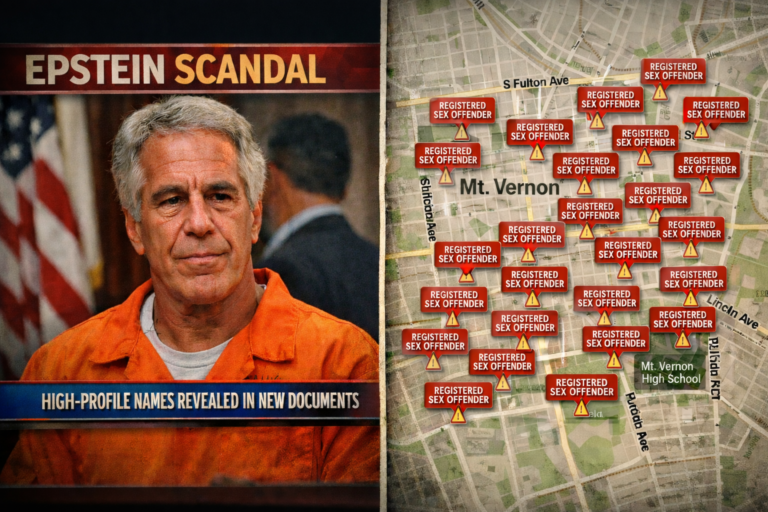
For weeks, timelines have been dominated by outrage over the Epstein files — a national scandal involving powerful people, distant locations, and courtroom documents. The language used is moral: protect the children. But protecting children is not measured by statements. It is measured by exposure to risk.
Start with proximity.
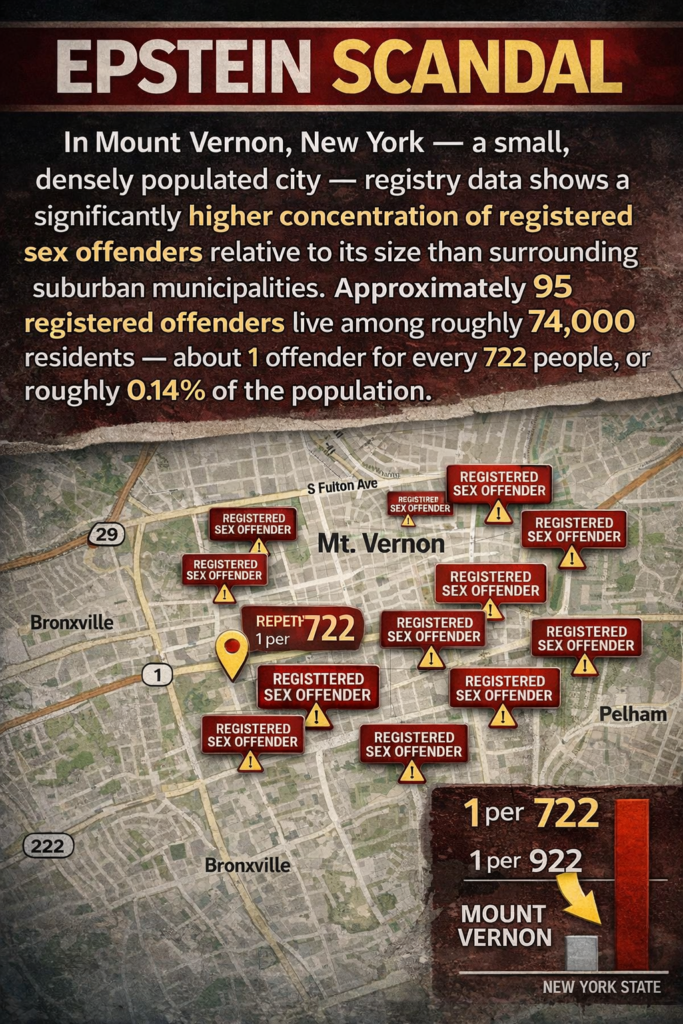
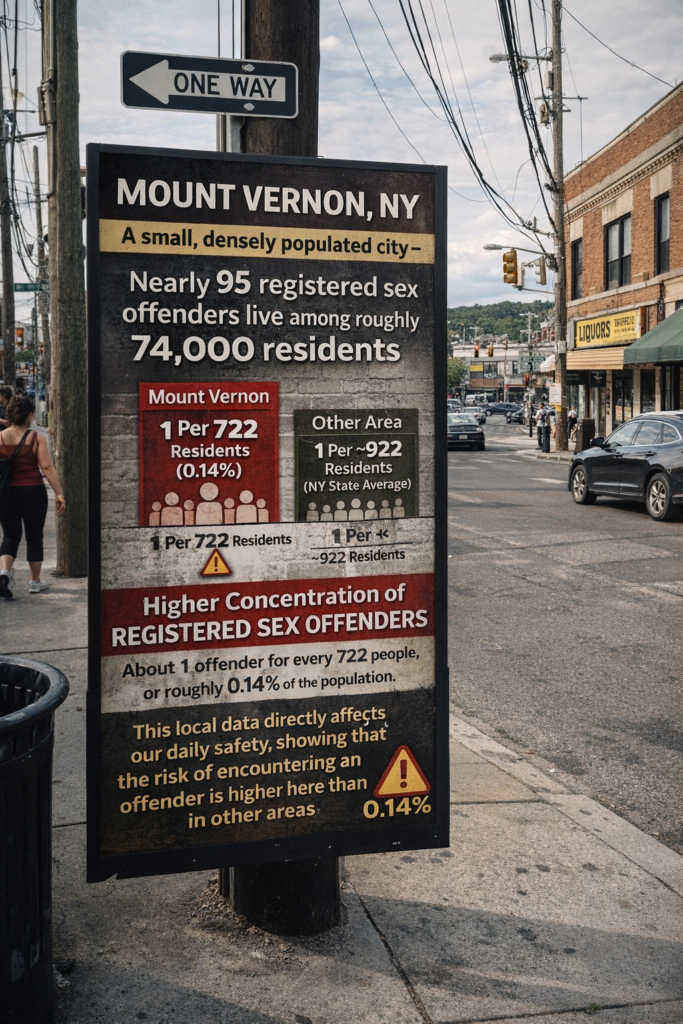
In Mount Vernon, New York — a small, densely populated city — registry data shows a significantly higher concentration of registered sex offenders relative to its size than surrounding suburban municipalities. Approximately 95 registered offenders live among roughly 74,000 residents — about 1 offender for every 722 people, or roughly 0.14% of the population. This local data directly affects our daily safety, showing that the risk of encountering an offender is higher here than in other areas, which should influence our community priorities.
The state does not publish a ranking, so the relevant question is not whether it is number one. The relevant question is probability. When concentration rises in a confined geographic space, the chance of encounter increases. That is not political. It is arithmetic.
When I lived in Mount Vernon, I checked a public registry app to assess how close the issue actually was. Within my own apartment building alone, four registered offenders were listed. That is what proximity looks like in real life — not a headline, not a trending topic, but a daily environment.
A child’s safety is determined less by who appears in a national court filing and more by who lives within walking distance of home, school, and transit routes. The daily environment determines risk frequency. National scandals do not.
And this is where the contradiction shows itself. If the concern is truly “protect the children,” then the most urgent conversation should be the one closest to the children. Yet when Mount Vernon’s own reality is in front of us — the concentration of registered sex offenders inside a small Black city — timelines are largely silent. The same people who post daily about Epstein rarely post about that. The moral language is loud when the scandal is far away, and quiet when the risk is next door.
This is not taking away any accountability that may come from the files. Crimes should be investigated and wrongdoing exposed wherever it exists. But distance changes behavior. It is always easier to condemn people far away than to question people you know, see at fundraisers, or interact with locally. Distant accountability costs nothing. Local accountability costs relationships.
Read:The Clock and the Culture: What Did Mount Vernon’s Leadership Know, and When Did They Know It?”
A recent local case involving a head coach arrested in connection with alleged sexual activity involving a minor produced limited sustained public pressure from many of the same voices who regularly post about the Epstein story. There were also public accusations that the mayor contacted the individual connected to the case, and she publicly acknowledged having a conversation with him. Whether one agrees with that decision or not, the reaction pattern is notable: no protests outside the Westchester County District Attorney’s office, no broad public demand for an explanation, no emergency community forums. Timelines were largely quiet. The same accounts posting daily about Epstein barely addressed the local incident at all.
The difference in response shows a consistent social pattern. People react most strongly when responsibility is lowest.
Discussing distant wrongdoing requires opinion. Addressing local conditions requires decisions. Local issues force practical scrutiny — and scrutiny creates social friction. So attention shifts toward safer outrage rather than uncomfortable accountability.
This pattern appears beyond crime. Communities often invest emotional energy in narratives as they adapt to measurable conditions. Over time, abnormal exposure becomes routine simply because it is familiar. Familiarity lowers reaction, not risk.
Incentives shape attention. National outrage produces agreement and moral signaling. Local scrutiny produces conflict and obligation. The result is predictable: the discussion expands while the environment remains unchanged.
Whether names appear in the Epstein files will not alter where offenders live in a specific city. It will not change supervision practices. It will not change the daily encounter probability. Those are local realities governed by local awareness and local leadership decisions.
This does not make national crimes unimportant. It establishes scale. The likelihood of harm is governed by proximity, not publicity.
If the objective is safety, priorities must follow outcomes.
Based on reaction patterns, society shows greater energy for distant scandals than for nearby risks. That is not a moral accusation. It is an observable behavior. Observable behavior reveals the true hierarchy of concern.
We debate nationally.
We live locally.
But we rarely apply urgency to what affects us most.
Until attention follows probability, conversations about protecting children will remain expressive rather than effective.
During the Winter Semester of 2025, Environmental Leaders of Color (ELOC) expanded its Artificial Intelligence program for Mount Vernon High School students in grades 9–12. What began as a technical course on machine learning quickly revealed a deeper truth: teaching young people how technology works is only half the job. If we do not also teach them how money works, we prepare them to participate in the future — but not to benefit from it.
Throughout the semester, students learned the foundations of machine learning, data patterns, and algorithmic decision-making. Just as important, they explored the ethical responsibilities behind these systems. A major component of the course asked students to analyze the difference between beneficial and harmful agents — not just in coding, but in society. They discussed how AI can improve healthcare, education, and business efficiency, but also how it can reinforce inequality if used irresponsibly.
This conversation naturally led to a broader realization: the same ethical questions exist in finance. Technology is increasingly deciding who receives loans, credit approvals, insurance rates, and even job opportunities. If a community lacks financial literacy, it cannot properly evaluate the systems that shape its economic future.
To bridge the gap between theory and reality, ELOC invited professionals from both the AI and financial sectors to speak with students. These sessions demonstrated how algorithms shape real-world financial decisions—from credit-scoring models to automated trading systems. Hands-on workshops enabled students to experiment with AI tools and financial software, providing practical experience rather than abstract knowledge.
At the end of the semester, students presented original projects that applied what they had learned. A panel of judges, families, and Mount Vernon School District leadership — including Superintendent Dr. Demario Strickland — attended the presentations. Many projects combined technology and economics, including an AI-powered budgeting application designed to help young users manage expenses and savings goals.
After reviewing the presentations, the judges made a clear recommendation: the students understood technology but needed structured financial education to use it fully. In response, ELOC partnered with Lindsay Carden, Vice President of Beacon Bank, to launch a Financial Literacy Program for Mount Vernon students in grades 9–12 enrolled in the AI course.
The goal of this program is not simply to teach budgeting or saving. It is to change how students understand money in a digital economy.
Today’s financial system is no longer paper statements and bank tellers. It is automated underwriting, algorithmic risk assessment, digital payments, and behavioral data tracking. Without financial literacy, a person becomes a user of the system. With financial literacy, they become participants—and potentially owners.
Students will learn practical topics such as:
• How credit actually works and why scores matter
• The long-term cost of debt versus the power of compounding savings
• Digital banking and financial technology risks
• The ethics behind algorithm-driven financial decisions
• How to evaluate financial products rather than simply accept them
• The connection between career income, investment behavior, and generational wealth
Parents and guardians have expressed strong interest because they recognize a reality schools often overlook: students graduate knowing formulas, but not contracts. They can solve equations but cannot interpret loan terms. They understand history but not interest rates. This gap has real consequences in communities where financial mistakes compound across generations.
ELOC will collect feedback from students and families to continually adapt the curriculum to community needs. The long-term vision extends beyond the classroom. Planned community showcases will allow students to present projects to residents, local leaders, and media — turning financial education into a public conversation rather than a private struggle.
This initiative represents a shift in how education should function in the modern economy. Teaching coding without finance produces skilled workers. Teaching coding with finance produces decision-makers.
We thank the Mount Vernon School District and Superintendent Dr. Demario Strickland for supporting this program, and we welcome Beacon Bank to this collaboration. Together, we are working toward a simple but powerful outcome: students who not only understand the future, but are prepared to prosper in it.
Students interested in participating may register online at www.eloc.earth.
Financial literacy is not a supplemental subject. In the age of AI, it is survival knowledge.
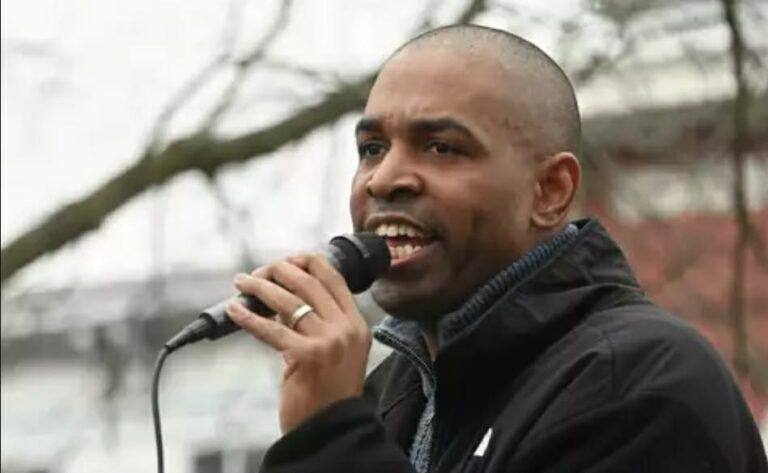
Lt. Gov. Antonio Delgado Ended His New York Gubernatorial Campaign After Gov. Hochul Secured The Democratic Nod And An Avalanche of Endorsements. He Cited No Viable Path Forward.
Lt. Gov. Antonio Delgado announced in a statement posted on X on Tuesday that he’s ending his campaign for governor.
“I’ve decided to end my campaign for Governor of New York. After much consideration, I’ve concluded that there simply is no viable path forward. And though my campaign has come to an end, I fully intend to do all I can in our effort to build a more humane, affordable, and equitable state that serves all New Yorkers. I will also support Democrats in our effort to hold the line against Trump and take back our democracy. I do not make this decision lightly, particularly given that so many have poured their belief into our campaign and are desperate to be given a voice. To those who have supported this effort, especially my incredible campaign team and volunteers, I can’t begin to express my gratitude for each and every one of you. And a special thanks to India Walton, who joined this campaign because she shares this vision and I know will also continue working toward it. To everyone else who believed in us: Please never forget that your voice matters, and its power extends well beyond any one campaign or any one politician. You must always hold people in office accountable, because at the end of the day, they work for you. We, and I, work for you. Ultimately, this decision for me comes down to my belief that to walk with purpose, is to walk with love. That belief has animated this campaign. That is why Lacey and I entered politics nearly a decade ago. That is the lesson we try to impart on our young boys. And that is the same spirit I will carry with me as I continue to serve the people of New York as Lieutenant Governor,” Delgado announced.
The decision occurred just a week after Lt. Governor Delgado revealed his running mate, India Walton, a former Buffalo mayoral candidate and Democratic Socialist. Until only a few days ago, Delgado had stated that he planned to petition his way onto the ballot after failing to receive enough votes at the state Democratic nominating convention last Friday.
NYWFP issued a statement on Wednesday following Delgado’s decision to drop out of the race. He was challenging Hochul in the Democratic Primary as she seeks reelection to a second full term.
“Yesterday’s news that Lieutenant Governor Antonio Delgado is ending his campaign for Governor marked an important moment in New York politics — and underscores the impact of a real debate about affordability, democracy, and leadership in our state,” Jasmine Gripper & Ana María Archila, Co-Directors of the New York Working Families Party, shared with Black Westchester. “Lieutenant Governor Antonio Delgado did what he set out to do: he offered New Yorkers an alternative vision and added his voice to the chorus of more than a million New Yorkers who voted to demand bold solutions to the rising cost of living. We are grateful for his leadership and proud of the Working Families Party affiliates who supported his campaign early and helped create a moment of genuine deliberation inside our Party and across New York.”
Hochul and Delgado had been battling for some months before Delgado announced his campaign in June. He believed New York needed more progressive, revolutionary leadership. Delgado remained Hochul’s lieutenant governor despite making barbs at her during his candidacy. He announced Tuesday that he will continue to serve as lieutenant governor and support Democrats.
Senate Majority Leader Andrea Stewart Cousins said Delgado’s decision to suspend his campaign was a “good idea.”
“Clearly, the convention over the last week was very definitive in terms of the people who support the governor,” Stewart-Cousins told reporters in Albany minutes after Delgado dropped out. The leader noted NYC Mayor Mamdani’s and Rep. Alexandria Ocasio-Cortez’s endorsements of Hochul, and Delgado’s lack of party support.
“It was just very clear that there was nothing that defined him, particularly, in a way that would make him catch on, apparently,” Stewart-Cousins said. “It’s better that we are united because we know that when you’re trying to defeat a Trump administration and folks who would deprive us of health care and environmental protections and food – I could go on and on.”
Delgado faced a nearly insurmountable polling deficit, with the latest Siena University poll showing Democrats statewide supported Hochul over Delgado by more than 50 points, 64%-11%.
Delgado’s decision to drop out of the race gives Hochul a clear path in the Democratic primary. Last week, she named Adrienne Adams, the former speaker of the New York City Council, as her replacement lieutenant governor pick for the upcoming election.
On the Republican side, Nassau County Executive Bruce Blakeman is expected to be the GOP nominee for governor in November. Blakeman chose Madison County Sheriff Todd Hood as his running mate for Lieutenant Governor.
The bailiff for Courtroom A at the Mount Vernon City Court pushes aside the large door of the entryway. It is a bright, warm day in early October, and sunlight streams through the hallway windows and onto the heads of half a dozen people waiting outside the courtroom. The bailiff invites them to come in.
On the schedule is a conference session with the Honorable Judge Tamika A. Coverdale. Eight cases on the docket are part of the Mount Vernon Emerging Adult Justice part of the court—MVEAJ, for short. The initiative is one of only nine similar efforts throughout the country, which offers alternatives to conventional prosecution and incarceration for 18- to 25-year-old individuals. The program connects participants to services, resources, and opportunities, promotes healing to avoid re-offending, and strengthens public trust in the criminal justice system.
The discussion at the conference session brings together representatives from the district attorney’s office, as well as the people who were waiting outside in the sunny hallway moments before: counsel to young adults facing non-violent misdemeanor charges, and staff from community-based organizations. The staff represents organizations that provide a variety of programming to support youth, including finding stable housing, access to health care and behavioral health treatment, attaining gainful employment, GED, and credentialing requirements along their vocational journey. In summary, they provide social support and professional development that every person needs to overcome life’s challenges, including and especially youth at a critical period of their lives.
Vincent Jackson, a program manager at the Youth Shelter Program of Westchester (YSOW), and Matthew Kaufman, a social worker, settled into chairs at the large mahogany conference table between the bench and court gallery. Both men are well over six feet and carry themselves with a powerfully calm presence that belies the immense passion they have for their jobs and the deep care they have for the young people they work with in the MVEAJ program. Their care becomes readily apparent when Judge Coverdale invites them to speak about the progress young people in programs at the Youth Shelter are making toward their goals. Staff at the Youth Shelter call each person’s list of goals an Individual Service Strategy. It may include regularly attending a GED class, completing a food service or construction safety certificate course, or meeting with licensed specialists to support their behavioral health needs.
At the core of the MVEAJ program is an approach to criminal justice that replaces punishment with accountability. Through consistent, small wins, young people make progress toward larger goals with support from Mr. Jackson, Mr. Kaufman, and several other staff at the Youth Shelter who run a variety of educational, vocational, clinical, and additional enrichment programs.
The conference session with Judge Coverdale garners input from all parties for each case: the district attorney’s representative, counsel to the youth facing one or more misdemeanor charges, and staff from the community-based organizations. Judge Coverdale shows interest in the person behind the paperwork on the conference table. For young people already accepted to the MVEAJ program, she wants to know if the young person is showing accountability to the expectations of the program that they leverage the programming and support from the Youth Shelter to address their educational, vocational, and other personal goals and needs. When the group moves on to cases where a young person has yet to be accepted to the MVEAJ program, the discussion turns to whether the case is a good fit.
“This program isn’t a pass, but an opportunity. It requires commitment that is not for everyone,” says Mr. Jackson. “We need to see young people aspire to change their narrative and their behavior. We know the young people we work with. We know the reasons they end up in court, or worse, locked up. MVEAJ is about the village coming together and addressing those reasons. As someone who’s been there, my mission is to create pathways for young people to get off the streets and create opportunities for them to thrive. Their job is to show up and put the work in.” And they do, the vast majority of cases that come through the emerging adult part of the court do end up with reduced charges because young people have achieved the goals they have set for themselves. MVEAJ doesn’t lower the bar; it changes what is being measured. It turns out that when you measure growth instead of compliance, most young people exceed expectations.
During a Youth Justice Symposium that the Youth Shelter hosted at Westchester Community College later in October, Judge Coverdale was a guest speaker. “The Emerging Adult Justice Part [of the court] in Mount Vernon works directly with the Youth Shelter, and we have those young adults who are 18 to 25 [years of age] in that part. That’s a crucial age group, and at times they feel they are not listened to,” Judge Coverdale said during her speech. “But I listen to them all the time. And every organization that we have involved with them listens to them. And our goal is to ensure that young people have resources.” She continues, “Some of our young people are food insecure. So, you have to make sure [to ask] ‘Do you have food? Do you have a place to live? Do you have therapy?” The questions point to the structural issue that youth involved with the justice system often are without support to meet their basic needs, needs that every person must meet to live a life with dignity.
Later in the symposium, attendees heard from Michia, a participant in YSOW’s community programs. She shared a poem, entitled “The Art of Surviving”, which encapsulated how supporting young people to live lives with dignity is key to building brighter futures. As part of her poem, Michia passionately recites:
Change doesn’t come from talk; it comes from access.
From systems that listen. From people who remember that potential doesn’t disappear just because someone stumbles.
We don’t need saving. We need space. Room to build. Room to breathe. And room to become more than the world expected.
“We’re witnessing a life being rewritten every time a young person chooses to invest in themselves instead of just serving time,” says Joanne Dunn, Executive Director of the Youth Shelter Program of Westchester. “That’s what makes this work so meaningful. We’re not managing consequences; we’re building brighter futures.”
Key to the MVEAJ program’s success is not only the milestones that individual young people reach—such as earning their GED or securing employment—but also the collective successes of the program. In 2025, the Youth Shelter supported 25 young people in the MVEAJ program, nearly twice as many as the 14 participants annually during the prior two years. During these three years, the time it took young people to complete their accountability goals decreased. In 2023, the time between when a participant was accepted to the MVEAJ program and their final disposition, which is nearly always a dismissal of the case, was 375 days, on average. In 2024, this average dropped down to 207 days, and down further to 139 days in 2025. This saved time preparing for and attending court dates translates to more time the youth have to invest in their goals. In fact, while a goal for all young adults in the MVEAJ program is to be accountable and have their case dismissed, several young people continue to stay connected with the Youth Shelter beyond the court mandate because of the ongoing opportunities available to build a brighter future for themselves.
“The heart of the work is a young person realizing that they are so much more than a detrimental moment, and that happens through the unconditional love of the village,” says Mr. Kaufman. “When a young person realizes that they’re not alone and they can make things right by reaching for their potential, worlds start to shift. Our biggest success lies when they start to believe that they can. We don’t always see them graduate or land their dream job, but often we do. They’ll call for their flowers.”
About the author: Bijan Kimiagar serves as director of impact at Youth Shelter Program of Westchester, where he supports staff to leverage their professional expertise and program data to promote the success of their programs and the young people they serve.
About the Youth Shelter Program of Westchester: Since 1975, the Youth Shelter Program of Westchester (YSOW) has been a pioneer in providing community-based alternatives to incarceration for young people involved in the criminal justice system. YSOW serves justice-impacted young people ages 16–25 through two primary program structures— residential and community-based programming—that offer court-aligned, structured alternatives allowing young people to remain connected to their families and communities while taking meaningful accountability. Our residential program operates a 12-bed facility serving young men ages 18–24, while our community programming, also known as the LEAD (Leadership, Excellence, and Development) Academy, provides diversion, special court initiatives, intervention, and post-support services. Across both program structures, YSOW addresses the root causes of justice involvement through education and GED programming, workforce development, behavioral health and substance use services, violence prevention, conflict resolution, arts and cultural enrichment, and consistent mentorship. Through close partnerships with courts, government agencies, and community organizations, YSOW replaces confinement with opportunity and supports young people in building safer, more stable, and hopeful futures.
Every Black History Month, we celebrate firsts. First elected, first hired, first promoted. But history is not actually changed by firsts alone. History changes when someone demonstrates that a standard can be upheld once they arrive.
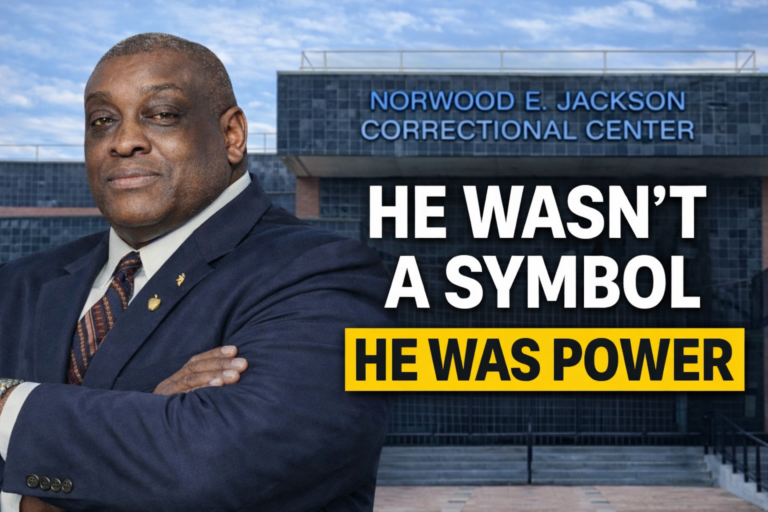
That is why Commissioner Norwood E. Jackson mattered.
The Norwood E. Jackson Correctional Center is not simply named after the first Black commissioner in Westchester County corrections. It is named after a man who demonstrated that Black authority could exist within an institution without apology, without compromise, and without lowering standards to make anyone comfortable.
Born in Washington, D.C., in 1934, Jackson’s path did not follow the modern idea of leadership through rhetoric. At Central State University, he excelled academically and athletically, dominating football, discus, and shot put before a brief stint with the Cleveland Browns. But the real shaping of his leadership came in the military. Fifteen years of active duty as an Airborne Ranger, service in Vietnam, Area Provost Marshal in West Germany responsible for tens of thousands of soldiers and their families, earning the Legion of Merit, and retiring as a Lieutenant Colonel. That kind of background does not produce a man searching for approval. It produces a man trained to establish order.
When he entered the Westchester County Department of Correction in 1972 as a cross-complex security warden, he entered one of the few professions in which theory immediately dies. A jail does not respond to political language. It responds to command credibility. Staff survival and inmate behavior depend on predictability. Either the administration controls the building or the building controls itself.
By the time he became commissioner in 1989, he did not symbolize authority—he already embodied it.
Modern conversations treat representation as progress, but inside corrections, representation means nothing if rules fluctuate. Jackson understood something many administrators forget: you cannot rehabilitate chaos. Stability comes first. Only after that can fairness exist. Officers knew policy meant something. Inmates knew that lines did not move in response to pressure or mood. Violence drops when expectations stop changing. That is not ideology. That is cause and effect.
Affectionately called “Big Jack,” he believed in rehabilitation, education, and mental health programs, but he also understood that those things only work inside a structure. Under his leadership, the county confronted overcrowding and built the modern facility, which opened in 1992. Not reform by slogan — reform by function.
For Black officers, however, his impact extended beyond policy.
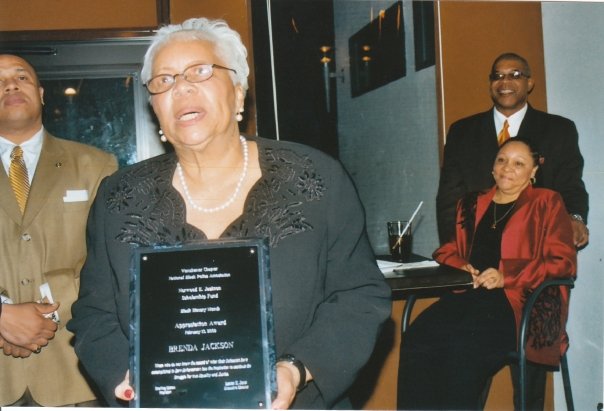
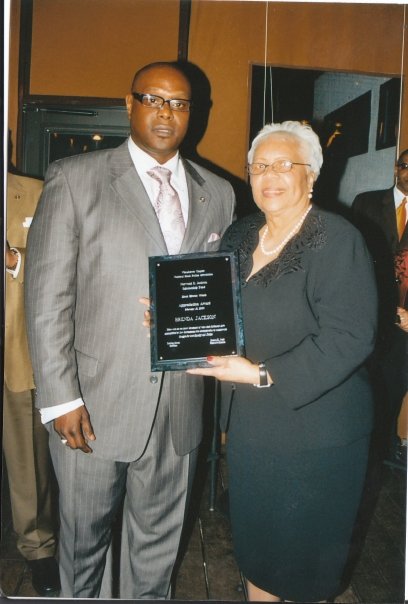
Damon K. Jones, Publisher of Black Westchester and New York Representative for Blacks in Law Enforcement of America, presents an appreciation award to the widow of Norwood E. Jackson in honor of her husband’s service, leadership, and example as a Black man in law enforcement.
A baby lion learns to become a lion by watching a grown lion. Jackson was that lion. When I started, he was the only Black commissioner in any law enforcement agency in the county, and his presence alone changed how you carried yourself. Many Black officers today have never seen leadership like that — a man who kept his dignity intact while working in an era of racism far worse than what officers face now. His example made us see it wasn’t about a paycheck, overtime, or fitting in with white officers. It was about representing and protecting our community while maintaining authority inside the institution. He always treated everyone equally, regardless of their ethnic background. He did not teach victimhood or hostility. He promoted professionalism backed by confidence. He treated everyone fairly and demanded excellence, and for Black officers, he represented something we rarely saw — institutional authority that did not need permission to exist.
He didn’t open doors by asking. He walked through them and showed you how to walk through them without shrinking.
Jackson’s legacy was not a Black face in a place. He was a Black man, proud of who he was, who changed the system rather than managed it for a paycheck. He exercised authority instead of borrowing it. That stands in sharp contrast to too many moments in public safety history where leadership became about maintaining position rather than improving the institution. Jackson didn’t sit in the chair — he defined the chair.
His Black excellence did more than affect corrections. It reset expectations across the county. After Westchester saw a Black man successfully run one of its largest and most difficult law enforcement agencies with discipline, integrity, and control, it became harder to argue that Black leadership was a risk. Other appointments followed over time because competence had already been demonstrated. The barrier had been psychologically broken before it was politically broken.
If you are Black and hold a commissioner or command-level position in law enforcement in this county today, you did not arrive in a vacuum. The road was cleared before you. Jackson showed Westchester that a Black man could run a major public safety institution with excellence, integrity, and respect. That proof mattered more than any diversity statement ever could.
That is what Black power originally meant. Not symbolism, not slogans, not emotional unity. Control of institutions that affect daily life and the discipline to run them correctly once you have them. Jackson didn’t protest the system. He ran it effectively, and that effectiveness forced respect.
He never denied his Blackness to advance, but he never used it as an excuse either. Racism existed — everyone knew it — yet he answered it the old way: mastery. Excellence that removed arguments. Authority grounded in competence instead of volume.
That is why his legacy still resonates with officers decades later. Not nostalgia. Memory of stability. When leadership stands behind lawful action, staff morale rises, and inmate behavior adjusts. When rules stay consistent, the environment calms. Institutions function when authority is predictable.
Today, many evaluate leadership by tone and narrative. But public safety is governed by outcomes. Removing consequences and disorder increases. Remove standards, and professionalism collapses. Jackson understood authority is not oppression when exercised responsibly — it is protection.
His name on the building made it the first law enforcement facility in Westchester named after a Black man. But the real achievement was not the naming. It was what made the naming unavoidable.
The fact of the matter is, Norwood E. Jackson laid the foundation that a Black man could do the work in this county — and do it at the highest level — long before voters were willing to place one in the highest elected office. His leadership normalized Black competence within government. Because people had already seen a Black man run one of the county’s most difficult institutions successfully, the idea of a Black County Executive was no longer theoretical. It was proven.
Long before Westchester elected its first Black County Executive, Jackson demonstrated that Black leadership in government could be firm, disciplined, and transformational without being symbolic. He did not simply break a ceiling. He showed what to do once you reached the floor above.
So, his legacy is more than just a memory for Black History Month; it is a model to follow. Progress isn’t made by just entering institutions and making them comfortable. It’s made by mastering those institutions and improving their performance since you arrived.
He didn’t ask to be validated.
He established order — and that earned respect that still hasn’t faded.
Public debate often treats immigration enforcement as a moral theater — one side speaks the language of compassion, the other the language of order. But courts do not rule on feelings. They rule on structure. This recent federal decision, which allows immigration agents to wear masks while requiring identification, highlights how legal authority and federalism shape enforcement practices in a federal republic.
In February 2026, U.S. District Judge Christina A. Snyder of the U.S. District Court for the Central District of California issued a ruling on a California law that attempted to prohibit federal immigration agents from wearing masks during enforcement operations. The court blocked the state’s mask mandate, emphasizing that federal authority controls federal operations under the Supremacy Clause. This decision should reassure the audience that legal authority is clear and consistent, thereby reinforcing trust in the system’s fairness.
The loudest reactions missed the point by focusing on symbolism. Some framed masked agents as secret police. Others framed any restriction as an attack on law enforcement. The court did neither. Instead, it asked a simpler question: who controls federal officers — Washington or the states?
The answer, unsurprisingly, was Washington.
The Constitution’s Supremacy Clause exists precisely because a nation cannot function if every jurisdiction can rewrite federal operations. If one state can dictate uniforms, another can dictate arrest procedures, and a third can dictate when enforcement may occur, federal law becomes optional geography. This ruling underscores that federal authority controls enforcement, reaffirming the constitutional structure that maintains national unity.
So the judge blocked the state’s attempt to ban masks. Not because masks are a good policy, but because states lack the authority to micromanage federal enforcement tactics.
Yet the ruling did not give federal agencies unlimited discretion. The court allowed identification requirements. Agents may conceal their faces, but not their authority. This distinction between appearance and accountability is crucial because it determines how legal authority is exercised and maintained in enforcement practices.
One regulates appearance. The other regulates accountability. The first interferes with operations. The second preserves civil order.
This is the difference between power and transparency — and courts routinely protect one while permitting the other.
What does this mean practically? States can’t stop federal enforcement. I don’t care what a politician might tell you! They can refuse to participate. They can demand clarity, but not control.
That is not a political compromise. It is federalism functioning as designed. The national conversation often assumes policies must either protect immigrants or empower the government. But the ruling demonstrates something more mundane: governments at different levels have different jurisdictions. When states try to block enforcement directly, courts intervene. When they regulate their own cooperation, courts allow it. When they demand that agents identify themselves, courts see legitimacy rather than obstruction.
In other words, the outcome depends not on the moral argument but on the legal mechanism. Many political movements fail because they focus on optics instead of authority. Passing a law that will predictably be struck down may energize supporters, but it does not change reality. The measurable result is court injunctions, legal fees, and unchanged enforcement practices. Symbolic victories often produce operational defeats.
This case illustrates a broader lesson: policies should be judged by what they produce, not what they signal. Emphasizing outcomes helps the audience see that legal decisions are practical and impactful, fostering confidence in the rule of law rather than symbolic gestures. If the goal was to stop masked arrests, the law failed.
If the goal was to increase accountability, the ruling partially succeeded. Outcomes matter more than intentions.
The debate in the future will likely shift. States will move away from dictating how federal agents operate and toward requiring documentation, record-keeping, and post-arrest transparency — areas courts consistently permit. That is not retreat; it is adaptation to constitutional limits. Political rhetoric promises sweeping change. Constitutional structure delivers incremental boundaries. The difference between the two explains why many policies generate headlines, but few generate results.
In the end, the ruling did not decide immigration policy. It clarified authority. Federal officers answer to federal command. States answer for their own participation. And accountability lives in identification, not in wardrobe regulations. A functioning society depends less on winning arguments than on understanding limits. This case reminds us that government power in America is not a single instrument but a divided one — and ignoring that division produces noise, not change.
This case illustrates a broader lesson: policies should be judged by what they produce, not what they signal. Emphasizing outcomes helps the audience see that legal decisions are practical and impactful, fostering confidence in the rule of law rather than symbolic gestures. If the goal was to stop masked arrests, the law failed.
If the goal was to increase accountability, the ruling partially succeeded. Outcomes matter more than intentions.
The debate in the future will likely shift. States will move away from dictating how federal agents operate and toward requiring documentation, record-keeping, and post-arrest transparency — areas courts consistently permit. That is not retreat; it is adaptation to constitutional limits. Political rhetoric promises sweeping change. Constitutional structure delivers incremental boundaries. The difference between the two explains why many policies generate headlines, but few generate results.
In the end, the ruling did not decide immigration policy. It clarified authority. Federal officers answer to federal command. States answer for their own participation. And accountability lives in identification, not in wardrobe regulations.
A functioning society depends less on winning arguments than on understanding limits. This case reminds us that government power in America is not a single instrument but a divided one — and ignoring that division produces noise, not change.
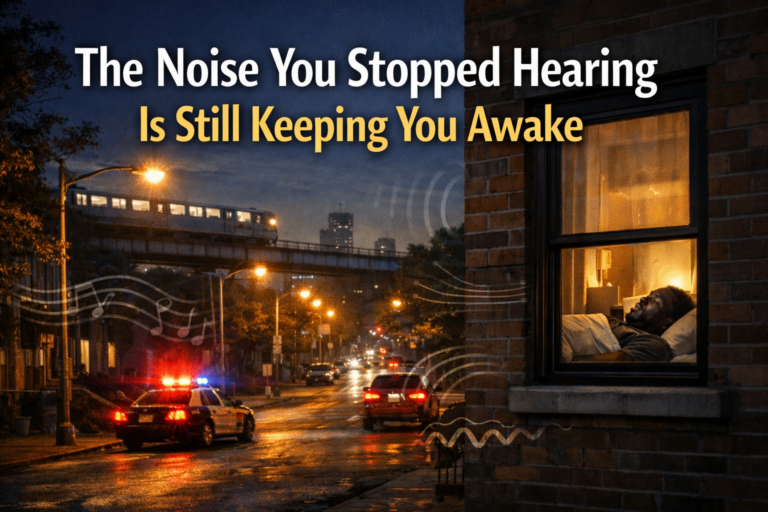
How Sound Pollution Quietly Steals Sleep in Black Communities
Harold came to see me a while back with the kind of sleep complaint I hear often. He was logging seven, sometimes eight hours a night, but waking up feeling like he had barely closed his eyes. His blood pressure had been creeping up, and his focus at work was slipping.
We went through the usual questions about caffeine, screens, alcohol, supplements, medications, and stress. Everything checked out reasonably well. His sleep hygiene was solid. His primary care doctor had already run the basics, and his blood work was unremarkable. A sleep study showed no apnea, no significant limb movements, nothing that explained why his sleep felt so hollow.
Then one afternoon, almost in passing, Harold mentioned how convenient his apartment was. He could walk to the train station in under five minutes and loved that he never had to call an Uber. He said it like it was a selling point.
I paused. How close is the train?
Close enough that freight trains passed through at 2 and 4 a.m. most nights. He had lived there for years. He did not hear them anymore.
Or at least, he did not think he did.
(Harold is a composite patient. Details have been changed to protect privacy.)
That conversation changed how I ask about sleep. Because it surfaced something I now see far more often than I expected: people whose bodies are reacting to sound environments their conscious minds stopped registering a long time ago.
Noise-fractured sleep is a health issue across many communities. But in neighborhoods shaped by highway placement and zoning decisions, the exposure burden often begins before anyone turns out the lights.
What Your Nervous System Needs at Night
Sleep is a nervous system event. We live between two gears: the sympathetic system that keeps you alert and reactive, and the parasympathetic system that handles repair, relaxation, and restoration. Sleep is what happens when our nervous system can shift into repair mode and stay there long enough for the work to get done. Heart rate slows and blood pressure dips and stress hormones quiet down. The brain clears metabolic waste that built up during the day.
When that shift gets blocked or interrupted, we get the worst of both worlds. We are tired and wired. We logged the hours, but the tissue never got what it needed. Focus slips, reactions slow, and our fuse shortens in ways that can cost us at work, in relationships, and in how we feel about ourselves over time.
The Sound Your Brain Never Stops Hearing
Light, sound, timing, and workload all shape how the nervous system behaves at night. Light is usually the loudest signal. But sound may be the most underestimated, because of one uncomfortable fact: we can adapt to noise consciously, and our body cannot.
There is an evolutionary reason for this. Our brains evolved to treat sounds during sleep as possible threats. In an older world, that sensitivity kept us alive. Different sleepers in a group would cycle through lighter and deeper stages at different times, so someone was almost always semi-alert, scanning for danger. That system worked well when the sounds that woke you meant something. It becomes a liability when the predator is not a lion but a garbage truck.
A siren at 2 a.m. can trigger a micro-arousal, bump cortisol, nudge heart rate upward, and pull us out of deep sleep without us ever remembering it happened. Our brain’s auditory processing does not shut off at night. It keeps scanning, and the circuits that feed into arousal centers in the brainstem are set up to respond before we ever become conscious of the sound.
Research confirms the biology: nocturnal noise triggers measurable increases in stress hormones, heart rate, and blood pressure during sleep, and most of these responses go completely unnoticed by the sleeper.
Even sounds as quiet as 33 decibels can provoke cortical arousals. The World Health Organization recommends nighttime noise stay below 40 decibels outside the bedroom. In many urban neighborhoods, that threshold is exceeded on most nights.
Each noise event nudges the sympathetic system back online. The deeper stages of sleep get shortened or skipped. Over months, blood pressure that should dip during sleep stays elevated. Inflammation creeps upward. And the person wakes up feeling like something is wrong but cannot name it, because the cause happened while they were unconscious.
Harold near the train tracks had adapted beautifully on the surface, but his brainstem never did. It kept receipts.
Where the Volume Gets Turned Up
Environmental noise is not spread evenly across a city.
A nationwide study using over one million hours of sound data found that neighborhoods with at least 75 percent Black residents — many of which overlap with historically redlined areas or major highway corridors — had median nighttime noise levels 4 decibels higher than neighborhoods with no Black residents. Four decibels may sound modest. But even relatively small increases in nighttime sound exposure can meaningfully alter sleep architecture across an entire community.
The reasons trace back to decisions made decades ago. Highways routed through Black neighborhoods. Industrial zones placed next to residential blocks. Rail corridors and airports built near communities that lacked the political power to redirect them. Redlining concentrated families into areas already closer to these sources, and the infrastructure that followed only intensified the exposure.
A 2025 University of Michigan study confirmed that historically redlined neighborhoods still carry higher noise levels today. This is a story about zoning and infrastructure patterns, not about any one family or block. The patterns trace to policy decisions that shaped physical environments over decades. Socioeconomic status and race often intersect in these exposure patterns, and both shape who bears the burden. But on average, across the data, Black communities are more likely to live near the kinds of noise sources that fragment sleep and strain the cardiovascular system over time.
And it is worth saying: noise does not only come from outside.
A snoring partner, a loud HVAC system, thin walls between apartments, a television left on in another room. Even in a quiet neighborhood, the sound environment inside the home can fragment sleep the same way. If you are reading this and thinking your block is peaceful enough, the question still applies: how loud is it where you sleep?
What It Costs
Chronic noise-fragmented sleep is associated with higher rates of hypertension, heart disease, stroke, and diabetes. A review in the European Heart Journal described the pathway: nocturnal noise activates the sympathetic nervous system, damages blood vessel lining, and raises oxidative stress, all of which compound over time into measurable cardiovascular harm.
The science is moving quickly. In just the last few years, large-scale reviews have reclassified environmental noise from a nuisance to a modifiable cardiovascular risk factor, with a 2025 umbrella review pooling 20 studies and finding noise associated with increased risks of hypertension, atrial fibrillation, and coronary heart disease. For any one person, the increase in risk may appear modest. Across entire populations, however, those small shifts translate into meaningful differences in who develops disease over time. New research is beginning to measure these effects specifically in Black adults and urban neighborhoods, using objective sleep data rather than self-report alone. The evidence base is no longer thin.
Noise rarely acts alone; it often clusters with air pollution, heat exposure, housing quality, and chronic stress load, amplifying cumulative risk.
The everyday cost of disturbed sleep shows up before the clinical diagnosis.
Thinking gets foggier, reactions slow, and patience with coworkers, partners, and children wears thinner. A shorter emotional fuse we chalk up to stress when it may be something more specific: a nervous system that never completed its repair cycle because the environment would not allow it.
When a community’s sleep is routinely disrupted, the effects ripple into school performance, workplace productivity, and the ability to fully show up in family and civic life.
Why This Belongs in a Black History Month Conversation
There has long been external control over Black communities’ relationship with rest. Forced labor schedules that denied sleep as a basic right. Overcrowded housing that made restoration structurally difficult. Environmental noise reflects the downstream consequences of those structural decisions. The highway routed through a neighborhood in 1958 is still generating sound pressure waves at 2 a.m. tonight. The zoning decision from two generations ago is still fragmenting sleep. The mechanisms are less visible than the ones history books tend to focus on, but the effect on the body is measurable and the consequences are real.
What To Do: From Policy to Pillow
The most important solutions are structural, because the problem is structural.
Zoning policies can be revisited, and noise ordinances can be enforced. Traffic-calming measures, construction timing rules, sound barriers, and building codes that require better insulation in high-noise areas all reduce the volume at the source. These conversations deserve more energy than they currently get.
At the community level, the first step is naming the problem.
Phone apps can measure decibel levels inside your bedroom. Conversations in churches, barbershops, and clinics can start including a question almost nobody asks: How loud is it where you sleep? Tenant associations, neighborhood councils, and local environmental justice groups can turn that documentation into policy pressure. When communities frame nighttime noise as a health issue, it becomes harder for policymakers to treat it as background.
At the individual level, there are things we can do tonight.
Move the bed away from the wall that faces the highway or rail line. Ergonomic earplugs designed for sleep may be the single most effective personal tool available; a 2026 clinical trial found that standard foam earplugs recovered roughly 72 percent of the deep sleep lost to environmental noise, observed under controlled laboratory conditions in a relatively small sample and reflecting short-term intervention effects, and a controlled lab study published in the journal Sleep confirmed they outperformed continuous sound-masking.
For those who cannot tolerate earplugs, a fan or white noise machine can help reduce the contrast between background silence and sudden noise events, though recent research suggests continuous broadband sound may come with its own trade-offs for REM sleep and should be used thoughtfully. And build a wind-down routine that acknowledges a noisy environment. Working with the sound environment you actually have is more effective than pretending it is quiet.
A Final Word
If you work in healthcare, add noise to the conversation when you screen for sleep and blood pressure. Ask where the bedroom sits relative to the street. Ask whether the patient has adapted to sounds they no longer notice. That adaptation is often the clinical clue that something environmental is working against recovery.
If you live in a neighborhood where the nights are louder than they should be, know that quiet is a health resource. It belongs in the same conversation as access to parks, healthy food, and safe streets.
And if you are a parent or an educator, know that a child sleeping through noise may still be losing the deeper sleep stages that support focus, mood, and learning over time.
Sleep is how the body repairs what the day breaks down. Protecting Black sleep, in the homes, neighborhoods, and in policy conversations, is part of protecting Black futures.
Derek H. Suite, M.D., is a board-certified psychiatrist, CEO and Founder of Full Circle Health, and host of The SuiteSpot, a daily podcast exploring science, spirituality, and human performance. Drawing on a decade of teaching Clinical Psychopharmacology at Teachers College, Columbia University, he writes about sleep, recovery, and what allows performance to hold up when it matters most. He is the author of the forthcoming book Sleep as Performance Medicine and a guest contributor to Black Westchester Magazine.
This article is for educational purposes only and is not a substitute for individualized medical advice. Readers should consult their own healthcare professionals regarding sleep concerns
References and Further Reading
Casey JA, Morello-Frosch R, Mennitt DJ, et al. Race/ethnicity, socioeconomic status, residential segregation, and spatial variation in noise exposure in the contiguous United States. Environmental Health Perspectives. 2017;125(7):077017.
Shkembi A, Patel K, Smith LM, Meier HCS, Neitzel RL. Racial and ethnic inequities to noise pollution from transportation- and work-related sources in the United States. Journal of Exposure Science & Environmental Epidemiology. 2025.
Münzel T, Gori T, Babisch W, Basner M. Cardiovascular effects of environmental noise exposure. European Heart Journal. 2014;35(13):829-836.
Tabaei S, Rashki Ghalenoo S, Panahandeh M, Bagheri G, Tabaee SS. The relationship between noise pollution and cardiovascular diseases: an umbrella review on meta-analyses. BMC Cardiovascular Disorders. 2025;25(1):630.
Basner M, Smith MG, Cordoza M, et al. Efficacy of pink noise and earplugs for mitigating the effects of intermittent environmental noise exposure on sleep. Sleep. 2026;zsag001.
Halperin D. Environmental noise and sleep disturbances: a threat to health? Sleep Science. 2014;7(4):209-212.
World Health Organization. Night noise guidelines for Europe. 2009.