


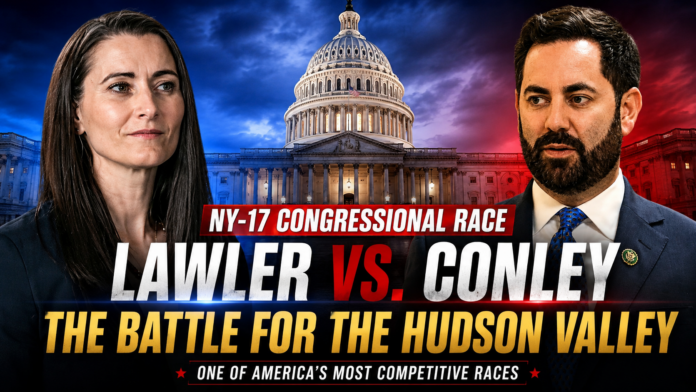





The battle for New York’s 17th Congressional District is shaping up to be one of the most closely watched races in the country, with a new independent poll showing incumbent Republican Congressman Mike Lawler holding a narrow lead over Democratic challenger Cait Conley.
The survey, conducted by the independent polling firm co/efficient, found Lawler leading Conley 50% to 45%, with just 5% of likely voters still undecided.
The results come just weeks after a Democratic-backed poll showed Conley leading by six points, highlighting just how fluid the race remains. Together, the competing surveys reinforce why political observers continue to rate NY-17 as one of the nation’s premier congressional battlegrounds.
How NY-17 Became One of America’s Most Competitive Districts
The political landscape of New York’s 17th Congressional District changed dramatically following New York’s congressional redistricting after the 2020 Census.
Before the district lines were redrawn, NY-17 was represented by Mondaire Jones, who made history in 2020 as New York’s first openly gay Black member of Congress. At the time, the district leaned comfortably Democratic, and Jones won his seat by nearly 15 percentage points.
Following the 2020 Census, New York Democrats approved new congressional maps that Republicans argued were designed to maximize Democratic seats in Congress. The maps quickly became the subject of a legal challenge, and in 2022 the New York Court of Appeals ruled that the original congressional map violated the state’s constitutional redistricting process. A court-appointed special master was then tasked with drawing new district boundaries.
Those new lines fundamentally changed NY-17.
The revised district brought together portions of Westchester, Rockland, Putnam, and Dutchess Counties, creating a far more politically balanced electorate. The new map also prompted Mondaire Jones to run in a different congressional district, leaving the seat open and setting the stage for one of the nation’s biggest political upsets.
In 2022, Republican Mike Lawler defeated then-Democratic Congressional Campaign Committee Chairman Sean Patrick Maloney, becoming one of the few Republicans to flip a Democratic-held House seat in New York. Since then, NY-17 has consistently ranked among the most competitive congressional districts in America, with both national parties investing millions of dollars to either defend or reclaim the seat.
Why NY-17 Matters
New York’s 17th Congressional District has become one of the country’s premier swing districts. With Republicans holding only a narrow majority in the House of Representatives, Democrats view flipping NY-17 as essential to regaining control of Congress. At the same time, Republicans see holding the seat as critical to maintaining their majority.
The district has consistently demonstrated a willingness to split its ticket. While Democratic presidential candidates have remained competitive throughout the region, Lawler has twice built a coalition broad enough to win congressional elections in a district where neither party can afford to take voters for granted.
Could Black Voters Become the Deciding Factor?
One of the most overlooked storylines heading into November is whether Congressman Mike Lawler can continue making inroads with Black voters throughout the Hudson Valley.
Historically, Black voters have overwhelmingly supported Democratic candidates. However, recent election cycles have shown Republicans making modest gains among some Black voters nationally, particularly among homeowners, entrepreneurs, veterans, churchgoers, and working-class families, who are focused on issues such as affordability, public safety, education, and economic opportunity.
During his previous campaigns, Lawler made a visible effort to engage communities that many Republican candidates have often overlooked. He attended community events, met with Black clergy, spoke with Black business owners, participated in local forums, and sought endorsements from respected community leaders throughout Westchester and Rockland Counties. While Democrats continued to receive the overwhelming share of the Black vote, Lawler’s outreach helped him earn support from some Black voters who were willing to cross party lines.
That dynamic could prove significant again in 2026.
In a race where polls show only a five-point margin, even a modest shift in Black voter turnout—or in support among independent and swing Black voters—could influence the outcome. Both campaigns understand that they cannot afford to ignore Black communities in Mount Vernon, Peekskill, Spring Valley, White Plains, Yonkers, and other parts of the district.
For Democrats, maintaining their traditional level of support among Black voters will be critical. For Republicans, expanding upon the relationships Lawler has built over the past four years could provide the margin needed to secure another victory.
The Issues Likely to Decide the Race
Although national politics will dominate much of the campaign, local concerns remain at the forefront for many Hudson Valley residents. Among the issues expected to shape voters’ decisions are:
- Inflation and the rising cost of living
- Property taxes and housing affordability
- Public safety
- Immigration and border security
- Healthcare costs
- Energy and utility bills
- Economic development and job creation
Both candidates are expected to spend the final months of the campaign competing for independent and moderate voters who have historically decided elections in the district.
The Bottom Line
The latest poll suggests Congressman Mike Lawler currently holds a slight advantage, but the race remains far from settled. With competing polls showing different leaders, significant national attention, and millions of dollars expected to flow into the district, NY-17 remains one of America’s premier political battlegrounds.
The race also illustrates how dramatically a congressional district can change. What was once a safely Democratic seat represented by Mondaire Jones has evolved into one of the nation’s most competitive swing districts, where independents, suburban voters, and potentially even modest shifts among Black voters could determine control of one of the most closely watched House seats in the country.
As November approaches, every vote—and every community—will matter.