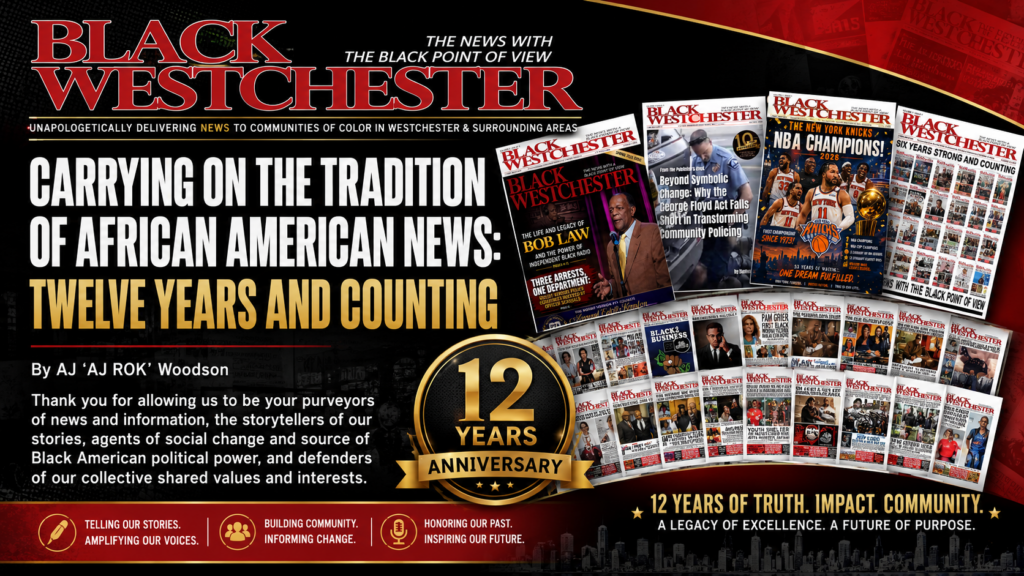




Carrying On the Tradition of African American News: Twelve Years and Counting
Celebrating Black Westchester’s twelfth anniversary gives me an opportunity to reflect on how we got here and to reintroduce ourselves to those discovering us for the first time—as well as those who may not have been riding with us for the entire journey. And to everyone who has supported us since day one, I paraphrase the words of the great African American poet Shawn Corey Carter: “Allow us to reintroduce ourselves…”
Over the past several years, many of you may have noticed that Black Westchester has devoted significant attention to the local political landscape. That work is important, but it represents only one part of who we are and what we have always done.
We take our responsibility as members of the Black press seriously because we understand the tradition we inherited. We stand on the shoulders of the pioneering African American newspapers that came before us—publications that informed their communities, challenged injustice, documented Black life and reported stories the mainstream press too often ignored, distorted or refused to tell.
That legacy stretches back to Freedom’s Journal, founded in 1827 by Samuel Cornish and John B. Russwurm as the nation’s first African American-owned and operated newspaper. It continued through institutions such as the Chicago Defender, the Detroit Tribune and the Pittsburgh Courier; through New York’s historic Amsterdam News; and locally through publications such as the Westchester Observer and the Westchester County Press.
These newspapers did much more than report the news of the day. They served as advocates, historians, watchdogs and trusted voices for Black communities. They celebrated our achievements, exposed injustice, challenged those in power, and preserved stories that might otherwise have been erased.
Black Westchester understands the importance of carrying that mission forward. Whether we are covering politics, education, criminal justice, business, health, sports, entertainment, faith, or community affairs, our purpose remains the same: to document what is happening around us and provide the news through a perspective rooted in the experiences, concerns, and aspirations of the Black community.
We understand the Black press is a critical—but often ignored—aspect of African-American history and culture. Along with churches, political and service organizations, cultural institutions, and schools and universities, the Black press has been central to community formation, protest and advocacy, education and literacy, and economic self-sufficiency. Since the earliest known black-owned and published newspaper, like the Freedom’s Journal, the black press has provided a public sphere for an aggrieved community barred from mainstream channels of discourse. These publications disseminated African-Americans’ ideas, accomplishments, and cultural products within their communities and to the rest of the world.
African American journalism has always served a dual purpose: reporting the news and helping transform the conditions affecting Black communities. The Black press has never functioned solely as a distributor of information. It has also been an advocate, organizer, watchdog and agent of social change.
For nearly two centuries, Black newspapers have been a vital source of African American political power—informing readers, shaping public opinion, challenging injustice and holding elected officials and institutions accountable. Even at their most commercially successful, these publications have remained defenders of our shared values, interests and collective well-being.
That tradition reminds us that journalism does not have to abandon objectivity to recognize injustice or remain silent in the name of neutrality. The Black press has always understood that accurately documenting inequality, amplifying overlooked voices and demanding accountability are essential parts of telling the complete story.
The 1944 annual meeting of the National Negro Press Association adopted a “Credo for the Negro Press.” The Credo begins:
I Shall Be a Crusader…
I Shall Be an Advocate…
I Shall Be a Herald…
I Shall Be a Mirror and a Record…
Matthew F. Delmont wrote in his book titled “Black Quotidian: Everyday History In African-American Newspapers,” published by the Stanford University Press in 2019;
This special mission figures prominently in coverage of racial violence in the Black press. When Black newspapers reported on lynchings, police brutality, and other everyday acts of racial violence, they did not simply give an account of what transpired. Black reporters and editors urged local and federal authorities to defend the rights of Black people and to bring perpetrators to justice; they investigated criminal acts that law enforcement agencies either ignored or refused to probe; and they expressed outrage, on behalf of the Black community, that these acts of racial terror continued to take place in America. The Black press also recorded the names of victims, entering them into the historical record and leaving a paper trail of cases, some of which scholars, reporters, and lawyers are still trying to solve. African-American newspapers recorded murders that have become well known—such as the lynching of Emmett Till and the bombing of the 16th Street Baptist Church in Birmingham, killing four young girls, Addie Mae Collins, Denise McNair, Carole Robertson, and Cynthia Wesley—as well as lesser-known crimes that are no less disturbing, including the bombings of the homes of the Short family in Fontana, California, and the Moore family in Mims, Florida. It would have been possible to fill Black Quotidian with only examples of the daily racial terror Black people have fought against. I elected not to do this because I wanted to illustrate how joy and the threat of violence have always been part of the quotidian lives of Black people in America.
Black Westchester as a member of the National Association of Black Journalist, the New York Association of Black Journalist and the National Newspaper Publisher Association (NNPA) – inducted as an unofficial member by the organization’s President and CEO Dr. Benjamin Chavis when he appeared on Episode 297 of our weekly talk radio show People Before Politics Radio, Sunday, April 25, 2021 – we take this credo of African-American newspapers who came before us seriously as we carry on the tradition. Like Delmont, we also elect not just to give examples of the deadly consequences of being Black in America, but to illustrate and document how the threat of violence has always been part of the quotidian lives of Black people in the United States of America.
The NNPA’s Credo Of The Black Press reads;
The Black Press believes that America can best lead the world away from racial and national antagonisms when it accords to every person, regardless of race, color or creed, full human and legal rights. Hating no person, the Black Press strives to help every person in the firm belief that all are hurt as long as anyone is held back. Since World War II, it has also served as the industry’s news service, a position that it has held without peer or competitor since the Associated Negro Press dissolved by 1970.
The Black press has played a crucial role in the Fourth Estate since its inception in the early 19th century. In the early days, the Black press reported mainly on issues affecting the newly-formed African- American community and identity. African-American news organizations highlighted the challenges and triumphs of the Black community, while providing a more nuanced portrait of the lives of Black Americans when mainstream media would report predominantly negative or otherwise bigoted stories of Black Americans.
Covering events and celebrating African-American excellence like the Westchester County Press, but also realizing the need to be more radical at times like the Mount Vernon-based Westchester Observer. Ben Anderson’s motto was “Dedicated to Justice for All.” Ben Anderson wasn’t afraid to be an activist as well as accurately covering the movement of his time. Black Westchester tries to carry on the tradition of both Westchester Black Newspapers as we strive to inspire a new generation of truth-speakers.
Since our inception in 2014, Black Westchester has covered the movements, marches, and protests of the people while remaining at the forefront of the fight for freedom, justice, and equality.
We have stood beside families who lost loved ones at the hands of law enforcement, as well as those grieving victims of senseless gun violence committed by people who looked like them. We have given a platform to individuals who were wrongfully incarcerated, helping some tell their stories, regain their freedom, and ultimately clear their names.
Our reporting has also helped expose misconduct and abuse of power, contributing in some cases to officers being suspended, terminated or convicted. We have consistently held elected officials, community leaders and public institutions accountable—especially those who look like us and claim to represent us.
At times, our coverage has helped candidates gain the public’s trust and win office. In other cases, our reporting has contributed to voters deciding that certain officials no longer deserved to remain there.
That is the responsibility we accepted when we entered this work: not to protect personalities, political parties or institutions, but to serve the people, pursue the truth and demand accountability—no matter who is involved.
We have also made it a priority to shine a light on the unsung heroes and sheroes in our communities—the people who have been doing the work for years, often without recognition, headlines or public praise. By telling their stories, we hope not only to give them the acknowledgment they deserve, but also to encourage and inspire a new generation of truth-tellers, organizers, advocates and activists.
This journey has been a labor of love. At times, it has come without the support of some of the very people we have worked to educate, inform, and uplift. Still, we remain committed because we understand the role Black Westchester plays in our community and throughout the surrounding region.
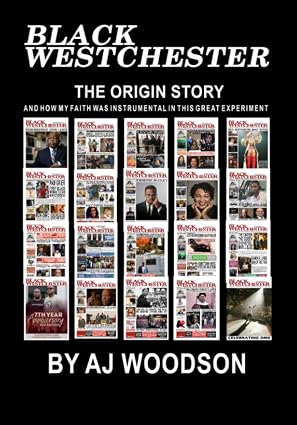
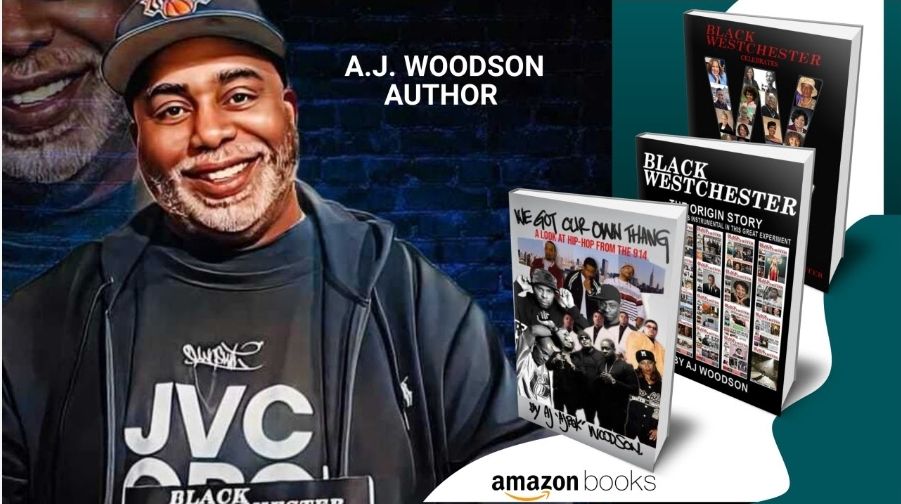
As we approach our twelfth anniversary and mark the occasion, I remember the final chapter of my first book, “Black Westchester – The Origin Story: And How My Faith Was Instrumental In This Great Experiment.” With the current political climate and attack of the media, I felt it was important to reshare this here and now!
We welcome those who have supported us from the beginning and those who are only now discovering our work. Together, we share the Credo of Black Westchester as we continue carrying forward the proud tradition of the African American newspapers that came before us.
At the request of my sister Nicole, I watched a video of Trevor Noah at the 2022 White House Correspondents’ Dinner; she knew it would inspire me. He ended with a challenge to the press.
“As we sit here tonight, people, I really hope you remember what the real purpose of this evening is really about… The reason we’re here is to honor and celebrate the Fourth Estate and what you stand for. An additional check and balance that holds power to account and gives voice to those who otherwise wouldn’t have one. I’m not just talking about the CNNs, Fox, or any other major organizations; I’m talking about everyone, including the local media who are not in this room. Every single one of you, whether you like it or not, is a bastion of democracy. If you ever begin to doubt your responsibilities, if you ever begin to doubt how meaningful it is, look no further than what’s happening in Ukraine. Look what’s happening there. Journalists are risking and even losing their lives to show the world what’s really happening.
You realize how amazing it is? America, you have the right to seek the truth and to speak the truth, even if that makes people in power uncomfortable. Even if it makes your viewers and your readers uncomfortable, you understand how amazing that is? I stood here tonight and made fun of the President of the United States, and I’m going to be fine… Do you understand what a blessing that is? Maybe it’s happened for so long, it might slip your mind. It is a blessing. If fact, ask yourself this question. If Russian journalists who are losing their livelihoods and freedom for daring to report on what their own government is doing, if they had the freedom to write any words, to show any stories, to ask questions? If they basically had what you have, would they be using it the same way you do? Ask yourself that question every day, because you have one of the most important roles in the world.”
My sister, as she so often is, was exactly right. Her words inspired me, and that is why I ended the book—and will end here—by saying this:
Thank you for allowing us to be your purveyors of news and information, the storytellers of our stories, agents of social change, a source of Black American political power, and defenders of our shared values and collective interests.
We understand the responsibility that comes with that role, and we remain committed to working as hard as possible to uphold it. We cannot promise that we will always do the work exactly the way everyone believes we should. We will make mistakes. We will face criticism. We will sometimes take positions that make people uncomfortable. But we can promise that we will always give our best effort, remain true to our mission, and never stop fighting to tell the stories that matter.
We understand the assignment.
No—we overstand the assignment.
And as long as Black Westchester has a voice, we will continue unapologetically delivering The News With The Black Point Of View!
Since 2014, Black Westchester has proudly delivered The News With The Black Point of View to our community free of charge. For nearly 12 years, we have remained committed to providing independent, community-focused journalism through our website, newspaper, and radio show without placing our content behind a paywall.
Unlike many media outlets that require subscriptions to access important news and information, Black Westchester remains free and accessible to everyone. We are unbought, unbossed, and truly independent. However, we could not have accomplished all we have over the years without the support of advertisers, donors, and community partners like you.
As we begin work on our upcoming 12th Anniversary Issue, we are reaching out to invite you to support Black Westchester by:
- Advertising your business, organization, event, or service
- Purchasing a congratulatory ad recognizing our anniversary
- Making a donation to help sustain independent Black media in Westchester County and beyond
Your support helps us continue to provide quality journalism, amplify underrepresented voices, and keep our content free for the community.
The deadline to advertise in our 12th Anniversary Issue is Friday, July 31, 2026, but we encourage you not to wait until the last minute. We also offer discounted advertising packages for businesses and organizations interested in 3-month, 6-month, and 12-month advertising opportunities. Email BlackWestchesterMag@gmail.com for ad rates or to donate in celebration of our 12th anniversary.