


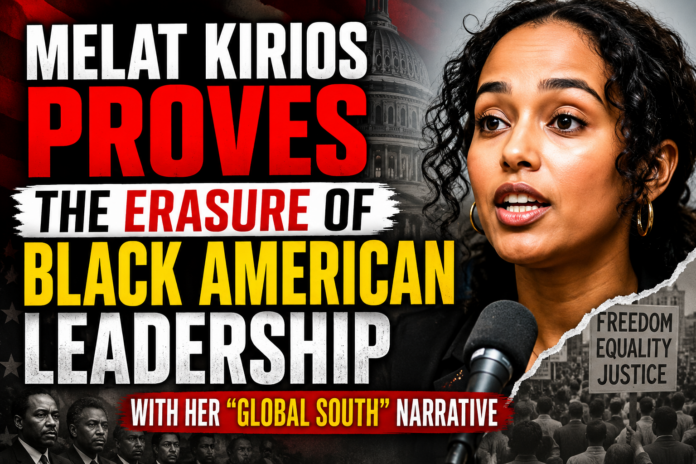




Melat Kiros, the Democratic Socialists of America-backed nominee for Colorado’s 1st Congressional District, recently told a Tigrayan diaspora audience:
“The responsibility that we have as Americans… is only going to be challenged if we are getting represented by people who understand that on a fundamental level. And that means getting more immigrants into office. That means getting more people who have heritage in the global south into office because that’s where those decisions are made specifically.”
She was not talking about housing, jobs, schools, or safety in Denver’s Black neighborhoods. She was talking about reshaping America’s role in the “global world order” by placing more people from other countries—people not born in America, and not even Black Americans—into elected office. Her call for more immigrants and more people with “heritage in the global south” in leadership treats native-born Black Americans as secondary. That framing is not neutral. It systematically erases the Black American struggle that produced the very rights immigrants exercise the moment they arrive.
Notice the language itself. Kiros frames this as “the responsibility that we have as Americans.” According to her, the duty of Americans is to vote more immigrants into office. That does not even sound right. A nation’s political responsibility is first to its own citizens and the communities that built and sustained it—not to prioritize people born elsewhere as the solution to its problems.
The 13th, 14th, and 15th Amendments were not abstract gifts from the international community. They were the hard-won constitutional results of the Civil War and Reconstruction, secured by Black freedmen and women in the South who organized, voted under threat, and paid in blood. The long fight against Jim Crow—court cases, boycotts, marches, and federal legislation—expanded and enforced those rights against determined resistance. Later immigrants, including those from Africa, Latin America, and Asia, stepped into a rights architecture that Black Americans had already forced into existence. They did not have to invent equal protection, due process, or the franchise. Those tools were already there because earlier generations of Black people refused to accept less.
Kiros’s “global south” lens treats that history as background noise. Her solution is demographic: more immigrants and people with heritage from the developing world in office so America can be challenged for its “exploitative and extractive nature” on the global stage. The specific American Black experience—slavery, Reconstruction, Jim Crow, and the unfinished work of ownership, family stability, and economic circulation—disappears inside a broader international category. The people who built the rights regime are reduced to one more group of “people of color” rather than a people with a distinct history and a distinct set of unfinished business inside the United States.
The same worldview shows up in her call to abolish ICE. When the central political project is challenging America’s “exploitative” global role and elevating people with heritage from the global south, the domestic enforcement agency that controls borders and removals becomes an obvious target. Abolishing ICE is presented as solidarity with migrants rather than as a policy that must be weighed against its effects on wages, neighborhood safety, and the social fabric of the communities already living in places like Denver. Once again, the particular interests and hard-won institutional achievements of Black Americans are not the measure. The global framing is.
This is not an argument against immigration or against any individual’s right to run for office. It is a refusal to pretend that all histories are interchangeable. Many of the countries grouped under “global south” still lack the enforceable protections for speech, assembly, property, and political participation that Black Americans forced into American law. People leave those places, in part, because the rights environment is weaker. When political leaders treat “heritage in the global south” as the primary credential for challenging America, they skip past the reality that the strongest rights framework on the continent was built by Black Americans under far harsher conditions than most of those origin countries have ever imposed on their own citizens.
We see versions of this pattern repeatedly in progressive and DSA-aligned discourse. The particular Black American struggle is folded into “BIPOC,” “global majority,” or “global south” solidarity. International grievances take priority over domestic outcomes. Representation by recent arrivals or diaspora identity is presented as progress, while the metrics that actually determine whether Black communities advance—business ownership, family structure, neighborhood safety, education that produces skills instead of debt—receive less attention. The result is a politics that can sound radical while remaining silent on the concrete conditions inside Black America.
Black communities do not need their history subordinated to a global narrative that treats the United States primarily as an extractive force and treats Black Americans as interchangeable with recent immigrants from the developing world. The rights that make political participation possible were not free. They were extracted through sacrifice by people whose descendants still live with the consequences of that history. Any serious politics that claims to speak for justice should begin by recognizing that fact rather than erasing it.
Kiros is free to pursue her internationalist vision. Black America is free to insist that its particular struggle, its particular achievements, and its particular unfinished work will not be dissolved into someone else’s global category. The two are not the same project. Pretending they are is not solidarity. It is erasure.