



Nearly 76% of nonprofit and community workers report experiencing severe burnout, while mental health researchers increasingly point to “moral trauma” as one of the hidden emotional costs of justice work.
And honestly?
“Moral trauma” probably explains what many people in restorative justice spaces are actually feeling better than burnout ever could.
Because burnout sounds temporary.
Burnout sounds like vacation days and sleep.
Moral trauma sounds like what happens when your spirit gets exhausted from witnessing too much pain while still being expected to function like nothing is happening.
And if you’ve spent enough time inside restorative justice spaces across New York, from the Bronx to Yonkers, Mount Vernon to Brooklyn, Harlem to New Rochelle, you already know exactly what that feels like.
Because this isn’t just about being tired.
This is about being emotionally overloaded while constantly expected to hold everybody else together.
And New York creates a very specific kind of nervous system pressure.
This city rewards survival mode.
People wear exhaustion like designer fashion here.
In New York healing spaces, people facilitate trauma circles all day, answer crisis calls all night, hold community pain for entire neighborhoods, and still show up to events pretending they’re “good.” Meanwhile their nervous system has been in emergency mode for months.
That’s not simply burnout anymore.
That’s moral trauma.
Moral trauma happens when compassionate people repeatedly witness violence, injustice, grief, addiction, incarceration, poverty, and systemic failure while feeling emotionally responsible for helping everybody survive it.
And restorative justice spaces across New York are full of people carrying exactly that weight.
It’s the Bronx mentor trying to save teenagers from systems that already decided who they’re allowed to become.
It’s the Mount Vernon organizer answering emotional emergencies at midnight while privately struggling with anxiety themselves.
It’s the Harlem healer pouring energy into everybody else’s restoration while secretly feeling emotionally numb.
It’s the Yonkers advocate facilitating peace circles while their own nervous system hasn’t experienced peace in years.
And because New York culture glorifies hustle, hyper-independence, and resilience, many people don’t even realize they’re depleted until their body physically forces them to stop.
Suddenly:
- Your chest stays tight constantly.
- Text messages feel emotionally overwhelming.
- You’re exhausted even after sleeping.
- Rest feels uncomfortable.
- Joy feels unfamiliar.
- Small conflicts feel emotionally catastrophic.
- Your body feels alert even when nothing dangerous is happening.
That’s what chronic nervous system activation looks like.
And honestly?
A lot of people stay overly invested in everybody else’s problems because it feels safer than paying attention to themselves.
Because healing requires stillness.
Self-awareness requires honesty.
And both of those things can feel terrifying when your nervous system has spent years surviving instead of resting.
It actually takes an enormous amount of energy to avoid yourself.
To constantly stay busy.
To always answer everybody’s crisis calls.
To over-function in community spaces.
To become the “strong one” for everybody else while quietly neglecting your own emotional needs.
Sometimes taking on everybody else’s pain becomes a distraction from your own.
And restorative justice spaces attract deeply compassionate people, but compassion without boundaries can quietly turn into self-abandonment.
A lot of healers know how to hold space for others but panic when they finally have to sit alone with themselves in silence. Because once the meetings end, once the organizing slows down, once the community emergencies stop for five minutes, there’s often grief, exhaustion, anger, loneliness, and nervous system dysregulation waiting underneath all the movement.
That’s why rest can feel uncomfortable for so many people in justice work.
Stillness forces truth to rise.
And truthfully?
Some people aren’t burned out from doing too little.
They’re emotionally overwhelmed from spending years disconnected from themselves while constantly rescuing everybody else.
Healing is not only learning how to help people.
Healing is learning how to come back home to yourself too.
And let’s tell another truth nobody says enough inside movement spaces:
You cannot build sustainable healing from a permanently dysregulated nervous system.
Healing work requires regulated people too.
Not perfect people.
Not endlessly available people.
Regulated people.
And part of that regulation is learning how to build nervous system capacity.
Not just calming yourself down temporarily.
Actually expanding your body’s ability to experience stress, emotion, conflict, uncertainty, grief, and responsibility without immediately collapsing into survival mode.
Because a lot of people in restorative justice spaces think healing means becoming emotionless. It doesn’t. Healing means your nervous system can stay present without shutting down, exploding, dissociating, over-functioning, or abandoning yourself emotionally every time life becomes overwhelming.
That’s capacity.
And honestly, many Black and Brown communities across New York are carrying nervous systems shaped by generations of survival. Hypervigilance. Hustle culture. Emotional suppression. Constant adaptation. We inherited coping mechanisms that helped people survive systems designed to exhaust them.
But survival patterns eventually become stored inside the body.
That’s why certain environments, smells, tones of voice, conflicts, abandonment, instability, or even silence can trigger reactions that feel bigger than the present moment itself. Sometimes your nervous system isn’t only responding to today. It’s responding to accumulated memory.
And this is where conversations around quantum memory become deeply important in healing spaces.
Quantum memory explores the idea that emotional experiences, trauma patterns, survival responses, and energetic imprints can remain stored within the body and subconscious in ways that move beyond linear thinking. Whether people understand that spiritually, scientifically, ancestrally, or emotionally, many healers already recognize the body remembers what the mind tries to move past.
Anybody who has ever felt anxiety in a safe room, panic during rest, grief with no immediate explanation, or emotional exhaustion that feels older than the current moment already understands this intuitively.
The body carries memory.
And nervous system healing is not just about managing stress in the present. Sometimes it’s about teaching the body that safety is finally possible after years, sometimes generations, of bracing for harm.
That’s why building nervous system capacity matters so much in restorative justice work.
Because people cannot create sustainable peace externally while internally living in constant emotional emergency.
Capacity-building looks like:
- Learning how to stay grounded during conflict.
- Allowing yourself to rest without guilt.
- Practicing emotional regulation before crisis happens.
- Expanding your ability to experience joy without waiting for disaster afterward.
- Sitting still long enough for your body to recognize safety without immediately searching for danger.
That kind of healing changes communities too.
Because regulated people create different conversations.
Different relationships.
Different homes.
Different movements.
And honestly?
A lot of people don’t need more productivity tools.
They need nervous systems that no longer believe survival is the only way to exist.
So what does actual restoration look like for organizers, healers, mentors, restorative justice practitioners, and community leaders across New York?
Not performative self-care.
Not luxury wellness aesthetics.
Real nervous system repair.
1. Stop Carrying Every Emergency Inside Your Body
New York trains people to react immediately to everything. But every text, email, crisis, or conflict does not require your nervous system to enter panic mode. Pause before responding. Slow your breathing intentionally. Let your body know you are safe first.
2. Create Physical Rituals To Remove Emotional Residue
After emotionally heavy conversations, restorative circles, community meetings, or crisis intervention:
- Wash your hands with cold water intentionally.
- Change clothes when you get home.
- Sit in silence before scrolling social media.
- Stretch your shoulders, jaw, and neck.
- Burn sage, palo santo, incense, or light candles if spiritual grounding practices resonate with you.
Your body needs help understanding the danger has passed.
3. Reconnect With New York Joy
Healing isn’t always isolation. Sometimes healing looks like:
- Summer nights walking the Bronx waterfront.
- Music playing from cookouts in Mount Vernon.
- Caribbean food spots in Flatbush.
- Sitting near the water in New Rochelle.
- Dancing at family functions.
- Laughing with people who don’t need emotional labor from you.
- Sitting quietly in front of the Enslaved Africans Rain Garden on the Yonkers riverfront for thirty minutes without answering anybody’s texts.
Just breathing.
Watching the water move.
Letting your nervous system remember that not every moment requires performance, productivity, or emotional labor.
Because places like that matter.
The rain garden itself carries deep historical energy and remembrance. The memorial sculpture created by acclaimed artist Vinnie Bagwell honors the lives and humanity of enslaved Africans whose labor helped build New York long before many communities are willing to fully acknowledge that truth.
Sitting near that space forces a different pace onto your body. Slower. More grounded. More honest.
And honestly, too many people in restorative justice spaces move through New York constantly overstimulated without ever permitting themselves to pause long enough to hear their own thoughts clearly.
The riverfront becomes a reminder that healing is not always loud.
Sometimes healing looks like stillness.
Sometimes healing looks like water.
Sometimes healing looks like finally sitting with yourself long enough to realize how exhausted you actually are.
And for people carrying moral trauma, moments like that are not small.
They’re nervous system medicine.
4. Stop Treating Rest Like A Reward
You do not have to collapse first to deserve restoration. Especially Black people in New York have been conditioned to believe rest must be earned through suffering. That mindset keeps nervous systems trapped in survival mode.
5. Practice Stillness Without Productivity
Not content creation.
Not multitasking.
Not “productive healing.”
Stillness.
Five quiet minutes of intentional breathing can interrupt stress cycles your body has normalized for years.
Organizations across New York are expanding restorative justice work because communities are desperate for healing-centered alternatives. But the movement cannot keep talking about restoring communities while ignoring the emotional depletion of the people doing the restoring.
That contradiction becomes part of the harm itself.
Because burnout might leave you exhausted.
But moral trauma disconnects people from joy, softness, safety, and eventually themselves.
And too many brilliant healers, organizers, educators, advocates, mentors, and restorative justice practitioners across New York are silently carrying emotional weight nobody sees.
You deserve restoration, too.
Not just survival.
Not just functionality.
Not just pushing through.
Real restoration.
And honestly?
You should not have to heal alone.
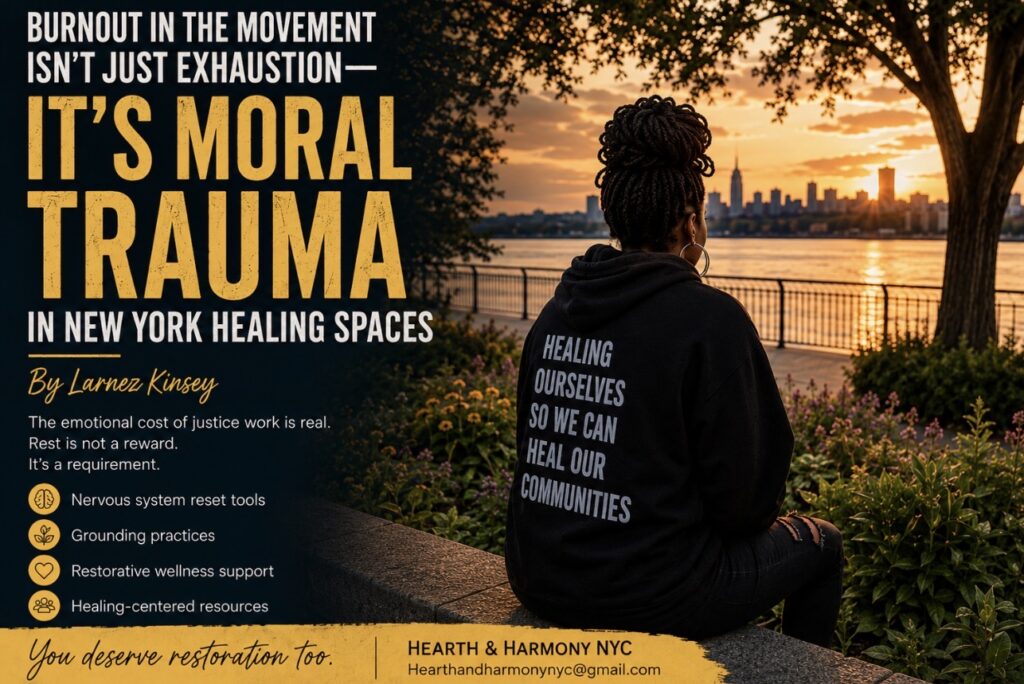
If this article resonated with you, if your nervous system feels exhausted, if you’ve been carrying community pain while quietly neglecting yourself, Hearth & Harmony NYC was created for people exactly like you.
Through nervous system reset tools, grounding practices, restorative wellness support, healing-centered conversations, and community care resources, the goal is simple: helping people reconnect with themselves before burnout turns into complete emotional disconnection.
Because regulated people change communities.
And healing yourself is not abandoning the movement.
It’s making sure you survive it.
For support, workshops, healing-centered resources, or restorative wellness guidance, contact: Hearth & Harmony NYC Hearthandharmonynyc@gmail.com