


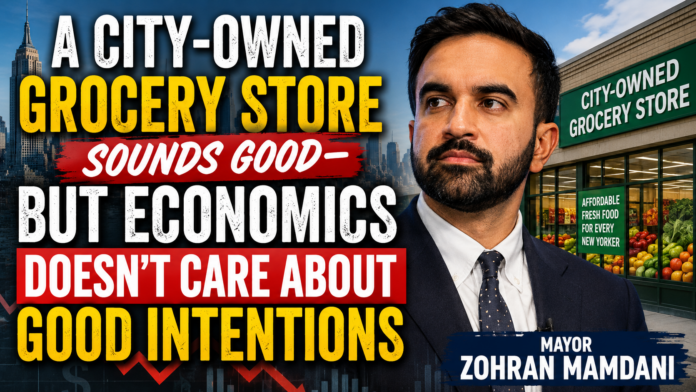





Let’s start with something we can all agree on. Every New Yorker wants lower grocery prices.
Food costs have climbed dramatically over the past several years, squeezing working families, seniors on fixed incomes, and many Black households already struggling with the rising cost of living. Any proposal that promises to make groceries more affordable deserves serious consideration.
That is why Mayor Zohran Mamdani’s plan to open city-owned grocery stores selling food 30 percent below retail prices has captured so much attention. On its face, it sounds like an innovative solution to a real problem.
But public policy should be judged not only by its intentions, but by whether the economics actually work.
Good intentions alone do not pay wholesalers. They do not cover payroll, refrigeration, transportation, utilities, insurance, inventory losses, or the countless operating costs of running a grocery business.
The question isn’t whether New Yorkers deserve lower grocery prices—they do.
The question is whether a city can sustainably sell groceries 30 percent below market prices without creating an ongoing financial burden for taxpayers or putting neighborhood grocery stores at a competitive disadvantage.
Before we celebrate the promise, we should understand the price.
Unlike many industries, grocery stores operate on razor-thin margins. Most supermarkets earn only 1 to 3 percent in net profit after paying for inventory, labor, utilities, transportation, refrigeration, insurance, maintenance, spoilage, and theft.
That raises a simple question:
If private grocery stores can barely make money selling food at today’s prices, how can a city-owned grocery store sell the same products 30 percent cheaper without someone absorbing the loss?
Government doesn’t receive groceries at a magical discount.
The city will still purchase food from wholesalers. It will still pay employees, maintain buildings, cover utility costs, replace spoiled inventory, and manage one of the most logistically demanding businesses in the country.
If the city has discovered a business model that allows groceries to be sold at 30 percent below market prices while remaining financially sustainable, it should publish it. Economists, retailers, taxpayers, and small business owners deserve to see how the numbers work.
Supporters often point to municipally owned grocery stores in other parts of the country as proof that government can successfully operate grocery stores.
But the comparison is misleading.
The most successful examples are found in small rural towns like St. Paul, Kansas, where the community had lost its only grocery store. The city’s goal was not to beat private businesses on price. It was simply to make sure residents had access to groceries at all. In a town of only a few hundred people, residents supported the store because the alternative was driving many miles for necessities.
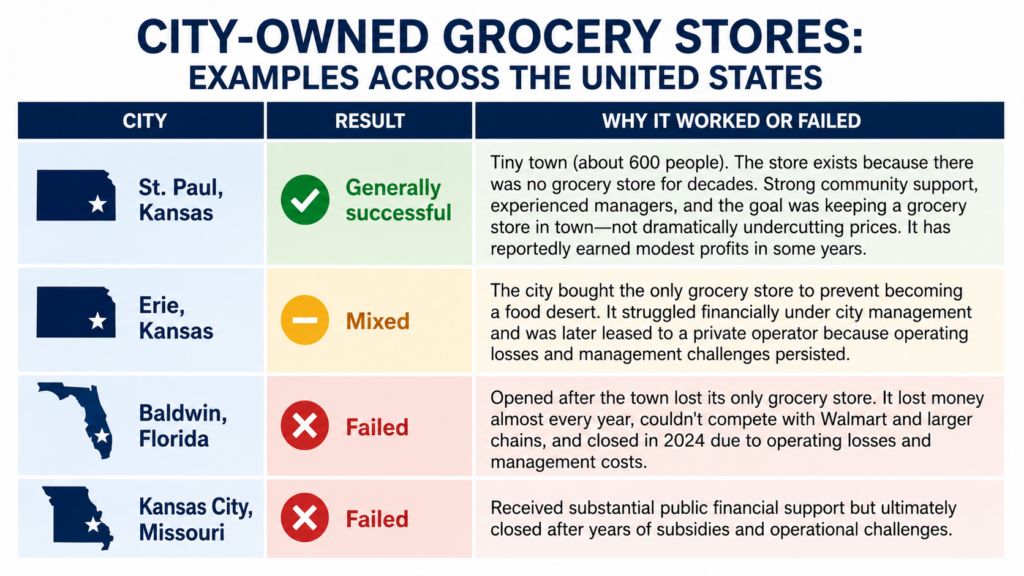
Other municipal grocery stores have struggled or failed. Communities such as Baldwin, Florida, and Erie, Kansas, experienced years of operating losses, management challenges, or eventually turned operations over to private management after the economics proved difficult. These examples demonstrate just how challenging the grocery business can be—even on a much smaller scale.
New York City is an entirely different situation.
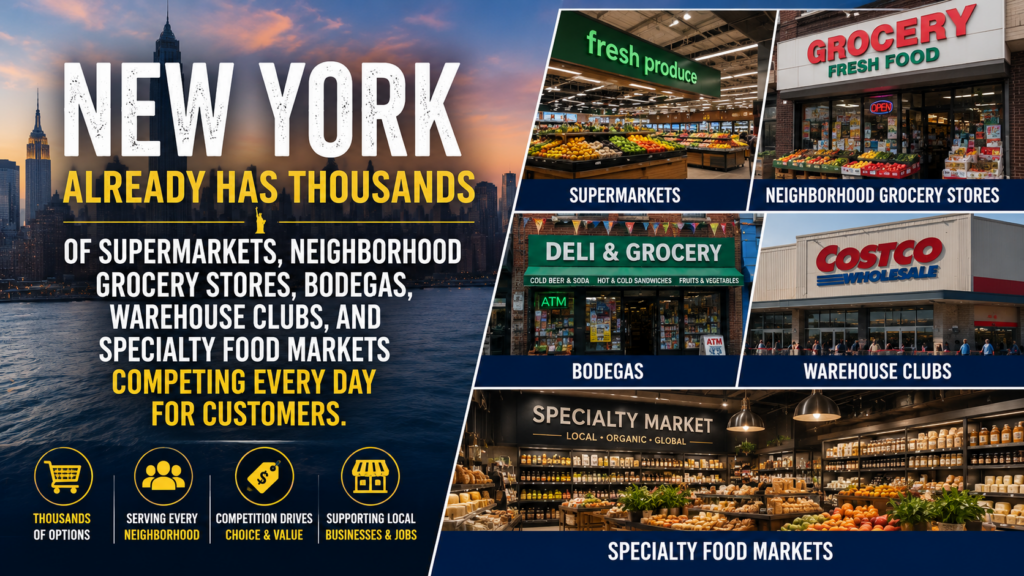
This isn’t a rural food desert with no grocery options. New York already has thousands of supermarkets, neighborhood grocery stores, bodegas, warehouse clubs, and specialty food markets competing for customers every day.
The proposal is not simply to provide access to food where none exists.
It is to have government compete in an existing marketplace while selling groceries at prices 30 percent below retail.
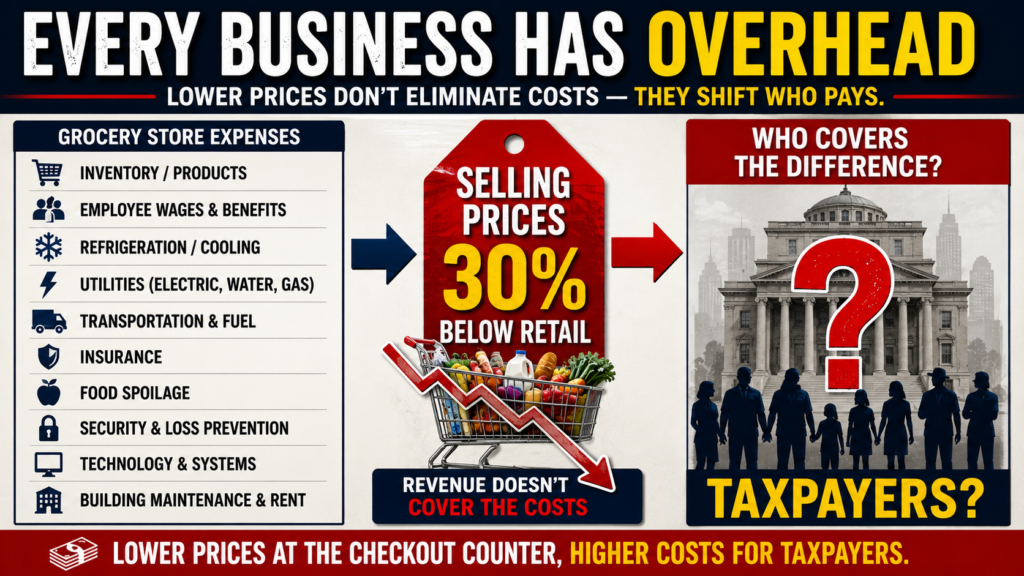
Running a business by selling products 30 percent below market prices may sound like a win for consumers, but the economics raise an unavoidable question: Who pays the overhead? Every grocery store—whether privately owned or government-run—must pay for inventory, employee wages, utilities, refrigeration, insurance, transportation, maintenance, technology, spoilage, and theft. Those costs do not disappear simply because the city owns the business. If the revenue from selling groceries at significantly reduced prices is not enough to cover those expenses, the shortfall must be made up elsewhere. In a government-owned operation, that burden typically falls on taxpayers through subsidies or public funding. In other words, while shoppers may save money at the checkout counter, taxpayers could ultimately be paying the operating costs behind the scenes. The question is not whether lower grocery prices are desirable—they certainly are. The question is whether a business can sustainably sell products 30 percent below market prices without shifting the true cost from the customer to the taxpayer.
That raises another important question.
What happens to the neighborhood grocery stores and family-owned supermarkets that cannot rely on taxpayer funding to offset losses?
Many of these businesses already operate on extremely thin margins while paying some of the highest commercial rents, labor costs, insurance premiums, and taxes in the country. If government becomes a subsidized competitor, some private stores may lose customers, reduce staff, or eventually close.
Every business has overhead, regardless of who owns it. A grocery store must pay for inventory, employee wages, refrigeration, utilities, transportation, insurance, maintenance, security, and food spoilage before it can ever make a profit. Those costs do not disappear because the government operates the store. If groceries are sold 30 percent below retail prices and the revenue generated is not enough to cover these operating expenses, the difference must be paid from another source. In the private sector, the business owner absorbs the loss. In a government-owned grocery store, that burden typically falls on taxpayers through public subsidies. Lower prices at the checkout counter may provide immediate relief for shoppers, but they do not eliminate the true cost of running the business—they simply shift who ultimately pays the overhead.
That would hardly strengthen neighborhood economies.
None of this means government should ignore food affordability.
Far from it.
The city should absolutely look for ways to reduce grocery costs. It could reduce unnecessary regulations, improve public safety along commercial corridors, lower the cost of doing business, encourage more competition, expand targeted nutrition assistance, or partner with existing neighborhood grocery stores rather than compete against them.
Those are conversations worth having.
But promising groceries at 30 percent below retail without fully explaining the long-term financial model risks creating expectations that may be unsustainable.
Economics is not partisan.
Whether you’re a Democrat, Republican, Socialist, or Independent, every business must eventually answer the same question: Will revenues cover expenses?
If they don’t, someone else pays the difference.
Government cannot suspend the laws of economics.
Good intentions are admirable.
Sound economics are essential.
Before New Yorkers embrace this proposal, they deserve more than a slogan. They deserve a transparent business plan that explains exactly how these stores will operate, who pays if they lose money, and whether this model can truly succeed in the most expensive city in America.
Because in the end, good intentions don’t balance budgets.
Economics does.