




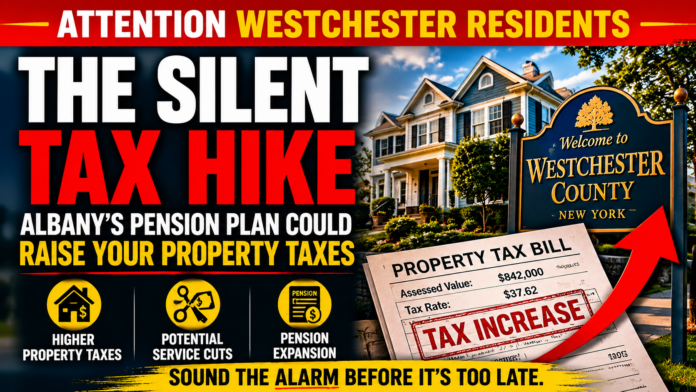





No press conferences are warning you. No headlines telling you to prepare. No elected official standing in front of a camera saying your cost of living is about to rise again.
But make no mistake, that is exactly what is being set in motion.
A proposal coming out of Albany, tied to the New York State and Local Retirement System, would expand pension benefits by allowing earlier retirement and reducing worker contributions, while maintaining guaranteed payouts. On paper, it sounds like a benefit for public workers. In reality, it is a long-term financial obligation that does not disappear. It simply shifts.
And in counties like Westchester County, that shift has a predictable destination. It lands on the taxpayer.
Pensions are not abstract policy ideas. They are contractual guarantees backed by law. When benefits increase and contributions decrease, the system does not absorb the difference through goodwill or efficiency. It absorbs it through money. If the money does not come from workers, it must come from the government. And if it comes from the government, it comes from you.
This is not speculation. It is arithmetic.
If a worker retires earlier, the system pays out for a longer period. If a worker contributes less, the system collects less. If investment returns fail to close the gap, taxpayers must do so. That is how the system is structured. There is no alternative mechanism waiting in the background.
What many residents do not realize is how directly this affects their tax bill. When pension costs rise under the New York State and Local Retirement System, local governments in places like Westchester County are required to increase their annual contributions. Property taxes primarily fund those contributions. That means when the pension bill goes up, your property tax bill is not far behind. Homeowners will see it directly, while renters will feel it through higher rents as landlords pass along those costs. Unlike discretionary spending, pensions cannot be cut or delayed, so the burden has to be absorbed somewhere in the budget. In practical terms, that leaves local officials with limited options, and raising taxes becomes the most immediate and reliable solution.
Westchester residents should be especially concerned because this is not a county with financial flexibility. Property taxes here are already among the highest in the nation. Housing costs are driving out both the middle class and the upwardly mobile. Local governments are already balancing rising payrolls, infrastructure needs, and public safety demands within tight budgets.
So the question is not whether this proposal is well-intentioned. The question is what happens when the bill comes due.
There are only three outcomes, and none of them are theoretical.
The first is higher property taxes. That burden falls directly on homeowners and indirectly on renters, as landlords pass costs through higher rents. In a county already struggling with affordability, this is not a minor adjustment. It is another push toward displacement.
The second is service reduction. When pension obligations rise, they compete with other budgetary priorities. That means fewer resources for schools, delayed road repairs, reduced sanitation services, and increased strain on public safety departments. The government does not operate on unlimited funds. Every dollar has a trade-off.
The third is financial deferral. Governments borrow, restructure, or push costs into the future. This may soften the immediate impact, but it guarantees a larger problem later. Deferred costs do not disappear. They compound.
These are not ideological arguments. They are the mechanical outcomes of how pension systems operate.
What makes this moment particularly dangerous is that it is happening quietly, layered on top of an already fragile economic environment. New York has been losing residents for years. Businesses are relocating. High earners, who carry a disproportionate share of the tax burden, are leaving for states with lower costs and fewer obligations. When that base shrinks, the remaining taxpayers are forced to carry more of the burden.
That is the part policymakers rarely address.
It is easy to expand benefits in isolation. It is much harder to sustain them in a system where the funding base is eroding. The risk is not immediate collapse. The risk is slow erosion. Higher taxes, fewer services, and continued outmigration all feed into each other.
Westchester cannot afford to ignore this pattern.
This is not about opposing public workers. It is about understanding the full cost of policy decisions before they are made. A system that promises more than it can sustainably fund does not create stability. It creates pressure. And that pressure does not stay in Albany. It shows up in your tax bill, your rent, your services, and your community.
Residents should be asking simple, direct questions. How will this be funded? What are the projected long-term costs? What happens if investment returns fall short? And most importantly, who pays the difference?
Because someone always does.
If those questions are not answered clearly and honestly, then the outcome is already predictable. Westchester residents will not hear about this proposal when it is passed. They will feel it later, when the numbers change, and the bills arrive.
By then, it will not be a debate. It will be a reality.


Great article EXCEPT the author failed in spelling out pertinent specifics. The NYS and Local retirement system sounds a bit broad based. Who is a part of this system? How many people? When will (if) this happen? Will there be a vote? Etc…