

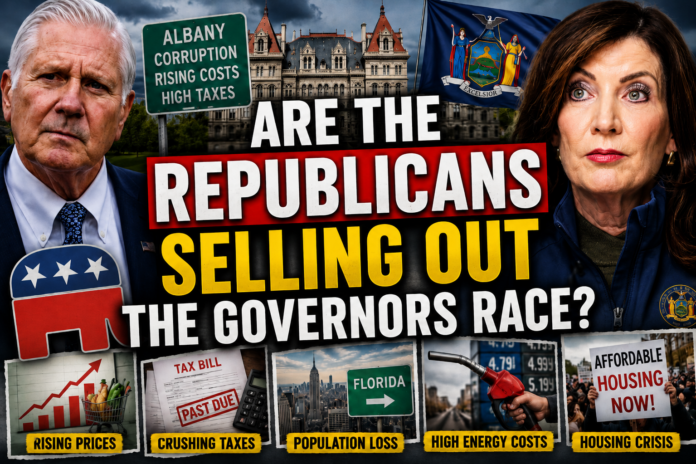




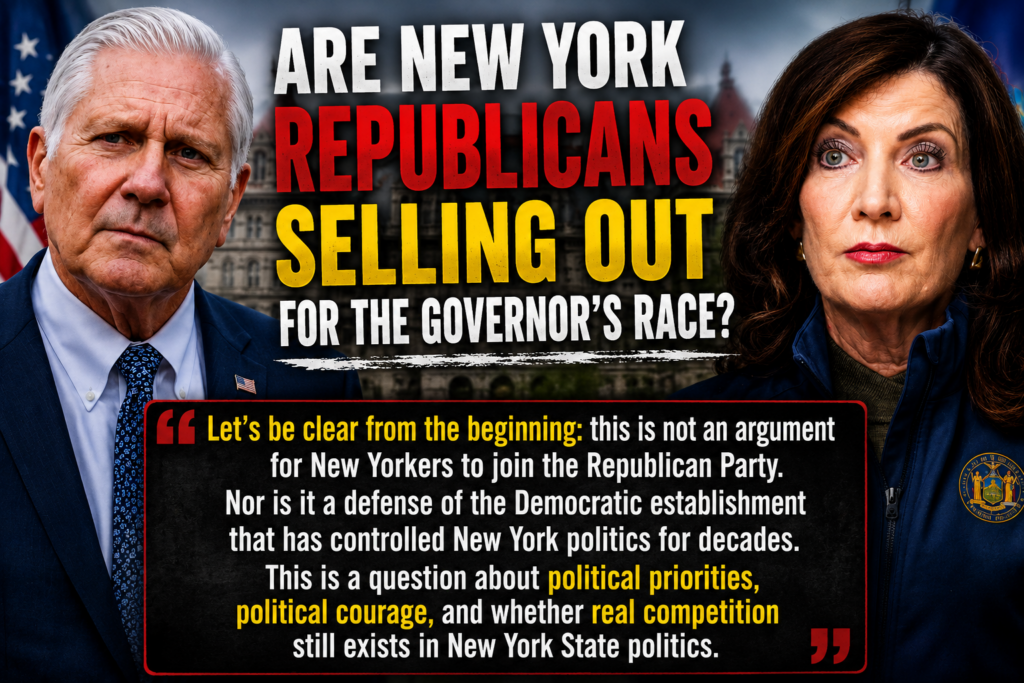
Let’s be clear from the beginning: this is not an argument for New Yorkers to join the Republican Party. Nor is it a defense of the Democratic establishment that has controlled New York politics for decades. This is a question about political priorities, political courage, and whether real competition still exists in New York State politics.
From the outside looking in, it increasingly appears that the New York Republican establishment may be sacrificing broader statewide engagement in exchange for a narrow strategy focused almost entirely on protecting select suburban seats over the governor’s race.
As a newspaper publisher, part of my responsibility is to examine political strategy, messaging, and outcomes objectively, regardless of party affiliation. From the outside looking in, it is difficult to identify a clear statewide strategy from New York Republicans that seriously challenges Democratic dominance beyond a few isolated suburban contests. That may work in the short term for Democrats because limited competition often benefits the party already in power. But the larger question is whether that is healthy for political balance, accountability, or the people of New York overall. One-party dominance, regardless of which party controls it, can eventually produce complacency, weak oversight, and a political culture in which voters are given fewer real choices and less meaningful debate about the state’s future direction.
And if that is true, then millions of New Yorkers—especially in urban communities—may feel overlooked and disconnected from the political conversation, highlighting the need for greater inclusion and representation.
Meanwhile, the real-life conditions facing working-class New Yorkers continue getting worse.
Prices continue rising across the board. Energy costs are climbing while the state pushes aggressive mandates without fully addressing affordability concerns for ordinary residents. Property taxes remain among the highest in the nation, especially in counties like Westchester. Rent continues increasing while pathways to homeownership shrink. Middle-class families are continuing to leave New York for states like Florida, Texas, Georgia, Tennessee, and the Carolinas in search of lower taxes, lower energy costs, economic opportunity, and a better quality of life.
At the same time, New York’s political climate increasingly appears hostile toward large-scale business investment and wealth creation. The continued attacks on high earners, corporations, developers, and major employers may satisfy political rhetoric, but they also create real economic consequences. When businesses scale back investment or relocate operations, the working class ultimately absorbs the damage through job losses, shrinking tax bases, rising costs, and declining economic opportunities.
And yet despite these realities, many New Yorkers see little evidence that Republicans have developed a serious, organized statewide plan to address any of it.
Instead, politics in New York increasingly revolves around one figure: Donald Trump.
Everything becomes about Trump. Every debate becomes filtered through Trump. Every political conversation becomes nationalized around Trump. Meanwhile, the daily realities affecting working-class New Yorkers receive far less sustained attention than political theater and partisan warfare.
The result is a political environment in which many Republicans spend more time reacting to Trump-related news cycles than in aggressively building issue-based coalitions around affordability, economic survival, energy policy, housing, education, infrastructure, workforce development, and the future of New York itself.
That is not a winning long-term strategy.
As the publisher and co-founder of Black Westchester Magazine and host of YouTube platforms that collectively reach more than 100,000 viewers monthly, I have personally seen this disconnect firsthand. Republican candidates and officials have been invited onto the platform to discuss these issues openly. With all the problems facing Albany and New York State, one would assume elected officials and party leadership would welcome opportunities to engage urban audiences and working-class voters directly.
But that has not been the case.
The lack of urgency is noticeable. The lack of outreach is noticeable. And the absence of consistent engagement with Black media platforms and independent community voices raises serious questions about whether the goal is truly statewide expansion—or simply maintaining a controlled political strategy centered around select regions and select voters.
Critical issues facing New York are not being debated with the urgency they deserve. The housing crisis continues, pushing families out of homeownership. Energy costs continue rising while long-term infrastructure concerns remain unresolved. Young people are entering an AI-driven economy with little public discussion about how to prepare them for the future workforce. Meanwhile, middle-class families continue leaving New York for Southern states in search of affordability, economic opportunity, and stability.
These are not small issues. These are defining issues.
This is not just about Black communities. It is about working-class New Yorkers across the board who feel ignored while the state continues moving in the wrong direction. That is how the political sellout works. Just enough visibility for a newspaper headline here and there, a few press conferences, a few carefully staged appearances, but no real substance, no serious statewide strategy, and no long-term commitment to changing the conditions people are actually living under.
If Republicans and conservatives truly believe New York is suffering from failed leadership, then where is the aggressive outreach to all the communities being crushed by taxes, unaffordable housing, population loss, economic decline, and public frustration? Where is the consistent presence in neighborhoods that politicians usually only visit during election season? Instead, much of the effort feels performative rather than transformational. Enough activity to create the appearance of opposition, but not enough to build a serious movement capable of competing statewide or changing the political direction of New York.
That approach may make sense to consultants focused on short-term math. But it also creates a dangerous long-term outcome: millions of voters increasingly believe nobody is seriously competing for them.
So the question becomes unavoidable: are New York Republicans truly trying to expand their coalition, or are they simply managing political positioning for the next governor’s race?
Recent election cycles have already demonstrated that Republicans can compete in New York when campaigns are disciplined, visible, and properly organized. Figures like Elise Stefanik have shown how aggressive messaging and consistent infrastructure can energize a base and create political momentum. Candidates like Michael Henry also demonstrated that there is space for challengers willing to confront the political establishment directly.
The blueprint exists.
But the current atmosphere suggests something different is happening inside New York politics. Instead of aggressive statewide expansion, many voters see caution, silence, and controlled messaging. That perception only deepens when independent or outsider voices struggle to gain traction within the political system.
Which raises another uncomfortable question: have the Republican and Democratic political elites in New York quietly reached an understanding—not ideologically, but structurally? Because when both major parties benefit from controlling ballot access, media exposure, donor networks, and institutional influence, independent movements and minor parties become threats to the system itself.
New Yorkers have seen versions of this before.
The collapse and takeover battles surrounding the Independence Party in places like Westchester County served as a warning about what can happen to alternative political structures once larger political interests move in. What began as a lane for voters outside the two-party establishment eventually became another example of how independent political energy can be absorbed, redirected, or neutralized.
That history matters today because many voters increasingly feel politically homeless.
Voices like Larry Sharpe have openly criticized the structural barriers facing independent candidates and alternative political movements. Whether voters agree with him or not, the broader issue remains: if the system only protects insiders, real political competition slowly disappears.
And the data suggests voters are noticing.
Recent polling from Siena College showed weakening support for Donald Trump in New York, including declines among Republicans themselves. The most important detail was not the Democratic opposition, which remains expected in New York. The key detail was that erosion appeared within the Republican base.
That matters because weakening enthusiasm inside a party usually signals something deeper than ideology. It often reflects frustration, disengagement, or lack of inspiration. In a healthy political environment, that kind of polling would trigger aggressive voter outreach, public debate, and renewed efforts to energize disconnected communities.
Instead, many New Yorkers see political maintenance rather than political competition.
Across the state—and increasingly across national politics—America is moving toward something dangerous: political environments where one party becomes so dominant that real competition begins disappearing. Whether it is Democrats dominating states like New York and California, or Republicans dominating states in other parts of the country, the long-term danger is the same. One-party political cultures eventually weaken accountability, discourage open debate, and create systems where political survival matters more than solving problems.
That should concern every American regardless of party affiliation.
The strength of the American republic was never supposed to come from permanent political domination. It was supposed to come from competition, checks and balances, and the constant pressure placed on leadership by opposing viewpoints and an engaged electorate. When one side believes it no longer has to compete seriously for voters, complacency and political arrogance often follow.
History shows this repeatedly.
When political systems become too insulated, voters eventually begin feeling unheard, disconnected, and powerless. Policies become shaped more by party loyalty, donor influence, and institutional protection than by outcomes for working-class citizens. Over time, frustration builds beneath the surface.
And the pendulum always swings back.
It may not happen immediately. It may take years. But American political history consistently shows that periods of one-party dominance eventually give rise to backlash movements, political realignments, and voter revolts. The danger is that by the time the pendulum swings, the economic and social damage may already be deeply rooted.
That is why healthy political competition matters.
Not because either party has all the answers, but because competition forces accountability. It forces debate. It forces leadership to defend results rather than rely on party identity and institutional power.
It is total hypocrisy for Hakeem Jeffries and other New York Democrats to challenge states like Florida or accuse Republicans elsewhere of trying to create one-party dominance when New York has operated under that model for decades. Congressional maps, political infrastructure, media influence, and institutional control have long favored Democratic dominance in this state. The outrage only seems to appear when other states begin using the same political hardball tactics New York normalized years ago.
Because once politicians stop fearing competition, the people often stop being the priority.
The issue is bigger than Trump. Bigger than Democrats versus Republicans. Bigger than one election cycle.
The real issue is whether New York still has a political culture willing to challenge failing policies and engage voters honestly and openly—or whether both parties have become more focused on preserving power than solving problems.
If Republicans are not doing anything visible to seriously challenge the conditions facing working-class New Yorkers—rising prices, crushing taxes, energy costs, housing affordability, population loss, and economic decline—then voters have a right to question whether the party is truly trying to change New York or preserve its position within the existing political system.
Because when voters stop believing anyone is seriously fighting for solutions, turnout drops, cynicism rises, and political machines grow stronger.
And that may be the greatest danger of all.
One-party rule is rarely healthy for the people, as power without serious competition often breeds complacency, corruption, and a lack of accountability. When politicians know their party is almost guaranteed to win, the pressure to perform begins to disappear. Government becomes more about protecting political allies, rewarding insiders, and maintaining control than delivering real outcomes for taxpayers. Nepotism grows because loyalty to the party becomes more important than competence. Public contracts, appointments, and leadership positions often circulate within the same political circles while the everyday concerns of citizens are ignored. Over time, public safety declines, infrastructure weakens, schools struggle, and financial mismanagement becomes normalized because there is no real political fear of losing power. Citizens should feel empowered to demand accountability and change, which is essential to inspire hope and active participation in governance.
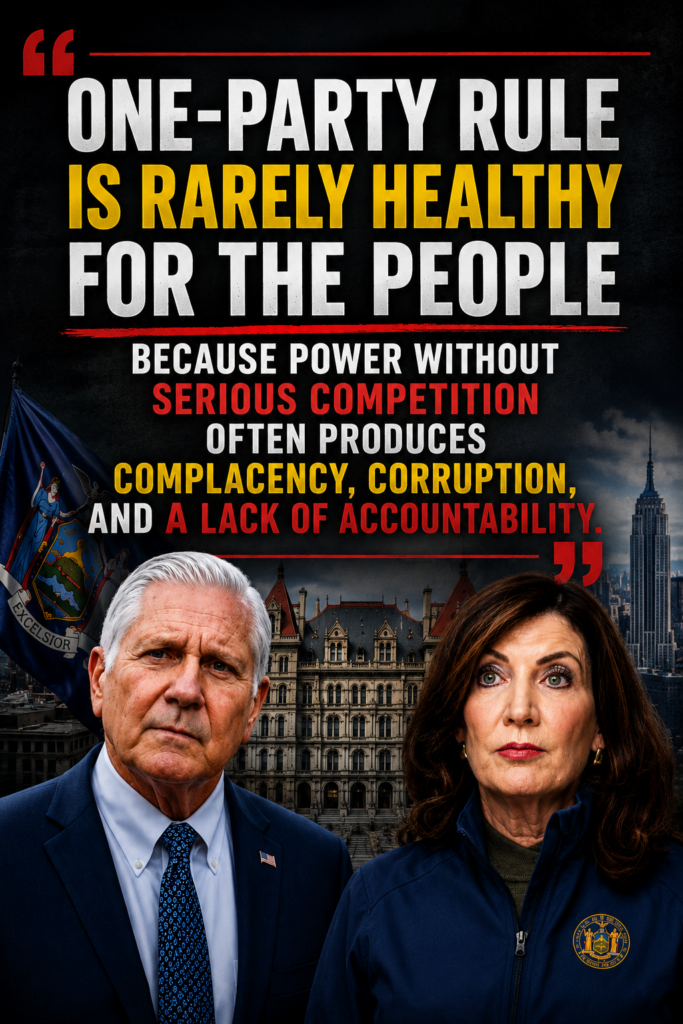
The danger is not simply about Democrats or Republicans. Any state dominated by one party for too long becomes vulnerable to arrogance and stagnation. The opposing party eventually stops serious competition because the state is viewed as politically unwinnable, turning the people into collateral damage of political imbalance. Meanwhile, taxpayers continue paying higher taxes while services decline and the quality of life deteriorates. Families and communities feel the weight of this decline, leading to frustration and disillusionment. When people are forced to confront this reality, emotions like concern and frustration grow, making the need for change more urgent. Citizens begin asking the most important question of all: Is the government actually improving the lives of the people who fund it?
New Yorkers are not demanding perfection. They are demanding competition, transparency, accountability, and leadership willing to engage difficult realities openly. If neither major party is prepared to provide that, then the appetite for independent movements, outsider coalitions, and political disruption will only continue to grow.
The electorate is watching carefully.