




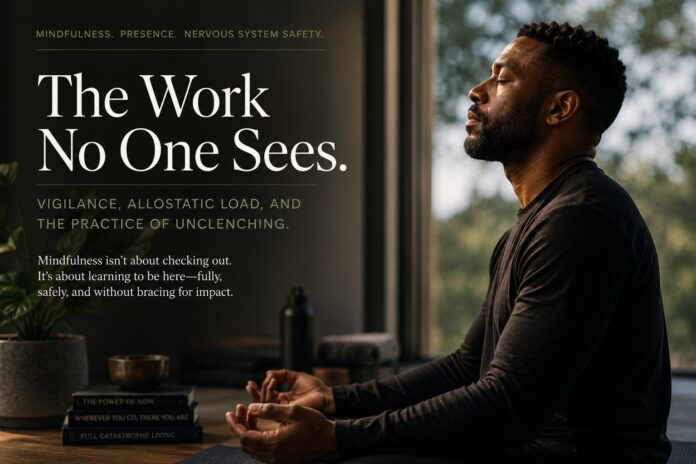





Before mindfulness can work, the nervous system has to feel safe.
A few years ago, I was sitting in an interdisciplinary meeting at a hospital when one of the senior attendings, a Black physician with years of clinical experience, asked a reasonable question about a treatment protocol. His question reflected the kind of care that comes from having been around long enough to know where systems tend to break down. The response from colleagues came back sharper than it needed to, and it wasn’t openly disrespectful, which is what makes moments like these difficult to explain sometimes. If you replayed the meeting later, some people probably wouldn’t notice anything at all. Sitting in the room, though, you could feel the shift immediately. There was less patience, no curiosity, and a sense that the question was unnecessary.
A few minutes later, another physician asked essentially the same question, and the tone in the room became more accepting and softened completely. The attending didn’t react outwardly. He nodded, leaned back slightly, and kept listening. Then a small thing happened that most people in the room missed. His right hand, resting next to his coffee cup, closed slowly into a loose fist and stayed there for the rest of the meeting. He took the rest of the conversation in through that fist.
Over the years, I’ve learned to pay attention to what happens physically when somebody absorbs a moment they don’t feel safe responding to honestly. The jaw tightens, breathing gets shallower, and a person grows quieter while still appearing composed. It’s a kind of sustained, low-level vigilance that never really lets go.
I’ve watched men walk into mindfulness sessions still carrying this posture, the careful, deliberate way you learn to hold yourself during a traffic stop, where hand placement and stillness are not abstractions. You can see it in the way their shoulders sit, how they place their hands where nobody can misunderstand them, the careful stillness they hold themselves in. The quality of that stillness has less to do with calm and more to do with staying careful. After a while, you recognize how much vigilance can resemble composure.
A lot of Black men become so accustomed to making these small adjustments throughout the day that the tension underneath them starts feeling normal. Monitoring tone becomes automatic. Some men rehearse how something will sound before they say it. Others learn to flatten visible frustration because confidence itself can be misread depending on the room. Many prepare carefully before entering spaces where they aren’t fully sure how their competence will be received.
The body adapts to that kind of vigilance even when the mind starts calling it professionalism.
By the time many men arrive in a mindfulness room, they aren’t arriving unfamiliar with awareness. Most have spent years tracking shifts in tone, posture, expression, interruption, and risk with extraordinary precision, and what often goes unrecognized is that this vigilance already reflects a form of sustained attention, even if it developed for protection rather than restoration.
That distinction matters clinically because mindfulness is often introduced as though the primary problem is distraction or disconnection. For many Black men, the issue is rarely a lack of attention but the burden of carrying too much of it for too long.
Research on social pain, including work led by Naomi Eisenberger at UCLA, has shown that the brain doesn’t separate dismissal from injury as cleanly as we once assumed. Most people imagine stress as one major event with a clear name attached to it: a confrontation, a loss, something traumatic. A nervous system can also wear down quietly through repeated moments of vigilance, restraint, anticipation, and self-monitoring that accumulate over years. Arline Geronimus has described this specifically in Black populations through what she calls weathering: the way chronic exposure to social stress shows up biologically as accelerated aging across the life course. The wear is real and measurable.
I see it in the office regularly. A patient sits down, agrees the chair is comfortable, and his shoulders stay near his ears for the first ten minutes anyway. He’s not anxious in the clinical sense. He’s just somebody whose body learned a long time ago that settling all the way down isn’t always available.
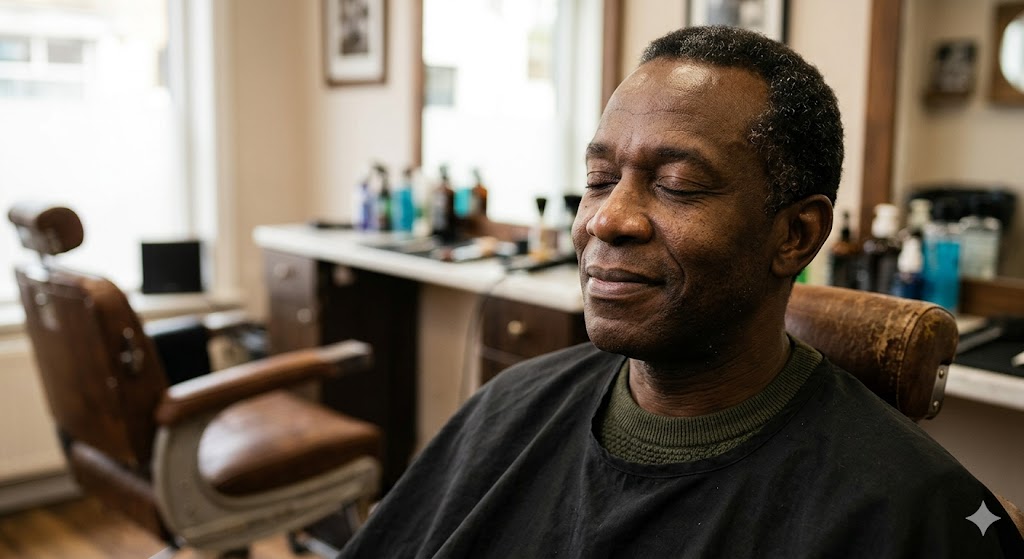
Outside the office, the same men relax in moments that barely register to anybody else. A barbershop chair. Sitting in the car for a few extra minutes before walking into the house after work. Some men I know call this the driveway pause, a small ritual of decompression between roles. The quiet after church lets out and nobody needs anything from them for a moment. Sometimes you realize a man has been carrying tension all day because you finally watch his shoulders come down.
Individually, these moments can seem small, but repeated over years, they teach the body to stay prepared even in places where a person wants to relax. Some men become extraordinarily skilled at functioning while carrying enormous amounts of tension underneath their performance.
Over time, the body adapts to that vigilance. Sleep becomes lighter, and breathing stays shallow longer, stress hormones remain elevated, blood vessels constrict more often, and blood pressure rises. The body becomes less efficient at recovery. Researchers refer to some of this accumulated wear and tear as allostatic load: a term developed by Bruce McEwen to describe what happens when the body stays prepared for stress longer than it was designed to.
What mindfulness can offer in this context isn’t denial so much as a brief interruption. A short lowering of the body’s guard before exhaustion becomes identity.
For many Black men, mindfulness isn’t about pretending the storm is gone but learning how to breathe inside it without allowing constant vigilance to consume the body carrying it. Becoming unaware isn’t the point, since awareness is often what helped them navigate difficult environments in the first place. The work is learning when the nervous system can safely ease its grip, even temporarily, so the body isn’t forced to carry every moment at full activation.
I know many men who keep going long after their bodies have started asking for relief. Myself included. Mindfulness, at least clinically, isn’t about removing somebody from the realities they face. Sometimes it’s simply the few minutes where the nervous system is allowed to stop gripping everything so tightly before returning to it again.
Something else worth saying out loud is that Black men have been practicing forms of this regulation for a long time without always calling it mindfulness. The hush that settles after a praise song in church. The third stanza of a hymn when a man finally lets his eyes close. A slow exhale in a barbershop chair where, for forty-five minutes, nobody is going to misread him. The father who sits quietly in his parked car after work before going inside, allowing himself a few still minutes between responsibilities. These are forms of regulation, too.
And the clinical literature did not invent stillness for us. Howard Thurman was writing about contemplative stillness as survival for the disinherited long before mindfulness-based stress reduction entered hospital protocols, and hush harbors during slavery were, among other things, rooms where breath itself had to be regulated quietly enough not to be heard. The tradition is older than the terminology.
What helps, in my experience, is mindfulness, therapy, and breathing exercises. I’ve watched all of them change people profoundly. What wellness culture sometimes misses is that people don’t enter these spaces with identical relationships to safety. You can’t ask a nervous system to settle while it still believes vigilance is necessary.
Some environments signal safety quickly. Others communicate evaluation just as quickly. Shoulders often register it before the mind does.
In my own work, athletes and executives have engaged deeply with mindfulness once trust was established, and others have become emotionally open once they no longer felt subtly judged, managed, or misread the moment they entered the room. What sometimes gets read as resistance in these rooms tends, in my experience, to be self-protection wearing a different name.
There is another layer that mindfulness spaces don’t always recognize. Many Black men enter these rooms already accustomed to being evaluated constantly, including emotionally, so even the language of “nonjudgment” can become complicated when somebody has spent years being judged in subtle ways before they have spoken at all. Some men quietly worry they are failing mindfulness if they cannot relax easily, cannot empty their thoughts, cannot settle their bodies on command, especially in front of people they don’t know or in unfamiliar settings. For somebody used to being evaluated constantly, even stillness can start to feel performative, and instead of feeling restored, they begin monitoring whether they are performing calm correctly.
Before the body settles, it looks for signs that it can safely unclench. Am I safe enough here?
Dignity in practice often looks ordinary: patience, eye contact, and being listened to without interruption. Not having your competence treated as surprising, or feeling pressure to constantly calculate how you are being perceived while trying to focus on the actual conversation in front of you. These moments seem small until you spend years watching what happens to the body when they are consistently absent.
The form this vigilance takes varies across upbringing, profession, temperament, and experience, but the underlying vigilance itself is something I have encountered repeatedly. Many of the men I know developed extraordinary observational discipline because they had to, and the cost comes when vigilance stays switched on long after the moment requiring it has passed.
As a performance psychiatrist, I have become less interested in telling people to relax and more interested in understanding what allows a nervous system to finally stop bracing itself. Stillness is not relaxing for everybody. For some men, stillness is the first place the body finally lets them feel how tired they have been all along, and that is usually where the real work starts.
I think sometimes about the attending doctor in that meeting. I don’t know whether his hand ever uncurled that afternoon, or whether he carried that fist out of the room with him and into the parking lot, into his car, into whatever quiet he could find before walking through his own front door. What I do know is that for a lot of men I have sat with over the years, the unclenching tends to happen somewhere nobody is watching. Once in a while, if the work is going well, it happens in the room we are sitting in together.

Derek H. Suite, M.D., is a board-certified psychiatrist, founder of Full Circle Confidential, and host of The SuiteSpot podcast. His clinical work integrates mindfulness, sleep medicine, and performance psychiatry. He is a regular guest contributor to Black Westchester Magazine and the author of the forthcoming Sleep as Performance Medicine.


What a great article Darcell !.
Extremely helpful to me.