

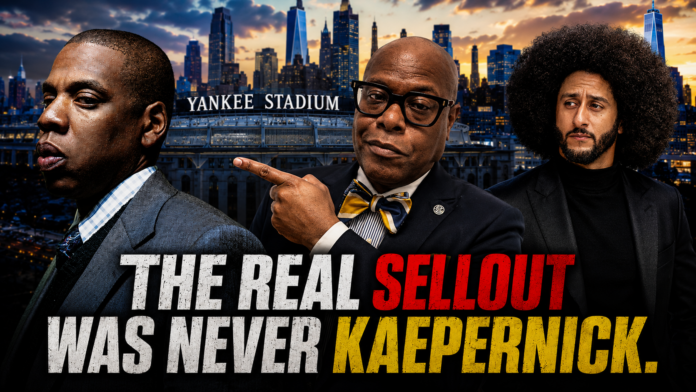


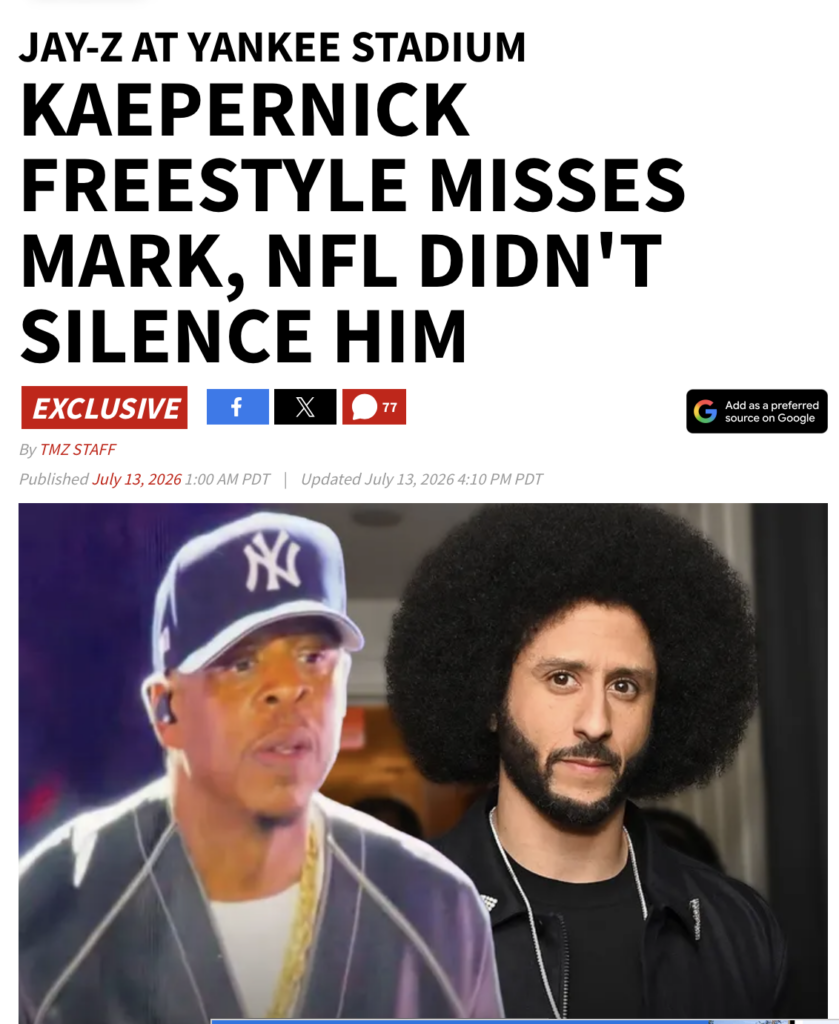
Jay-Z stood on a Yankee Stadium stage this month and took a shot at Colin Kaepernick, rapping that the former quarterback “took a check” and had to “sign a non-disparagement” agreement to get it — the price, apparently, of his silence. There’s just one problem: according to TMZ Sports, sources with direct knowledge of Kaepernick’s 2019 NFL settlement say no such clause exists. That matters, because it turns Jay-Z’s rhyme into an onstage lie. Kaepernick has spent years publicly speaking about what being blackballed by the league cost him, and how he’s turned that setback into a platform. That’s not the behavior of a man who signed his voice away.
So if anyone in this story sold their silence, it wasn’t Kaepernick. It was Jay-Z who went quiet — and worse, went to work for the very institution that Black America was protesting on Kaepernick’s behalf, and on behalf of the countless families of Black men and women who have been unjustly shot, shot at, or killed by police and are still fighting for justice.
“We’re Past Kneeling”
Let’s remember how we got here. In August 2019, standing next to NFL Commissioner Roger Goodell — the same commissioner presiding over a league that had frozen Kaepernick out for kneeling — Jay-Z announced Roc Nation’s partnership with the NFL and told reporters: “I think we’ve moved past kneeling. I think it’s time to go into actionable items.”
Players who were still kneeling at the time didn’t take it well. Panthers safety Eric Reid, who knelt alongside Kaepernick and filed his own collusion grievance, called the comments “asinine” and asked the obvious question: “When has Jay-Z ever taken a knee to come out and tell us that we’re past kneeling?” Dolphins receiver Kenny Stills said the NFL had done “a good job shifting the problem onto Roc Nation and Shawn Carter’s shoulders, instead of themselves.” Kaepernick’s own Instagram response praised the players still kneeling — a pointed contrast to the man who’d just declared the gesture obsolete.
This wasn’t a nobody weighing in from the sidelines. This was a man who had worn a Kaepernick jersey on Saturday Night Live, who had turned down the Super Bowl halftime show himself and bragged about it on record — “I said no to the Super Bowl: You need me, I don’t need you” — becoming, within months, the league’s paid entertainment strategist and the public face of the same controversy he once stood inside of.
Same Story, Different Decade
Fast forward to 2026, and the pattern repeats. Target has been the subject of a boycott led by Pastor Jamal Bryant and organizers such as Nekima Levy Armstrong and Jaylani Hussein since the retailer rolled back its DEI commitments and pledges to Black-owned businesses. Whatever you think of the boycott’s effectiveness, it was a real, organized stand by Black consumers, with named organizers and stated demands.
Jay-Z’s answer was to cut an exclusive vinyl deal with Target for the 30th anniversary of “Reasonable Doubt.” Boycott organizer Monique Cullars-Doty didn’t mince words, saying the move amounted to helping “aid and support white supremacy” against the very community Jay-Z claims to represent. When he finally addressed it on stage, he didn’t apologize or explain — he deflected, accusing his critics of “picking and choosing” which corporations to boycott, even as his own deal gave Target a high-profile win during the boycott.
The Pattern Is the Point
The throughline is the same: when Black people organize a boycott or a protest against a powerful institution, Jay-Z finds a business reason to align with that institution instead — and then reframes the criticism he receives as the real problem. He wasn’t the one who lost a career over a knee. He wasn’t the one whose settlement terms were picked apart on stage by a billionaire looking for a rebuttal to his own bad press. Kaepernick gave up his job and, by every available account, never gave up his voice.
If there’s a sellout in this story, it’s not the man still unemployed for a protest a decade later. It’s the man who keeps finding a paycheck on the other side.
Controversy sells, and Jay-Z knows that better than almost anyone alive. But amid this controversy, he has shown us exactly who he really is. The question now isn’t what he’ll say next — it’s whether Black America will finally believe him.