Home Blog Page 26

Kenneth W. Jenkins Sworn In as Westchester County Executive, Marking Historic Firsts for County and State

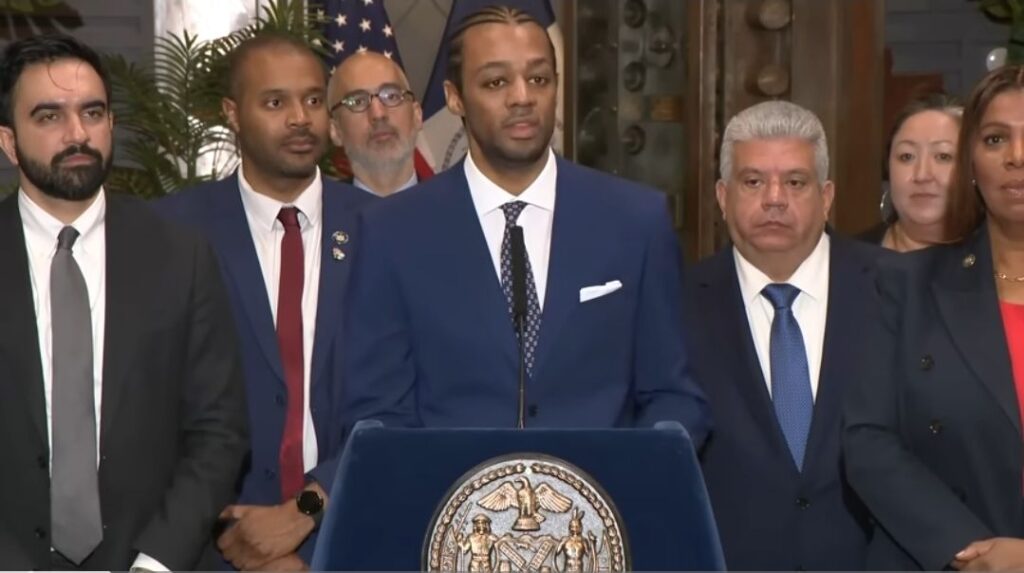
Purchase, NY — Kenneth W. Jenkins was officially sworn in as Westchester County Executive during an Inauguration Ceremony held at Purchase College, marking the start of a new three-year term in office and a historic milestone for both Westchester County and New York State.

With his inauguration, Jenkins broke the glass ceiling as the first Black County Executive in Westchester County’s history. He is also the only Black County Executive currently serving in New York State, underscoring the significance of the moment in a state with 62 counties and a long history of limited diversity in county-level executive leadership.

The ceremony reflected both continuity and transition, celebrating Jenkins’ leadership over the past year while setting the stage for the work ahead. Family members, elected officials, community leaders, and residents gathered to witness the event, underscoring its civic importance and historical significance.

Jenkins took the oath of office administered by the Honorable Anne E. Minihan, pledging to uphold the Constitution of the United States, the Constitution of the State of New York, and the Charter of Westchester County.

In his inaugural remarks, Jenkins emphasized a leadership philosophy grounded in accountability, responsiveness, and results.

“In my first year as County Executive, I’ve been guided by a simple principle: leadership that listens, acts, and delivers for the people of Westchester County,” CE Jenkins said. “We’ve strengthened our financial footing, invested in housing and infrastructure, expanded educational and economic opportunities, and made real progress on public safety — all while staying true to the values that unite us.”

Black Westchester’s Jailyn Gardner caught up to CE Jenkins to talk about his first order of business…

He framed the new term as a continuation of that approach while signaling a forward-looking agenda.

“This is just the beginning,” Jenkins added. “Together, we will continue to build a Westchester where opportunity is real, government is responsive, and every community thrives. We’ve proven that responsible leadership works.”

As Jenkins begins his historic term, the administration is expected to focus on maintaining fiscal stability, accelerating housing development, improving infrastructure, and ensuring that economic growth and public safety initiatives benefit every community across Westchester County.

The NYC COPA Law and the Cost of Restricting Black Homeownership in New York City

The New York City Council has now passed the Community Opportunity to Purchase Act, commonly known as the NYC COPA Law. What was once debated as a proposal is now a binding policy. As with any law passed in the name of protection, the objective measure of its value will not be its intentions, but its consequences.

The NYC COPA Law applies to multifamily buildings with three or more residential units. When an owner of such a property decides to sell, the transaction no longer begins in the open market. Instead, the owner must first notify the City and allow designated nonprofit entities to purchase the property before it can be freely sold to private buyers. Supporters frame this as an anti-displacement measure. But policies should be evaluated by how they alter behavior, not by the language used to defend them.

The NYC COPA Law fundamentally alters the meaning of ownership for Black New Yorkers who own small multifamily homes because it threatens their ability to build generational wealth. These properties have long served as one of the few reliable pathways into the Black middle class in New York City. Three-family homes, in particular, are often owner-occupied, family-managed, and held not as speculative investments, but as sources of stability. They have paid medical bills, funded retirements, supported education, and allowed families to remain in neighborhoods where rising rents would otherwise have forced them out. This law risks undermining that critical pathway to economic mobility for Black families.

By setting the threshold at three units, the NYC COPA Law does not simply regulate large landlords or corporate investors. It reaches directly into the segment of the market where ownership is most fragile and where owners are least equipped to absorb delays, uncertainty, and legal complexity. These are not institutional actors with legal departments and capital reserves. They are working families whose equity is often their primary financial cushion.

The consequences extend beyond current owners. The highest long-term cost of COPA lies in its impact on entry.

For decades, the traditional starting point for Black real-estate entrepreneurship in New York City was the small multifamily property. Young buyers would purchase a three-family home, live in one unit, rent the others, and gradually build credit, cash flow, and practical experience. This pathway did not require venture capital, political connections, or large-scale financing. It required discipline, risk tolerance, and ownership.

COPA disrupts that ladder. By granting nonprofits and designated entities the first opportunity to purchase qualifying buildings, the law sidelines first-time buyers, small business owners, and young Black entrepreneurs seeking to enter real estate at a scale they can realistically afford. These buyers are not speculators. They are the next generation of Black owners, managers, and developers. When policy blocks the entry point, it does not eliminate speculation. It eliminates participation, especially for Black entrepreneurs who rely on this pathway to build wealth and community stability.

Over time, the outcome is predictable. Fewer Black New Yorkers will own income-producing property. Fewer will gain hands-on experience in asset management. More housing will be consolidated under institutions that collect rent but do not build local wealth. A market that restricts ownership at the starter level does not preserve opportunity. It narrows it.

The NYC COPA Law also shifts control of housing toward nonprofit entities and land trusts. While many of these organizations perform essential work, they are not neutral actors. They are often externally funded, politically connected, and insulated from the accountability that comes with private ownership. Each building removed from the private market is one fewer opportunity for a family to own, manage, and eventually pass down an asset. This shift could limit Black families’ ability to participate directly in ownership and wealth-building.

Perhaps most revealing is the logic underlying the policy itself. COPA treats Black-owned property not as a private asset, but as a public instrument whose transfer must be supervised. Owners are told that their right to sell freely must be constrained because their equity might disrupt someone else’s stability. This logic is rarely applied in affluent neighborhoods or high-value enclaves. It is used where ownership has only recently been achieved.

If displacement is the problem, its causes are well known. Zoning restrictions, tax policy, capital concentration, and decades of planning decisions that limited supply while increasing demand have driven housing instability. COPA addresses none of these structural drivers. Instead, it intervenes after equity has already been built, regulating how and to whom Black owners may sell.

Policies that interfere with ownership without expanding opportunity rarely create new wealth. They redistribute control. History suggests that when ownership becomes conditional, it is not the most powerful who bear the cost.

The NYC COPA Law is now in effect. Its consequences will not be measured in press conferences or policy memos, but in the quiet decisions of families who choose not to buy, not to sell, or not to try at all.

A city serious about equity would widen the path to ownership, not narrow it. It would recognize that protecting communities means protecting their ability to own, build, and exit on fair terms. Policies should aim to create more opportunities for Black families to participate in the market, fostering hope and empowerment rather than restriction and disempowerment.

Albany Defense Lawyer Jasper Mills Indicted For Witness Tampering by AG Tish James

0

Jasper Mills Charged for Releasing Confidential Information on Cooperating Witness, Resulting in Death Threats and a Slashing

New York Attorney General Letitia James and New York State Police Superintendent Steven G. James announced the arrest and indictment of Jasper Mills, a criminal defense attorney who unlawfully shared confidential witness information in a homicide trial, which ultimately led to a cooperating witness being threatened and attacked in a federal prison. Mills, a former Albany County prosecutor, was indicted for violating an Albany County protective order, which prohibited him from providing any copies of discovery material that listed witness names, including a sensitive list naming two cooperating witnesses. Shortly after Mills shared the sensitive witness list, a cooperating witness was threatened in federal prison and later slashed with a knife, which required a hospital stay for his wounds. Mills was charged with five crimes, including Intimidating a Witness and Tampering with a Witness, and was arraigned today in Albany County Court.

Jasper Mills, a criminal defense attorney, faces five charges, including intimidating a witness and tampering with a witness, after allegedly violating a court protective order by sharing a sensitive witness list in a gang-related homicide case. Attorney General Letitia James and New York State Police Superintendent Steven G. James announced the indictment on Tuesday. (see full indictment below)

New York v Jasper Mills Indictment Indictments 2025 by BLACK WESTCHESTER MAGAZINE

“Witness intimidation corrupts our justice system and prevents victims of crimes from getting justice with a fair trial,” said AG James. “Jasper Mills allegedly shared witness information that put lives in danger, and my office will hold him accountable. I will not tolerate any illegal tactics that jeopardize criminal investigations and put New Yorkers at risk.” 

“This investigation underscores our commitment to protecting witnesses and holding individuals accountable when their actions jeopardize public safety and the justice system,” said Superintendent James.

Mills represented Vramir Branch, one of four defendants charged in the January 2021 gang-related murder of 32-year-old Shanita Thomas. Judge Roger McDonough issued a protective order on Oct. 27, 2022, specifically prohibiting Mills from providing his client any documents containing witness names or personal information.

On June 3, 2024, the judge ordered prosecutors to provide a witness list naming two cooperating witnesses to the defense attorneys. That night, an assistant district attorney emailed the list to all defense attorneys with a reminder that protective orders prohibited sharing copies with their clients.

Two days later, on June 5, 2024, a cooperating witness incarcerated at FCI Ray Brook in Lake Placid was approached by several armed inmates who threatened to kill him unless he left their housing unit. The attackers told him they knew he had “turned state witness.” The witness fled to a correction lieutenant’s office and was moved to protective custody.

An investigation uncovered that a witness list that contained Mills’ distinctive markings was released on social media, including Snapchat. A second copy of the witness list that also contained Mills’ distinctive markings was circulated via text message. However, the protective order barring Mills from providing any hard copies of the discovery was still in effect.

On September 8, 2024, the cooperating witness was attacked again while in protective custody. The attackers stated they knew the cooperator was a witness and the cooperator was slashed on the wrist with a prison shiv, which required hospitalization due to infection.

In addition to the witness list that was circulating on social media, Mills delivered a hard drive with other information on it to Branch at Albany County Correctional Facility on April 8, 2024. The hard drive contained multiple documents that Mills was prohibited from providing to his client, including the names and quotes from various eyewitnesses to the Shanita Thomas homicide that were used for various search warrant affidavits.

Mills is charged with Criminal Contempt in the Second Degree, Intimidating a Witness in the First Degree, Intimidating a Witness in the Second Degree, Tampering with a Witness in the First Degree, and Tampering with a Witness in the Second Degree. If convicted, he faces a maximum sentence of eight and one-third to twenty-five years in jail.

Mills was arraigned on Tuesday, December 30th, in Albany Supreme Court. The charges in the indictments are merely allegations, and the defendant is presumed innocent unless and until proven guilty in a court of law.

The investigation was conducted by the New York State Police.

The prosecution is being handled by Senior Counsel Mary Gorman and Assistant Attorney General Nicholas Kyriacou, under the supervision of Public Integrity Bureau Chief Gerard Murphy, with assistance from Legal Support Analyst Samantha Shaughnessy. The Public Integrity Bureau is part of the Division for Criminal Justice. The Division for Criminal Justice is led by Chief Deputy Attorney General José Maldonado and overseen by First Deputy Attorney General Jennifer Levy.

No Tax on Tips? Let’s Talk About No Tax on Survival Wages

Every year, New York publishes salaries like receipts without context.

Big numbers.

Bold headlines.

No hours attached.

Civil servants. Restaurant workers. Nurses. Bartenders. Corrections officers. The public sees six figures and assumes comfort. What they don’t see is the math or the body count of burnout it takes to get there.

Here’s the reality.

I’m a civil service worker.

My base salary is $79,000.

With overtime because the system is chronically understaffed, I make around $150,000 before taxes.

That number gets printed like a flex.

What doesn’t get printed is that overtime accounts for nearly 30–40% of income for many frontline public employees in New York, according to state labor and payroll analyses. That means the state doesn’t just allow overtime, it depends on it to keep facilities open, safe, and compliant.

And every time I walk through those doors, I’m prepared to give 16 hours. Not occasionally. Every time.

That’s not ambition.

That’s contingency staffing.

Now let’s talk taxes because this is where the squeeze becomes intentional.

In New York:

  • Combined federal, state, and payroll taxes can take 35–45% of overtime earnings
  • Overtime is taxed at the same marginal rate as base income, even though it comes from extended labor, not salary privilege
  • Tips are treated as fully taxable earned income, despite being unstable, unpredictable, and dependent on customer behavior, not employer wages

Translation:

Labor beyond capacity is taxed as if it were excess.

So when restaurant workers say, “If we weren’t taxed on our tips, we could save, breathe, maybe skip that extra shift,” that’s not entitlement, it’s economics.

According to the U.S. Bureau of Labor Statistics:

  • 70% of tipped workers live paycheck to paycheck
  • The median hourly wage for tipped workers (before tips) remains well below a living wage
  • Over 60% of service workers take extra shifts solely to offset taxes and deductions, not to increase quality of life

Different uniforms.

Same trap.

Yet Kathy Hochul and Albany lawmakers have refused to extend the federal “no tax on tips” policy to state income taxes, while still branding themselves as champions of affordability.

Let’s be honest.

This isn’t about loving Donald Trump.

This is about acknowledging that a policy that reduces pressure on working people works, regardless of who proposed it.

Refusing to adopt it doesn’t protect values.

It protects optics.

And here’s the part civil servants understand better than anyone:

The state budgets for our overtime.

Schedules around our overtime.

Counts on our overtime during crises.

Then taxes it like we’re living lavishly and publishes the gross number without context, turning the public against the very workers holding the system together.

That $150,000 headline number?

  • doesn’t include the forced doubles
  • doesn’t include the missed holidays
  • doesn’t include the trauma exposure
  • doesn’t include the shortened lifespan studies now associate with chronic overtime work

Yes, studies show workers regularly clocking extended shifts face higher rates of cardiovascular disease, anxiety disorders, sleep disruption, and early burnout. That income isn’t wealth. It’s a health tradeoff.

So no, this conversation isn’t about tips versus salaries.

It’s about a state that runs on excess labor and then penalizes people for providing it.

You cannot tax survival wages like luxury income and still claim to support working families.

You cannot preach affordability while extracting breath from the people keeping the lights on.

Affordability is not a slogan.

It’s not a press release.

It’s whether people can work without being punished for surviving.

And if New York keeps confusing sacrifice for excess, the real cost won’t show up on a paycheck.

It’ll show up in burnout.

In staffing shortages.

In public systems cracking under the weight of workers who finally decide they’ve given enough.

That’s not political.

That’s arithmetic.

Reference Link:

https://nypost.com/2025/12/26/us-news/hochul-wont-serve-up-trumps-no-tax-on-tips-policy-ticking-off-ny-restaurant-workers

Bye Bye MetroCard, Hello OMNY – Countywide Rollout of Contactless Fare Payment System Begins Jan 4, 2026

1

WESTCHESTER COUNTY PREPARES FOR OMNY ROLLOUT WITH FULL BEE-LINE INSTALLATION

New Fare Technology Will Speed Boarding and Expand Payment Options for Riders


Westchester County Executive Ken Jenkins toured the Bee-Line Bus garage in Valhalla to view newly installed OMNY fare scanners on the Bee-Line fleet. The visit marked a major milestone ahead of the official County-wide launch of OMNY (One Metro New York) on January 4, 2026, at 5 a.m., when the Bee-Line bus system will fully adopt the Metropolitan Transportation Authority’s (MTA) contactless fare payment system.

Beginning January 4, Bee-Line fares will also be adjusted to align with MTA’s new fare rates. The changes include a 25-cent increase to the base and on-board cash fare, a 15-cent increase for reduced fares for seniors and people with disabilities, and a separate adjustment for the BxM4C express route. Aligning fares allows Bee-Line riders to continue receiving free transfers between Bee-Line buses and MTA subways and buses and to benefit from the seven-day OMNY fare cap of $35 for unlimited trips, excluding the BxM4C. The fare cap for reduced-fare riders is $17.50.

“Westchester deserves a transportation system that works the way people live today. Installing OMNY across our entire Bee-Line fleet is about making transit easier, faster, and more reliable for riders while ensuring access for everyone. This is a smart investment in modern public transportation that strengthens mobility across our County,” CE Jenkins shared with Black Westchester.

Joining the MTA, Beeline buses are replacing the MetroCard that was first tested in the system in 1993, debuting to the larger public in January 1994 with a pay and go system where you can pay your fare with credit or debit cards as Visa, Mastercard, American Express, and Discover, as well as digital wallets such as Apple Pay, Google Pay, Samsung Pay, and Fitbit Pay. The last day to buy or refill a MetroCard is Wednesday, but the cards will be accepted into mid-2026. The final acceptance date is yet to be announced. 

Liberty Lines Transit President Thomas Murphy said, “Our staff has worked closely with the County to support the installation and launch of OMNY for Bee-Line riders. The new fare payment option is designed to enhance convenience and modernize the boarding process, contributing to an improved overall payment options and experience for the many customers who rely on the Bee-Line system each day.”

Department of Public Works and Transportation Commissioner Hugh Greechan said: “This was a fleet-wide effort that required coordination, testing, and hands-on work across all Bee-Line buses. Our team worked closely with Liberty Lines to install the OMNY equipment efficiently and safely so riders can benefit from a modern fare system starting day one.”

Department of Planning Commissioner Blanca Lopez said: “The Department of Planning played a key role in coordinating logistics of the OMNY rollout, including work on the back-end databases critical to OMNY operations on Bee-Line, integration with the system’s on-board technology, and coordination of program timing and public outreach.  OMNY brings Westchester in line with transit systems across the region and helps ensure riders have access to a simple, consistent fare payment experience.”

While OMNY officially launches on January 4 at 5 a.m., riders may continue using MetroCards on Bee-Line buses as long as the cards are not expired. MetroCard sales will end on December 31, 2025, and cards will no longer be reloadable after that date. Riders may transfer remaining MetroCard balances to OMNY cards through the OMNY Mobile Sales Van, which continues to visit locations across Westchester.

For riders who use weekly or monthly MetroCards, those cards must be activated by January 31, 2026, in order to be valid. Passengers can purchase OMNY cards at select retail locations. To find the nearest store that carries OMNY cards, visit: https://omny.info/retail-locations.

The Mount Vernon School District (MVCSD) uses the Bee-Line Bus System for student transport, and these buses accept OMNY tap-to-pay (contactless cards/phones) for fare payment, but also offer special passes for students (like free passes for middle/high schoolers), with details found on the Westchester County Transportation site, making it easy to ride by tapping your card/phone or using specific student/reduced fare options on the county’s Bee-Line buses. 

The district provides subsidized or free passes for students (e.g., middle/high schoolers get an annual pass), often requiring sign-up through links or QR codes. Check the MVCSD’s Instagram or website for specific student pass enrollment info. 

When the MetroCard replaced the New York City subway token in 1994, the swipeable plastic card infused much-needed modernity into one of the world’s oldest and largest transit systems. Now, more than three decades later, the gold-hued fare card and its notoriously finicky magnetic strip are following the token into retirement.

OMNY cards are accepted on MTA buses, subways, Staten Island Railway, Roosevelt Island Tram, Hudson Rail Link, and AirTrain-Howard Beach, and AirTrain Jamaica stations, and now on Beeline buses in Westchester County. Riders can also register for an OMNY account online, link their card and set up automatic reloads, according to OMNY’s website.

In addition to OMNY, riders can continue paying with coins on Bee-Line buses. This ensures flexibility and continued access for those who prefer using cash fare. For more information on the OMNY rollout in Westchester County, visit http://www.westchestergov.com/beelinebus or call the Bee-Line customer service center at (914) 813-7777.

Election Season Westchester vs. Governing Season Westchester

There’s a version of Westchester that shows up like clockwork every few years.

It’s the version where your phone rings back.

Where elected officials are suddenly at the same block parties, fish fries, and Sunday services you’ve been attending for years.

Where familiar faces remember your name, ask about your family, and promise to follow up this week.

It feels warm.

It feels close.

It feels like access.

And then the votes are counted.

That version of Westchester quietly clocks out.

What replaces it isn’t hostility, it’s distance. Emails that once got same-day replies now take weeks, if they get answered at all. Conversations that used to happen standing on the sidewalk now require calendars, gatekeepers, and agendas. Presence becomes scheduled. Visibility becomes selective.

If you’ve noticed that shift, you’re not being ungrateful.

You’re being observant.

Election season, Westchester is built on proximity.

Governing season Westchester is built on distance.

And the space between those two realities is where trust begins to thin.

During campaigns, access feels abundant. The same faces appear repeatedly. Hands are shaken. Photos are taken. Notes are written. The word “we” is used generously. Community feels centered. Alignment feels mutual.

After elections, that closeness recalibrates.

Meetings move behind closed doors.

Appearances become seasonal.

Language shifts from “we’re working on it” to “there’s a process.”

Access that once felt relational becomes procedural.

This isn’t a character flaw.

It’s a system feature.

Political culture rewards visibility before power is secured and caution afterward. Once a seat is held, the risk calculus changes. Advocacy becomes something to manage instead of something to embody. Courage doesn’t vanish, it becomes conditional.

Communities feel this shift immediately, often in their bodies before their minds can articulate it.

You feel it when emails go unanswered longer.

When familiar faces stop showing up in the spaces they once shared with you.

When presence feels borrowed, not sustained.

When engagement becomes transactional instead of relational.

And here’s what often goes unspoken:

Trust moves at the speed of light. So does distrust.

The difference is how long each one is allowed to go unacknowledged.

No one announces the change.

It just happens.

This is how disillusionment grows quietly, not through dramatic betrayal, but through absence. Through redirection instead of engagement. Through the slow realization that participation does not always lead to power-sharing.

Across Westchester, public engagement has increased over the years, more listening sessions, more forums, more town halls, yet voter turnout in many local elections still hovers around 20–30%, and confidence in institutional responsiveness continues to lag. People are showing up. They are speaking clearly. They are naming the same concerns year after year.

What’s missing isn’t feedback.

It’s follow-through.

For communities that are already under-resourced and over-consulted, this pattern lands hard. It teaches people to expect visibility without accountability. To brace for alignment that expires once ballots are cast.

If you felt that shift before you could explain it, that wasn’t negativity or cynicism.

That was recognition.

And witnessing, especially when it’s shared, is medicine.

This is not a crisis of perception.

It’s a reckoning with patterns long felt and rarely named.

Elections are moments.

Governance is a relationship.

And relationships don’t survive on appearances alone.

If you’re tracking the difference between who shows up when power is being sought and who remains present once power is secured, you’re not wrong.

You’re paying attention.

And in Westchester, attention that is steady, shared, and unexhausted remains one of the most effective forms of power we have.


If You Felt That…

Black Westchester readers, we want to hear from you.

  1. Have you noticed a difference between how accessible leaders feel during election season versus after they’re in office?
  2. What shifts in presence, communication, or engagement have stood out to you the most?

Share your thoughts in the comments below.

Let’s see what patterns Black Westchester Magazine readers are noticing across our communities.

Local Churches Offer Solace to 30 Cottage Ave Fire Victims

Christ Tabernacle Church and Oneness Rehoboth Church each stepped forward to provide vital support to the victims of the 30 Cottage Fire, delivering over 200 hot meals to those affected. The victims are currently being sheltered at Holmes School, where they are in a warm and safe environment.

Both churches reached out to Judy Williams-Davis with a desire to get involved and help.

Sade Ritter, the project coordinator and nutritionist, expressed her gratitude, noting that weekends are especially challenging for the displaced population. 

“Two weekend deliveries of hot meals were arranged. Their meals were delivered and served, and they were most appreciated,” she said.

 A 5-alarm fire tore through the Mount Vernon apartment complex, displacing all 250 residents, on Sunday, November 23, 2025.

Although the community has responded with overwhelming generosity, a warm meal when you have no way of preparing food for your family is always welcome. The efforts of CHRIST Tabernacle Church and Oneness Rehoboth Church have brought comfort and relief to those who need it most.

Pastor Rev. Michael Basedo of Christ Tabernacle Church and Rev. Arthur Thomas of Oneness Rehoboth Church are to be commended for their generosity and commitment to their community. By extending themselves to serve wherever needed, they exemplify the mission of their churches: to uplift, care for, and provide for those in need.

For those interested in offering additional support, please contact Sade Ritter at 914-665-2446 for more information.

Why Mount Vernon’s ARPA Spending Requires a Federal Audit

A City That Received $41 Million Allowed a COVID-Stricken Police Officer to Go Unprotected

The City of Mount Vernon received approximately $41 million in federal funding under the American Rescue Plan Act. Those funds were explicitly intended to address the public health harms of COVID-19, including protecting frontline workers and stabilizing essential services. Yet Mount Vernon’s own actions demonstrate that the Mayor failed to use ARPA funds to secure COVID-related healthcare and benefits for police officers. The case of Derek Williams—a 19-year veteran who contracted COVID-19 on duty and later suffered catastrophic long-term illness—stands as direct evidence of that failure. When a city receives historic pandemic relief yet allows a COVID-stricken officer to lose access to healthcare, the issue is not administrative oversight. It is misallocation. That misallocation now warrants a federal audit of Mount Vernon’s ARPA spending.

That funding was not discretionary stimulus money. It was governed by ARPA §9901 and implemented through the U.S. Department of the Treasury’s Final Rule, codified at 31 C.F.R. Part 35, with a defined purpose: to address the public health harms of COVID-19 and stabilize governments facing extraordinary pandemic-related costs.

Treasury’s rule is explicit. ARPA funds may be used to “respond to the public health emergency or its negative economic impacts.” The rule defines eligible workers as those who perform essential, in-person work and explicitly includes public safety employees.

Most critically, Treasury recognizes that COVID-19 does not end with initial infection. Covered public health expenditures include medical expenses for COVID-19 treatment, including long-term care, rehabilitation, and therapy for post-COVID conditions.

This language is regulatory, not optional.

At the state level, New York General Municipal Law §207-c imposes a mandatory obligation on municipalities to maintain pay and medical coverage for police officers injured or taken ill in the performance of duty. A police officer who contracts COVID-19 while actively serving during a declared public health emergency meets that standard.

These two frameworks were designed to work together. ARPA exists to reinforce existing obligations when extraordinary events strain municipal systems—not to excuse failure.

The Derek Williams case is a contradiction.

Officer Williams served throughout the height of the COVID-19 pandemic while much of the municipal government operated remotely. He contracted COVID-19 in the line of duty. He later developed severe, long-term medical complications, including kidney failure requiring dialysis—precisely the type of post-COVID condition Treasury explicitly recognizes as an eligible public-health expense.

Yet despite the existence of both federal relief funding and a clear state-law duty to maintain medical coverage, Officer Williams was placed in a position where his healthcare, employment status, and financial stability were put at risk rather than automatically protected.

The City’s own public statements make several facts unavoidable. Healthcare protection was not automatic. Coverage was restored only temporarily and only after public pressure intervened. Relief was framed as an act of grace rather than the fulfillment of a legal obligation. Responsibility was shifted from exposure and duty status to paperwork. And throughout the City’s explanation, ARPA funds—specifically designed to address COVID-related public health harms—were never mentioned, cited, or explained.

This outcome cannot be reconciled with the governing law.

Other Cities Used ARPA to Address COVID-Related Illness Among First Responders

Mount Vernon’s handling of a COVID-injured officer is not representative of how ARPA was applied nationwide.

In San Francisco, ARPA funds were used to offset COVID-related personnel costs tied to public safety employees, including medical leave, health-related absences, and continuity of benefits for first responders affected by the virus. COVID exposure and illness among police and firefighters were treated as compensable public-health impacts of the pandemic.

In the Greater Cleveland region surrounding Cleveland, counties and municipalities used ARPA funds to cover COVID-related payroll and benefits for police officers who became ill or were quarantined due to exposure, citing pandemic-related workforce disruption and medical impacts.

In Cumberland, ARPA allocations were used to address COVID-related health impacts on public-safety personnel, including accommodations tied to illness, isolation, and recovery, to maintain continuity of essential services during the public-health emergency.

Across several municipalities in Connecticut, ARPA spending plans included provisions addressing COVID-related illness among first responders, including medical leave, exposure response, and workforce stabilization resulting directly from COVID infections.

National surveys conducted by the U.S. Conference of Mayors further show that cities such as AustinCharlotteOakland, and Arlington identified COVID-related illness, medical leave, and benefit continuity for first responders as eligible ARPA uses under the public health response and essential worker protection categories.

These examples demonstrate a consistent national understanding: ARPA was a tool to address COVID-related illness among first responders, including long-term health impacts and benefit continuity.

Against that backdrop, Mount Vernon’s failure to use ARPA funds to secure healthcare and benefits for a police officer who contracted COVID-19 on duty is not the result of unclear law or limited authority.

It is a deviation from established practice.

Why a Federal Audit Is Warranted

When law, funding, and outcomes point in opposite directions, accountability is no longer optional.

A federal audit is warranted to determine how ARPA funds were allocated in Mount Vernon, what portion—if any—was directed toward COVID-related healthcare protection for first responders, why existing §207-c obligations were not reinforced with federal relief, and who made the decisions that allowed pandemic risk to be borne by an individual officer instead of the institution.

Statutes do not enforce themselves. Institutions choose whether to honor them. When a city can receive $41 million in emergency public-health funding while a frontline officer who caught COVID-19 on duty is left unprotected, the question is no longer rhetorical.

It is evidentiary.

Where did the ARPA money go—and why wasn’t it used where the law most clearly required it to go?

References

  1. United States Congress.
    American Rescue Plan Act of 2021, Pub. L. No. 117-2, §9901, 135 Stat. 4 (2021).
    — Establishes the State and Local Fiscal Recovery Fund (SLFRF) and defines the statutory purpose of ARPA funds as responding to the COVID-19 public health emergency and its negative economic impacts.
  2. U.S. Department of the Treasury.
    State and Local Fiscal Recovery Funds Final Rule, 31 C.F.R. Part 35.
    — Treasury’s binding interpretation of ARPA, defining eligible uses of funds, eligible workers (including first responders), healthcare-related expenditures, and compliance requirements.
  3. Federal Register.
    Coronavirus State and Local Fiscal Recovery Funds; Final Rule, published January 27, 2022.
    — Official publication giving legal force to Treasury’s ARPA rules and interpretive guidance.
  4. U.S. Department of the Treasury.
    SLFRF Compliance and Reporting Guidance.
    — Defines how municipalities must document, justify, and report ARPA expenditures, including public health and workforce-related costs.
  5. U.S. Department of the Treasury.
    SLFRF Frequently Asked Questions (FAQs).
    — Clarifies eligible uses of ARPA funds, including public safety payroll, healthcare continuity, and COVID-related workforce impacts.
  6. New York State Legislature.
    New York General Municipal Law §207-c.
    — Requires municipalities to provide salary and medical coverage to police officers injured or taken ill in the performance of duty.
  7. New York State Comptroller.
    Local Government Management Guides and Opinions on §207-c.
    — Interprets municipal obligations regarding line-of-duty injury and illness benefits.
  8. Centers for Disease Control and Prevention.
    COVID-19: Long-Term Health Effects.
    — Documents long-term and organ-related health impacts following COVID-19 infection.
  9. U.S. Department of Labor.
    COVID-19 and Worker Safety Guidance for First Responders.
    — Federal recognition of heightened exposure risks for public safety workers during the pandemic.
  10. Treasury Office of Inspector General.
    Oversight of State and Local Fiscal Recovery Funds.
    — Provides audit and enforcement standards for ARPA compliance and misus

WCPR Statement On DA Susan Cacace’s Decision Not To Pursue Charges On Peekskill Police For Beating Damar Fields

2

Westchester County District Attorney Susan Cacace has chosen not to prosecute a police officer involved in a contentious arrest in Peekskill after examining video and eyewitness testimony for several weeks.

The decision has caused much outrage, with many, including The Westchester Coalition for Police Reform (WCPR), who released a strongly-worded statement condemning the decision, on Tuesday.

The WCPR strongly condemns District Attorney Susan Cacace’s decision not to file criminal charges against the police officers involved in the violent assault of Damar Fields on December 3, 2025, at Waterfront Park in Peekskill.

Damar Fields, an unarmed man with emotional disabilities who was known by Peekskill Police, was beaten and tased three times by armed officers. The decision not to pursue charges sends a dangerous message that excessive force against vulnerable people will go unpunished.

This outcome is deeply troubling, not only for Damar Fields and his family, but for every resident who participated in good faith in Westchester’s police reform process following the murder of George Floyd. That year-long effort, required by Governor Andrew Cuomo’s Executive Order, was meant to center on de-escalation, accountability, and respect for human dignity. The District Attorney’s decision undermines that work and erodes public trust.

Serious questions remain unanswered:

  • Why was the Project Alliance Mobile Crisis Response Team, designed to respond to mental health crises, not activated?
  • Why did no officer intervene, despite a clear duty-to-intervene policy intended to prevent excessive force?

We reiterate our call for the charges against Damar Fields to be dropped immediately. A person experiencing a mental health crisis should not be criminalized.

When prosecutors decline to act, calls for accountability must not end. We call for independent review, legislative oversight, and systemic reforms to ensure that no one, especially armed government officials, is above the law.

This is not how our communities choose to be policed. We reject policing rooted in violence and impunity, particularly toward people with emotional disabilities.

Accountability is not anti-police. Transparency creates trust. Damar Fields deserves justice.

Our communities deserve better.

The DA’s office has referred the matter back to the Peekskill police chief for an internal investigation. Stay Tuned to Black Westchester for more on this developing story!

DA Declines To Prosecute Peekskill Police Officers Involved In Disturbing Arrest Of Damar Fields

3

The cops involved in a contentious arrest at a Peekskill waterfront park will not be prosecuted by the Westchester County District Attorney’s Office. A spokesperson for the DA’s office wrote in a statement, “After reviewing all of the evidence in this case, our office has determined that there is an insufficient basis to pursue criminal charges against any Peekskill police officer involved in the incident.”

42-year-old Damar Fields was tased, kicked, and cursed at during an arrest by the gazebo at the Peekskill Riverfront Green Park, on Wednesday, December 3rd. The Peekskill Police Officer has been placed on administrative leave after a viral cellphone video shows the officer repeatedly tasing a man on the ground, as well as punching and kicking him while cursing at him to get on his face and stomach. Several other officers joined the officer in holding the man down. The video begins after the incident was already in progress.

On Dec. 4th, the Peekskill Police Department referred the use-of-force incident involving several police officers to the Westchester County District Attorney’s Office for review. The incident involved the arrest of a person known to the department at the Riverfront Green Park, according to the DA.

The Public and Law Enforcement Integrity Bureau of the office then began what was called a thorough investigation of the incident. The entire body-worn camera footage of the incident was examined by investigators and assistant district attorneys from various perspectives; an eyewitness was interviewed; incident police reports were examined; social media footage of a portion of the incident was examined; the Peekskill Police Department’s Standard Operating Procedure Manual was examined; and the Peekskill community was contacted directly for any further information.

“Last Tuesday, Dec 16th, I agreed to talk to investigators from Westchester County District Attorney Susan Cacace’s office. I told them respectfully I have no faith in their boss. They have a video of clear police brutality, and they were still investigating. I told them it looked to me that they are investigating a way to charge the Black victim and exonerate the white attackers,” said Community Activist Darrell Davis, shared with Black Westchester.

The DA’s Office also “recommended to the Peekskill Police Department that it consider additional training on how to deal with mentally ill or emotionally disturbed persons and on the use of de-escalation techniques.” The DA’s Office published all body-worn camera footage collected as part of the review, which can be viewed here.

“The City of Peekskill and its Police Department recognize that this event has the potential to damage community trust,” the city said in the official statement in the days that followed the incident. “It is important to examine all factors surrounding this incident, including those not visible in the video, to fully understand the actions of both the officer and the individual involved. For that reason, the City is committed to a comprehensive investigation.”

Priscilla Augustin, president of the Peekskill chapter of the NAACP, condemned the misuse of power by the police officers directly involved in the incident.

“After reviewing the video that was posted, it is clear that the officers used excessive force, employed derogatory language, and engaged in racial name-calling toward the man in their custody,” Augustin said on December 7th. “This is unacceptable. We acknowledge the decision to suspend the officer; however, we firmly believe the suspension should be without pay pending the outcome of a full and transparent investigation. Moreover, the consequences imposed in this case will speak volumes about whether law enforcement is truly committed to serving the community’s best interests—or whether some officers believe they are above the law.”

The DA’s office findings were sent to Peekskill Police Chief Adam Renwick, and the matter was referred back to the department for an internal investigation.

At the December 8th Council meeting, five members of the City of Peekskill’s Civilian Complaint Review Board (CCRB) were reappointed and will be reviewing the incident. They are Dennis Adams, Jay Buckiewicz, Antonio Knott, Lisa McClain, and Harriet Ray.

Davis tells Black Westchester he will continue to seek justice for Fields. “They know Damar, they know him. Peekskill is a small city. They should have treated him from the beginning,” he said.