



Let’s skip the corporate language for a minute and go straight to the numbers. Apple Bank: $68.5 million in new qualified investments. $665,000 in qualified grants. 77.4% of the dollar value of new qualified investments directed toward affordable housing. And the percentage we are examining against its stated strategic commitment: 0.057%. Now look at the previous CRA evaluation period: $96.9 million in new qualified investments and approximately $15.7 million in qualified grants. If you live, work, or build a business in Westchester County, those numbers should make you pause.
This isn’t about creating a headline just for the sake of creating a headline. It’s about asking what those numbers mean on the ground in Mount Vernon, Yonkers, New Rochelle, White Plains, Peekskill, Ossining and communities throughout Westchester and the Hudson Valley. What does the investment look like in the neighborhoods where Black and Latino families are building businesses, raising children, creating nonprofits, producing media and trying to build generational wealth?
I’m not saying Apple Bank did something improper. I’m asking the question that every community should be able to ask: What did you commit, what did you deploy, where did it go, and could the people who needed it actually access it? The 0.057% figure also needs to be tied to the exact strategic commitment and denominator before it is presented as a final apples-to-apples measurement. The math matters. The methodology matters. The community deserves both.
Now look at the change in reported activity. $96.9 million became $68.5 million. Approximately $15.7 million in qualified grants became $665,000. That is a dramatic difference. I’m not saying Apple Bank had a $15.7 million grant budget and then only spent $665,000. The CRA evaluations don’t establish that. I am saying the reported numbers changed, and the community has every right to ask what changed and why.
Then there is the 77.4%. Apple Bank reported that 77.4% of the dollar value of its new qualified investments went toward affordable housing. Housing is absolutely part of economic stability in Westchester, where housing costs can make building wealth feel like trying to run uphill in heels. But community development is bigger than housing. It includes the small-business owner on a commercial corridor in Mount Vernon, the entrepreneur in Yonkers, the nonprofit in New Rochelle, the community organization in Peekskill, the creative building a media company, and the family-owned business trying to remain open long enough for the next generation to take over.
That brings me to the question I really want Westchester to wrestle with: Who has the key?
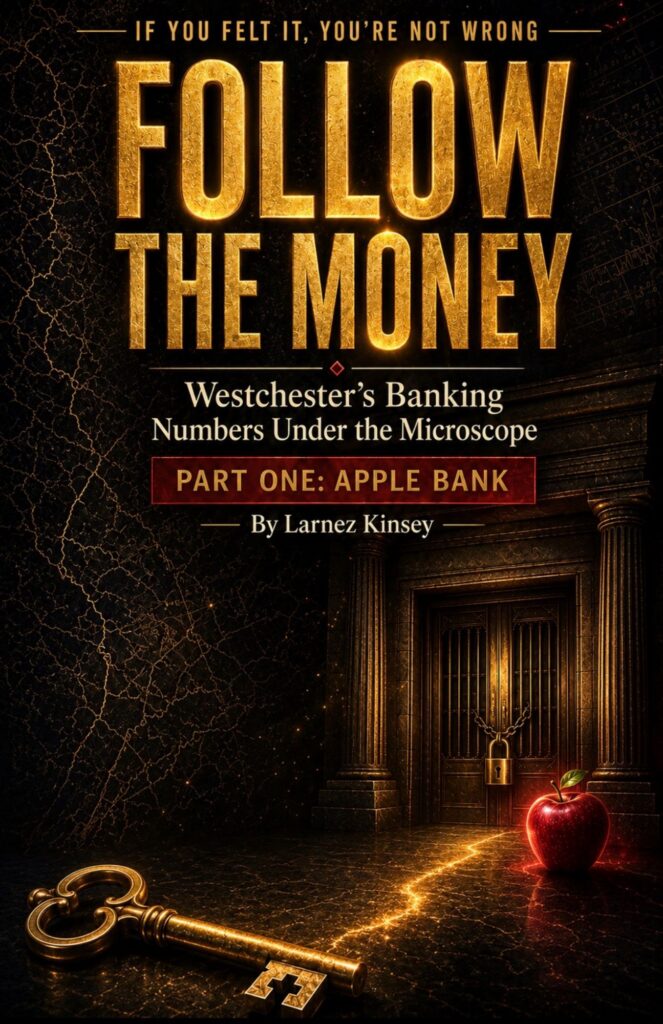
Community resources should not become inherited privileges. If one organization, business, nonprofit or community leader was given the key to a financial institution, grantmaker, sponsor or decision-maker, that key should not simply be passed from one connected person to another while everyone else is left trying to figure out who to call. Access should create more access. It should not create ownership of the doorway.
A new nonprofit should know where to apply. A small business owner should know who to contact. A first-generation entrepreneur should understand the requirements. A community organization should not need an inside connection just to discover that a resource exists. If the opportunity is intended for the community, the pathway should be visible to the community.
And then there is another piece of the economic equation that deserves attention: marketing.
Financial institutions want our customers, our businesses, our deposits, our mortgages and our attention. So who gets paid to reach us? What percentage of those marketing dollars goes to Black-owned and minority-owned media in Westchester and the Hudson Valley? What happens to the advertising dollars going into publications like Black Westchester Magazine, community newspapers, podcasts, radio programs, newsletters and independent digital outlets?
Community media is not simply a place to put an advertisement. It is part of the economic infrastructure of our communities. These outlets employ journalists, photographers, designers, salespeople, web developers and other professionals. They tell our stories, cover our elected officials, promote our businesses, announce our events and connect residents to information that often doesn’t receive the same attention from larger media organizations.
If a financial institution says it wants to reach Black and Latino communities, then I want to know whether its spending actually reaches the businesses and media organizations that already have relationships with those communities.
That is not asking for a favor.
That is asking about economic circulation.
Money comes into our communities. Where does it go next?
Does it stay with local businesses?
Does it support minority-owned media?
Does it create jobs?
Does it strengthen nonprofits?
Does it help entrepreneurs grow?
Does it reach organizations that don’t already have a relationship with the institution?
Those are Westchester questions.
And I want Westchester’s elected officials in this conversation.
Not to tell a private bank who must receive a loan. Not to interfere with legitimate underwriting. The role is bigger than that. Our elected leaders can help bring financial institutions, business owners, nonprofits, community organizations and residents into the same conversation about economic development.
Imagine a Westchester where residents don’t have to know somebody who knows somebody to find out where the opportunities are. Imagine a centralized community resource system where nonprofits and businesses can see available grants, loans, CRA opportunities, sponsorships, contracts and educational programs. Imagine banks regularly explaining their programs directly to the communities they serve. Imagine minority-owned media being included in the economic-development conversation instead of being remembered only when somebody needs a press release published.
That is the kind of conversation I want to have.
The African American Chamber of Commerce Hudson Valley can be part of that bridge. If you’re a business owner, nonprofit leader, or community member trying to understand financial resources, business opportunities, or financial literacy, reach out to the Chamber at 845-570-2367 or connect with @AACCHV.
I also want bankers, elected officials, nonprofit leaders, business owners and media organizations to reach out. I’m not presenting myself as the person who has every answer. I’m presenting myself as someone willing to ask the questions and bring the right people into the room.
Westchester doesn’t need another conversation where everybody agrees that economic opportunity matters and then goes home.
We need the people with capital talking to the people building businesses.
We need the people with programs talking to the people who need them.
We need the people making decisions talking to the people affected by those decisions.
And we need to stop treating access like a family heirloom.
The key should not be inherited.
It should be visible.
The rules should be clear.
The opportunity should be real.
Apple Bank is where I’m starting.

Bank of America. Citizens. TD Bank. Trustco Bank. Wells Fargo. You’re next.
The questions will remain the same: What did you commit? What did you report? Where did it go? Who benefited? Who didn’t? Who received the contracts? Who received the sponsorships? Who received the marketing dollars? And could the people who needed the opportunity actually find the door?
This isn’t about attacking banks.
It’s about accountability.
It’s about economic power.
It’s about Westchester deciding that community investment should be something we can actually see, understand and participate in.
So if you’ve tried to access resources and couldn’t figure out where to start, reach out.
If you’re a business owner who has successfully accessed capital, tell us what worked.
If you’re a nonprofit that keeps getting told about opportunities after the deadline, tell us.
If you’re a banker who believes there is a better way to connect with Westchester communities, come to the table.
If you’re an elected official who wants to help build that table, let’s talk.
And if you’re a minority-owned media organization that wants a seat in the conversation about the dollars being spent to reach our communities, I want to hear from you too.
This is only Part One.
A is for Apple.
The numbers are the beginning.
The questions are the point.
Let’s follow the money. Let’s follow the access. And let’s build the bridge right here in Westchester.
THE BANKS: READ THEIR OWN COMMITMENTS