



Murray has admitted to having sexually abused a child. Although his guilty plea settles the criminal issue, it once again raises the question at the heart of this story: why did Mayor Shawyn Patterson-Howard contact Dwayne Murray after receiving a message that did not mention him?
Dwayne Murray had continued to publicly deny the accusations that affected Mount Vernon for over a year. On 18th September 2026, the criminal issue concerning the well-known youth basketball figure was settled in court, where Murray admitted to committing the crime of Course of Sexual Conduct Against a Child in the First Degree, a Class B violent felony involving a girl who was under the age of 13. He is expected to receive 18 years’ imprisonment in state prison, followed by 20 years of post-release supervision, when he is sentenced in November.
Murray’s guilty plea shows he accepts responsibility for the crime he pleaded guilty to, but it does not address another question that has arisen about this case since 2025. Specifically, what happened on April 28, 2025, between Mayor Shawyn Patterson-Howard receiving a message about an unnamed individual and her acknowledged contact with Dwayne Murray? More than a year after the event, Mount Vernon voters and taxpayers still deserve a full explanation.
THE MESSAGE DID NOT NAME DWAYNE MURRAY
Greg Bonaparte has made public the message he says he sent to Patterson-Howard at 8:12 a.m. on April 28, 2025. In the screenshot, Bonaparte said that he had heard serious reports concerning a ‘middle-aged close associate’ of the mayor who was accused of having inappropriate physical relations with a 14-year-old eighth grader and also referred to an allegation involving a nonprofit organization, asking Patterson-Howard if she was aware of the allegations.
The message does not mention Dwayne Murray’s name. Bonaparte has already said he deliberately omitted the person’s name because he expected the mayor to ask who was being referred to or to request clarification about the information he had given.
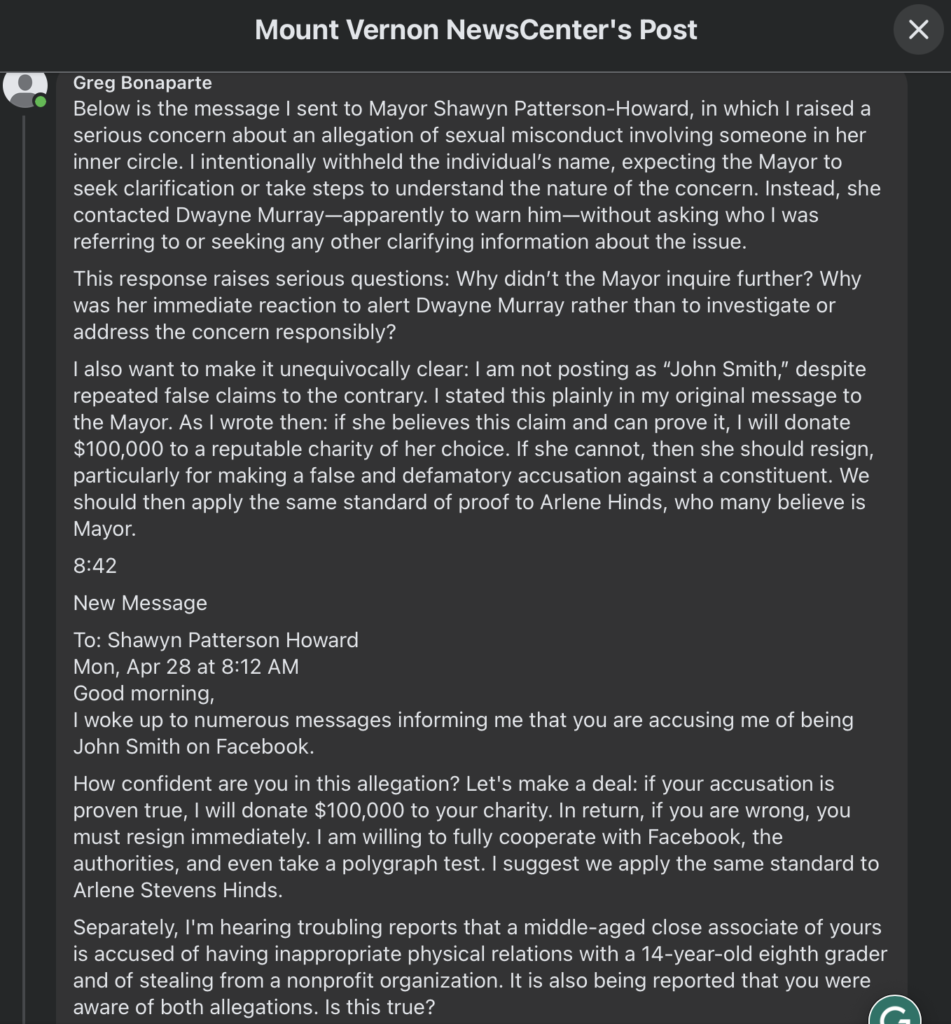
Bonaparte goes further in his public statement by claiming that Patterson-Howard contacted Murray to warn him. That is Bonaparte’s claim, and it must be presented as such since the available evidence on its own does not prove the mayor’s intention. Nevertheless, we need not accept Bonaparte’s interpretation of the mayor’s motives to see the clear question the message raises: if Bonaparte had not told Mayor Patterson-Howard the conversation was about Dwayne Murray, how did she link that message specifically to Dwayne Murray?
DWAYNE MURRAY SAID IT IN HIS OWN WORDS
This is where the story becomes even more significant: Patterson-Howard’s communication with Murray doesn’t stem solely from Bonaparte or the lawsuit; Murray confirmed it in his own words. Before his arrest, he said publicly that on April 28 he “had a chat with Mayor Shawyn Patterson-Howard” and that “she told me she got a text message.”
This acknowledgment matters because it links Murray directly to the April 28 incidents. Although the message Bonaparte displayed does not name Murray, Murray said Patterson-Howard spoke to him and told him he had received a text message. Together, these two facts fill a gap in the timeline that has never been properly explained to the people of Mount Vernon.
Had Patterson-Howard already had information linking Murray to the allegations of sexual misconduct? Was it someone other than Bonaparte who told her about Murray after his message had arrived? Has she had further information which has never been made public? Did she get in touch with Murray and ask him whether the allegation was about him? Although there may be a completely reasonable explanation, the public still doesn’t know it more than a year later.
THE MAYOR’S OWN STATEMENT DOESN’T ANSWER THE QUESTION
Following Murray’s arrest, Mayor Patterson-Howard released an official statement about the inquiry. She described herself as a social worker, a minister, a mayor, and a mandated reporter, and said she takes this duty with “utmost seriousness”. She explained that she had received a “vague, anonymous and suspicious text message with accusations of sexual misconduct”. She added that the message lacked specific details and seemed politically motivated.
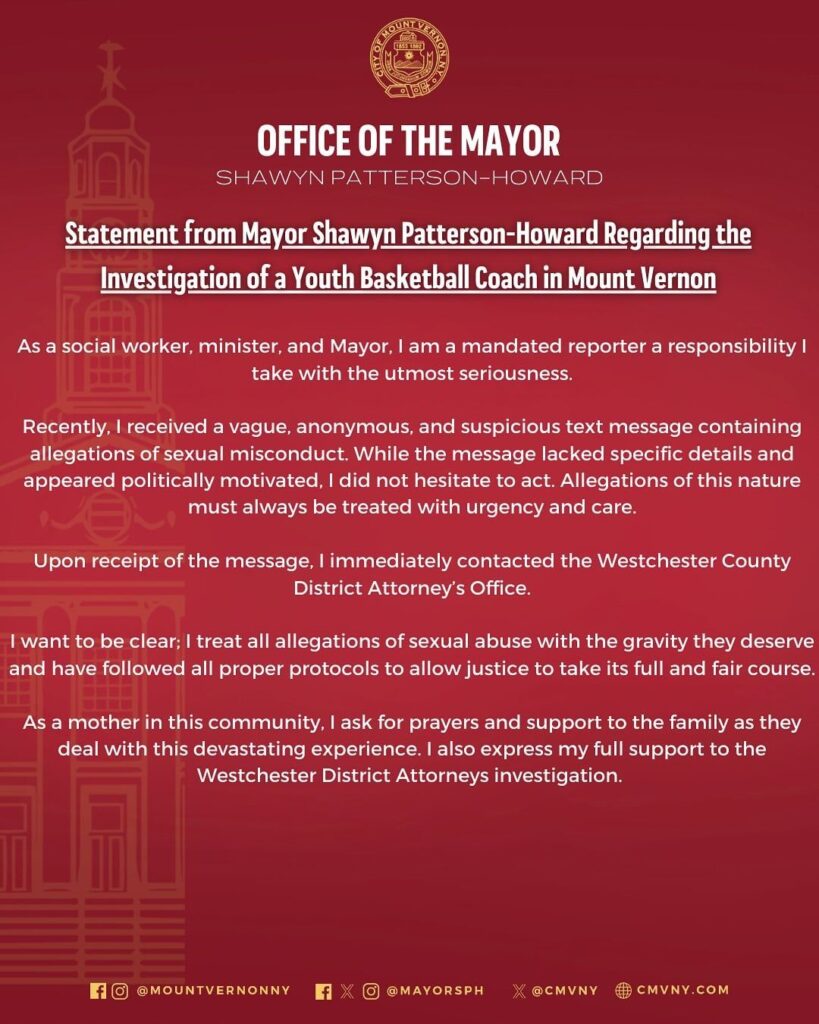
The mayor then made a statement essential to understanding this timeline. “As soon as I received the message, I got in touch with the Westchester County District Attorney’s Office,” Patterson-Howard said, adding that she had adhered to the proper procedures and had expressed her support for the District Attorney’s investigation.
That is how the mayor has presented her official version of the situation, and it should be given a fair hearing. However, her statement does not clarify her dealings with Murray. If Patterson-Howard had contacted the District Attorney’s Office right away, when was she in contact with Murray? Was the District Attorney contacted first and Murray contacted afterward, or was Murray contacted before the District Attorney? The use of the word ‘immediately’ means that it is all the more important to establish the actual order of events.
Even if Patterson-Howard contacted the prosecutors first, one question remains: why did she then contact Murray? If the case had been handed over to law enforcement, did anyone from the District Attorney’s Office tell her to speak to Murray? If she had not been instructed to contact him, what was the point of the conversation? Most important of all, how did she know that the person mentioned in Bonaparte’s message, the one not named, was Murray?
THE DISTRICT ATTORNEY WAS ALREADY INVESTIGATING MURRAY
The importance of the timeline is increased by the fact that Patterson-Howard’s communication on April 28 did not initiate the criminal investigation into Murray; District Attorney Susan Cacace made it public after Murray was arrested that her office had received a tip about Murray on April 12, 2025, more than two weeks prior to Bonaparte sending his message to Patterson-Howard on April 28.
That distinction matters because it would be wrong to say the mayor received the complaint and then passed it on to the prosecutors, thereby starting the investigation. The DA had already been looking into Murray on his own. Later, Patterson-Howard got another message that didn’t mention Murray, went to the District Attorney’s Office, as she herself stated, and also talked to Murray, as Murray has publicly stated.
On May 5, Murray came forward and denied the accusations, calling them false and saying he was willing to answer investigators’ questions. He was arrested on May 14, and at the press conference held by the District Attorney the next day, Cacace said that Murray had made statements about his involvement in the crime during an interview with the investigators. Over a year later, Murray has now entered a formal guilty plea.
THE LAWSUIT MADE AN EVEN MORE SERIOUS ALLEGATION
The lawsuit filed in 2025 went beyond what Murray had publicly admitted about his communications with Patterson-Howard; it claimed the mayor called Murray to City Hall and showed him Bonaparte’s message before his arrest. Patterson-Howard denied the lawsuit and described it as being politically motivated. The allegations about her behavior remain disputed, and Murray’s guilty plea does not prove the claims against Patterson-Howard in the lawsuit.
That distinction matters because Murray’s criminal behavior and Patterson-Howard’s actions are separate issues, and each requires independent evidence. Murray’s guilty plea shows he is responsible for the offense to which he pleaded guilty; it does not show what Patterson-Howard knew on April 28, what her intentions were, why she contacted Murray, or what information she gave him.
Accountability functions in both directions. It is not proper to take Murray’s guilty plea as automatic proof against Patterson-Howard, nor should the contested status of the lawsuit be used as an excuse to ignore valid questions regarding her admitted communications with Murray. A clear distinction exists between accusing the mayor of wrongdoing and asking the mayor to explain what took place.
THE DISTRICT ATTORNEY SHOULD CLARIFY THE TIMELINE
Now the Westchester County District Attorney’s Office is in a special position to make clear the law-enforcement aspect of this timeline; it knows when its investigation started, has already stated that it received its first tip on April 12 and should have the records showing when Patterson-Howard or someone acting on behalf of City Hall contacted the prosecutors on April 28.
The public does not need confidential details concerning the child victim, and no information should be made public that infringes on her privacy or breaches information that is legally protected. However, Mount Vernon voters and taxpayers have a right to know—so far as the law allows—whether the mayor contacted the District Attorney’s Office and whether the prosecutors instructed, advised, or otherwise expected her to speak to Murray.
The court should establish whether the mayor contacted the DA first or whether Murray was contacted first. If the prosecutors were contacted first but did not advise Patterson-Howard to speak to Murray, the mayor should explain why the contact with Murray then took place. The public shouldn’t have to guess about a matter that timestamps, telephone records, emails, or other documentation could establish.
RELEASE THE APRIL 28 TIMELINE
That is why the full April 28 timeline matters. The screenshot Bonaparte took indicates he sent his message at 8.12 a.m. The time when Patterson-Howard contacted the District Attorney’s Office should be identifiable. Likewise, the time she communicated with Murray should be identifiable, as should the means of communication—whether by telephone, text, an in-person meeting, or a combination of those methods.
It is just as important to consider the content of the communication. Was Murray merely informed that the mayor had received a complaint, or was he given specific details? Was he told who sent the message? Was he shown the message? Did Patterson-Howard ask Murray if Bonaparte was referring to him? Such questions are fundamental when assessing the actions of a public official during an extremely serious criminal investigation.
If the records show that Patterson-Howard contacted the prosecutors first and then spoke with Murray without disclosing anything that could have compromised the investigation, then those facts should be made public. If the records show something else, residents also have a right to be told. Transparency must not be based on whether the information makes City Hall look good or bad; it is about revealing what actually took place.
THIS IS ABOUT ACCOUNTABILITY, NOT POLITICAL TEAMS
Mount Vernon has spent too many years turning reasonable questions regarding government into political conflicts. When you ask a question about an elected official, someone immediately wants to know which side you’re on; when you request records, someone says you have an agenda; and when you challenge an official explanation, the discussion soon turns into one about personalities and politics rather than facts.
It must not happen here. A child had been sexually abused, and a well-known member of the community who worked with young people had publicly denied the accusations before eventually pleading guilty to a violent felony involving a child. People from all political backgrounds should want an accurate historical record of this case.
We aren’t interested in the one put forward by the Democrats, the one by the Republicans, the one from City Hall, or the one on social media. We want the version based on documentation. Bonaparte has made clear what he claims to be his original message. Murray, in his own words, admitted that he had correspondence with Patterson-Howard. Patterson-Howard, in her own words, said that she got in touch with the District Attorney at once. The District Attorney said its investigation began more than two weeks earlier.
MOUNT VERNON DESERVES THE ANSWERS
If you combine all the facts, the questions then become simple: How did Mayor Patterson-Howard know that the unnamed ‘middle-aged close associate’ of Bonaparte was Dwayne Murray? Why did she talk to Murray about the message? What specific information was passed on to him? And which one of them was contacted first on April 28, 2025—the Westchester County District Attorney’s Office or Dwayne Murray?
The questions do not assume that the answers are known, nor do they claim that Patterson-Howard acted improperly. They are questions voters and taxpayers are fully entitled to ask when an elected official says he reported the allegations to the authorities and the person at the heart of the later criminal prosecution says she told him she received a text message.
Although Dwayne Murray’s criminal case is drawing to a close, Mount Vernon should not let its questions about April 28, 2025, vanish as a result. The mayor should explain her communications with Murray, the District Attorney should make clear the law-enforcement timeline as far as the law allows, and the records must show the order of events. Provide the voters and taxpayers with the facts and let the people of Mount Vernon come to their own conclusions.