


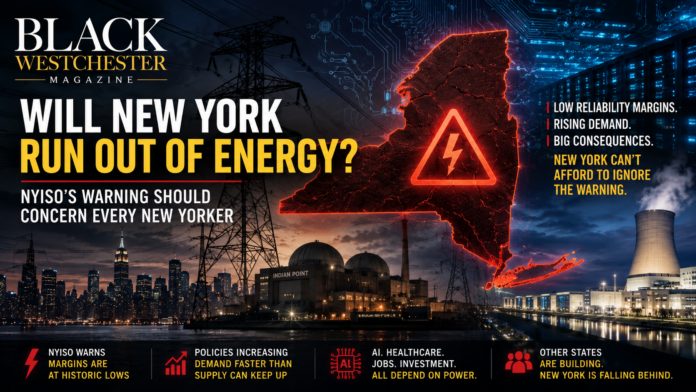





The New York Independent System Operator (NYISO), the organization responsible for managing New York’s electric grid, recently issued a warning that should concern every resident, business owner, hospital administrator, educator, and elected official in the state. While NYISO did not say New York will definitely run out of power this summer, it did warn that the state is entering the season with one of the lowest reliability margins in recent history. In practical terms, that means New York has less room for error if demand spikes during prolonged periods of extreme heat or if generation and transmission problems occur at the same time.
The question New Yorkers should be asking is not whether there will be an emergency this summer. The more important question is how New York reached a point where such a warning became necessary in the first place. For years, state leaders have adopted policies that increase the demand for electricity. Electric vehicles, building electrification mandates, battery storage initiatives, and the broader transition toward an all-electric future have all increased the importance of a reliable power supply. At the same time, the state has removed major sources of dispatchable power generation while struggling to bring replacement capacity online fast enough to meet future needs.
Every public policy should ultimately be measured by outcomes rather than intentions. The outcome today is that the organization responsible for operating New York’s electrical grid is warning that reliability margins are shrinking while demand continues to grow. Regardless of where someone stands in the political debate over energy policy, that outcome deserves serious examination.
The issue extends far beyond keeping the lights on. New York is entering a period in which access to reliable and affordable electricity will become one of the primary factors determining economic competitiveness. Artificial Intelligence, advanced manufacturing, healthcare technology, scientific research, and large-scale data processing all require enormous amounts of electricity. States that can provide reliable power will attract investment, jobs, and innovation. States that cannot will struggle to compete.
This is why the discussion surrounding Indian Point remains important. When the nuclear facility was closed, supporters argued that renewable energy projects, transmission upgrades, and future investments would replace the power that was lost. Critics warned that removing a major source of reliable electricity before replacement infrastructure was fully operational could create long-term reliability challenges. Five years later, NYISO’s warnings about shrinking reliability margins have caused many New Yorkers to revisit that debate.
The significance of this issue becomes even greater when viewed through the lens of Artificial Intelligence. Many people think of AI as a software revolution, but it is also an energy revolution. Data centers require enormous amounts of electricity to power servers, cooling systems, storage infrastructure, and advanced computing operations. As AI becomes integrated into business, healthcare, education, finance, and government, electricity demand will continue to rise.
Healthcare may provide the clearest example of what is at stake. Hospitals and healthcare systems are increasingly adopting AI-assisted diagnostics, medical imaging analysis, patient monitoring systems, predictive analytics, and research tools. These technologies have the potential to improve patient outcomes, reduce costs, and expand access to care. However, all of these advancements depend upon reliable electrical infrastructure. A state that struggles to meet future energy demands risks falling behind in one of the most important technological transformations of the century.
This concern is not limited to healthcare. Universities, research institutions, manufacturers, and technology companies are all making decisions about where to invest based in part on infrastructure reliability. Businesses do not locate billion-dollar facilities where power supplies are uncertain. They invest where they are confident that energy will be available, affordable, and capable of supporting future growth. If New York cannot provide that confidence, investment will increasingly flow to competing states.
What makes this discussion particularly frustrating is the tendency to blame utility companies for problems that originate in public policy. Con Edison did not establish New York’s energy strategy. Con Edison did not decide to close Indian Point. Con Edison did not create electrification mandates or determine how quickly existing generation sources would be replaced. Those decisions were made by elected officials and state policymakers. If the outcome of those decisions is a grid with shrinking reliability margins and growing concerns about future capacity, then policymakers have an obligation to address those results honestly.
Meanwhile, other states appear to be preparing for the future with greater urgency. Across the South, state governments are actively competing for AI investment, data centers, advanced manufacturing facilities, and technology jobs. Many are expanding energy production, upgrading transmission infrastructure, and exploring advanced nuclear technologies. Technology companies understand that Artificial Intelligence is not simply a competition for software engineers. It is a competition for energy. Without electricity, there is no AI economy.
The NYISO warning should therefore be viewed as more than a seasonal concern. It is a warning about whether New York’s current energy strategy is capable of supporting the economy of the future. Artificial Intelligence will continue to expand. Healthcare systems will become more dependent on advanced computing. Research institutions will require greater processing power. Businesses will demand more energy, not less.
The question facing New York is straightforward. Can the state provide the reliable and affordable electricity necessary to support those developments, or will it continue pursuing policies that increase demand faster than supply? The answer will determine not only whether New York remains economically competitive, but whether future generations choose to build their careers, businesses, and lives here or in states that are better prepared for the future.