






By the Numbers
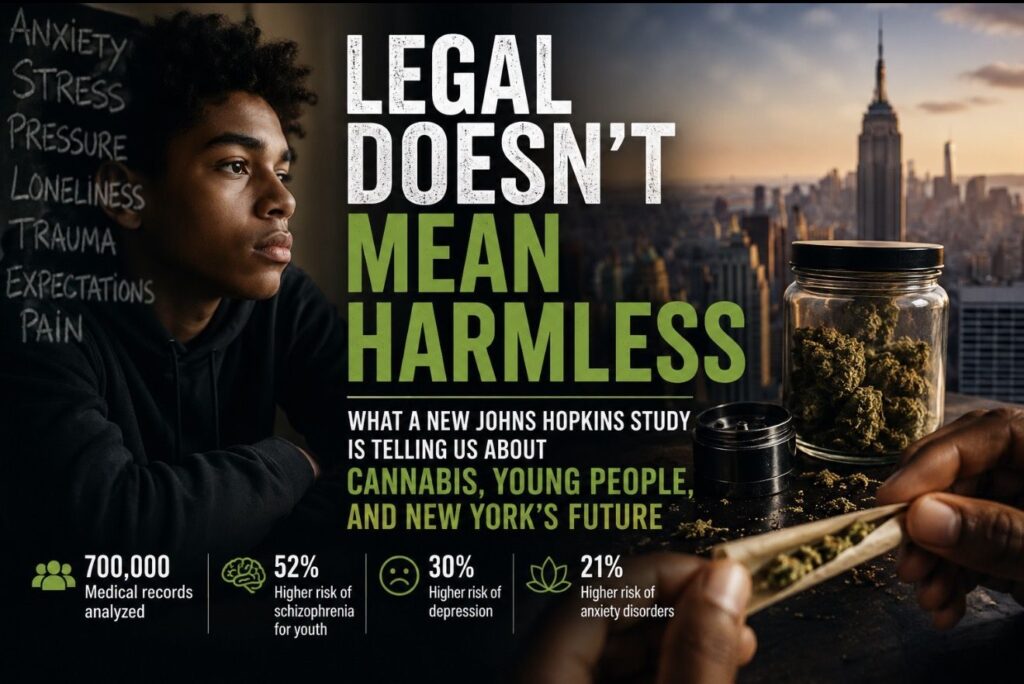
- Nearly 700,000 medical records analyzed.
- 49,586 youth records included participants 17 and younger.
- Young people with cannabis use disorder had:
- 52% higher risk of schizophrenia
- 30% higher risk of recurrent major depression
- 21% higher risk of anxiety disorders
- Nearly 10% of substance use disorders began before age 12.
- A study published in March 2026 in the American Journal of Psychiatry.
For decades, the fight to legalize cannabis centered around justice.
And rightfully so.
Communities of color were disproportionately criminalized. Families were torn apart. Opportunities were denied. Entire neighborhoods bore the weight of policies that punished people more than they protected them.
But now that New York has entered a new era of legalization, perhaps it’s time for another conversation.
Not about criminalization.
Not about morality.
Not about fear.
But about health.
Because just because something is legal doesn’t mean it is harmless.
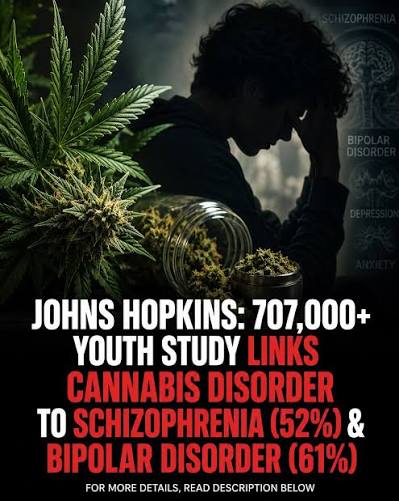
And a new study from Johns Hopkins Bloomberg School of Public Health is asking us to pay attention.
Not panic.
Pay attention.
Researchers analyzed nearly 700,000 medical records comparing individuals with cannabis use disorder, heavy or problematic cannabis use, with people diagnosed with other substance use disorders.
What they found was striking.
Young people 17 and under with cannabis use disorder were 52% more likely to later receive a diagnosis of schizophrenia, 30% more likely to experience recurrent major depression, and 21% more likely to develop anxiety disorders compared with young people using other substances.
Among adults, however, the opposite pattern emerged. Adults with cannabis use disorder actually had lower rates of psychiatric disorders compared with adults using other substances.
What Is This Study Actually Saying?
Let’s slow down.
This study is not saying cannabis causes schizophrenia.
It isn’t saying every teenager who smokes marijuana will develop mental illness.
And it certainly isn’t advocating for a return to the failed war on drugs.
What the study does suggest is that age matters.
Brain development matters.
And heavy cannabis use during adolescence may carry risks that deserve serious attention.
Researchers themselves acknowledge there are still many unknowns.
Perhaps heavy cannabis use accelerates psychiatric disorders in young people.
Or perhaps young people predisposed to anxiety, depression, or psychosis are turning to cannabis to self-medicate before symptoms become fully apparent.
Either way, the message is clear:
Something important is happening.
And we cannot afford to ignore it.
Why This Matters for New York
Cannabis legalization has transformed New York.
Dispensaries are opening across the state.
Edibles are packaged like candy.
High-potency products are more accessible than ever.
And culturally, marijuana has become normalized.
Many teenagers don’t see cannabis as dangerous.
Many parents don’t either.
After all, it’s legal.
But today’s cannabis isn’t the marijuana many adults remember from decades ago.
Today’s products contain significantly higher levels of THC.
And while legalization has created economic opportunities and corrected some historical injustices, legalization without education creates vulnerability.
Especially among young people whose brains are still developing.
What This Means for Our Communities
For Black and Brown communities, conversations around cannabis are complicated.
We know what over-policing has done.
We know families that suffered because of criminalization.
We know people who are still living with the consequences of laws that have since changed.
But protecting our communities and protecting our children are not opposing ideas.
Both can be true.
We can support legalization and still acknowledge risk.
We can reject stigma and still embrace science.
We can fight for equity and still educate our youth.
Because love requires honesty.

Perhaps the Bigger Story Is Pain and Unaddressed Trauma
Underneath all the statistics, this study points us toward something much deeper than cannabis.
It forces us to ask uncomfortable questions.
Why are so many young people trying to escape?
Why are anxiety and depression increasing among children and adolescents?
Why are teenagers seeking relief before they’ve even fully discovered who they are?
Perhaps marijuana itself isn’t the whole story.
Perhaps the bigger story is pain and unaddressed trauma.
Perhaps beneath the diagnoses and the data is a generation of young people trying to regulate nervous systems overwhelmed by experiences they were never given the language or support to process.
Adverse childhood experiences.
Community violence.
Bullying.
Family instability.
Loss.
Grief.
Social isolation.
Academic pressure.
The endless comparison machine called social media.
Intergenerational trauma passed down in silence.
Because trauma doesn’t disappear simply because we don’t talk about it.
It doesn’t vanish because we tell children to “be strong.”
It doesn’t leave because adults are uncomfortable with emotions.
Trauma adapts.
Sometimes it becomes anxiety.
Sometimes depression.
Sometimes rage.
Sometimes perfectionism.
Sometimes numbness.
And sometimes, it looks like self-medication.
A substance often becomes a solution when healthier tools are unavailable.
And perhaps that’s what this study is quietly inviting us to consider.
Not simply whether cannabis is dangerous.
But what pain young people may be trying to soothe.
Because behavior is communication.
And symptoms are often messengers.
A New Public Health Conversation
This study is not asking us to fear our children.
It is inviting us to understand them.
To become curious instead of judgmental.
To ask different questions.
Not: “What’s wrong with you?”
But: “What happened to you?”
“What hurts?”
“What are you carrying?”
Maybe the next chapter of public health in New York shouldn’t begin with punishment or panic.
Maybe it begins with prevention.
With emotional literacy.
With trauma-informed schools.
With accessible mental health care.
With nervous system awareness.
With spaces where young people can speak before they smoke, cry before they collapse, and heal before they numb.
Because no substance, legal or illegal, should become the primary language our children use to communicate pain.
And perhaps that is what this study is ultimately asking us to pay attention to, not simply what our young people are consuming, but what they are carrying.
Because if legalization is the conversation, healing must be part of it too.
And if we truly want to protect the next generation, perhaps the deeper question isn’t merely:
“What are our children using?”
Perhaps the question is:
What kind of world have we built that makes escape feel easier than being present?
And what kind of world are we willing to build where healing becomes easier than escape?
Because our children deserve more than access.
They deserve tools.
They deserve language.
They deserve connection.
And above all, they deserve a world that teaches them how to live with pain, not simply how to run from it.
If this study teaches us anything, it’s that prevention is bigger than prohibition.
Perhaps protecting the next generation isn’t simply about telling young people what not to use.
Perhaps it’s about teaching them how to feel.
How to grieve.
How to regulate.
How to name what hurts.
How to ask for help.
How to build the internal capacity to navigate life’s inevitable storms.
If you are a parent, educator, clinician, faith leader, youth-serving organization, or policymaker, now is the time to invest in trauma-informed spaces, emotional literacy, and nervous system education that helps young people process pain before they attempt to numb it.
Because healing is not a luxury.
It is infrastructure.
And if legalization is part of New York’s future, then emotional wellness must be part of its public health strategy.
The conversation cannot end with access.
It must continue with awareness.
And ultimately, with healing.
Because our children deserve more than warnings.
They deserve tools.
For speaking engagements, trainings, and community conversations on trauma-informed care, nervous system awareness, and building emotional capacity in youth and communities, contact: Larnez Kinsey, Founder & Principal Consultant of BlackGate Consulting Group LLC EMAIL: BlackGateCG@gmail.com – Phone: (914) 953-0877