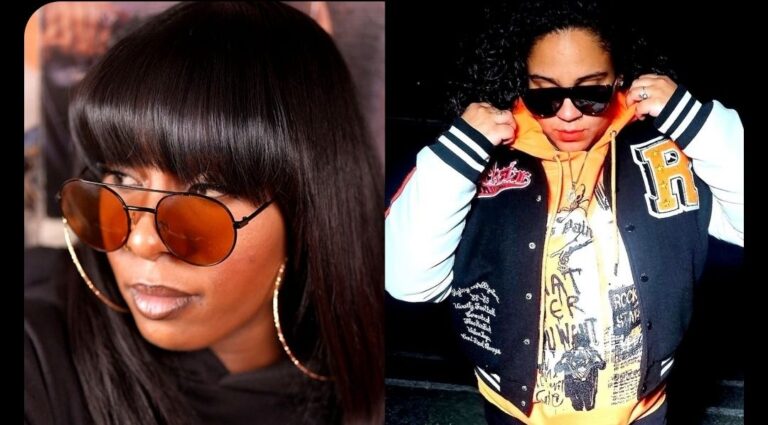
While much of the conversation surrounding rap focuses on the industry’s biggest stars, two Yonkers artists are proving that longevity, perseverance, and purpose continue to define the city’s rap scene.
For Julisa Robinson, better known as JuJu F’n Baby, music has been a lifelong passion shaped by family and experience. Growing up around DJs, she developed a love for hip-hop at an early age and later performed with rap groups before building her own identity as a solo artist. Today, she performs at open mic events throughout New York and New Jersey and is preparing to take her music to Puerto Rico.
A mother herself, JuJu says her greatest inspiration is her son. Looking back, she wishes she had stopped doubting herself sooner and ignored people who tried to dim her light. She also recalls nearly being signed at the former Yonkers nightclub Razzous, a moment that reinforced how close opportunity can be. Beyond performing, JuJu has also shared her passion by teaching young people how to write songs. One of the artists who inspires her most is 50 Cent.
JuJu F’n Baby won the “Good Stock” open mic championship in 2025 at the Yonkers Brewing Company, and she followed it by winning the Female Breakout Artist of the Year award at the MoneyStylesNYC Awards. She has been dominating the local Hip-Hop scene with her producer, Rico Cookin Beats.
Lady Slim, born Kitreace Harris, is an independent Hip-Hop recording artist and songwriter raised in Yonkers, New York. Respected throughout the local music community for her razor-sharp lyricism, fearless authenticity, and commanding presence, she remains deeply committed to representing her city and helping preserve, strengthen, and elevate Yonkers’ rich Hip-Hop culture.
Lady Slim’s journey began at a young age; she began rapping at just nine years old. She gained widespread local exposure, where she holds her own with her standout verse on the hit regional anthem “So Yonkers” by Cash B, a collaborative track showcasing the city’s diverse talent and unity.
A graduate of Lincoln High School, Lady Slim has been rapping since childhood and brings far more than lyrical ability to the stage. A versatile musician, she sings, raps, and plays the drums, giving her a well-rounded musical foundation and dynamic performance style. Like fellow Yonkers artist JuJu, Lady Slim also sharpened her skills performing at Razzous, one of the city’s notable showcases for emerging local talent.
Now a parent, Lady Slim says motherhood has changed her perspective, sharpened her priorities, and strengthened her determination to succeed. Her advice to aspiring artists is direct and practical: save your money, remain focused on building your career, and never allow relationships or distractions to pull you away from your goals. Musically, she draws inspiration from influential artists such as Lauryn Hill, whose honesty, versatility, and powerful storytelling continue to resonate with her.
JuJu F’n Baby and Lady Slim—“Baby and Slim,” but not the famous New Orleans duo—are carving out their own lane and making serious noise in Yonkers’ growing Hip-Hop scene.
Keep an eye on both artists as they continue striving in their careers.
The City’s toughest housing rhetoric has been aimed at private landlords. But if equal accountability is the standard, New York’s own public housing should lead the way.
Mayor Zohran Mamdani has made holding private landlords accountable one of the defining themes of his administration. Press conferences. New inspection initiatives. Public hearings. Tough rhetoric. The message is clear: negligent landlords will be held accountable.
No reasonable person should oppose safe housing. Every New Yorker deserves to live in an apartment free of mold, leaks, broken heat, pests, and unsafe conditions. Private landlords who violate the law should absolutely be held accountable.
But there is one question City Hall has yet to answer.
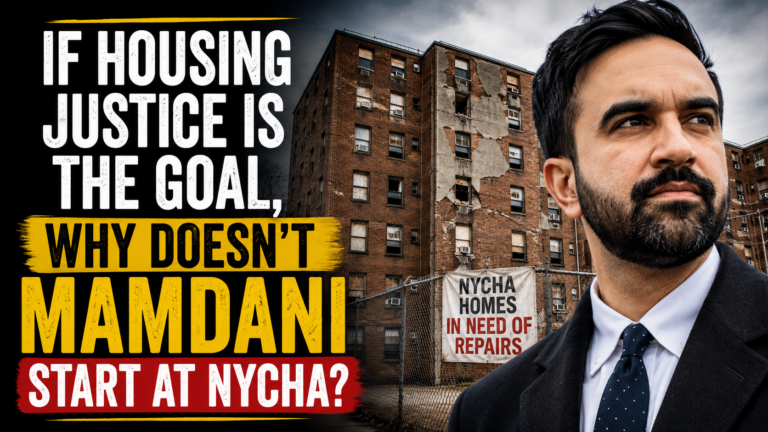
If housing justice is truly the goal, why doesn’t it start at NYCHA?
The New York City Housing Authority is home to nearly 280,000 residents, including more than 120,000 Black New Yorkers. These are some of the poorest families in the city. Many are seniors, people with disabilities, veterans, and working families living on limited incomes. They often cannot simply move if conditions become unbearable. They depend on the City to provide safe, decent housing.
Yet the administration’s most visible housing campaign has been directed at private property owners through aggressive inspections, enforcement actions, and public “Rental Ripoff” hearings, while NYCHA continues to struggle with long-standing complaints involving mold, heating failures, broken elevators, water leaks, pests, and delayed repairs.
To be fair, Mayor Mamdani has committed significant funding to NYCHA. His administration has announced a long-term investment plan totaling approximately $5.6 billion for repairs, modernization, and restoring vacant apartments. Investment in public housing is necessary, and no one should dismiss the importance of funding.
But funding alone is not accountability.
Every mayor in recent history has announced new money for NYCHA. The question is not whether dollars have been allocated. The question is whether City Hall is holding itself to the same visible standards it demands of private landlords.
The contrast has not gone unnoticed by the very people City Hall says it wants to protect.
When Mayor Mamdani launched his highly publicized “Rental Ripoff” hearings, many NYCHA residents asked a simple question: Why aren’t we included? Residents pointed out that they continue to live with many of the same conditions the Mayor condemns in private housing. Their concern was not that private landlords should receive less scrutiny, but that NYCHA should receive the same level of urgency and accountability.
Those complaints are not new. For years, NYCHA residents and community organizations have documented deteriorating living conditions throughout the City’s public housing system. During this year’s budget debate, a coalition that included NYCHA residents criticized the Mayor’s housing priorities, arguing that he had retreated from campaign promises on housing assistance. The frustration reflects a broader concern that the City’s most visible housing campaign has focused on private landlords while public housing remains plagued by longstanding problems.
This is not an argument against enforcing housing laws. It is an argument for enforcing them consistently.
If aggressive inspections, public hearings, transparency, and public accountability are the right approach for private landlords, then why isn’t the City applying those same visible standards to NYCHA—the largest landlord in New York City?
Imagine if the same inspection model used against private landlords were applied to NYCHA. Imagine public hearings dedicated solely to NYCHA conditions. Imagine publicly released inspection reports for every development. Imagine firm repair deadlines with regular public progress updates. Imagine the Mayor standing inside deteriorating NYCHA developments with the same frequency he stands in front of privately owned buildings announcing new enforcement actions.
Government should lead by example. If the City expects every private landlord to provide safe and dignified housing, then it should hold itself to at least the same standard. Housing justice should begin with the housing the City owns.
Housing justice cannot be selective.
If Mayor Mamdani wants to build a lasting legacy on housing reform, that legacy should begin with the families who have the fewest choices. It should begin with NYCHA residents. They deserve not only billions in investment, but also the same inspections, transparency, public scrutiny, and accountability that the administration demands from every private landlord.
Until that happens, New Yorkers will continue to ask a simple question:
If housing justice is the goal, why doesn’t it start at NYCHA?
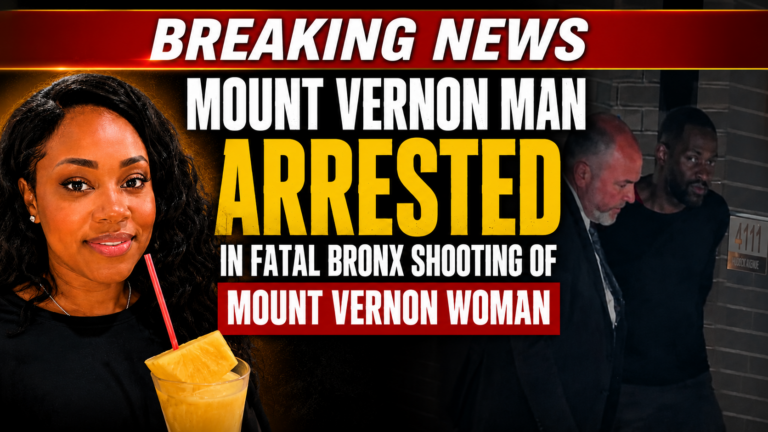
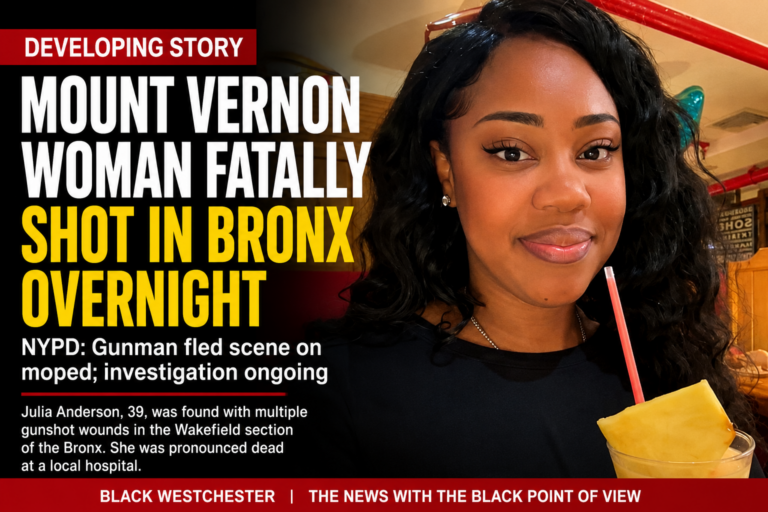
A Mount Vernon man has been arrested and charged in connection with the fatal shooting of a Mount Vernon woman in the Wakefield section of the Bronx earlier this week.
The New York City Police Department announced that 58-year-old Michael Foster, of Mount Vernon, was taken into custody Wednesday evening in connection with the death of 39-year-old Julia Anderson, who was shot multiple times shortly before midnight on Murdock Avenue near the Westchester County border.
According to police, Foster has been charged with murder, manslaughter, and ten counts of criminal possession of a weapon.
Authorities previously said Anderson was found suffering from multiple gunshot wounds to the chest and was transported to a nearby hospital, where she was pronounced dead. The suspect was initially reported to have fled the scene on a moped, prompting an intensive investigation by NYPD detectives.
Investigators have confirmed that Foster and Anderson shared the same Mount Vernon address. Family members told News 12 that Foster was Anderson’s uncle. While some media reports have suggested the shooting may have stemmed from a dispute involving an inherited family home, the NYPD has not officially confirmed a motive.
Following news of the arrest, Mount Vernon Councilman André Wallace offered his condolences to Anderson’s family.
“Julia’s life mattered. She was more than a headline or a news story—she was a daughter, a relative, a friend, and a valued member of our Mount Vernon community. Her loss is felt not only by those who knew and loved her but by our entire city,” Wallace said.
The investigation remains ongoing. Anyone with additional information is encouraged to contact the NYPD Crime Stoppers hotline.
Black Westchester extends its deepest condolences and prayers to the family and loved ones of Julia Anderson as they continue to mourn this tragic loss.
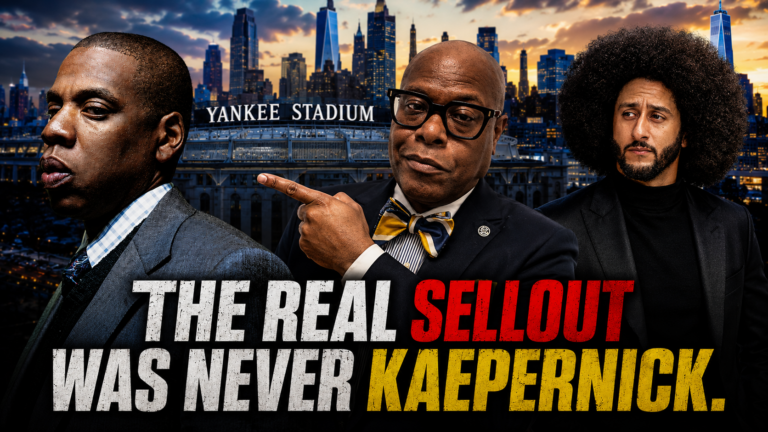
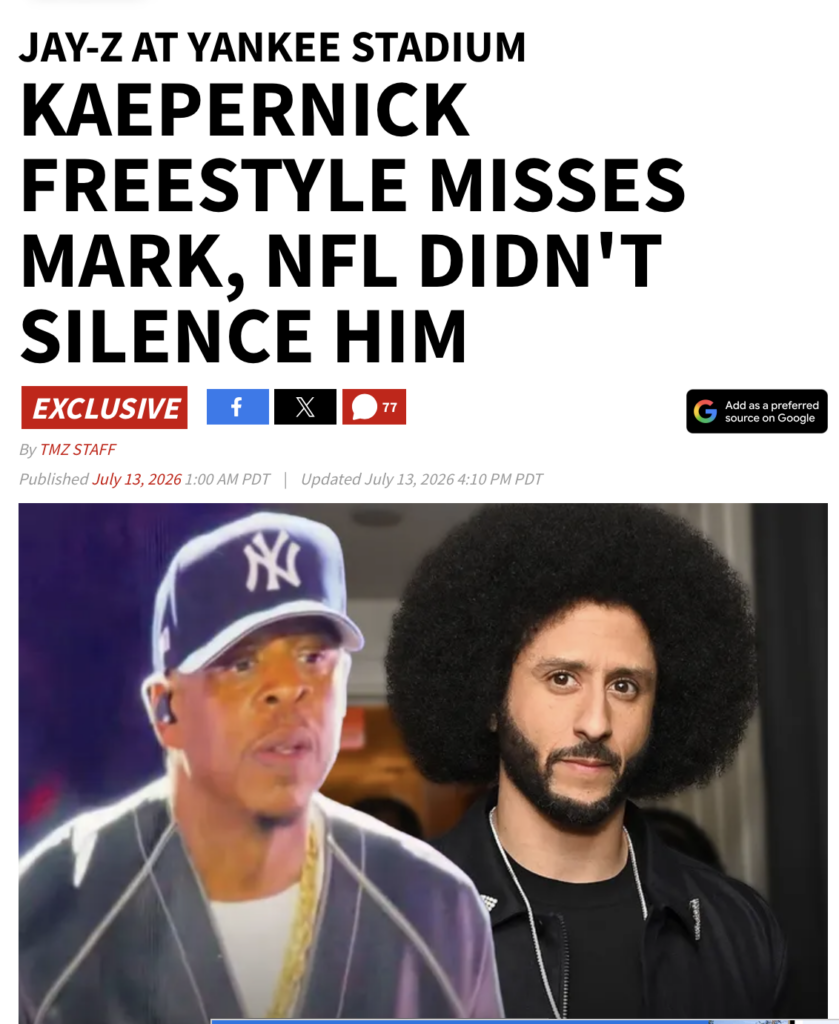
Jay-Z stood on a Yankee Stadium stage this month and took a shot at Colin Kaepernick, rapping that the former quarterback “took a check” and had to “sign a non-disparagement” agreement to get it — the price, apparently, of his silence. There’s just one problem: according to TMZ Sports, sources with direct knowledge of Kaepernick’s 2019 NFL settlement say no such clause exists. That matters, because it turns Jay-Z’s rhyme into an onstage lie. Kaepernick has spent years publicly speaking about what being blackballed by the league cost him, and how he’s turned that setback into a platform. That’s not the behavior of a man who signed his voice away.
So if anyone in this story sold their silence, it wasn’t Kaepernick. It was Jay-Z who went quiet — and worse, went to work for the very institution that Black America was protesting on Kaepernick’s behalf, and on behalf of the countless families of Black men and women who have been unjustly shot, shot at, or killed by police and are still fighting for justice.
“We’re Past Kneeling”
Let’s remember how we got here. In August 2019, standing next to NFL Commissioner Roger Goodell — the same commissioner presiding over a league that had frozen Kaepernick out for kneeling — Jay-Z announced Roc Nation’s partnership with the NFL and told reporters: “I think we’ve moved past kneeling. I think it’s time to go into actionable items.”
Players who were still kneeling at the time didn’t take it well. Panthers safety Eric Reid, who knelt alongside Kaepernick and filed his own collusion grievance, called the comments “asinine” and asked the obvious question: “When has Jay-Z ever taken a knee to come out and tell us that we’re past kneeling?” Dolphins receiver Kenny Stills said the NFL had done “a good job shifting the problem onto Roc Nation and Shawn Carter’s shoulders, instead of themselves.” Kaepernick’s own Instagram response praised the players still kneeling — a pointed contrast to the man who’d just declared the gesture obsolete.
This wasn’t a nobody weighing in from the sidelines. This was a man who had worn a Kaepernick jersey on Saturday Night Live, who had turned down the Super Bowl halftime show himself and bragged about it on record — “I said no to the Super Bowl: You need me, I don’t need you” — becoming, within months, the league’s paid entertainment strategist and the public face of the same controversy he once stood inside of.
Same Story, Different Decade
Fast forward to 2026, and the pattern repeats. Target has been the subject of a boycott led by Pastor Jamal Bryant and organizers such as Nekima Levy Armstrong and Jaylani Hussein since the retailer rolled back its DEI commitments and pledges to Black-owned businesses. Whatever you think of the boycott’s effectiveness, it was a real, organized stand by Black consumers, with named organizers and stated demands.
Jay-Z’s answer was to cut an exclusive vinyl deal with Target for the 30th anniversary of “Reasonable Doubt.” Boycott organizer Monique Cullars-Doty didn’t mince words, saying the move amounted to helping “aid and support white supremacy” against the very community Jay-Z claims to represent. When he finally addressed it on stage, he didn’t apologize or explain — he deflected, accusing his critics of “picking and choosing” which corporations to boycott, even as his own deal gave Target a high-profile win during the boycott.
The Pattern Is the Point
The throughline is the same: when Black people organize a boycott or a protest against a powerful institution, Jay-Z finds a business reason to align with that institution instead — and then reframes the criticism he receives as the real problem. He wasn’t the one who lost a career over a knee. He wasn’t the one whose settlement terms were picked apart on stage by a billionaire looking for a rebuttal to his own bad press. Kaepernick gave up his job and, by every available account, never gave up his voice.
If there’s a sellout in this story, it’s not the man still unemployed for a protest a decade later. It’s the man who keeps finding a paycheck on the other side.
Controversy sells, and Jay-Z knows that better than almost anyone alive. But amid this controversy, he has shown us exactly who he really is. The question now isn’t what he’ll say next — it’s whether Black America will finally believe him.
A 39-year-old Mount Vernon woman was shot and killed late Monday night in the Wakefield section of the Bronx, just steps from the Westchester County border, according to the New York City Police Department.
Police identified the victim as Julia Anderson, a Mount Vernon resident who lived less than a mile from the scene of the shooting. Authorities say Anderson was found with multiple gunshot wounds to the chest shortly before midnight near the intersection of Murdock Avenue and Nereid Avenue. She was transported to a nearby hospital, where she was pronounced dead.
Investigators recovered multiple pieces of evidence at the scene, including shell casings near a black Jeep that had been struck by gunfire. The vehicle’s front passenger-side window was shattered by bullets.
Residents who live nearby told local media they heard two gunshots followed by a woman screaming for help moments before police arrived. Witnesses also reported seeing a moped speeding away from the area immediately after the shooting, although investigators have not confirmed whether the rider was involved in the homicide.
At this time, the NYPD has not released a description of a suspect or announced any arrests. Detectives are continuing to investigate what led to the fatal shooting and are asking anyone with information to contact the NYPD Crime Stoppers hotline.
The killing has drawn attention in Mount Vernon because the shooting occurred just across the city line in the Wakefield neighborhood, an area frequently traveled by residents of southern Westchester.
Black Westchester will continue to follow this developing story and provide updates as additional information becomes available, including any announcements regarding arrests, funeral arrangements, or community responses.
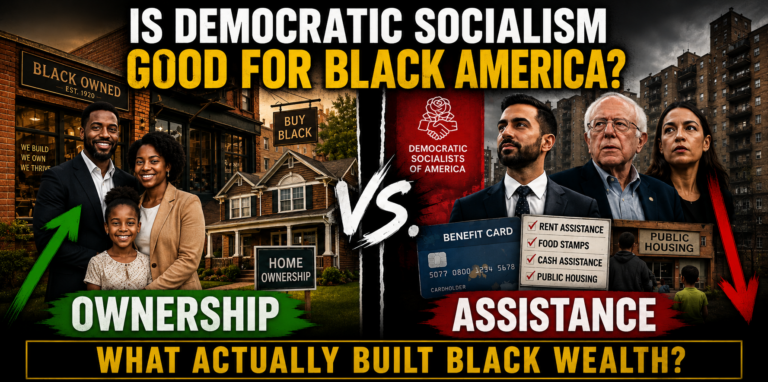
There’s a pattern in American politics where a movement adopts the language of racial justice and assumes that settles the question of whether its policies actually serve Black interests. Democratic socialism, and its leading vehicle, the Democratic Socialists of America, is the latest version of this. It’s worth asking, plainly and without deference to the rhetoric: does this platform actually build Black wealth and independence? The historical record — and the platform’s own design — suggests the answer is no, not in the way that matters most to Black Americans.
What Actually Built Black Wealth Before
After emancipation, Black Americans built a distinct economy almost entirely from nothing — no government safety net, no War on Poverty, no minimum wage law. Black-owned banks, insurance companies, hotels, newspapers, HBCUs, and thriving commercial districts like Tulsa’s Greenwood, Atlanta’s Sweet Auburn, Chicago’s Bronzeville, and Harlem emerged through private capital, mutual aid, and entrepreneurship, often under the weight of Jim Crow segregation and outright violence. This is the closest thing America has to a controlled experiment in what builds wealth for a community starting with almost none: ownership. Land, businesses, banks, and property — not transfer payments — is what generated fast, visible economic progress even under hostile conditions.
The tragedy of that era isn’t that conditions were good. They weren’t — this was a period of legal exclusion and, for much of it, slavery itself. The tragedy is that a real, working model of Black wealth-building was repeatedly destroyed, sometimes by mob violence with no legal recourse, and later by New Deal and postwar programs — FHA-backed mortgages, the GI Bill, union protections — that built enormous middle-class wealth for white America while structurally excluding Black Americans from the same tools.
What the Later Programs Actually Delivered
The next large-scale attempt to close the gap, Lyndon Johnson’s War on Poverty and Great Society, tells a more mixed story than either side likes to admit. Black poverty rates did fall substantially in the years after 1964. But the programs were built around income support and consumption — food stamps, cash assistance, Medicaid — not asset ownership. Six decades later, the wealth gap between Black and white Americans remains enormous, and some economists and historians argue the design of these programs, particularly benefit structures that penalized two-parent households, contributed to family instability without building the kind of durable, transferable wealth that homeownership or a business does. Whatever one concludes about that debate, one thing is clear: none of it closed the wealth gap the way the private, ownership-based institution-building of 1865–1920 did, dollar for dollar of effort.
Where DSA’s Platform Fits
This is the lens through which to evaluate what democratic socialism is actually offering now. Look at the flagship policies: rent control and expanded public housing, universal benefits, and a $30-an-hour minimum wage now moving through New York City’s Council. Each addresses affordability or income in the moment. None of them builds ownership.
The minimum wage proposal is the clearest case. Small businesses — where Black ownership is disproportionately concentrated — operate on some of the thinnest margins in the economy: 1–3% for grocery stores, 3–9% for restaurants, 3–8% for retail. A jump from $17 to $30 an hour, a 76% increase, isn’t a marginal cost adjustment for businesses like these; for many, it consumes the entire margin. Economists sympathetic to the policy, including the Economic Policy Institute, have acknowledged this proposal goes well beyond anything the existing research on minimum wage effects can confidently predict. The most likely outcomes for thin-margin, undercapitalized small businesses — disproportionately Black-owned, with less access to credit and cash reserves than their competitors — are hiring freezes, reduced hours, or closure. Larger, better-capitalized firms can absorb the cost far more easily, which risks squeezing out exactly the kind of independent Black-owned businesses that history shows are the actual engine of Black wealth-building.
New York City’s own numbers make the stakes concrete: the median white household in the city holds roughly $276,000 in wealth; the median Black household holds about $18,000. Mamdani’s administration has proposed a “Racial Equity Plan” naming this gap directly — a genuinely notable step. But as of this writing, it remains a plan still in public comment, with no implementation record, and it has already drawn skepticism from Black political commentators, including in the Black press, who’ve questioned whether Black interests are being prioritized in practice or simply invoked rhetorically.
The Immigration Question
There’s another piece of this that can’t be left out: the sense in some Black communities that migrants have been prioritized over them in the allocation of scarce city resources. This isn’t an abstract grievance. New York City has spent more than $7.5 billion on shelter and services for asylum seekers over the past three years, with annual spending peaking near $3.7 billion in a single fiscal year. That is real money, spent at real scale, in a city that simultaneously cannot find the funding to close a $276,000-to-$18,000 wealth gap between white and Black households. When city leadership — including DSA-aligned officials — treats one form of need as an emergency requiring billions in immediate, uncapped spending, while treating generational Black economic disparity as a plan still open for public comment, it’s fair to ask what that says about actual priorities versus stated ones.
Here, precision matters. National polling that shows “Black Americans” favor immigration typically treats Black America as one undifferentiated group — but that blends together descendants of American chattel slavery with a growing population of Black immigrants and their children, who now make up roughly a quarter of the Black population nationally and arrive, on average, with higher education and income levels. Those are two populations with different starting points and, often, different material interests. A poll showing broad favorability toward immigration doesn’t tell you what descendants of American slavery specifically think about competition for entry-level jobs, housing, and shelter resources in their own neighborhoods — because the sample isn’t asking that question.
That distinction is at the center of a real, if contested, current within Black political thought — sometimes organized under the banner of “Foundational Black Americans” or “American Descendants of Slavery” — which argues that lineage-based experience, not race alone, should shape how policy priorities and even reparative claims are defined. It’s a position some mainstream Black commentators and scholars have pushed back on, arguing it risks dividing Black communities rather than building solidarity. But the underlying grievance driving it is concrete and locally verifiable: Black elected officials and community organizers in New York have documented real strain — competition for entry-level jobs, shelter and housing resources stretched thin, and city contracts flowing to migrant-services nonprofits while long-promised investment in Black neighborhoods lags. Whatever one thinks of the broader framework, that specific tension is real, and it’s the one felt directly by the communities descended from American slavery — not an abstraction settled by a national poll. A movement that claims to center racial equity has an obligation to reckon with that tradeoff honestly, rather than assume solidarity by default because both groups are treated as marginalized under the same broad political framework.
Mamdani’s own words gave this critique a concrete anchor. In his November 2025 victory speech, he declared that “New York will remain a city of immigrants, a city built by immigrants, powered by immigrants, and as of tonight, led by an immigrant” — a line that made no mention of the enslaved Black New Yorkers who built the city’s early economy and infrastructure centuries before its major immigration waves. The omission didn’t go unnoticed. Months later, during Black History Month, Mamdani himself publicly apologized, acknowledging he had been “guilty” of overlooking Black New Yorkers’ role and that “when we tell a sweeping generalization like that, we lose sight of the fact that Black New Yorkers helped to build New York City.” The moment wasn’t an isolated slip — it echoed a nearly identical controversy involving a Grammy-winning artist’s acceptance speech around the same time, one significant enough that Martin Luther King Jr.’s daughter, Bernice King, publicly weighed in to insist Black Americans “have also built this country.” That this correction only came after visible public pressure from Black voices and outlets is itself the point: the default framing overlooked Black America, and it took Black America speaking up to correct it.
The Deeper Problem
There’s also a demographic reality worth naming without discomfort: DSA’s own membership is roughly two-thirds white and disproportionately college-educated — whiter than the country as a whole. That doesn’t automatically invalidate its policy positions. But it’s a fair basis for skepticism when an organization built primarily by a different demographic invokes “racism” and “white supremacy” as blanket explanatory frameworks while offering little in the way of ownership-focused, wealth-building policy specifically designed around what has historically worked for Black Americans. Treating every disparity as requiring the same redistributive answer isn’t just imprecise policy — it can be its own form of condescension, assuming Black Americans can’t distinguish a specific, documented instance of discrimination from a broad ideological narrative applied uniformly.
The faces at the front of the movement reinforce the same pattern. The most nationally visible DSA-aligned figures right now are Mamdani, an immigrant born in Uganda; Bernie Sanders, who is white; Alexandria Ocasio-Cortez, who is of Puerto Rican descent; and Rashida Tlaib, who is Palestinian-American. None are descendants of American slavery. That doesn’t prove any of them lack genuine concern for Black Americans specifically — intent is hard to prove either way, and it would be a mistake to assume bad faith just from a leadership photo. But it’s a legitimate basis to ask the movement to demonstrate, not just declare, that Black wealth-building is a real priority rather than a rhetorical one — and to ask why, in an organization that talks about race as often as DSA does, that leadership layer doesn’t yet include a prominent voice from the community most directly affected by the wealth gap it claims to be organizing around. Black voters delivered real margins for Mamdani and other DSA-backed candidates. Whether that translates into a leadership table that reflects those voters, or policy shaped with them at the table rather than just counted at the ballot box, is the question that will actually answer whether the interest is genuine or transactional.
What Would Actually Be Different
None of this means every individual policy on the democratic socialist platform is without merit — universal healthcare, for instance, addresses real and well-documented disparities in coverage and outcomes, and polls reasonably well among Black voters on its own terms. The point isn’t that everything the DSA proposes is bad. The point is narrower and more precise: as currently designed, this platform prioritizes income relief and cost-of-living support over ownership and asset-building, and that is a real mismatch with the model of wealth creation that has actually worked for Black Americans historically — one built on banks, businesses, land, and institutions, not benefit checks.
If Black communities want their next chapter of economic progress to look more like Greenwood than like the stalled wealth gap left behind by the Great Society, the platform to demand isn’t one that manages poverty more generously. It’s one that puts capital, credit, and ownership directly into Black hands — and judges itself by whether Black-owned businesses and Black household wealth actually grow, not by how loudly it names the problem.
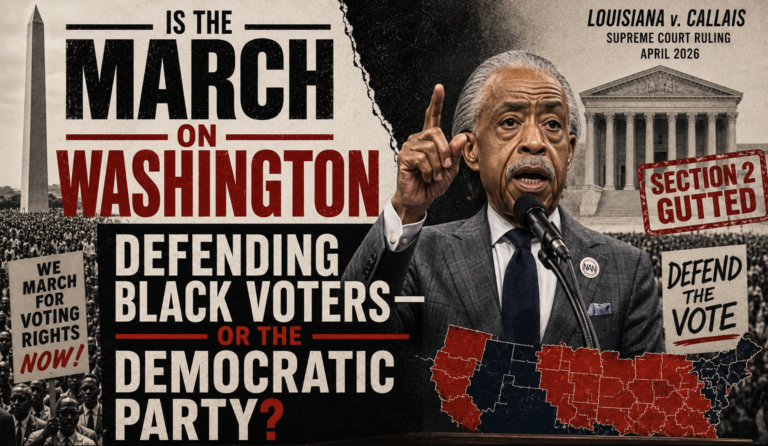
On August 28, 2026, Rev. Al Sharpton will lead thousands to the National Mall for the “March on Washington: Defend the Vote,” marking the 63rd anniversary of the original 1963 march. The occasion is the Supreme Court’s April ruling in Louisiana v. Callais, which gutted Section 2 of the Voting Rights Act and triggered a scramble across Southern states to redraw congressional maps in ways that will likely cost Black communities several House seats this cycle — possibly the largest single-election loss of Black representation since Reconstruction.
That is a real and consequential legal development. It deserves scrutiny, litigation, and organizing. What it doesn’t obviously deserve is another march — at least not without first asking a harder question: what, exactly, are we trying to protect, and does marching actually protect it?
Nobody is losing the right to vote.
Let’s be precise about language, because precision has been the first casualty of this debate. No Black citizen in Louisiana, Alabama, Tennessee, or anywhere else has been denied a ballot, turned away at a polling place, or stripped of the legal right to cast a vote. Even Alabama’s own attorney general has pointed out the state is seeing record turnout. What’s actually being contested is representation — whether a district’s lines let a bloc of voters elect the candidate of its choice. That’s a legitimate issue, but it is not the same issue as the one the marketing around these marches implies. Calling redistricting “the new Jim Crow” or “voter suppression” collapses two very different harms into one, and that conflation makes it harder, not easier, to have an honest conversation about what’s actually happening.
The selectivity problem.
If the principle is “protect Black political power from being displaced by the mechanics of redistricting,” then the principle should have applied in 2022 — because that single round of New York redistricting hit two Black members of Congress at once, and it undid something historic in the process. In 2020, Jamaal Bowman and Mondaire Jones became the first two Black members of Congress in Westchester County’s history, elected in the same cycle, representing neighboring, overlapping communities. Two years later, that same redistricting round took it apart.
Mondaire Jones — one of the first two openly gay Black members of Congress — was redistricted out of his own seat by a fellow Democrat, Sean Patrick Maloney, who used the newly drawn lines to move into Jones’s district rather than defend his own. Jones stepped aside. Maloney went on to lose the general election to Mike Lawler, a Republican, who holds the seat to this day.
In that same 2022 map, Jamaal Bowman’s neighboring 16th District lost Co-op City — a Bronx housing development with more than 40,000 mostly Black residents — while gaining more of white, suburban Westchester County. The district’s Black population dropped nine points in that single redraw, while its white population rose from a third to nearly half. Bowman survived that round; two years later, on a subsequent map, he lost his seat entirely to a white-primary challenger.
Two Black incumbents, hit by the same redistricting cycle at the same time by their own party — the first two Black congressmen Westchester County had ever had- were undone within two years of making that history. Where was the march for either of them? Where was the statement condemning a Democrat’s district-hopping that cost the party a Black member of Congress and, eventually, the seat itself, or condemning a map that stripped 30,000 Black, Hispanic and Asian residents out of another Black incumbent’s district? Neither the National Action Network nor the NAACP raised public alarm over it. If the silence in 2022 and the mobilization in 2026 are both genuine applications of the same principle, someone should be able to explain the difference between them. If they can’t, the honest conclusion is that the principle isn’t really “protect Black representation” — it’s “protect Democratic-held Black representation.” Those are not the same thing, and Black voters deserve an advocacy infrastructure that makes that clear.
Which power are we actually protecting?
That gap is worth naming directly, because it’s the real question underneath everything else here: is the current wave of marches and statements protecting Black political power, or Democratic political power? Those two things are treated as identical in much of the rhetoric from Black leadership right now, but they are not the same. The Democratic Party is not the Black party, any more than the Republican Party is the white party. But Black voters are the only ethnic group in America that votes roughly 90 percent for one party — and that fact has let political and civil rights leadership quietly collapse “protect Black voters” into “protect Democratic seats,” without ever having to say so out loud, and without much pushback from the communities being organized. When a Black seat is threatened by a Republican map, it’s a civil rights emergency. When a Black seat is threatened by a Democrat, as it was for Mondaire Jones and Jamaal Bowman, it’s a primary. That inconsistency isn’t really about race at all — it’s about party. And as long as Black political leadership keeps borrowing the language of one to defend the other, it will keep asking Black voters to treat every Democratic map as sacred and every Republican map as an attack, instead of asking the harder, more honest question: which candidates and which policies actually deliver for Black communities, regardless of the letter next to their name.
Representation is not the same as power.
Even setting selectivity aside, there’s a deeper question worth asking out loud: does descriptive representation — a Black face in the seat — reliably translate into better outcomes for Black communities? The evidence is mixed at best. Tire Nichols was killed by Memphis police officers who were themselves Black, serving under a Black police chief. Freddie Gray died in Baltimore police custody under a Black mayor and a Black police commissioner. Black-led cities have not been immune to the very harms that Black political representation is so often invoked to solve. That’s not an argument that representation never matters — it’s an argument that representation alone is not a strategy. It’s a precondition, at best, and a symbol, at worst.
What would actually hold everyone accountable?
If the goal is power rather than symbolism, the tool isn’t a march timed to a Supreme Court ruling that only implicates one party. It’s a published, specific policy agenda — on policing, school funding, economic development, housing, and criminal justice — against which every candidate, Democrat or Republican, incumbent or challenger, is scored and held accountable. Not “does this candidate share my identity,” but “does this candidate’s actual voting record move the needle on the outcomes I care about.” That kind of agenda doesn’t evaporate when a favored party loses a redistricting fight, and it doesn’t go silent when the party you favor is the one doing the displacing.
None of this is an argument that redistricting doesn’t matter, or that Callais was rightly decided, or that the concerns animating the August march are made up. Reasonable people, including serious legal scholars, think the ruling was a significant and damaging reinterpretation of the VRA. But a march organized around defending a particular set of maps is not the same as a movement organized around defending a set of outcomes — and Black voters, of all people, have earned the right to ask which one they’re actually being offered.
Patient names and identifying details have been changed, and certain clinical details have been combined to protect privacy.
Gloria had followed the instructions. By the time she came to see me, she could recite them better than some of the residents I have trained. She kept her bedroom dark, cool, and quiet, and did box breathing to relax. She had pulled all of it from a couple of reels and a podcast she liked. She had even asked her doctor to order thyroid studies and magnesium levels, which came back normal, and she ran ocean waves all night. “I’ve done a lot of research on this, doc,” she told me, “but I still wake up wired and exhausted.”
It took us three visits to reach something her research had never touched: her bedroom. In it were two laptops, a tablet, and an exercise bike. She kept every device on silent and dark mode, and still, Gloria admitted, she was aware of them, and she slept with one ear open for the buzz of a notification. Most mornings she would lie in bed answering email before she had showered. The online advice was sound as far as it went. It was just scratching the surface. In our sessions, we began exploring what staying connected was doing for her, what she feared she might miss, and why letting the devices go felt harder than the sleep advice suggested it should. Those were questions no algorithm had thought to ask. We are still working on them. Last I checked, one laptop had made it out into the hallway, which she counted as a win, and so did I.
Gloria is not unusual anymore. In a 2026 Pew Research Center survey, four in ten American adults, and about half of those under fifty, said they get their health information from influencers or podcasts, and Black Americans are among the most likely to. Before many ever call for an appointment, they have already watched, listened, searched, and more or less made up their minds.
Scolding people for searching online misses what I keep hearing in the office, which is that many started looking elsewhere after the traditional system failed to earn their confidence.
That said, in twenty years of this work, I can count on one hand the patients who have raised Tuskegee with me, or brought up a history of medical harm. That history, real and painful as it is, rarely comes up. What I have come to understand is that people are protecting themselves by holding on to some control. For some, that means resisting a system they have experienced as impersonal, commercial, or too quick to take ownership of their symptoms. What gets shared, sometimes with real frustration, are the micro-insults: that somewhere along the line a doctor talked down to them, ignored them, or dismissed their complaints, depleting the little faith they had left.
Unlike the doctor, a reel is always accessible. It’s there at midnight, costs nothing, and asks for no copay, no transportation. It takes no days off, and there is no six-week wait for the next opening. When the front door of the clinic is hard to reach, the one on the phone is always unlocked.
The creators people keep returning to usually offer the opposite of a rushed appointment. They sound accessible, take the worry seriously and hand the faith back as a feeling of agency. They tell us we can manage this ourselves, that a few vitamins or the right herbs might be the answer, and that the medical world has been keeping something from us. Some of this lands differently for Black Americans. In the same Pew survey, twenty-four percent of Black influencer users said what they heard was very different from what their own providers told them, compared with sixteen percent of white users. And about one in five Black users said a major reason they go online is to learn about things they would rather not ask a doctor at all, roughly double the white share. That last number is worth noting.
I want to tread carefully here, because what earns trust in my office has surprisingly little to do with information. It begins before I utter a word, with whatever reputation walked in ahead of me, and then with a warm handshake, steady eye contact, and the small talk that lets a person know I am seeing them and not a chart. When we happen to share a culture, and in our community that matters more than people like to admit, some of the distance closes on its own. Then comes the part that does most of the quiet work. I listen long enough to hear the whole story, and I say it back in my own words, so the person feels respected and knows I am with them. There is room to ask questions, and a pause before I answer. And near the end there is the question that opens the trapdoor, when I ask whether there was something else they wanted to tell me. That is usually where the real history comes out: the family, the marriage, the habit that never made the first pass.
Trust is built differently on a screen. A line like what your doctor doesn’t want you to know can manufacture intimacy by handing you a secret, and being let in registers, somewhere below thinking, as being cared for, even when the person on the other side has never asked you a single thing about your life.
That said, I have also seen online creators do work that medicine has often struggled to do well. Many are taking the shame out of mental health, moving people toward care they had put off, and explaining hard things in language people can hold. Some are licensed clinicians using the platform beautifully. The trouble here is more structural than personal. Many platforms reward attention, certainty, and novelty, and some accounts are selling untested supplements or lab panels built to surface a problem that justifies the next thing they sell. I will admit I do not always know where the line sits between a supplement that helps someone feel in charge of their health and one that is quietly delaying a conversation they need to have. Most people are nobody’s fool about this. But skepticism does not always protect us, though, from a confident voice, a frightening story, or a promise that lands at the right emotional moment. Only about one in ten say they trust most of what they hear online, and close to a quarter trust little or none of it. The skepticism is already there. It just does not always land in the right place. And the viewer is not encountering these claims in a neutral library. The platform learns what holds attention and keeps serving more of it, which can make a suspicion feel widely confirmed long before it has been carefully examined.
I remember a young man who came in certain that his weight loss meant cancer. He had a family history of it, and he had done real homework, the kind of deep search that turns up a frightening amount of accurate information. He arrived braced for the worst thing he could imagine. What he had not recognized as relevant, and so had never included in his search, was that he had been taking a stimulant for his attention for months, and it had steadily suppressed his appetite the whole time. The medication offered a plausible explanation, though it did not replace the ordinary workup that unexplained weight loss deserves, and we did that too. When we worked that out together, the fear left him.
The screen is often useful for discovery. It can help you name a symptom, feel less alone, or walk into an appointment with sharper questions. The trouble begins when discovery quietly turns into diagnosis, and diagnosis turns into treatment, with no history, no exam, and no one accountable for what happens next.
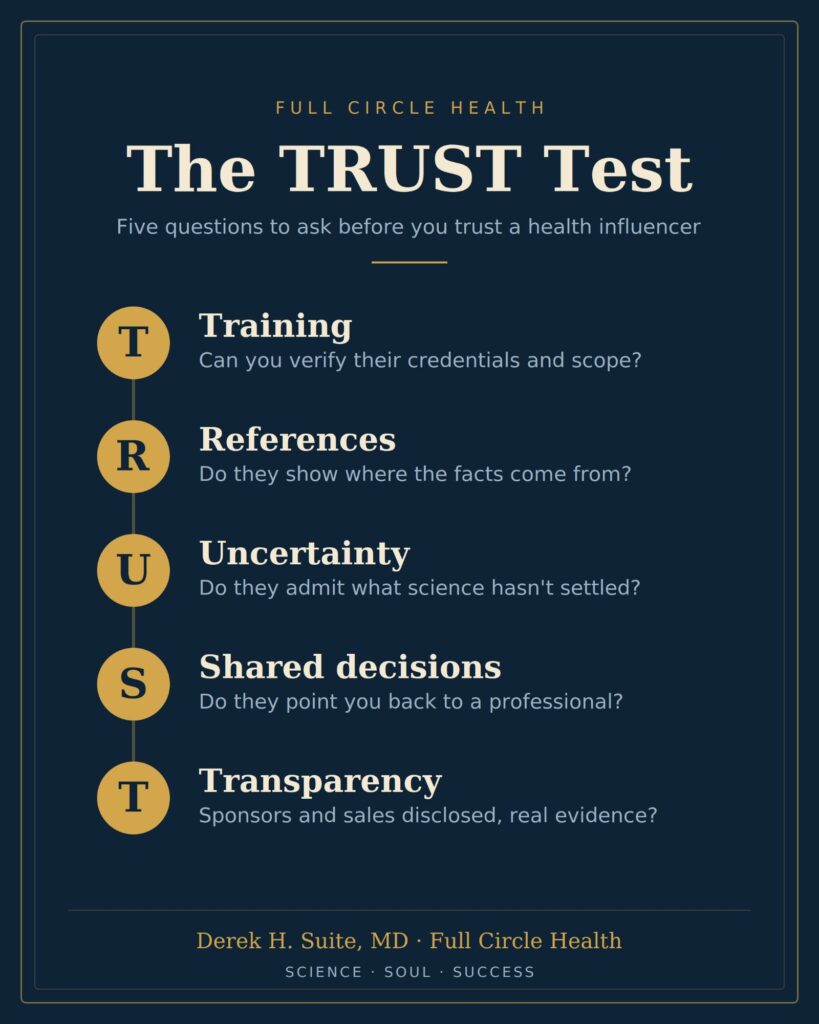
How to vet a health influencer: the TRUST test
I give patients a simple filter I call TRUST. Training: can you verify the person’s qualifications, and are they speaking within the limits of their training and professional scope? References: do they tell you where their information comes from? Uncertainty: are they honest about the limits and the places the science is still moving? Shared decision-making: do they send you toward a conversation with a professional instead of trying to be the last word? And transparency: are sponsorships, financial interests, and product sales out in the open, and if something is being sold, is the evidence for it stronger than testimonials, ratings, or the creator’s own word? Then build a small team around this filter: a primary care clinician if you have one, and if you do not, finding that person is the first job and not the last; a mental health professional when you need one; a credible public health source; and a couple of creators genuinely worth your time. Let them start the conversation. Don’t let them end it.
Let me admit the harder part to my colleagues. Good doctors are not missing from these spaces because they have stopped caring. They are missing because doing it well takes real time, energy, and resources. Doctors get fifteen minutes with you as it is; their days run long, and responsible public education asks for research, production, consistency, and a willingness to stand behind every word, on top of a schedule that is already full. There is also a license to protect, which keeps doctors careful, and careful hedging can read as evasion, while the person with no license at stake gets to sound certain, sell a product, and answer to no scientific or ethical standard at all. This is why I am careful not to push every clinician to become a content creator. What I know is that when the careful voices stay home, the confident ones inherit the whole room. Some clinicians are already finding their way through, building real educational podcasts on their own terms, and the profession is making progress. If the front door to our health has become a digital one, then those of us who have earned people’s trust, the clinicians, the researchers, the churches, the community that raised us-have to stand in that doorway too. Feeling understood and getting good care should never be a choice anyone is forced to make.
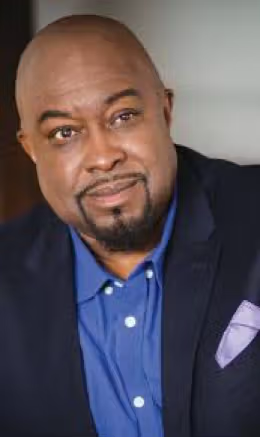
Derek H. Suite, M.D.
Derek H. Suite, MD, is a board-certified psychiatrist whose work focuses on sports psychiatry and sleep medicine. He is an alumnus of the Columbia University Graduate School of Journalism and a former adjunct professor of psychopharmacology at Teachers College, Columbia University.
Dr. Suite is the founder of Full Circle Health, hosts the weekly SuiteSpot podcast, and is a frequent health contributor to Black Westchester Magazine.
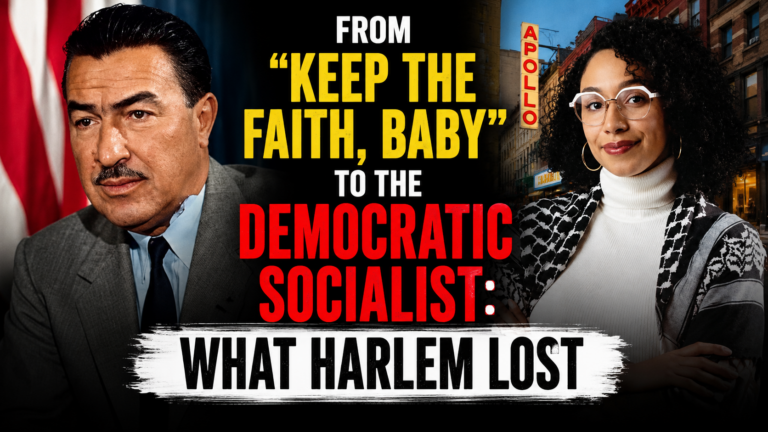
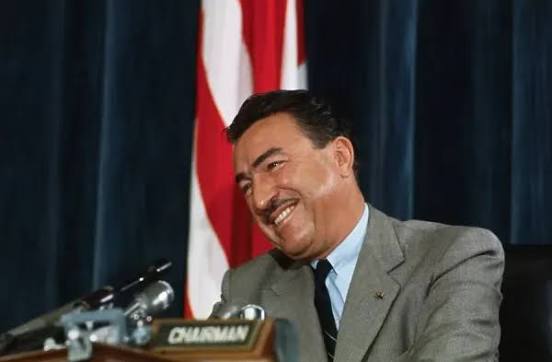
There is a boulevard in Harlem named for a man who once told the House of Representatives he would rather be censured than silent. Adam Clayton Powell Jr. Boulevard cuts through the neighborhood his namesake represented in Congress for 26 years, and it is worth asking what, exactly, the street sign still commemorates: a politician, or a model of Black political power that Harlem no longer has.
Powell became the first Black New Yorker elected to Congress in 1944, running from the Abyssinian Baptist Church — the largest Black congregation in the country at the time — into a newly drawn, majority-Black district built to give Harlem a voice of its own. He did not soften that voice to fit the coalition around him. He announced he would represent “the Negro people first and after that all the other American people,” and he meant it as a program, not a slogan. He forced open the whites-only facilities of the Capitol. He wrote the Powell Amendment, which denied federal funds to segregated institutions, and reintroduced it so many times that it became a permanent fixture of the civil rights fight until its substance was folded into the 1964 Civil Rights Act. And before Stokely Carmichael ever shouted the words to a crowd in Greenwood, Mississippi, it was Powell — at a 1965 Chicago rally and then in a 1966 Howard University commencement address — who put “Black Power” into the American political vocabulary, defining it as the right of Black people to build their own institutions rather than wait on white-controlled ones to let them in. That was not a rhetorical flourish. It was the design principle behind everything he built in Harlem. As chairman of the Education and Labor Committee, he moved more than fifty bills into law — minimum wage increases, school lunch programs, aid to the deaf, the scaffolding that would later become Medicare, Medicaid, and Head Start. He met with Nkrumah in Ghana and needled Eisenhower into integrating the armed forces. Harlem gave him nearly ninety percent of the Black vote and, when the House tried to expel him in 1967 over a corruption fight that reeked of retaliation, gave him eighty-six percent more in the special election held to spite him. The Supreme Court eventually ruled the expulsion unconstitutional. Powell did not need permission from a broader coalition to matter. He built the coalition around himself.
Eighty years later, the political lineage that runs through his old congressional turf — Powell to Charles Rangel to, eventually, Adriano Espaillat — has just produced its next chapter, and the contrast is instructive. Darializa Avila Chevalier, a twenty-something Democratic Socialists of America organizer, defeated the five-term incumbent Espaillat this summer in a primary for New York’s 13th District, which stretches from Powell’s old Harlem base up through Washington Heights, Inwood, and the West Bronx. She ran, credibly, as a champion of immigrant rights and against what she called “the politics of death” — militarism abroad, austerity at home. Mayor Zohran Mamdani, who built his own win on a multiracial, democratic-socialist coalition, endorsed her. She is, by every account, a serious and disciplined organizer.
She is also not the heir to Powell’s tradition of independent Black political power — and the race that put her in Congress makes that clearer than any commentary could. It was fought, ugly and explicitly, along ethnic lines: Avila Chevalier, who is Afro-Latina and the daughter of Dominican immigrants, says she was hit with birth-certificate demands and racial slurs from supporters of Espaillat, who is himself Dominican-American. Outlets covering the race described the contest as exposing anti-Haitian and anti-Black currents inside Dominican political circles in New York, and the Congressional Black Caucus itself has been reported to be absorbing a generational rift over exactly this kind of primary challenge. That is not the story of a community closing ranks behind a tribune the way Harlem closed ranks behind Powell in 1967. It is the story of Black political identity in northern Manhattan being contested, diluted, and subsumed into a broader ideological coalition — democratic socialism — whose energy comes as much from Mamdani’s citywide multiracial base as from anything rooted in Harlem’s own institutions.
That is the deeper shift: Powell’s power was institutional and self-generated. A church of thirteen thousand members, a newspaper he founded, a boycott machine he ran for two decades before he ever held office, a Harlem political base so loyal it survived his corruption scandals. He was not a junior partner in anyone’s coalition; national Democrats had to deal with him. Today’s version of Black political power in the same geography arrives as a plank in someone else’s platform — valuable to a citywide socialist movement insofar as it can be marshaled, but no longer the movement’s center of gravity. The seat exists; the independent institutional base that once made the seat formidable does not.
The numbers behind that shift are not flattering. A 2021 internal DSA membership survey — the same one that found 80% of members college-educated and more than a quarter earning six-figure incomes — put the organization at 85% white and just 4% Black. That is the coalition Black political power in northern Manhattan now has to negotiate with in order to get anything done: an organization whose own numbers show it is overwhelmingly white, asking a historically Black congressional seat to subordinate its independent identity to a movement it barely populates. Powell never had to ask a mostly white organization for a place at the table. He was the table.
The ideological gap is just as wide as the demographic one. Powell’s Black Power was explicitly about building up black people as the organizing category: build Black churches, Black newspapers, Black businesses, Black political machines, answerable to Black people first. Democratic socialism, as DSA itself defines it, organizes around class instead — capital versus labor, tenant versus landlord, worker versus boss — treating race as one form that class oppression takes rather than as its own axis of solidarity. That is a coherent political philosophy with a long American left tradition behind it, but it is not the philosophy that built Harlem’s political power in the first place, nor is it a neutral update of it. Powell wanted Black people to control Black institutions. The coalition Avila Chevalier answers to wants a multiracial working class to control shared institutions, with Black interests folded in as one constituency among several. Those are not the same project wearing different clothes; they are two different theories of where power should sit, and Harlem’s congressional seat has quietly changed hands between them.
The distinction is not about the size of government — Powell was one of the most effective builders of federal social programs Congress has ever seen, from the minimum wage to the legislative scaffolding under Medicare, Medicaid, and Head Start. It is about who is holding the lever. Powell used the federal government the way he used his pulpit and his newspaper: as an instrument Harlem pulled on its own terms, answerable to Harlem, chaired by a Harlem man who could not be primaried out of his own church. Black Power, in his formulation, meant Black people forcing recognition and equal standing on their own terms — not waiting to be included in someone else’s program. Socialism, as a governing philosophy, asks people instead to invest their trust in collective institutions administered on their behalf — a redistribution machine run by a coalition, decided by majority vote inside that coalition. Even when the outcomes align, the posture is different: one is a demand for independent standing; the other is a request for a larger, more generous seat inside somebody else’s house. Harlem’s political tradition was built on the first. It is now represented by the second.
None of this is really Avila Chevalier’s fault, and it would be lazy to make her the villain of a decline that predates her by decades. Powell’s own model of Black institutional power — grounded in an era of legally enforced segregation that produced, almost as a byproduct, a dense and captive set of Black-led churches, newspapers, and businesses in a handful of neighborhoods — was already fraying by the 1970s, as integration dispersed exactly the concentrated constituencies that had made men like Powell possible. Rangel held the seat for decades but never wielded it as a standalone power center the way Powell had. The transformation of a majority-Black Harlem into a demographically mixed, heavily Dominican and increasingly gentrified district was already most of the way to completion before Avila Chevalier ever organized her first tenant meeting. She is a symptom of the change, arguably one of its more talented political operators, not its author.
But a symptom is still worth naming. What Powell offered Harlem was leverage that ran through nobody else — he could not be primaried out of his own church, his own newspaper, his own boycott network. What today’s Harlem gets is a voice that is talented, sincere, and entirely contingent on the health of a citywide coalition led by other people, subject to being outflanked in the next cycle by whoever assembles the next winning combination of renters, socialists, and immigrant-rights voters. That is not a value judgment on socialism, or on immigrant solidarity, both of which have their own claims on justice. It is a judgment on independence. Powell’s Harlem could set its own terms. The 13th District’s Harlem now negotiates its terms as part of somebody else’s majority.
Keep the faith, baby, Powell used to say. The faith he meant was in Black political self-determination as an end unto itself — not a faction inside a larger movement, but a force other factions had to answer to. Measured against that standard, and only against that standard, something has indeed been lost between the boulevard and the district it now names.
A federal investigative referral submitted to the Mount Vernon City Council by Samuel L. Rivers, to be sent to the United States Attorney for the Southern District of New York, asks federal authorities to examine whether an interconnected political and development system operates within the City of Mount Vernon, with Kenneth Plummer at its center.
The 31-page referral does not accuse anyone of criminal wrongdoing, nor does it conclude that any laws have been violated. Instead, it argues that a decade-long pattern involving political influence, redevelopment, public incentives, campaign financing, land assembly, and financial relationships is sufficiently interconnected to warrant federal investigation through subpoena authority, financial review, and, if appropriate, grand jury proceedings.
At the center of that alleged system, according to the referral, is Kenneth Plummer.
The memorandum traces Plummer’s evolution over more than a decade—from documented lobbying activity connected to development approvals, to political strategist, to organizer of the Mount Vernon Forward coalition, and later to a publicly identified executive with Forward Thinkers Development on the more than $200 million Opal 115 redevelopment project. The referral does not present these roles as proof of wrongdoing. Instead, it argues that Plummer’s recurring presence at key stages of Mount Vernon’s political and development activity supports its central theory and justifies closer federal scrutiny.
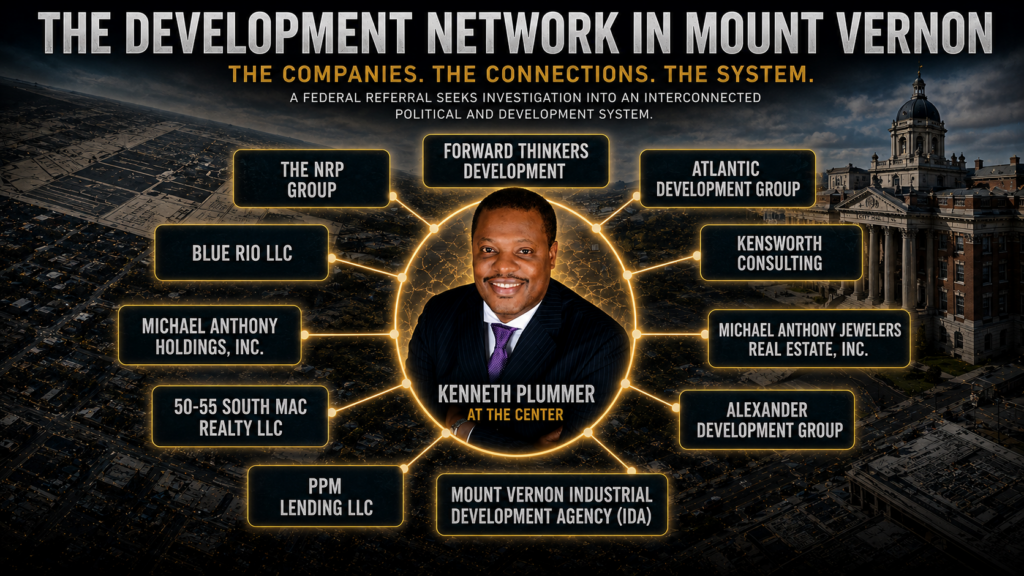
According to the referral, the investigation should not focus on a single individual or project. Rather, it asks investigators to determine whether a broader network of political organizations, developers, landowners, public agencies, political action committees, and financial relationships operated independently or as parts of an interconnected system influencing redevelopment decisions throughout the city.
The chronology outlined in the referral forms the foundation of its argument.
It begins with documented lobbying activity connected to development approvals. It then follows the creation of Mount Vernon Forward and the election of a coordinated political coalition. From there, it examines transit-oriented rezoning, strategic land assembly around the Mount Vernon West corridor, the development of Opal 115, developer compensation exceeding $20 million, campaign fundraising through the Rise Up Mount Vernon PAC, publicly recorded federal tax liens, and later financial transactions involving a White Plains condominium.
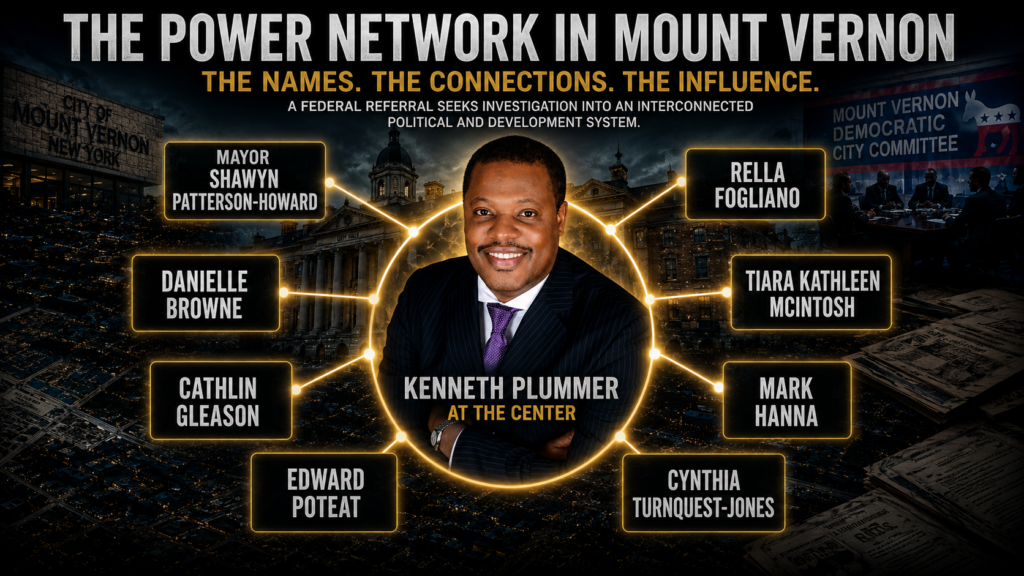
Beyond Kenneth Plummer, the referral identifies several political figures and individuals whose relationships, roles, or activities are described as part of the broader political and development network that federal investigators are asked to examine. Those named include Mayor Shawyn Patterson-Howard, City Council members Danielle Browne, Cathlin Gleason, Edward Poteat, and Cynthia Turnquest-Jones, as well as Mark Hanna, Tiara Kathleen McIntosh, and Rella Fogliano. According to the referral, these individuals are referenced because of their reported involvement in political organizations, campaign activities, political action committees, fundraising, or other relationships that the author contends are relevant to understanding the overall pattern. The referral does not assert that every person named engaged in criminal or unethical conduct; rather, it requests that federal authorities review communications, financial records, campaign finance filings, and other documents to determine the nature of these relationships and whether any violations of federal law occurred.
Viewed individually, the referral acknowledges that many of these events could represent lawful political, business, or financial activity. Viewed collectively, however, the memorandum argues they form a pattern that supports its central thesis and deserves independent federal review.
One of the referral’s central themes is that redevelopment in Mount Vernon extended beyond individual construction projects. It points to both the Mount Vernon West and Mount Vernon East transit-oriented development corridors, arguing that zoning changes, public incentives, Industrial Development Agency assistance, and strategic land ownership significantly increased the value of key properties while concentrating political and financial influence within the same redevelopment ecosystem.
The referral also examines the Opal 115 project, a publicly supported redevelopment valued at more than $200 million. Public records referenced in the memorandum describe developer fees exceeding $20 million, including approximately $8.3 million in upfront compensation. According to the referral, investigators should determine how ownership interests, compensation arrangements, financing structures, and communications surrounding the project were organized and whether all required disclosures were made.
Political financing is another major focus.
The memorandum discusses the Rise Up Mount Vernon PAC and campaign contributions from individuals and entities connected to the city’s development community. It does not contend that campaign contributions themselves are unlawful. Rather, it asks investigators to determine whether political fundraising, redevelopment interests, and municipal decision-making became improperly intertwined.
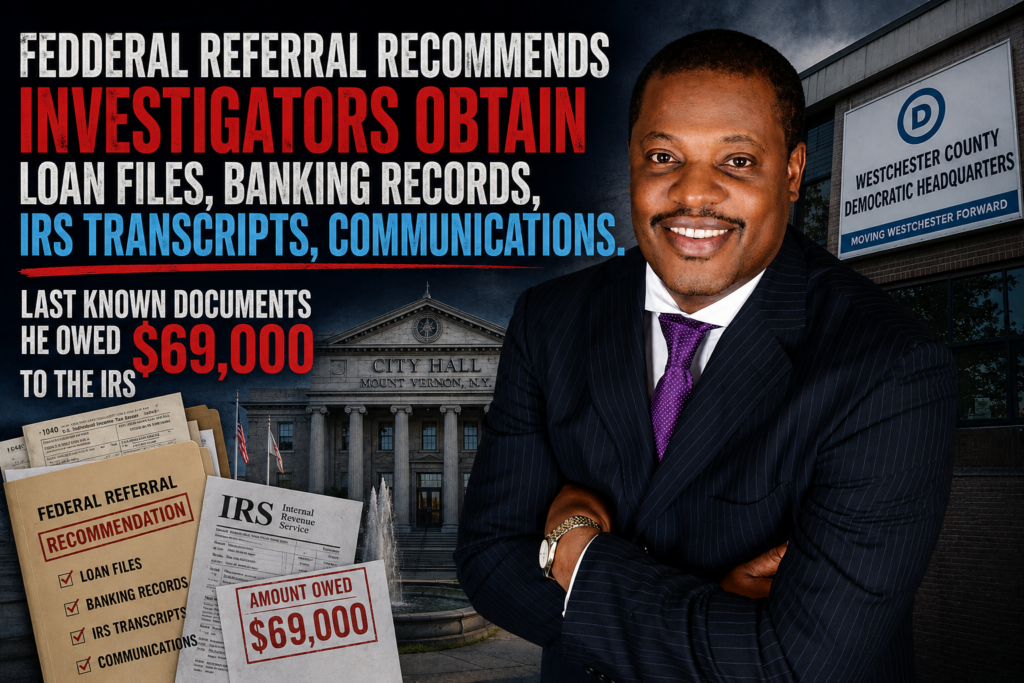
The referral further discusses publicly recorded federal tax liens, mortgage documents involving a White Plains condominium, and related financing records involving Kenneth Plummer. It recommends that investigators obtain loan files, banking records, IRS transcripts, communications, and financial disclosures to determine whether those financial matters are related to the broader political-development network described throughout the memorandum.
Beyond those issues, the referral also recommends reviewing additional redevelopment projects, including the Mount Vernon East corridor and 42 West Broad Street, arguing that investigators should examine whether similar patterns of political influence, development activity, and municipal oversight existed elsewhere within the city’s redevelopment efforts.
To answer those questions, the referral asks federal authorities to subpoena communications, campaign finance records, Industrial Development Agency files, land transfer documents, mortgage records, banking records, IRS files, inspection reports, and internal government communications involving multiple public officials, developers, political organizations, and private entities connected to Mount Vernon’s redevelopment.
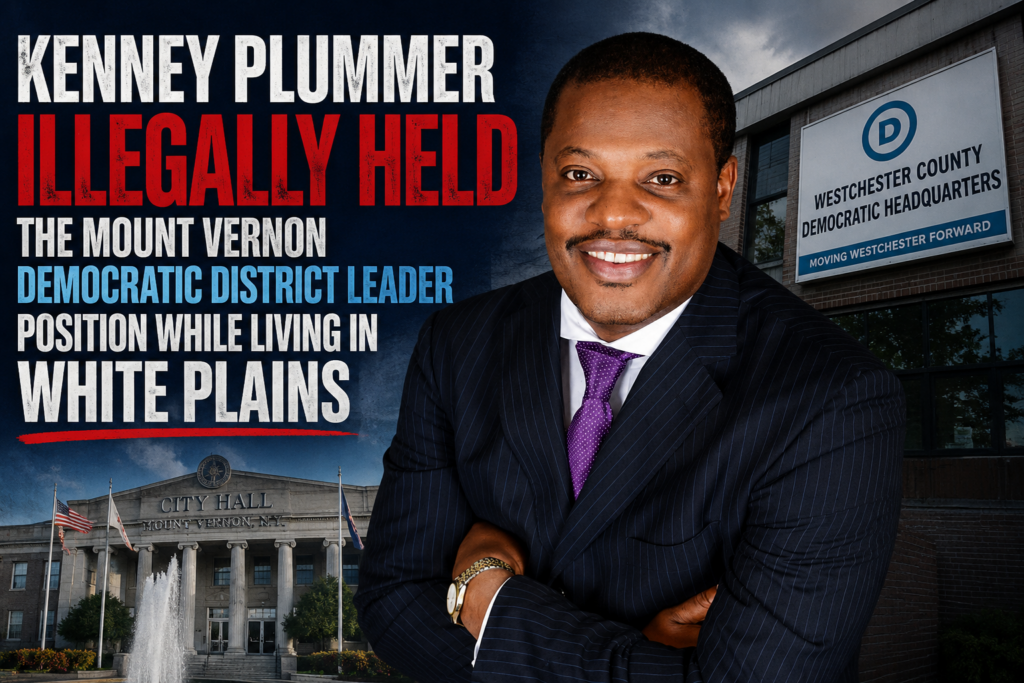
One of the most significant issues omitted from the federal referral is the controversy surrounding Kenneth Plummer’s former service as a Democratic District Leader.Kenny Plummer used his illegal postion to endorse candidates he later politically funded to give him favor on his projects. Prior to his resignation, complainants challenged Plummer’s eligibility to hold the position, alleging that he no longer satisfied New York Election Law’s residency requirements because his true domicile was in White Plains rather than the Assembly District he represented. The Westchester County Board of Elections reviewed the complaint and declined to remove Plummer. The complainants sharply criticized that review, contending that critical evidence was overlooked and that the investigation failed to fully examine the residency issue. They publicly announced their intention to seek a more comprehensive investigation by the Westchester County District Attorney’s Office. Before that process moved forward, Plummer resigned from his District Leader position. While the federal referral examines lobbying activities, political organization, development relationships, campaign financing, and financial transactions, it does not address this separate residency controversy or the circumstances surrounding Plummer’s resignation. For many observers, that omission leaves unanswered questions about an issue that had already raised significant concerns regarding transparency, eligibility for public party office, and accountability.
During the City Council discussion,Councilman Andre Wallace was the only member of the Mount Vernon City Council to publicly commit to reviewing the federal referral in detail. Wallace stated that he would carefully examine the document and, if he concluded that the evidence supported its allegations and warranted further action, he would personally sign onto the referral and forward it to federal authorities himself. While the other members of the Council did not publicly commit to taking similar action, Wallace’s response stood out as the only clear pledge to independently evaluate the referral and, if persuaded by its contents, lend his support to requesting a federal review.
Whether federal authorities pursue the matter remains unknown. No criminal charges have been filed, and no court has made findings regarding the allegations outlined in the referral.
What the memorandum ultimately presents is not simply a series of isolated concerns about one individual. It presents a theory that Mount Vernon’s redevelopment over the past decade may have been shaped by an interconnected system in which politics, land use, campaign financing, public incentives, and private financial interests repeatedly converged—with Kenneth Plummer identified as the central figure linking many of those relationships. Whether that theory is supported by evidence sufficient to establish violations of federal law is the question the referral now asks federal investigators to answer.