








For millions of New Yorkers already struggling under high taxes, rising utility bills, unaffordable housing, and economic uncertainty, the latest confusion coming out of Albany only reinforces a growing public frustration: who is actually running the state government?
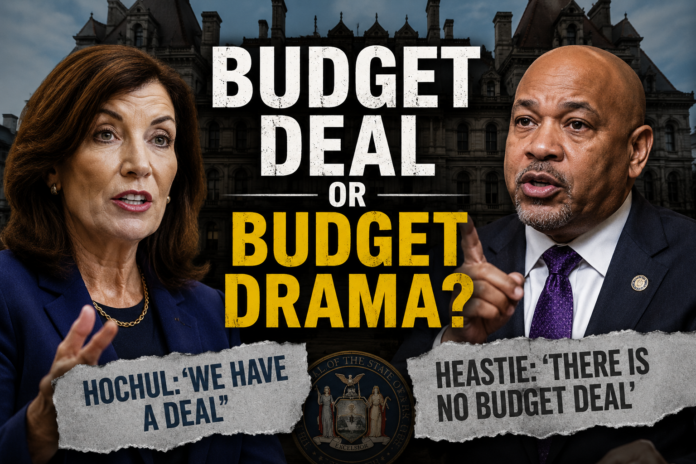
This week, Governor Kathy Hochul publicly announced that New York had reached a budget agreement. She spoke confidently about a deal being in place and presented the moment as a major breakthrough in negotiations over the state’s roughly $268 billion budget. But almost immediately afterward, Assembly Speaker Carl Heastie contradicted her publicly, stating plainly that “there is no budget deal.”
To the average taxpayer, that contradiction is not a small issue. It raises serious questions about transparency, leadership, and whether Albany’s political class is more focused on headlines than honest governance.
Technically, Heastie is correct. A budget is not finalized because politicians hold a press conference or claim there is a “general agreement.” A budget becomes real when legislative language is completed, lawmakers vote on it, and the governor signs it into law. Until then, New Yorkers are left with uncertainty while political leaders argue over definitions and messaging.
But the deeper issue is what this disagreement reveals about how Albany operates.
The budget process in New York has increasingly become less about fiscal discipline and more about political leverage. Massive policy issues often get folded into late-night negotiations behind closed doors, leaving taxpayers with little understanding of what is actually being negotiated in their name. From pension expansion proposals to climate mandates, utility regulations, housing policy, public safety spending, and aid to local governments, billions of dollars and long-term financial obligations are often decided through political bargaining rather than transparent public debate.
That matters because the consequences do not stay in Albany. They eventually land on the backs of ordinary residents through higher taxes, rising energy costs, shrinking services, or more people leaving the state altogether.
Westchester County residents understand this pressure better than most. Property taxes are already among the highest in America. Families are struggling with affordability while businesses and middle-class residents continue relocating to states with lower costs and more predictable economic policies. Every delayed budget, every rushed negotiation, and every unfunded political promise eventually affects local communities.
The disagreement between Hochul and Heastie also exposes growing tensions within New York’s Democratic leadership itself. Even though Democrats overwhelmingly control the governor’s office, the Assembly, and the Senate, the state still struggles to produce timely budgets and unified messaging. That should concern voters regardless of party affiliation because one-party dominance does not automatically produce effective government.
In fact, history often shows the opposite. When political competition weakens, accountability weakens with it. Leaders become more focused on internal power struggles than public outcomes. The public begins hearing different stories from different officials, while the actual problems facing the state continue to grow.
New Yorkers deserve more than political theater. They deserve clarity. If there is a budget deal, leaders should present the details honestly. If there is no final deal, they should stop pretending there is one for the cameras.
Because at the end of the day, budgets are not public relations campaigns. They determine how taxpayer money is spent, how services are funded, how much residents will ultimately pay to live here, and whether New York remains affordable for working families and businesses trying to survive.
And right now, Albany looks less like a government operating with confidence and more like a house divided trying to control the narrative while the people wait for answers.

Hey there, I was wondering if you took guest posts on blackwestchester.com? If so, how would I go about getting one on your site? If there is a fee, let me know.
Also, if you have any other sites you can get me a post on please list them.
Thanks
Justin