



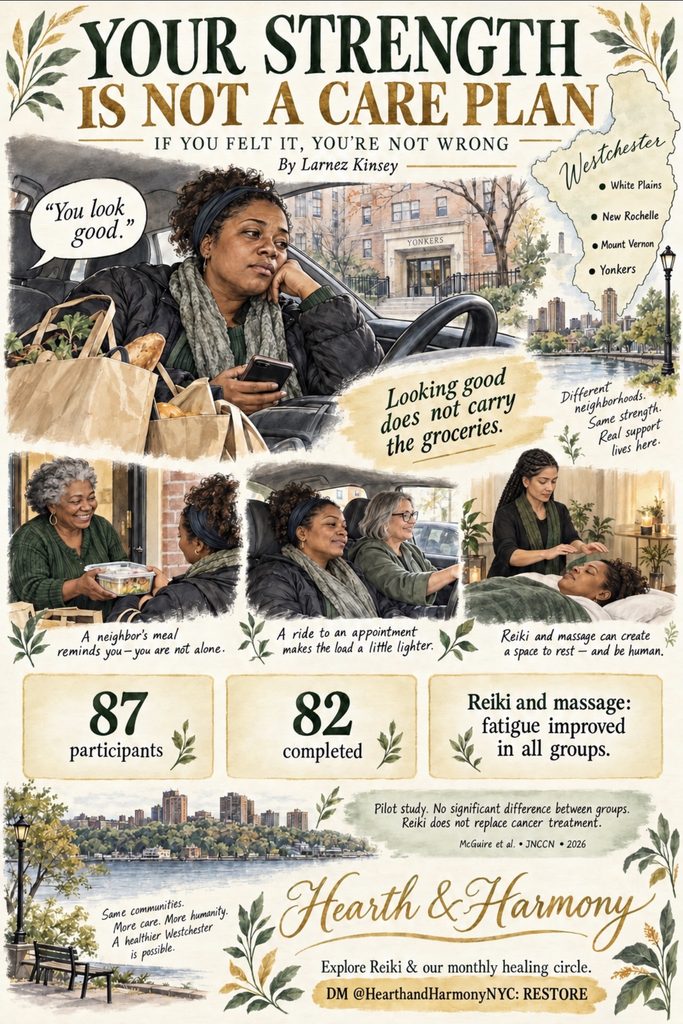
Eighty-seven participants. Eighty-two completed the study. A 2026 randomized pilot trial compared two massage sessions, two Reiki sessions, and four Reiki sessions for people with breast or prostate cancer receiving hormone therapy. Fatigue improved across all three groups, with improvements sustained through week ten. No adverse events related to either intervention were reported. However, differences between groups were not statistically significant, so the findings do not establish that Reiki works better than massage.
Imagine someone sitting in a parked car outside their Yonkers apartment after a medical appointment. Their bag is beside them. Upstairs, dinner needs figuring out. A text asks whether they can stop at the store. They need a minute before becoming available again.
This is an illustration, not a patient story. But consider the expectation inside it: If you are still answering messages, keeping appointments, and handling errands, people may assume you have enough energy to continue.
Someone says, “You look good.” You appreciate the kindness. You also wish looking good could carry the groceries.
Here in Westchester, we can make our conversations about care more practical. Around the kitchen table, after a church service or during a community gathering, we praise people for persevering. Then we hand them another responsibility. Admiration becomes convenient when it allows everyone else to keep depending on the person who needs help.
As a Reiki Master Teacher and founder of Hearth & Harmony, I am interested in tools that may support restoration. This study matters because it tested Reiki directly, giving us a specific practice and outcome to examine.
The limits matter, too. It was a small feasibility trial without a sham treatment or usual care-only comparison. Four Reiki sessions provided more treatment time than the two-session groups. The findings cannot establish a specific energy mechanism or separate the influence of attention, expectations, and other factors. Approximately 93 percent of participants were White, further limiting how confidently the results can be generalized across communities.
These are reasons for broader, more rigorous research. Someone navigating cancer deserves an explanation that leaves room for uncertainty before they spend their money or limited energy. Reporting no intervention-related adverse events in this trial also does not guarantee that every service, practitioner, or setting is appropriate for every person.
And energy is part of the cost. An appointment in White Plains can take much more than the hour printed on the calendar when you are coordinating transportation from another community. Add child care or time away from work, and receiving support starts requiring its own support system.
The question belongs in our conversations across Yonkers, Mount Vernon, New Rochelle, and the rest of the county: What makes care possible beyond having an appointment available?
A neighbor offering a ride or a family member handling an errand can make the difference. Before asking why someone has not prioritized their wellness, ask what they would have to rearrange to get there. “Make time for yourself” sounds simple when you are not the person negotiating where that time will come from.
Our community spaces can help people explore unfamiliar options without pressure. One person may approach Reiki through spiritual curiosity. Another wants a plain explanation and prefers no spiritual language. Someone else will choose a different practice. Nobody should have to defend their faith or skepticism to ask a question.
At Hearth & Harmony, I want people to understand the process, cost, and choices before committing. Your preferences about touch matter. You can stop. You do not owe a practitioner tears, a breakthrough, or a testimonial. Feeling small doesn’t mean you failed to believe enough.
For anyone receiving cancer treatment, discuss fatigue and complementary practices with your oncology team. Reiki is an optional supportive practice and does not replace medical evaluation or prescribed care. A promising study should help you start an informed conversation, not persuade you to abandon treatment.
For those helping a friend or relative, make your next offer specific. “I can bring dinner Thursday” is easier to accept than “Let me know if you need anything.” An exhausted person shouldn’t have to identify the task, arrange the help, and reassure you that accepting it will not be an inconvenience.
To learn about Reiki or our monthly healing circle, message @HearthandHarmonyNYC with “RESTORE,” or email HearthandHarmonyNYC@gmail.com. Share this article with someone who keeps postponing their own care, and tell me: What would make support easier to receive in your Westchester community?
The next time we call someone strong, let’s make sure we are not asking them to carry what we could help put down.
Want to learn more? Read “Feasibility and Efficacy of Reiki Versus Massage for Cancer-Related Fatigue in Patients With Breast and Prostate Cancer Receiving Hormone Therapy,” by McGuire and colleagues, published in JNCCN in 2026