




For many generations, New York has used the Regents examination system as a standalone way to measure what students know. The system goes back to the 1800s and originally involved a fairly simple arrangement: the local school districts are responsible for educating the students. At the same time, the state sets standards and uses common exams to provide an external assessment of whether students have mastered the subject matter.
The system has never been perfect; standardized testing has legitimate limitations, and no one exam can measure all the knowledge a student acquires or predict everything that student might achieve in life. Yet before New York removes the link between passing the Regents examinations and receiving a high school diploma, we should ask a simple question—what independent check will take its place, especially in schools already producing poor academic results?
That question matters even more for Black students.
New York Is Making A Major Change
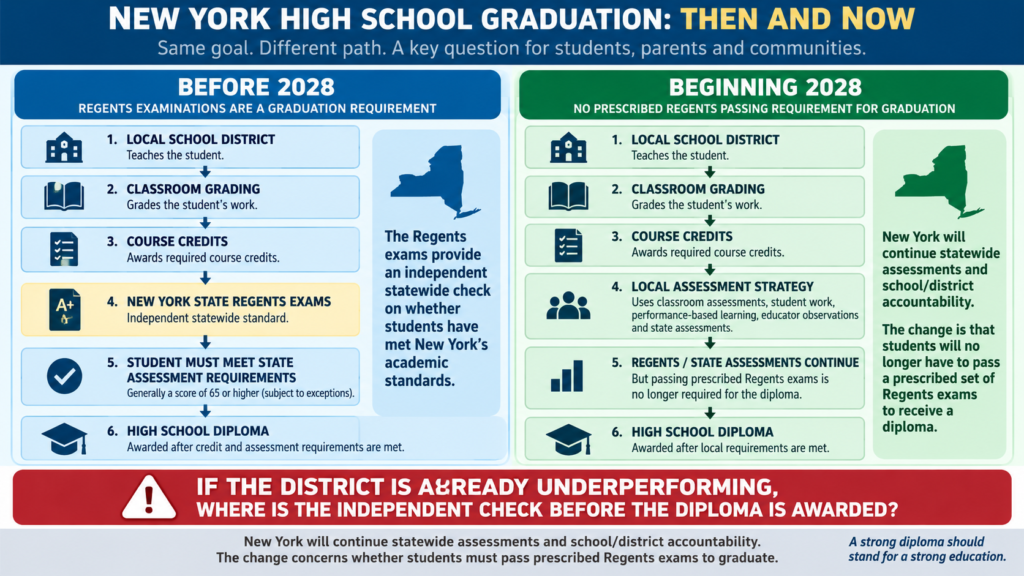
On September 14, 2026, the New York State Education Department announced that the Board of Regents had given the state the go-ahead to proceed with the next stage of NY Inspires. Starting with students who graduate in 2028, New York will move toward a single state high school diploma, and students will no longer be required to pass a prescribed number of Regents exams to graduate.
The Regents exams themselves will not disappear; according to New York, they will continue as statewide measures of student achievement, while districts create their own assessment strategies using classroom assessments, student work, performance-based learning, teacher observations, and the state assessments.
The distinction matters, but another is too: taking an assessment is not the same as showing a particular level of proficiency on that assessment to receive a diploma.
Under the current system, students usually must meet both credit and assessment requirements. The district is responsible for teaching the child, grading their work, and awarding credits, while the Regents sets an extra benchmark that applies across the state and is linked to graduation. For students who graduate in 2028, the relationship will change.
The issue isn’t whether we should worship standardized testing, since we shouldn’t. The real issue is whether we can create an accountability gap by removing the independent statewide passing requirement before a fully implemented replacement accountability system is in place.
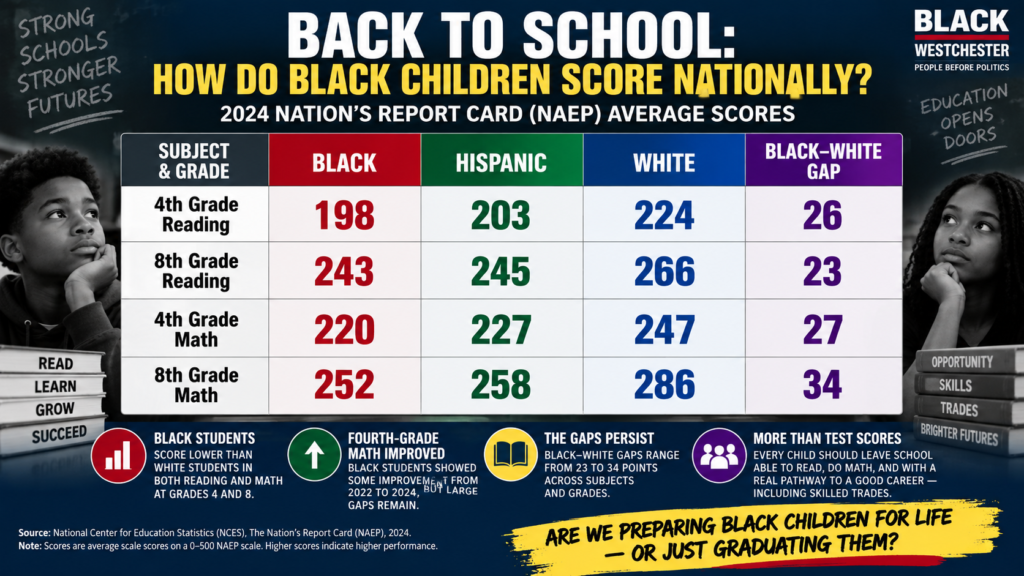
What occurs when the school is already failing?
Black parents should pay special attention to this.
When a school district achieves strong academic results, several local measures can offer useful extra information about student achievement. But what occurs when the school is itself in difficulty? And what happens when a large number of students are already below proficiency?
Think about the logic.
The child is taught at school, given assignments by the school, has their assignments marked by the school, receives credits from the school, the district develops much of the local assessment strategy, and finally the school issues the diploma.
Since this system is already leading to unsatisfactory academic results, where is the independent assessment that tells parents whether their child is truly academically prepared? That isn’t an accusation leveled at teachers; it’s a question relating to institutional accountability.
There is also a big difference between graduating and being proficient. A school district can raise its graduation rate without increasing its students’ proficiency in reading or mathematics. If we are not careful, we may celebrate more students walking across the graduation stage while failing to account for whether those young adults are actually ready for what happens the morning after graduation.
Black Children Cannot Afford Statistical Success
For Black communities, this discussion can’t be limited to whether graduation rates go up; we need to consider what the diploma really stands for.
Since Black students are disproportionately having difficulties with their academics, the appropriate course of action should be to find out why and then correct the situation. We should call for improved literacy instruction, mathematical intervention, vocational and technical education, apprenticeships, safer learning environments, better attendance, and greater parental involvement and accountability from the districts that keep failing children. Removing the graduation testing requirement doesn’t achieve any of those things on its own.
Here is the contradiction New York must explain. The state can identify a school as failing badly enough to require intervention, improvement plans, and even Receivership, yet beginning in 2028 students in that same school will no longer have to pass the state’s Regents examinations to receive a diploma. If New York believes the school needs outside oversight because its academic outcomes are unacceptable, why should parents automatically trust that same system’s local assessments as sufficient evidence that a child is academically prepared?
A child having difficulty with reading does not become a better reader just because the graduation requirement changes, and a child struggling with algebra doesn’t suddenly understand mathematics simply because the state alters how diplomas are awarded. The educational problem remains. The risk is that the statistics may get better even though the actual condition does not.
Will New York Standards Remain?
Betty Rosa, New York State Education Commissioner, and the Board of Regents say the reforms aim to keep academic standards rigorous while letting students show what they know in more meaningful ways.
That argument has a logical basis. Some students can show what they know more effectively through projects, practical applications, career-related learning, or ongoing classroom work than by relying on a single high-stakes exam. Employers also require graduates who can communicate, solve problems, and apply their knowledge rather than memorize information for a test. That does not solve the accountability problem, even if the weaknesses of standardized testing are admitted.
As stated in NYSED’s implementation schedule, students who graduate from January 2028 onwards will no longer be required to pass the Regents examinations to graduate; the complete introduction of New York’s new competency-based graduation system, however, will take place with those students entering ninth grade in the fall of 2029, and who will typically graduate around 2033.
That change merits thorough examination. Parents have a right to know precisely what will replace that statewide graduation safeguard if we remove it before the new system is fully in effect.
The Teacher’s Union Do not Get a Pass
The State Education Department is not the only one in favor of this approach since New York State United Teachers has publicly supported the change. Melinda Person, president of NYSUT, said the state should reconsider a system that places excessive emphasis on a single high-stakes exam. However, she stressed that academic standards should stay high and that students should have meaningful ways to show what they know. The position should be heard, but the union should also be held responsible for the results of the policies it publicly supports.
Good intentions do not teach children. Results do.
What guarantee is there that a Black student who is falling behind academically, attending an underperforming school, and able to graduate without meeting the state’s Regents requirements will leave school academically prepared? If the new system allows students to obtain diplomas without showing equivalent proficiency, then we have not addressed educational inequality; we have merely concealed it through more favorable graduation figures.
We do not intend to blame individual classroom teachers for all the problems in public education. Still, if organizations that represent teachers want to advocate for significant changes in graduation policy, they should not be excluded from the accountability discussion when we evaluate the results.
Demonstrate your figures on Black reading proficiency, on mathematics proficiency, and on college and career readiness. Then place those figures alongside the graduation rate, since having more diplomas doesn’t mean that you have more educated children.
A Diploma Has to Mean Somthing
A New York State high school diploma should convey some significant meaning to a college, to an employer, to a trade school, to a military recruiter and, most important of all, to the student who obtains it.
If a student is unable, at the end of high school, to understand complex reading material, communicate effectively, or carry out the required mathematics, then changing how graduation is determined has not overcome the educational failure; it has only changed the documentation the student gets at the end of school.
There’s another matter which we hardly ever talk about. Families with greater financial means can often make up for public schools’ shortcomings by buying tutoring, offering test preparation, enrolling their children in enrichment programs, hiring private teachers,, and accessing other educational opportunities.
A large number of Black families from the working class and those who are poor place considerable reliance on the public-school system to provide their children with the education they need. In these cases, the children require greater accountability, not less.
New York School Systems Must Show Outcomes
Education leaders in New York state say say the new system will keep standards high while giving students more ways to show what they have learned; the promise should be judged by actual outcomes.
Is Black students’ reading level higher? Is proficiency in mathematics increasing? Are the achievement gaps being narrowed? Are graduates ready for college without having to take remedial courses? Is a greater number of students now entering skilled trades, apprenticeships, and careers that require marketable skills?
These figures must be used to judge whether this reform is a success.
New York ought not to use higher graduation rates as proof that its education system has improved if academic proficiency remains unchanged. Graduating without achieving proficiency does not mean that educational equity has been attained; it only yields a more favorable statistic.
The Regents system has been around for over 160 years, and its age does not mean it should never be altered, any more than standardized testing should be preserved merely because it has always been followed.
Reform should replace accountability with better accountability rather than merely removing a consequence tied to an unpleasant measurement.
Before we celebrate the number of Black children who have crossed the graduation stage, demonstrate what they have learned. Before we celebrate the higher graduation rates, show us their reading proficiency, their mathematics proficiency, their career readiness, and their college readiness.
And if the school system itself is failing our children, somebody outside that system must still be able to tell parents the truth.
That is the check. That is the balance. And that is the conversation Black parents need to be having right now.