



Black women in America are nearly three times more likely to die from pregnancy-related causes than white women. Black patients are less likely to receive adequate pain medication in emergency rooms. Studies have shown that some medical providers still falsely believe Black people have “higher pain tolerance” or biologically thicker skin. Black women are also disproportionately diagnosed later with conditions like lupus, endometriosis, fibroids, heart disease, and autoimmune disorders — often after years of symptoms being minimized, dismissed, or blamed on stress.
Translation? A lot of Black women are not imagining medical neglect. They are surviving it. And there is a particular kind of loneliness Black women know that nobody talks about enough.
It’s the loneliness of sitting half-dressed on crunchy exam table paper while somebody with a medical degree looks you dead in the face and minimizes what your body has been screaming at you for months… sometimes years.
You know the feeling.
You rehearse your symptoms before the appointment because you already know you’re going to have to “prove” your pain. You practice sounding calm because if your voice shakes too much, suddenly you’re “emotional.” If you’re too informed, you’re “difficult.” If you advocate too firmly, now you have “an attitude.”
Meanwhile, your body is waving red flags like it’s directing traffic at JFK. And still, somehow, the doctor hits you with:
“It’s probably stress.”
“You just need to lose weight.”
“That’s normal for women.”
“You’re overthinking.”
Ma’am.
Sir.
Respectfully… are you overthinking the fact that I said my chest hurts and my vision blurred while climbing stairs?
Because let’s talk about it. Some doctors have gotten entirely too comfortable playing in Black women’s faces. Not listening! Not investigating! Not explaining! Just dismissing. And the dangerous part is how normalized it has become.
Women are walking around right now with undiagnosed autoimmune diseases, cardiac conditions, reproductive disorders, thyroid issues, neurological symptoms, and chronic illnesses because somebody in a white coat decided their pain sounded “dramatic” instead of medically significant. That is not a personality conflict. That is a healthcare crisis.
I remember talking to a woman who kept going back to doctors, complaining about exhaustion so deep she could barely make it through the workday. Her joints hurt. Her hair was thinning. She was dizzy constantly. One doctor told her she was probably “burned out.” Another suggested yoga. Another recommended reducing stress.
Reducing stress. As though her immune system was waiting for a bubble bath and positive affirmations before deciding whether to attack her body. Months later? Lupus diagnosis.
And what stays with her wasn’t just the illness. It was the humiliation of knowing she had been right about her own body while professionals made her feel irrational for noticing it.
That’s the part people don’t discuss enough. Medical dismissal makes women question themselves.
You start wondering:
“Maybe I am overreacting.”
“Maybe this pain is normal.”
“Maybe I’m being difficult.”
Meanwhile, your body is practically filing formal complaints. This is why language matters in medical spaces. Because too many women walk into appointments asking for permission to be heard instead of expecting competent care. And no, this is not about becoming combative.
It’s about becoming informed enough to protect yourself. Because you have a choice. You can choose to ask more questions. You can choose to get a second opinion. You can choose to change doctors. You can choose to stop shrinking yourself to make dismissive providers comfortable. A medical degree does not make someone incapable of bias, laziness, ego, or bad listening skills. And there are three questions every woman should know how to ask when a doctor starts minimizing her concerns.
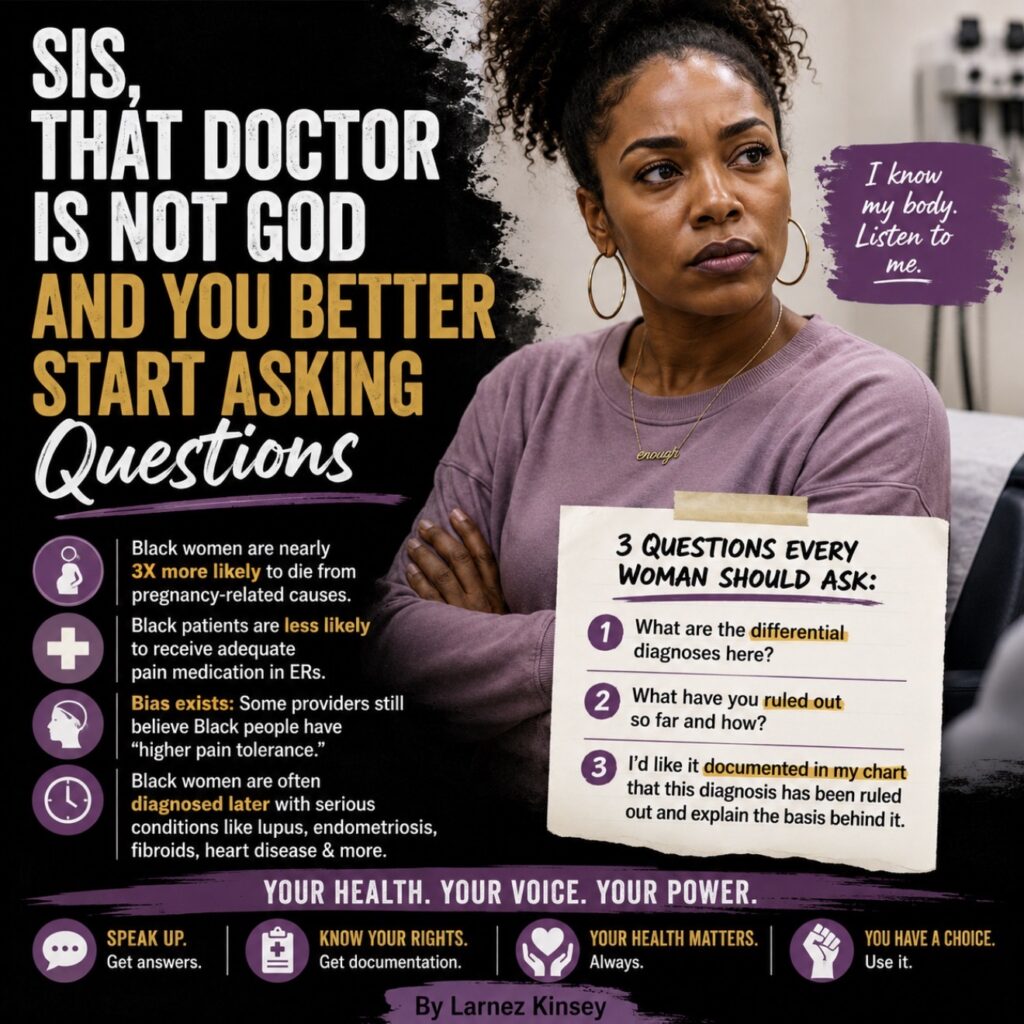
1. “What are the differential diagnoses here?”
Now I know that sounds like something said right before uncovering corruption in a political thriller, but stay with me. A differential diagnosis is simply the list of possible conditions that could explain your symptoms. This question forces the provider to think beyond their first assumption.
Because too often, Black women’s symptoms get categorized immediately as:
- stress
- anxiety
- hormones
- weight
- depression
- exhaustion
Without fully investigating what else could be happening. Asking: “What are the differential diagnoses here?” Changes the conversation from: “You’re probably fine,” to “Here are the conditions we’re considering and why.” That matters. Because your doctor should not be operating off vibes.
2. “What have you ruled out so far and how?”
This question right here? This is where the room shifts. Because now the provider has to explain the evidence behind their conclusions instead of casually tossing opinions at you like expired fortune cookies.
If they say, “I don’t think it’s cardiac-related.” Ask: “Okay, what testing ruled that out?”
If they say, “It’s probably hormonal.” Ask, “What labs support that conclusion?”
See, confidence is not confirmation. Some doctors speak with authority even when they’re making assumptions. And patients are often conditioned to interpret confidence as certainty. They are not the same thing. You are allowed to ask follow-up questions about your own body. That is not disrespectful. That is participation.
3. “I’d like it documented in my chart that this diagnosis was ruled out, and please explain the basis behind that decision.”
Whew. Now this one? This one suddenly makes people type slower. Because documentation creates accountability. If a provider dismisses your symptoms, refuses testing, or prematurely rules something out, asking for it to be documented creates a medical paper trail connected to that decision-making.
And suddenly the conversation becomes much more thoughtful. Because now there’s a record.
And before somebody says: “Well, that sounds aggressive…”
No. You know what’s aggressive? Ignoring women until symptoms become emergencies. You know what’s aggressive? Black maternal mortality. You know what’s aggressive? Women are being sent home from hospitals only to return in critical condition because nobody listened the first time. Women are taught to protect doctors from discomfort while women themselves are sitting in pain, confusion, fear, and exhaustion.
Enough. And let’s be clear about something else: advocating for yourself medically does not mean you think you know more than physicians. It means you understand healthcare should be collaborative.
The right doctor will not be offended by informed questions. The right doctor explains things clearly. The right doctor investigates thoroughly. The right doctor listens without making you feel ridiculous. The right doctor understands that patients know when something feels wrong. And if your provider repeatedly dismisses you, rushes you, talks over you, ignores your symptoms, or makes you feel small for advocating for yourself?
You have a choice. You can leave. You can find another provider. You can seek another opinion. You can stop handing blind trust to people who have not earned it. Because nobody lives inside your body except you. Not your doctor. Not social media. Not internet symptom checkers. Not wellness influencers drinking chlorophyll in soft lighting. YOU!
And Black women, especially, have spent generations being told to survive pain quietly. To endure. To be resilient instead of protected. But resilience should not be the entry fee for receiving competent healthcare.
You deserve thoroughness. You deserve explanation. You deserve investigation. You deserve dignity. You deserve to be believed the first time you say something feels wrong.
Too many Black women are getting harmed simply because they were taught to stay polite in rooms where nobody was truly listening.