







Public debates about New York City often split into two familiar camps. One side argues the city has become hostile to business and investment. The other argues that it has become unaffordable for working people. Both sides present real concerns. Both sides are incomplete.
What is missing is a focus on outcomes.
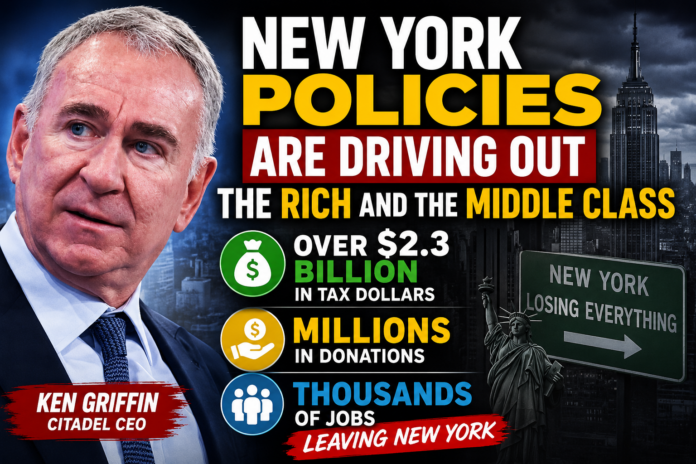
Recent comments from Ken Griffin and Jessica Ramos illustrate the divide. Griffin has made clear that his firm is expanding in Miami, citing a more favorable business environment. Ramos has emphasized that the cost of living, particularly rent, is forcing residents out of New York. These statements are often framed as opposing viewpoints. In reality, they are describing the same system from different positions within it.
New York has, over time, built a cost structure that is difficult to sustain. It is expensive to build housing, operate a business, and live. This is the result of accumulated policy decisions, including regulatory layers, tax burdens, fees, and approval processes that have grown more complex over time. Highlighting these causes helps readers understand the systemic nature of the decline. When costs rise across all three areas simultaneously, the results are predictable.
Developers respond first. When construction costs, regulatory uncertainty, and approval timelines increase, fewer projects meet the investment threshold. Some projects are delayed. Others have never started. Those that move forward often target the high end of the market, where margins are more likely to justify the risk. The result is a constrained housing supply relative to demand.
Businesses respond next. Companies evaluate where to allocate capital based on expected return. If operating in New York becomes significantly more expensive or uncertain than in other locations, firms may limit expansion, shift growth elsewhere, or relocate entirely. This is not a political decision. It is a financial one.
Residents feel the weight of rising costs daily, which can erode their sense of stability and security, especially for those with the least flexibility. Recognizing this emotional toll helps the audience understand the human side of economic shifts.
This is where the current narrative becomes misleading. It is often suggested that only the wealthy have mobility, while everyone else remains. The data shows a broader pattern. Domestic migration from New York has been negative for several years. In 2025 alone, the city experienced a net loss of roughly 114,000 residents to other parts of the United States. Since 2020, the cumulative losses have been in the hundreds of thousands.
This outflow is not confined to one income group. High earners, middle-class households, and working families are all part of the movement. The difference is not whether people want to leave. The difference is whether they can.
Those with resources and flexibility can evaluate the cost of living, tax structure, and opportunities elsewhere and make a decision. Those without that flexibility often remain, even as costs rise. Over time, this creates an imbalance. The system gradually loses those able to exit while increasing pressure on those who stay.
The implications extend beyond population shifts. They affect the city’s economic base.
Projects like Citadel’s $6 billion development at 350 Park Avenue are more than economic drivers; they symbolize potential growth and renewal. Highlighting their impact can inspire optimism about the city’s future.
Read: Is Mamdani Driving Capital Out of New York in the Name of Justice
If a project of that magnitude is delayed or canceled, the loss is tangible. It results in fewer jobs, less income, and lower revenue. The key question is how the city can replace that economic activity if multiple projects face similar delays, emphasizing the need for policy reevaluation to sustain growth.
This leads to a fundamental issue that public debate often avoids. A city cannot simultaneously discourage large-scale investment and expect to maintain or expand the revenue base required to support public services. Nor can it restrict housing supply and expect affordability to improve. These are not ideological claims. They are structural relationships.
After decades of policy decisions, the outcomes are visible.
Housing affordability has not improved, and the cost of living remains high. The complex regulatory and cost environment for business persists, and domestic migration continues to decline. These measurable results directly link policy choices to the city’s economic and population health, underscoring the need for policy reevaluation.
This does not mean that concerns about inequality or affordability are misplaced. Nor does it mean that maintaining a competitive business environment should be the sole priority. It means that policies must be evaluated based on whether they achieve their stated goals without producing counterproductive side effects.
At present, the evidence suggests a system under strain. The wealthy have the means to relocate or diversify their exposure. The middle class faces increasing pressure from rising costs. Working-class residents face the greatest mobility constraints while bearing the heaviest share of those costs.
When multiple segments of the population respond to the same environment by leaving or reconsidering their positions, it is no coincidence. It is a signal.
The real challenge is not just the interests of the wealthy or working people alone, but whether our policies create a sustainable future for the entire city. Framing it this way encourages shared responsibility and collective action.
Incentives matter. People and businesses respond to them consistently over time. If the incentives encourage exit, exit becomes more common. If they discourage investment, investment slows.
New York’s challenge is not simply to attract or retain one group or another. It is to realign its policies so that building, investing, and living in the city remain viable simultaneously.
Until that alignment is addressed, the pattern will continue. And when both the capital and the middle class begin to look elsewhere, the issue is no longer who is leaving.