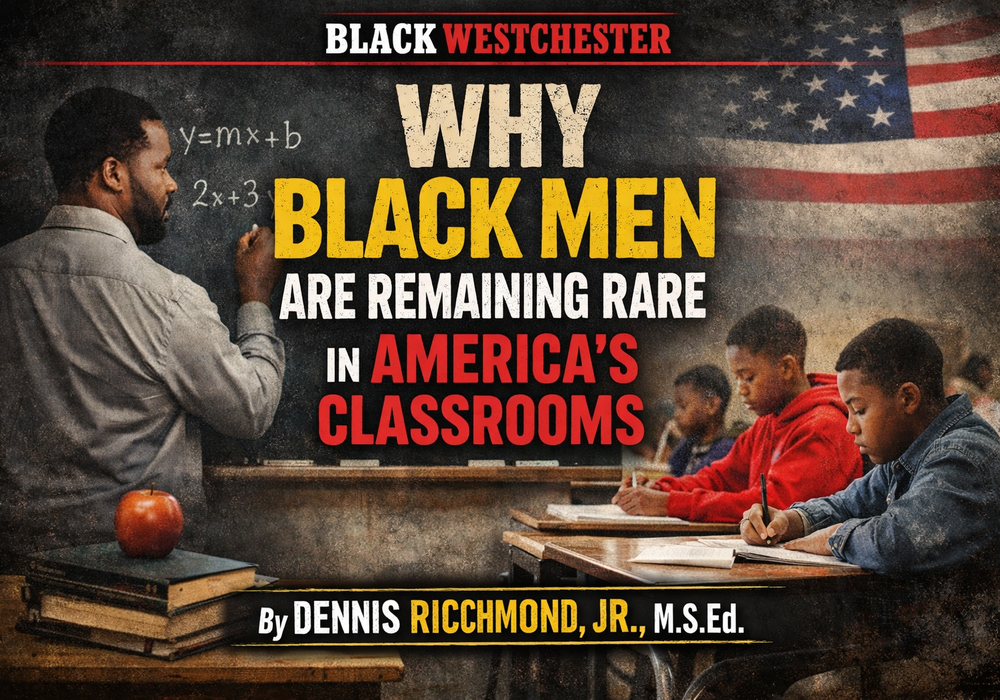







Across the United States, Black men remain one of the most underrepresented groups in public school classrooms—a reality that continues to raise concern among some educators, policymakers, and certain communities alike. While Black students make up roughly 15% of the nation’s public school population, Black male teachers account for less than 2%—often cited between 1.3% and 1.8%—according to recent data from the U.S. Department of Education and national education reporting in 2024 and 2025. I’m in that less than 2% number.
The disparity is remarkable. According to data from the National Center for Education Statistics (NCES), Black educators overall represent about 6% of the public school teaching workforce, while nearly 80% of teachers are white and approximately 77% are women. This imbalance highlights both a racial and gender gap in the profession that has remained largely unchanged in recent years.
Experts point to a combination of systemic, economic, and cultural factors that contribute to the low number of Black men in teaching. One major issue is the shrinking pipeline into the profession. According to higher education enrollment reports from 2024 and 2025, college enrollment among Black men has declined over the past decade, limiting the number of candidates entering teacher preparation programs. Based on data from Historically Black colleges and Universities, Black men now make up a significantly smaller percentage of students compared to previous generations, further narrowing the pathway into education careers.
Financial barriers also play a significant role. According to labor and economic analyses reported in 2025, teaching remains one of the lower-paying professions, in many states, requiring a college degree. Many teachers across Westchester County, New York are doing well for themselves, but that isn’t the case everywhere. Studies show that certain folks face a notable pay gap when compared to peers in fields such as business, technology, and engineering. Based on these findings, many Black men—who may feel pressure to pursue higher-paying careers—are less likely to enter or remain in the teaching profession.
Retention presents another challenge. According to multiple education studies published between 2024 and 2026, Black male teachers often report feeling isolated in predominantly white institutions and lacking mentorship and support systems. They are also more likely to be assigned disciplinary roles rather than instructional leadership, which can contribute to burnout and higher turnover rates.
The consequences of this underrepresentation are significant. According to research from organizations such as the Brookings Institution and education equity groups, Black students who have at least one Black teacher are more likely to graduate from high school, enroll in college, and experience fewer disciplinary actions. Based on these studies, representation in the classroom plays a critical role in student outcomes, particularly for Black boys.
Efforts to address the gap are ongoing. According to national initiatives and state-level programs launched between 2024 and 2026, some districts are investing in “grow-your-own” teacher programs, mentorship pipelines, and scholarship opportunities aimed at recruiting Black male educators. However, experts caution that without broader systemic changes—such as increased teacher salaries, stronger retention strategies, and culturally responsive school environments—the percentage of Black male teachers may remain stagnant. I think the number of Black male teachers will continue to decrease.
As America’s classrooms continue to grow more diverse, the question remains urgent: who is leading those classrooms—and who is still missing? And of course, why?
– Dennis Richmond, Jr., M.S.Ed., Author of He Spoke At My School