



The situation involving Mount Vernon police officer Derek Williams has sparked outrage, confusion, and now an official response from City Hall. A 19-year veteran of the Mount Vernon Police Department, Officer Williams is suffering from kidney failure, dependent on dialysis, and facing termination. That reality alone should trouble anyone who believes public service still carries meaning. But after reviewing the Mayor’s statement, one thing becomes clear: this crisis is not the result of a lack of authority — it is the result of how authority is being used.
During the COVID shutdown, while elected officials, administrators, and city leaders governed safely from home on Zoom, police officers were on the front lines. Officers like Derek Williams did not have the option to log off. They entered people’s homes, responded to emergencies, transported residents, and worked relentlessly overtime because public safety could not pause. Exposure to COVID under those conditions was not hypothetical — it was inevitable. Every first responder understood that risk and carried it so the rest of society could remain protected.
When Officer Williams contracted COVID during the pandemic, COVID-related worker protections were in place. This is not an attempt to apply rules retroactively. The protections were in place at the time of exposure. The fact that the long-term consequences of that illness emerged later does not erase the reality of when and how the exposure occurred.
Medical science now recognizes that COVID can cause lasting organ damage, including kidney failure. Given Officer Williams’ health, it’s vital that the audience feel compassion and understand the human toll of this illness, not just the legal details.
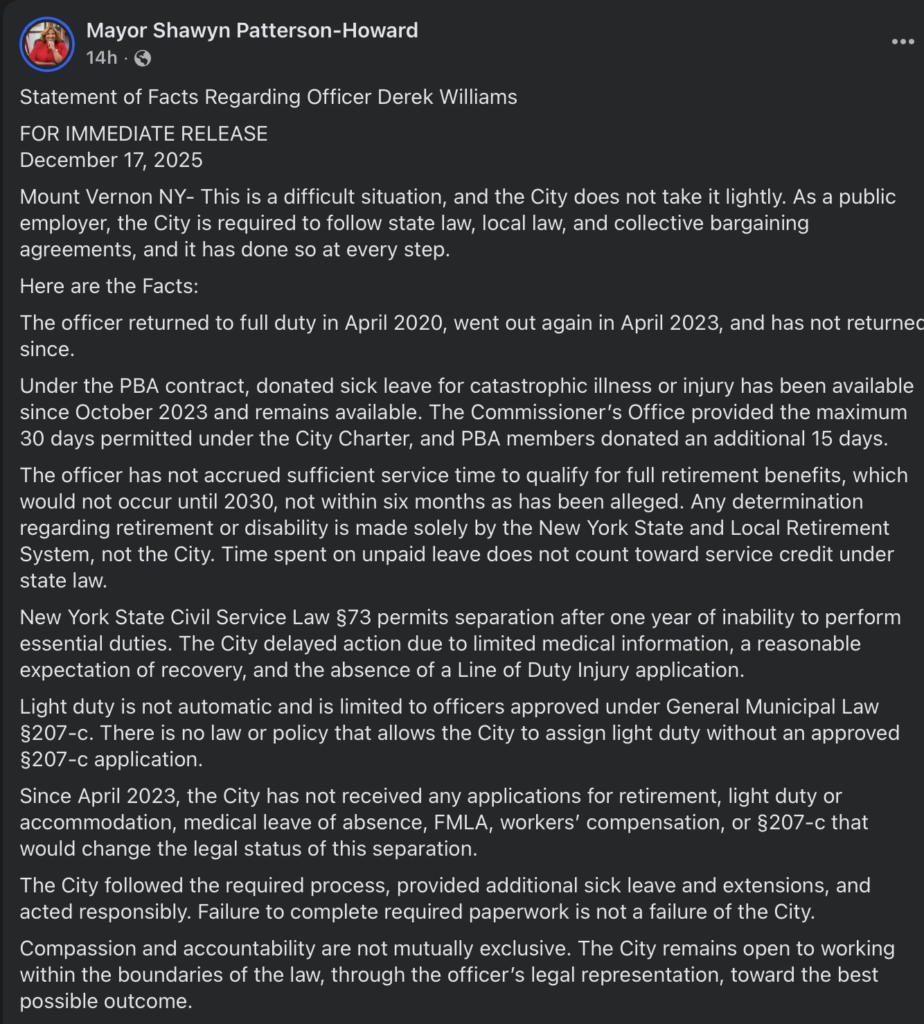
After public attention intensified, the Mayor’s office issued a statement asserting that the City followed state law, local law, the City Charter, and the collective bargaining agreement at every step. The statement notes that donated sick leave was provided, that Civil Service Law §73 permits separation after one year of inability to perform essential duties, that light duty requires an approved §207-c application, and that no applications for FMLA, accommodation, retirement, or workers’ compensation were filed that would change the officer’s legal status.
But following the narrowest possible interpretation of the law is not the same as exercising leadership. The audience should feel inspired to see leadership as an opportunity for compassion and moral clarity, not just rule-following.
Civil Service Law §73 permits separation — it does not mandate it. The City itself acknowledges that it previously delayed action, proving that discretion exists. Donated sick leave, while appreciated, is temporary. It does not provide job protection, and it does not preserve health insurance once exhausted. It is not a substitute for federal protections like the Family and Medical Leave Act.
Most notably, the City’s statement confirms that no FMLA was filed. That is not a defense — it is the heart of the problem. Dialysis is a textbook qualifying condition under federal law. FMLA does not require “magic words.” Once an employer knows an employee has a serious, ongoing medical condition, notice and designation are required. FMLA protections only work when they are activated before termination. Once employment ends, the protection disappears entirely.
The Mayor’s response emphasizes paperwork. But systems that remain silent while a critically ill employee misses critical protections are not neutral — they fail the very purpose those protections were designed to serve.
The statement also emphasizes that retirement and disability determinations are controlled by the State of New York, not the City. That may be true. But the City does control payroll status and health insurance today. This has never been about pension calculations. It is about whether a critically ill officer retains the health coverage required to survive.
What the Mayor’s response does not address is the central question: why discretion was not exercised when the consequences were so severe. Officers have reportedly stepped forward, willing to donate time so Officer Williams could remain on payroll. That option exists. The authority exists. The refusal to act is a choice.
At this point, City Hall’s sudden insistence on rigid adherence to “rules and regulations” invites an unavoidable question about consistency.
Mount Vernon residents are well aware that rules and procedures have not always been treated as immutable. Serious concerns have been raised publicly in other matters involving City leadership, including allegations reported elsewhere regarding the Mayor’s judgment and associations with sex offenders — issues that generated public controversy without the same level of procedural paralysis now being claimed. Whether or not proven, those situations did not appear to halt City action in the name of strict regulatory caution.
Read:The Clock and the Culture: What Did Mount Vernon’s Leadership Know, and When Did They Know It?
The same pattern exists within the Police Department itself. A U.S. Department of Justice report found that Mount Vernon police officers conducted unconstitutional strip searches despite explicit rules requiring probable cause, supervisory approval, and detailed documentation. Those rules were not ambiguous—they were unequivocal. Yet they were ignored. The consequences were severe: a detainee was able to bring a firearm onto a jail transport van and discharge it. Despite this failure of policy enforcement and supervision, not a single supervisor was suspended or held accountable.
Read: Mount Vernon Leaders Face Scrutiny Over Failure to Act on DOJ Report
So the question must be asked: why are rules suddenly inviolable now?
Why is discretion impossible when a man’s life is on the line, but flexibility seems to exist when political inconvenience or institutional failure is at stake? Why are collective bargaining agreements and the City Charter treated as ironclad only when the outcome is stripping a critically ill officer of his health insurance?
Rules were not sacred when constitutional rights were violated. Regulations were not untouchable when federal intervention became necessary. But now, when a man who served this City for nearly two decades is fighting to survive, procedure is elevated above humanity.
The Mayor of Mount Vernon has the authority — and the final say — to reverse this decision. She can allow Officer Williams back on payroll, even temporarily, so he can complete the final six months of service he earned. Officers have reportedly stepped forward, willing to donate time to make that possible. The solution exists. The will, so far, does not.
This is no longer about policy interpretation or administrative distance. At this stage, it is about choice.
To allow a critically ill man, who dedicated nearly two decades of his life to public safety, to be fired without health insurance while dependent on dialysis is not neutral. It is action through inaction. It is the conscious decision to let procedure outweigh humanity.
Let us be clear: terminating Officer Williams under these circumstances is not just ending a career — it threatens his ability to live. Dialysis is not optional. Health insurance is not a luxury. Removing it from a man in kidney failure is not abstract governance; it carries real and immediate consequences.
Public officials love to praise first responders in moments of crisis. The real test of leadership comes after the applause fades. Officer Williams showed up when the City needed him most. Now the City must decide whether it will show up for him.
This moment should not be reduced to a single employment dispute. It demands a reckoning — about how COVID exposure is treated, how worker protections are activated, and whether dignity still matters when a public servant’s body gives out before the system’s patience does.
Because if this City can watch a man who spent his life protecting others be discarded at his most vulnerable moment, then the issue is no longer policy alone.