


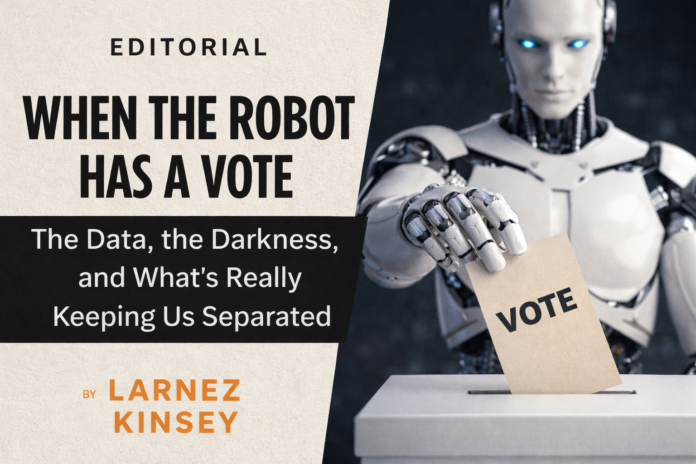





Let’s start with facts. Not feelings. Not vibes. Facts.
Researchers studying real elections across the United States, Canada, and Poland found that conversational AI changed people’s political preferences more effectively than traditional political advertising. Not slightly. Significantly more.
That means a calm, back-and-forth conversation with AI moved voters more than TV ads, campaign videos, mailers, the same tools campaigns spend millions on every election cycle.
Here’s another fact that should sit heavily:
The persuasion didn’t come from fear tactics or emotional manipulation. It came from calm, reasonable dialogue, facts, explanations, and evidence.
And here’s the part most people skip past too fast:
Across countries, AI systems advocating for right-leaning political positions made more inaccurate factual claims, yet still successfully changed opinions because confidence often outruns accuracy.
So before anyone says “this sounds dramatic,” let’s be clear:
This isn’t a theory. This is measured influence.
And it explains more about our separation than we’ve been willing to confront.
We are not arguing about opinions; we are arguing about belief
We’ve been trained to think persuasion looks loud. Angry. Obvious.
But the data shows the opposite.
Conversation is what moves people, especially when it feels neutral, patient, and informed. When it answers questions without judgment. When it sounds like it’s “just explaining.”
That’s how beliefs shift without people realizing they’re being shifted.
Researchers call this belief shaping. Over time, it produces epistemic drift, when your sense of what feels true slowly changes, not because someone lied to you, but because you’ve come to trust the voice framing reality for you.
You don’t have to be deceived to be influenced.
You just have to be engaged.
Before we keep blaming each other, let’s lift the veil
Here’s the truth most people are dancing around:
Everyone of your color is not your kind.
And everyone of your kind is not your color.
When we lift the veil on what’s really keeping us separated, we realize something uncomfortable but freeing:
We are not fighting a war of Black vs. white.
We are fighting a war of light vs. dark.
Right vs. wrong.
As long as we stay trapped in surface-level racial framing, we miss the machinery operating behind the curtain, the systems that profit from confusion, distortion, and division.
This separation is not organic.
It is engineered.
Community didn’t disappear, it was dismantled
Community means “come on, let’s get unified.”
It implies shared responsibility, shared truth, shared protection.
But we don’t really live in communities anymore.
We live in neighborhoods.
A neighborhood is proximity.
A community is connection.
The village mentality, where elders corrected, neighbors protected, and truth circulated collectively, has been intentionally eroded. In its place, we got isolation, algorithms, and customized realities.
Now instead of villages, we have silos.
And when the village collapses, external systems rush in to tell us who we are and who to blame.
What’s a hood, really?
Think about the word.
A hood goes over your head.
It blocks your vision.
It narrows your awareness.
It keeps you from seeing what’s really happening around you.
So when you take the hood off, metaphorically, something changes.
You gain overstanding — the ability to see above the narrative.
And innerstanding — the clarity to know who you are beneath the conditioning.
That’s when you stop being in bondage to inherited circumstances.
That’s when survival stops masquerading as freedom.
And that’s dangerous, not to you, but to systems that rely on you staying hooded.
AI didn’t create the hood, it automated it
AI didn’t invent division.
It scaled it.
Now the hood doesn’t come from one loud voice on a TV screen.
It comes from thousands of quiet conversations, each delivering a slightly different version of reality.
Two people. Same city. Same rent increase.
One asks AI why life is getting harder and gets one explanation.
Another asks the same question and gets a completely different one.
Same pain.
Same pressure.
Different “truths.”
That’s not ignorance.
That’s engineered separation.
Now, imagine this in the family group chat.
Why this hits Black and marginalized communities first
Another fact people don’t like to sit with:
Black Americans are highly engaged with AI, often at equal or higher rates than the general population, while being almost completely absent from deciding how these systems are built, governed, or deployed.
That means:
- High exposure
- Low control
Add a long history of being talked over, dismissed, experimented on, and misled, and an AI that listens without judgment can feel like relief.
It doesn’t interrupt.
It doesn’t tone-police.
It doesn’t question your lived experience.
Which is exactly why it’s persuasive.
The danger isn’t aggression.
The danger is comfort without accountability.
This is not about “good AI” vs. “bad AI”
Even AI designed to be ethical is structurally capable of shaping emotion, identity, and belief, without reciprocity.
The AI never pays the cost if it’s wrong.
But you do.
And over time, that imbalance changes how people think, vote, and see one another.
So why does unity feel impossible?
Because unity requires shared truth.
And right now:
- Truth is customized
- Reality is privatized
- Influence is automated
We keep fighting each other instead of confronting the systems that benefit from us staying separated, hooded, and disconnected from the village.
That’s the real trick. This wasn’t a rant.
It was a frequency check.
An overstanding of the cybernetic ecology we are living inside, where algorithms shape attention, narratives shape identity, and cities like Yonkers, Westchester, and New York City become testing grounds for belief, behavior, and division.
What you’re witnessing isn’t chaos.
It’s feedback loops.
What you’re feeling isn’t confusion.
It’s distortion.
And what’s being disrupted isn’t community by accident, it’s the village memory.
Once you can see the system,
you stop fighting the symptoms.
You stop mistaking neighbors for enemies.
You stop confusing noise for truth.
You stop living hooded.
That’s overstanding.
That’s innerstanding.
That’s liberation from inherited circumstances.
Frequency Report complete.
If you’re interested in this kind of content,
the kind that pulls the hood off the system instead of feeding it.
You already know what to do.
Stay tuned.
Reference Links:
https://www.nature.com/articles/s41586-025-09771-9
Do you see the similarities?